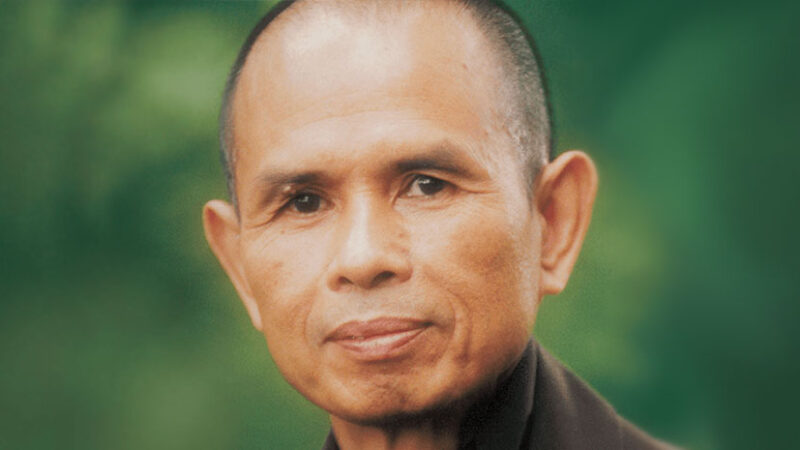
Just One Question | Thích Nhất Hạnh: What Is the Root Cause of Our Social Problems?

    —
June 18, 2026

Just One Question | Thích Nhất Hạnh: What Is the Root Cause of Our Social Problems?

Thich Nhat Hanh — June 18, 2026


What if the root cause of every social problem — starvation, ecological destruction, violence — wasn’t a broken system or a corrupt institution, but a collective state of unawareness? And what if the most powerful act of social change available to you today happened in your own mind?

That’s the territory Tami Simon explores in this remarkable exchange with Thich Nhat Hanh, the Vietnamese Zen master who founded Plum Village, pioneered engaged Buddhism, and became one of the most influential spiritual teachers of the twentieth century. Recorded more than two decades ago beneath a willow tree, this conversation feels astonishingly present.

Thích Nhất Hạnh’s answer to Tami’s question doesn’t point outward to policy or protest — it points inward, then ripples out. Individual awakening, he says, is collective awakening. Your practice is social action. Your light is contagious.

What you’ll hear in this exchange:

  • Why individual mindfulness practice is inseparable from social transformation
  • How collective enlightenment spreads — and how it already has, in ways we don’t always recognize
  • The role artists, teachers, economists, and politicians all play in the work of awakening
  • How to stay rooted in hope — and action — without being swallowed by despair

This is a short clip, but it carries the full weight of a lifetime of practice and teaching. It may change how you think about what you’re doing every time you sit down to meditate.

This clip is taken from the full Insights at the Edge conversation with Thích Nhất Hạnh. Find the complete interview in this feed or at soundstrue.com.

This episode is sponsored by Omega Institute, a global gathering hub for lifelong learning and spiritual exploration. Omega offers weekend workshops, special events, rest and rejuvenation retreats, professional training, online learning, and more. Discover what calls to you at eomega.org/true.

Thich Nhat Hanh (1926–2022) was a Zen master in the Vietnamese tradition, scholar, poet, and peace activist. He founded the Van Hanh Buddhist University in Saigon and taught at Columbia University and the Sorbonne. Thich Nhat Hanh is the author of the national bestseller Living Buddha, Living Christ and more than 60 other books. He was nominated for the 1967 Nobel Peace Prize by Martin Luther King Jr.

900 Episodes and Counting…

Subscribe to Insights at the Edge to hear all of Tami’s interviews (transcripts available too!), featuring Eckhart Tolle, Caroline Myss, Tara Brach, Jack Kornfield, Adyashanti, and many more.

Meet Your Host: Tami Simon

Each week on Insights at the Edge, Tami Simon interviews leading voices in the Mind/Body/Spirit space about a vast spectrum of fascinating ideas. Since 2009, Tami and her guests have been exploring the edge of understanding, nearly 1,000 episodes on the honest work of change, including spiritual discovery, awakening, intuition, purpose, trauma, and grief.

Photo © Jason Elias

Also By Author

Just One Question | Thích Nhất Hạnh: What Is the ...


What if the root cause of every social problem — starvation, ecological destruction, violence — wasn’t a broken system or a corrupt institution, but a collective state of unawareness? And what if the most powerful act of social change available to you today happened in your own mind?

That’s the territory Tami Simon explores in this remarkable exchange with Thich Nhat Hanh, the Vietnamese Zen master who founded Plum Village, pioneered engaged Buddhism, and became one of the most influential spiritual teachers of the twentieth century. Recorded more than two decades ago beneath a willow tree, this conversation feels astonishingly present.

Thích Nhất Hạnh’s answer to Tami’s question doesn’t point outward to policy or protest — it points inward, then ripples out. Individual awakening, he says, is collective awakening. Your practice is social action. Your light is contagious.

What you’ll hear in this exchange:

  • Why individual mindfulness practice is inseparable from social transformation
  • How collective enlightenment spreads — and how it already has, in ways we don’t always recognize
  • The role artists, teachers, economists, and politicians all play in the work of awakening
  • How to stay rooted in hope — and action — without being swallowed by despair

This is a short clip, but it carries the full weight of a lifetime of practice and teaching. It may change how you think about what you’re doing every time you sit down to meditate.

This clip is taken from the full Insights at the Edge conversation with Thích Nhất Hạnh. Find the complete interview in this feed or at soundstrue.com.

This episode is sponsored by Omega Institute, a global gathering hub for lifelong learning and spiritual exploration. Omega offers weekend workshops, special events, rest and rejuvenation retreats, professional training, online learning, and more. Discover what calls to you at eomega.org/true.

Thich Nhat Hanh: Meditation Is for Everyone

Thich Nhat Hanh is a Vietnamese Zen Buddhist monk, teacher, poet, peace activist, and the author of over 100 books and numerous Sounds True learning programs, including The Art of Mindful Living and Living Without Stress or Fear. In this episode of Insights at the Edge, Tami Simon speaks with Hanh about the core of Buddhist practice: discovering liberation through present-moment mindfulness. Hanh relates some of his experiences as a young monk in Vietnam, including his involvement in the “engaged Buddhism” movement. Finally, Tami and Hanh discuss why meditation is available no matter where you are or what condition you are in. (46 minutes)

Thich Nhat Hanh: Meditation Is for Everyone

Tami Simon speaks with Thich Nhat Hanh, a Vietnamese Zen Buddhist monk, teacher, poet, peace activist, and the author of over 100 books and numerous Sounds True learning programs, including The Art of Mindful Living and Living Without Stress or Fear. In this interview, Thich Nhat Hanh talks about his experience as a young monk, the engaged Buddhist movement, and the core of the Buddhist teachings: liberation through mindfulness. (45 minutes)

You Might Also Enjoy

Tara Brach: Choosing to Love in Perilous Times


What if the bravest thing you can do right now is refusing to close your heart?

This week, Tami Simon speaks with Tara Brach—beloved meditation teacher, clinical psychologist, and bestselling author of Radical Acceptance and Trusting the Gold—about her new inner workbook with Sounds True, The Courageous Heart: Choosing to Love in Perilous Times. At a moment when so many people feel pulled between despair and action, Tara offers a grounded path through both.

Join Tami and Tara to explore:

  • How to stay spiritually engaged—without burning out or spiritually bypassing the reality of suffering
  • The bodhisattva path as a living practice: what it means to be an “awakening being” in ordinary, everyday life
  • Why grief is often covered over by anger—and how moving through grief unlocks the capacity for love and action
  • The RAIN practice (Recognize, Allow, Investigate, Nurture) for working with armoring, fear, and excruciating pain in the heart
  • The shift from head space to heart space—and a brief guided meditation to experience it directly
  • How aspiration becomes the fuel for the spiritual path—and why Tara “sandwiches” her day with it
  • The practice of seeing basic goodness in others—including stories of Father Gregory Boyle and John Lewis that illuminate how this changes everything
  • What to do when you feel alone, disconnected, and uncertain where to start

Whether you’re overwhelmed by current events or searching for a more engaged and openhearted way to meet this moment, Tara Brach offers both the courage and the practical tools to begin.

Listen now and choose to love. →

This conversation offers genuine transmission—not just concepts about awakening, but the palpable presence of realized teachers exploring the growing edge of spiritual understanding together. Originally aired on Sounds True One.

Enter for a chance to win the Monthly Magic Subscription Journey. It includes 12 months of tea, a loose leaf starter kit, monthly virtual classes, and free shipping worth $673. Learn more at ClubMagicHour.com/TRUE (no purchase required). Get 20% off your first order of Magic Hour tea at ClubMagicHour.com with the code TRUE.

Peter Russell: Meeting Exponential Change with a Quiet...

We live in a world accelerating faster than the human mind was built to handle. So what do we do with that?

This week, Tami Simon speaks with Peter Russell—author, speaker, and leading thinker on consciousness and spirituality, with degrees in theoretical physics, psychology, and computer science from Cambridge—about his new book, How to Meditate Without Even Trying, featuring a foreword by Eckhart Tolle. Decades after coining the term “global brain” and predicting the internet, Russell turns his visionary lens on the present moment: a world of staggering technological power and equally staggering stress.

Join Tami and Peter to explore:

  • From global brain to global mind: how AI represents the next threshold in humanity’s collective evolution
  • Why exponential change is not going away—and the hidden costs it’s placing on our personal and planetary systems
  • Forgiving Humanity: why the crises facing our species may be the inevitable result of accelerating development, not human failure
  • Accepting the possibility of extinction—and how that acceptance can paradoxically free us to live and serve more fully
  • The shift from “saving the world” to navigating these times with grace, compassion, and groundedness
  • Why meditation is more necessary now than ever—and how effortlessness, not discipline, is the key
  • “Letting in” before letting go: a practice for metabolizing emotion and releasing tension at its root
  • The tension in thinking—and how noticing it during meditation changes how we think outside of it

Whether you’re overwhelmed by the pace of the world or simply looking for a steadier way to move through it, Peter Russell offers both perspective and practice.

Listen now and find your way back to the quiet.

This conversation offers genuine transmission—not just concepts about awakening, but the palpable presence of realized teachers exploring the growing edge of spiritual understanding together. Originally aired on Sounds True One.

Shi Heng Yi: The Shaolin Shift: This Is It


What if the greatest battle you’ll ever face is the one happening inside your own mind?

This week, Tami Simon speaks with Shi Heng Yi—a 35th generation Shaolin master, founder of the Shaolin Temple Europe, and author of Shaolin Spirit: The Way to Self-Mastery—about what it truly means to master yourself from the inside out.

Born in Germany to Vietnamese immigrant parents, Master Shi Heng Yi began martial arts training at age four and has spent decades making the profound teachings of Shaolin Buddhism accessible to modern seekers worldwide.

Join Tami and Shi Heng Yi to explore:

  • What self-mastery actually means—and why it has nothing to do with control
  • The difference between the self and the persona, and why most suffering comes from confusing the two
  • The concept of elevation—how life becomes lighter when we stop grasping
  • How the body becomes a doorway to discovering what lies beyond it
  • The mind lessons hidden inside the Shaolin horse stance (mabu)
  • Why the heart of a Buddha and the fight of a warrior are not opposites
  • The yin dimension within one of the world’s most physically demanding traditions

Whether you’re carrying the weight of a heavy identity, stuck in a cycle of suffering, or simply curious about what ancient wisdom has to say to the modern world, listen in to discover the freedom that comes from turning inward.

This conversation offers genuine transmission—not just concepts about awakening, but the palpable presence of realized teachers exploring the growing edge of spiritual understanding together. Originally aired on Sounds True One.