

David Whyte on Being at the Frontier of Your Identity
There is a particular kind of tiredness that comes from trying to hold a fixed idea of who we are, year after year, as everything around us keeps changing anyway. David Whyte built an entire body of work around that tension, and Sounds True founder Tami Simon has called her conversation with him one of the most beloved episodes in Insights at the Edge history, still resonating with new listeners more than a decade after it first aired. Something about the way Whyte speaks, unhurried and image-rich, seems to reach people in exactly the season of life where old answers have quietly stopped working.
Sounds True has carried David Whyte’s poetry, prose, and audio programs for years because few voices manage to speak so plainly to both the individual soul and the modern workplace at once. His willingness to bring genuine poetry into rooms built for spreadsheets and quarterly targets reflects the same spirit our founder set out to preserve back in 1985: teaching captured in its own unscripted, living voice.
What follows traces the frontier Whyte describes between who we were and who we are becoming, how exile trains us for that edge, and why a Yorkshire poet ended up teaching creativity inside boardrooms at Boeing and American Express.
Key Takeaways:
- Originality Has an Address: Learn why David Whyte locates creativity at the frontier of identity, not behind it.
- Exile Is a Skill: Understand why Whyte treats feeling like an outsider as something to develop, not escape.
- Poetry Enters the Boardroom: See how poetry and leadership intersect in Whyte’s decades of corporate work.

Originality Lives at the Edge, Not the Center
Whyte traces originality back to what he calls an edge identity, a frontier conversation that shows up across many of the world’s wisdom traditions. Reality itself, in his framing, is conversational rather than fixed, which means the self is never a finished project so much as an ongoing exchange with everything it meets.
Sounds True’s founder has described sitting with fourteen pages of notes on his teaching and underlining nearly every line, a reaction that says something about how differently Whyte approaches familiar questions of purpose and change, treating originality as a place a person stands rather than a trait they possess.
You can hear the full exchange in David Whyte on Being at the Frontier of Your Identity, still one of the most requested episodes in the archive.
Exile as a Core Human Competency
Rather than treating exile, the felt sense of not quite belonging, as a wound to heal, Whyte reframes it as a competency worth developing on purpose. Most people spend enormous energy trying to eliminate the feeling of being an outsider, whereas Whyte suggests the more useful move is to learn to work with it deliberately. A few ideas anchor this reframing:
- Exile Sharpens Perception: Standing slightly outside a group often reveals what belonging obscures.
- Competency, Not Condition: Whyte treats exile as a trainable skill rather than permanent exclusion.
- Frontier Over Center: Growth tends to happen at edges, not in comfortable middles.
This distinction matters because it removes the shame often attached to feeling like an outsider. Instead of a problem to solve, exile becomes a vantage point worth returning to on purpose.
The Frontier of Identity as a Living Threshold
The frontier of identity, Whyte’s central image, is not a line crossed once and left behind. It is a threshold a person returns to repeatedly, every time old certainties no longer fit a new season of life. Whyte suggests that vulnerability, often treated as weakness, actually functions here as enhanced perception, a heightened sensitivity that lets a person notice what a settled identity tends to miss.
He describes reality itself as conversational, meaning the self is shaped less by fixed traits and more by an ongoing exchange with circumstances, relationships, and unexpected turns. Standing at this frontier repeatedly, rather than resolving it once, is what Whyte considers the actual work of a lived, honest life.

Poetry and Leadership: An Unlikely Partnership
Long before this conversation, Whyte had already built a second career inside corporate life, consulting for companies including Boeing, Kodak, and American Express. His bestselling book, The Heart Aroused, argued that corporations suffered from too little poetry and too little humanity, a critique that landed him on business bestseller lists rather than only poetry shelves. This pairing of poetry and leadership runs through nearly everything Whyte has written since, treating verse not as decoration for executives but as a discipline for genuine reflection.
Whyte has predicted that the very word manager will eventually give way to something more alive with possibility, a shift he sees poetry as uniquely equipped to prepare leaders for. Rather than offering leadership frameworks or checklists, his workshops use verse to slow a room down enough to notice what usual business language tends to skip over entirely.
- Work as Pilgrimage: Whyte frames a career less as a task list and more as a journey of identity.
- Burnout Reconsidered: He suggests exhaustion can signal a need for renewal, not simple failure.
- Conversational Leadership: Genuine leadership, in his view, requires ongoing dialogue, not fixed authority.
Tapping the Invisible Support That Surrounds Us
Whyte closes much of his teaching on a note of quiet reassurance: that unseen support often surrounds a person exactly when they feel most exposed at the frontier of their own becoming. Recognizing this support, rather than assuming isolation, changes how a person approaches uncertainty, whether it shows up as a career change, a creative block, or a simple shift in how someone sees themselves.
Where Poetry Meets Everyday Attention
Whyte often describes a good poem as revelatory, something that takes hold of a reader and surprises them into new understanding rather than confirming what they already believed. This distinction matters for how he teaches: poetry, in his hands, is not a retreat from ordinary life but a way of paying closer attention to it. A single well-chosen image, he suggests, can reorganize how someone relates to a problem that logic alone has failed to move.

Final Thoughts
David Whyte’s teaching never promises a finished self waiting somewhere ahead. It offers something steadier: the frontier itself as home ground, revisited again and again across a lifetime of work and relationship. What makes this conversation endure, more than a decade after it first aired, may be exactly that refusal to offer a tidy arrival point.
Sounds True keeps returning to this conversation because it captures exactly what our mission asks of us, waking up to the edges we usually try to avoid rather than the comfortable center we think we want.
If Whyte’s words found you today, his fuller catalog of poetry and prose is waiting to keep the conversation going, one frontier at a time.
Frequently Asked Questions About David Whyte
Who is David Whyte?
He is a Yorkshire-born poet, author, and Fortune 500 consultant known for blending poetry with leadership.
What Sounds True programs feature David Whyte?
Sounds True has released Clear Mind, Wild Heart and What to Remember When Waking with David Whyte.
Does David Whyte only write poetry?
No, he has also authored prose books, including Crossing the Unknown Sea and The Heart Aroused.
What companies has Whyte worked with as a consultant?
He has led workshops at Boeing, Kodak, American Express, and Bristol-Myers Squibb, among others.
What podcast features this conversation with Whyte?
It appears on Insights at the Edge, hosted by Sounds True founder Tami Simon.
Is this conversation relevant outside creative fields?
Yes, Whyte’s ideas on identity and leadership apply broadly across careers, relationships, and life stages.
Where can I explore more spiritual teachers like David Whyte?
Visit our All Teachers & Authors page to browse voices across many traditions and disciplines.
Does Sounds True offer related content on purpose and vocation?
Yes, related titles appear throughout our Conscious Business and Spirituality & Awakening collections.

Michelle Cassandra Johnson is an author, activist, spiritual teacher, racial equity consultant, and intuitive healer. She is the author of six books, including Skill in Action and Finding Refuge. Amy Burtaine is a leadership coach and racial equity trainer. With Robin DiAngelo, she is the coauthor of The Facilitator’s Guide for White Affinity Groups. For more, visit https://www.michellecjohnson.com/wisdom-of-the-hive.

Reverend angel Kyodo williams: Warrior Spirit
Most people come to meditation looking for a break, a few quiet minutes away from a world that rarely slows down on its own. Reverend angel Kyodo williams spends much of this conversation gently taking apart that assumption, suggesting that real stillness was never about leaving the world behind at all. It’s a small shift in framing that ends up changing everything about how the rest of her teaching lands.
Rev. angel is an ordained Zen priest, activist, and founder of the Center for Transformative Change, recognized as the world’s second female Zen teacher of African descent and the author of Being Black and Radical Dharma.
Sounds True has featured her teaching across our Meditation Summit and A Year of Mindfulness precisely because she refuses to separate inner practice from outer justice, treating the two as a single continuous act rather than competing priorities. What follows traces her case for a warrior spirit built on presence rather than escape, and the meditation practice she offers as its foundation.
Key Takeaways:
- Retreat Isn’t the Goal: Learn why angel Kyodo williams reframes meditation as engagement, not escape.
- Effort Meets Release: Understand the meditation practice she developed for people doing social change work.
- A Different Kind of Fearlessness: See what warrior spirit means when it’s rooted in love rather than force.
Retreat Is Not What It Looks Like From Outside
Rev. angel opens by naming something many practitioners feel but rarely say aloud: the pull toward meditation often comes wrapped in a longing to retreat from an overwhelming world. She doesn’t dismiss that longing, but she does redirect it, suggesting that genuine practice engages our inner fullness rather than fleeing from outer noise. What looks like withdrawal from the outside, she argues, is closer to a deepening than a departure, a distinction that reframes the entire purpose of sitting down to practice in the first place.
Effort and Release Meditation: A Practice Born From Movement Work
Rev. angel developed a specific meditation practice she calls Effort and Release after years spent working alongside people doing demanding social change work. The practice blends deliberate effort with intentional letting go, addressing a pattern she noticed constantly among activists and organizers: a strong pull toward doing, accomplishing, and pushing that rarely leaves room for rest. She describes meditation and social change as inseparable, since the way a person relates to their own mind directly shapes what they find themselves willing to engage with in the wider world.
- Naming the Pattern: Many changemakers carry a constant urgency that outlasts any single campaign, even during rest.
- Effort With Purpose: The practice doesn’t reject action, only unconscious, exhausting overdrive.
- Release as Skill: Letting go is treated as an active discipline, not passive collapse or avoidance.
Hear the complete teaching in her episode, Reverend angel Kyodo williams: Warrior Spirit
Inner Life and Outer World as One Continuous Fabric
A central thread running through Rev. Angel’s teaching rejects any hard line between internal awareness and external action. She describes our self-talk, the noise level of our minds, and our capacity for presence as directly shaping how we show up for others and what we find acceptable in the wider world. This isn’t a metaphor for her; it’s closer to a working principle behind everything she teaches, from meditation instruction to movement strategy.
What we tolerate in the world outside us, she suggests, tends to trace directly back to what we’ve grown accustomed to tolerating within our own minds first, which is why she treats internal clarity as a precondition for meaningful external change rather than a separate, optional pursuit.
Warrior Spirit Rooted in Fearlessness, Not Force
The phrase “warrior spirit,” drawn from her earlier book Being Black, describes something quite different from combativeness or aggression directed outward at the world. For Rev. Angel, this spirit is built on truth-telling and responsibility, a foundation for genuine happiness rather than a posture of defensiveness. It asks practitioners to stay engaged with difficulty, including the difficulty of racism, patriarchy, and other inherited harms, rather than looking away or numbing out. This framing has resonated widely since the book’s original publication, offering readers across many backgrounds a way to hold fearlessness and tenderness together rather than treating them as opposites.
- Truth Before Comfort: Warrior spirit requires naming what’s actually happening, even when it’s unwelcome.
- Grace Alongside Fearlessness: Strength and tenderness are treated as complementary, not opposites.
- Responsibility as Practice: Taking ownership of one’s own patterns becomes part of the discipline itself.

Bridging Personal Transformation and Collective Justice
Rev. angel has spent more than fifteen years shaping what she calls Transformative Social Change, a field built on the belief that lasting justice work requires equally serious inner work. She resists treating meditation as a private escape hatch separate from activism, instead framing contemplative practice as fuel for sustained, clear-eyed engagement with collective harm. Burnout among organizers, in her view, often stems from skipping this inner dimension entirely, treating stillness as optional rather than structural to the work itself. She has described this field as one she helped name and shape, watching it grow from a personal conviction into a recognized approach embraced across activist and spiritual communities alike.
What Radical Dharma Adds to This Conversation
Rev. Angel’s later book, Radical Dharma, co-written with Lama Rod Owens and Jasmine Syedullah, extends this same warrior spirit into a direct examination of race, love, and liberation within Buddhist communities themselves. The book argues that spiritual communities are not exempt from the patterns of harm found elsewhere in society, and that genuine awakening has to include an honest reckoning with those patterns rather than a spiritual bypass around them. This willingness to hold institutions, including her own tradition, accountable runs consistently through everything she teaches, from her earliest writing through her more recent contributions to Sounds True’s programming.
Final Thoughts
Reverend angel Kyodo williams doesn’t offer meditation as a rest stop from the world’s demands. She offers it as a training ground for staying present with those demands without losing ourselves inside them. That distinction, subtle but significant, may be exactly what separates spiritual bypass from spiritual maturity, and it’s the thread that ties her meditation teaching to her justice work without contradiction. Listeners who come looking for a quick escape often leave with something more durable instead: a practice for staying rooted precisely where things are hardest.
Sounds True continues sharing her teaching because our mission to wake up the world has never meant looking away from what’s hardest to face, and few teachers hold that tension as steadily as she does. Her books and audio programs remain in our library for anyone ready to bring the same steadiness into their own life and work.
Frequently Asked Questions About angel Kyodo williams
Who is Reverend angel Kyodo williams?
She is an ordained Zen priest, activist, author, and founder of the Center for Transformative Change.
What books has she written?
Her books include Being Black: Zen and the Art of Living with Fearlessness and Grace and Radical Dharma.
What is the Effort and Release practice?
A meditation method blending deliberate effort with intentional letting go, developed for activists and organizers.
Is this teaching only relevant to activists?
No, her ideas on presence and inner work apply to anyone navigating stress, urgency, or burnout in daily life.
What does warrior spirit mean in her teaching?
A fearless, truth-telling posture grounded in responsibility and grace, not aggression or combativeness.
Has Sounds True featured her in other programs?
Yes, she has appeared in Sounds True’s Meditation Summit and A Year of Mindfulness series.
What is the Center for Transformative Change?
An organization she founded connecting inner personal work with large-scale social transformation.
Where can I hear more conversations like this one?
Explore our Insights at the Edge Podcast for further interviews on mindfulness, justice, and social engagement.
Michelle Cassandra Johnson is an author, activist, spiritual teacher, racial equity consultant, and intuitive healer. She is the author of six books, including Skill in Action and Finding Refuge. Amy Burtaine is a leadership coach and racial equity trainer. With Robin DiAngelo, she is the coauthor of The Facilitator’s Guide for White Affinity Groups. For more, visit https://www.michellecjohnson.com/wisdom-of-the-hive.

Guy Shahar and Melinda Edwards, MD: Sensitivity Is at ...
Autism is so often described in terms of what seems to be missing: eye contact, small talk, the expected social rhythms most people move through without thinking. This two-part conversation asks a different question entirely: what if the very traits read as absence are actually signs of a deeper, more intense form of connection than most neurotypical people ever access. It’s a reframing that asks listeners to set aside a familiar deficit lens and try on a considerably more generous one.
Sounds True brought Guy Shahar and Dr. Melinda Edwards together for this special episode of our Being Open series precisely because both speak from lived experience rather than from clinical distance alone, one as a father and later as a self-identified autistic adult, the other as a psychiatrist and mother of an autistic daughter. Their combined perspective reflects something Sounds True has believed since 1985: that the most transformative teaching often comes from people who have lived the question, not simply studied it.
In this piece, we look at what each of them learned, how their perspectives echo and diverge, and what it might mean to depathologize neurodiversity rather than simply manage it.
Key Takeaways:
- A Late Discovery: Learn how Guy Shahar found out at age forty-six that he is autistic himself.
- Connection, Not Absence: Understand why Dr. Melinda Edwards challenges the idea that autism means disconnection.
- Three Practical Keys: See the approach Shahar offers parents and caregivers for genuinely connecting.
A Conversation in Two Parts
This episode unfolds across two connected conversations, each offering a different vantage point on the same central idea. Guy Shahar, author of Transforming Autism, opens the discussion focused on parenting and connection.
- Part One: Shahar discusses educating caregivers, flexibility, and the intuitive capacity many autistic children show toward reading energy and intention. Full details appear in Guy Shahar and Melinda Edwards, MD: Sensitivity Is at the Heart of Autism.
- Part Two: Dr. Edwards continues the conversation, focusing on the overlooked spiritual gifts and interconnection autism can reveal.
Guy Shahar: A Discovery That Reframed His Own Life
Shahar’s path into this work began with his son, whose autism led the family to unconventional and unusually effective treatments detailed in Transforming Autism. His son, once written off by parts of the medical establishment as severely disabled, went on to thrive in a mainstream school by age six, an outcome Shahar attributes to focusing on inherent strengths rather than symptom correction. What makes his perspective unusual is what came next: at age forty-six, Shahar discovered he was autistic himself, a revelation that suddenly explained decades of experiences he had never quite understood, from communication struggles to a persistent sense of not fitting expected molds.
This late discovery reshaped how Shahar approaches his own book’s central argument. Rather than treating autism as a problem requiring correction, Transforming Autism proposes understanding the inherent characteristics of autistic children and bringing out their natural strengths instead, a philosophy Shahar later carried into founding a charity dedicated to the same principle.
Autism Sensitivity: What Looks Like Withdrawal Often Isn’t
A central theme threading through both conversations is autism sensitivity, the idea that heightened perception, not deficit, sits at the core of many autistic experiences. What often reads to outside observers as withdrawal or overwhelm may actually reflect a nervous system taking in far more information than a typical environment accounts for.
- Overwhelm as Overload: Shutdown often signals sensory flooding rather than disinterest in connection.
- Intuitive Attunement: Many autistic children show unusual sensitivity to the emotional energy of people around them.
- Idealism and Values: Shahar notes a strong pull toward altruism and idealistic values among many autistic individuals he has met.
Three Keys to Connecting with Autistic Children
Rather than offering another behavioral checklist, Shahar frames connection around three keys that emerged from years of trial, error, and eventual breakthrough with his own son:
- Flexibility Over Correction: Meeting a child’s actual state rather than insisting on typical behavior first.
- Play as a Bridge: Following a child’s own interests as the doorway into shared connection.
- Presence Over Performance: Showing up authentically, since autistic children often sense forced or anxious energy quickly.

Dr. Melinda Edwards: Connection Where Others See Its Absence
Dr. Edwards approaches the same territory as both a psychiatrist and the mother of an autistic daughter, and her central claim reframes the entire conversation. Rather than reading her daughter’s symptoms as disconnection, Dr. Edwards has come to understand them as reflections of a connection so deep it exceeds what conventional language typically describes. Her clinical training and personal experience together let her speak to something rarely voiced this plainly: that autism may offer neurotypical people a glimpse of interconnection they have simply lost access to.
Dr. Edwards’s perspective carries particular weight because it bridges two worlds that don’t often speak to each other candidly: the clinical framework she was trained in and the lived reality of raising a daughter whose experience didn’t fit neatly into that framework. Rather than discarding one for the other, she has spent years holding both, letting each inform and complicate the other.
From Anxiety to Faith
Both guests describe a similar arc within their own families: an initial period defined by anxiety, fear about diagnosis, fear about the future, gradually giving way to something closer to faith. This shift doesn’t erase real challenges, but it does change how those challenges are met, with curiosity rather than dread, and with trust that difficulty can carry its own unexpected gift.
Shahar describes this shift as one of the hardest and most necessary parts of his own journey, since fear tends to narrow attention exactly when openness is most needed. Faith, in the way both guests use the term, isn’t about certainty that things will turn out fine. It’s closer to a willingness to stay present with a child, or with oneself, without needing to fix everything first.
Spiritual Gifts and Evolutionary Guides
One of the more striking claims in this conversation is the idea that autistic individuals may serve as spiritual and evolutionary guides for the wider human community. Rather than framing this as a burden placed on autistic people to be exceptional, both guests present it as an invitation for neurotypical listeners to notice qualities, sensitivity, intuitive attunement, and resistance to social pretense that the broader culture has undervalued for generations.

Final Thoughts
Guy Shahar and Dr. Melinda Edwards offer something rarer than advice: two honest accounts of watching a label reorganize itself into something closer to reverence. Neither pretends the path is simple, but both suggest that sensitivity itself, so often treated as a burden, may be the very quality worth protecting and learning from. What lingers longest from this conversation may be the quiet suggestion that connection was never actually missing, only expressed in a register most of us were never taught to hear.
Sounds True shares conversations like this one because waking up the world sometimes means waking up to the people already sitting closest to us. If this conversation moved you, Guy Shahar’s book and the broader Being Open series carry it further.
Frequently Asked Questions About Guy Shahar
Who is Guy Shahar?
He is the author of Transforming Autism and co-founder of a charity supporting autistic children and their families.
When did Guy Shahar learn he was autistic?
He discovered his own autism at age forty-six, years after his son’s diagnosis.
What is the Being Open podcast series?
A special Insights at the Edge series exploring connection, consciousness, and openness across different life experiences.
Is Dr. Melinda Edwards a parent of an autistic child?
Yes, she is a psychiatrist and the mother of an autistic daughter, informing her perspective directly.
Does this conversation offer parenting techniques?
Yes, Shahar outlines three practical keys for connecting more effectively with autistic children.
What is Transforming Autism about?
It follows Shahar’s family journey as they support their son and reframes autism around inherent strengths.
Where can I find more Sounds True content on neurodiversity?
Related conversations continue throughout our Insights at the Edge Podcast archive and Relationships collection.
Is this conversation only relevant to parents?
No, its themes of sensitivity and connection speak to caregivers, clinicians, and curious listeners alike.
Michelle Cassandra Johnson is an author, activist, spiritual teacher, racial equity consultant, and intuitive healer. She is the author of six books, including Skill in Action and Finding Refuge. Amy Burtaine is a leadership coach and racial equity trainer. With Robin DiAngelo, she is the coauthor of The Facilitator’s Guide for White Affinity Groups. For more, visit https://www.michellecjohnson.com/wisdom-of-the-hive.

Life After Awakening, with Adyashanti
Friends, I wanted to share with you a free chapter from Adyashanti‘s inspiring (and very provocative) book The End of Your World: Uncensored Straight Talk on the Nature of Enlightenment.
More and more people are waking up spiritually. And for many of them, the question becomes: Now what? “Information about life after awakening is usually not made public,” explains Adya. “It’s most often shared only between teachers and their students.” The End of Your World is his response to a growing need for direction on the spiritual path. Consider this Adya’s personal welcome to “a new world.”
Here is the excerpt, entitled “Exploring Life After Awakening.”
There’s a phenomenon happening in the world today. More and more people are waking up—having real, authentic glimpses of reality. By this I mean that people seem to be having moments where they awaken out of their familiar senses of self, and out of their familiar senses of what the world is, into a much greater reality—into some- thing far beyond anything they knew existed.
These experiences of awakening differ from person to person. For some, the awakening is sustained over time, while for others the glimpse is momentary—it may last just a split second. But in that instant, the whole sense of “self ” disap- pears. The way they perceive the world suddenly changes, and they find themselves without any sense of separation between themselves and the rest of the world. It can be likened to the experience of waking up from a dream—a dream you didn’t even know you were in until you were jolted out of it.
In the beginning of my teaching work, most of the people who came to me were seeking these deeper realizations of spirituality. They were seeking to wake up from the limiting and isolated senses of self they had imagined themselves to be. It’s this yearning that underpins all spiritual seeking: to discover for ourselves what we already intuit to be true— that there is more to life than we are currently perceiving.
But as time has passed, more and more people are coming to me who have already had glimpses of this greater reality. It is because of them that I am giving the teachings in this book.
The Dawning of Awakening
This discovery I’m talking about is traditionally referred to as spiritual awakening, because one awakens from the dream of separation created by the egoic mind. We realize—often quite suddenly—that our sense of self, which has been formed and constructed out of our ideas, beliefs, and images, is not really who we are. It doesn’t define us; it has no center. The ego may exist as a series of passing thoughts, beliefs, actions, and reactions, but in and of itself it has no identity. Ultimately all of the images we have about ourselves and the world turn out to be nothing but a resistance to things as they are. What we call ego is simply the mechanism our mind uses to resist life as it is. In that way, ego isn’t a thing as much as it is a verb. It is the resistance to what is. It is the pushing away or pulling toward. This momentum, this grasping and rejecting, is what forms a sense of a self that is distinct, or separate, from the world around us.
But with the dawn of awakening, this outside world begins to collapse. Once we lose our sense of self, it’s as if we have lost the whole world as we knew it. At that moment— whether that moment is just a glimpse or something more sustained—we suddenly realize with incredible clarity that what we truly are is in no way limited to the small sense of self that we thought we were.
Awakening to truth or reality is something that is very hard to talk about because it is transcendent of speech. It is helpful, nevertheless, to work with some sort of a guidepost. The simplest thing one can say about the experiential knowledge of awakening is that it is a shift in one’s perception. This is the heart of awakening. There is a shift in perception from seeing oneself as an isolated individual to seeing oneself, if we have a sense of self at all after this shift, as something much more universal—everything and everyone and every- where at the same time.
This shift is not revolutionary; it’s the same as looking in the mirror in the morning and having an intuitive sense that the face you are looking at is yours. It is not a mystical experience; it is a simple experience. When you look in the mirror, you experience the simple recognition, “Oh, that’s me.” When the shift of perception that’s called awakening happens, whatever our senses come into contact with is experienced as ourselves. It’s as if we think with everything we encounter, “Oh, that’s me.” We don’t experience ourselves in terms of our ego, in terms of a separate someone or separate entity. It’s more a feeling of the One recognizing itself, or Spirit recognizing itself.
Spiritual awakening is a remembering. It is not becoming something that we are not. It is not about transforming ourselves. It is not about changing ourselves. It is a remembering of what we are, as if we’d known it long ago and had simply forgotten. At the moment of this remembering, if the remembering is authentic, it’s not viewed as a personal thing. There is really no such thing as a “personal” awakening, because “personal” would imply separation. “Personal” would imply that it is the “me” or the ego that awakens or becomes enlightened.
But in a true awakening, it is realized very clearly that even the awakening itself is not personal. It is universal Spirit or universal consciousness that wakes up to itself. Rather than the “me” waking up, what we are wakes up from the “me.” What we are wakes up from the seeker. What we are wakes up from the seeking.
The problem with defining awakening is that upon hear- ing each of these descriptions, the mind creates another image, another idea of what this ultimate truth or ultimate reality is all about. As soon as these images are created, our perception is distorted once again. In this way, it’s really impossible to describe the nature of reality, except to say that it’s not what we think it is, and it’s not what we’ve been taught it is. In truth, we are not capable of imagining what it is that we are. Our nature is literally beyond all imagination. What we are is that which is watching—that consciousness which is watching us pretending to be a separate person. Our true nature is continually partaking of all experience, awake to every instant, to each and every moment.
In awakening, what’s revealed to us is that we are not a thing, nor a person, nor even an entity. What we are is that which manifests as all things, as all experiences, as all personalities. We are that which dreams the whole world into existence. Spiritual awakening reveals that that which is unspeakable and unexplainable is actually what we are.
Abiding and Nonabiding Awakening
As I’ve mentioned, this experience of awakening can be just a glimpse, or it can be sustained over time. Now, some would say that if an awakening is momentary, it is not a real awakening. There are those who believe that, with authentic awakening, your perception opens up to the true nature of things and never closes back down again. I can understand this perspective, since ultimately the whole spiritual journey does lead us to a full awakening. Full awakening simply means that we perceive from the perspective of Spirit—from the view of oneness—all the time.
From this awakened perspective, there isn’t any separation anywhere—not in the world, not in the universe, not in all the universes everywhere. The truth is anywhere and everywhere, at all times, in all dimensions, for all beings. It is a truth that is the source of everything that will ever be experienced—in life, after life, in this dimension or any other dimension.
From the perspective of the ultimate, literally every- thing—be it at a higher or lower dimension, here or there, yesterday, today, or tomorrow, everything—is but a manifestation of Spirit. It is Spirit itself that wakes up. So, ultimately, the trajectory every being is on, whether they know it or not, is a trajectory toward full awakening—toward a full knowing, toward a full experiential knowledge of what they are, toward unity, toward oneness.
But the moment of awakening may or may not result in a permanent seeing. As I said, some people will tell you that unless it’s permanent, the awakening is not real. What I’ve seen as a teacher is that the person who has a momentary glimpse beyond the veil of duality and the person who has a permanent, “abiding” realization are seeing and experiencing the same thing. One person experiences it momentarily; another experiences it continually. But what is experienced, if it is true awakening, is the same: all is one; we are not a particular thing or a particular someone that can be located in a particular space; what we are is both nothing and every- thing, simultaneously.
So, as I see it, it doesn’t really matter whether an awakening is instantaneous or continuous. It matters in the sense that there is a trajectory—nobody’s heart will be totally fulfilled until that perceiving from the point of view of truth is continuous—but what is seen is an awakening, whether it is sustained or not.
This glimpse of awakening, which I call nonabiding awakening, is becoming more and more common. It happens for a moment, an afternoon, a day, a week—maybe as long as a month or two. Awareness opens up, the sense of the separate self falls away—and then, like the aperture on a camera lens, awareness closes back down. All of a sudden that person who had previously perceived true nonduality, true oneness, is quite surprisingly now perceiving back in the dualistic “dream state.” In the dream state, we’re back in our conditioned sense of self—in a limited, isolated sense of being.
The good news is that once a moment of this clear seeing has actually taken place, the aperture of our awareness can never completely close down again. It may seem like it has closed down completely, but it never quite does. In the deep- est part of yourself, you don’t ever forget. Even if you’ve only glimpsed reality for a moment, something within you is changed forever.
Reality is nuclear; it’s incredibly powerful. It’s unimaginably potent. People can experience a f lash of reality in the time it takes to snap your fingers, and the energy and the force that enters into them as a result is life altering.
Just one moment of awakening begins the dissolution of one’s false sense of self and, subsequently, the dissolution of one’s whole perception of the world.
Awakening Is Not What You Imagine It to Be
In a very real sense, it is much more accurate to talk about what we lose upon awakening rather than what we gain. We not only lose ourselves—who we thought we were—but we also lose our entire perception of the world. Separation is only a perception; in fact, when it comes to our world, there is nothing but perception. “Your world ” is not your world; it is only your perception. So while it may seem negative at first, I think it’s much more useful to talk about spiritual awakening in terms of what we lose—what we awaken from. This means we’re talking about the dissolution of the image we have of ourselves, and it’s this dismantling of who we thought we were that is so startling when one wakes up.
And it is indeed startling: it’s not what we think it’s going to be like at all. I’ve never had a single student come back and say, “You k now, Adya, I peered through the veil of separation, and it’s pretty much what I thought it would be. It measures up pretty closely to what I’ve been told.” Usually they come back and say, “This is nothing like what I imagined.”
This is especially interesting since many of the people I teach have been studying spirituality for many years, and they often have very intricate ideas about what awakening is going to be like. But when it happens, it is always different from their expectations. In many ways, it is grander, but also in many ways, it is simpler. In truth, if it is to be true and real, awakening must be different from what we imagine it to be. This is because all of our imaginings about awakening are happening within the paradigm of the dream state. It is not possible to imagine something outside of the dream state when our consciousness is still within it.
How Does Your Life Change after Awakening ?
With awakening there also comes a total reorganization of the way we perceive life—or at least the beginning of a reorganization. This is because awakening itself, while beautiful and amazing, often brings with it a sense of disorientation. Even though you as the One have awakened, there is still your whole human structure—your body, your mind, and your personality. Awakening can often be experienced as very disorienting to this human structure.
So it is the process that happens after awakening that I want to explore. As I’ve said, for a very few people, the moment of awakening will be complete. It will be final in a certain sense, and there will be no need for a continuing process. We might say that such people had an extraordinarily light karmic load; even though they may have experienced extreme suffering before awakening, one can see that their karmic inheritance, the conditioning that they were dealing with, wasn’t too deep. This is very rare. Only a few people in a given generation may wake up in such a way that there’s no further process to undergo.
What I always tell people is this: don’t count on that person being you. Better to count on being like everyone else, which means that you will undergo a process after an initial awakening. It won’t be the end of your journey. What I will attempt to do here is to point you in a direction that may be useful and orienting as you embark on that journey. As my teacher used to say, it’s like getting your foot in the front door. Just because you’ve gotten your foot in the front door doesn’t mean you have turned the lights on; it doesn’t mean you have learned to navigate in that different world that you’ve awakened to.
I’m very happy that this book, which is based on a series of talks I’ve given, offers me the opportunity to address this subject—the question of what happens after awaken- ing. The information that exists on life after awakening is not usually made public. It’s most often shared only between spiritual teachers and their students. The problem with that approach is that, as I’ve said, a lot of people are now having these moments of awakening, and there is very little coher- ent teaching available for them. In that sense, this book is meant to be a welcoming to that new world, that new state of oneness.
Golden Tara to Who Helps Manifest and Fulfill Purpose
Meditating on Golden Tara shifts your sense of identity away from the smaller self that experiences itself as a separate being. When you identify with Tara in meditation and throughout the day, you realize that you are always in relationship with a fantastic, complex universe. Your energy increases because you no longer feel alone. You have Tara’s help, the help of friends, and countless other beings as well.
On the one hand, you are an infinitesimally tiny part of the grand whole. On the other hand, you have a role to play in the continuing creation of this complex universe. As you deepen and stabilize your inner Tara consciousness, your actions are imbued with love and compassion, arising from your understanding that you are an integral part of whatever you seek to change.
Remembering Tara also helps preserve your energies when you encounter unexpected obstacles; her golden light reveals the treasures hidden in the unwelcome stumbling blocks of life. Difficult challenges hold keys to awakening. Tara helps you approach problems as an inherent part of the journey, supporting you as you move toward them to uncover wisdom they might offer. They often provide a wake-up call to send you in a new direction, offering greater clarity about your life purpose.
This inclusive attitude creates more health in your personal ecosystem as well as the universal ecosystem. Ask Golden Tara to transform your challenging emotions into love and to increase your energy for discovering meaning and purpose in your life.
Tara’s Appearance
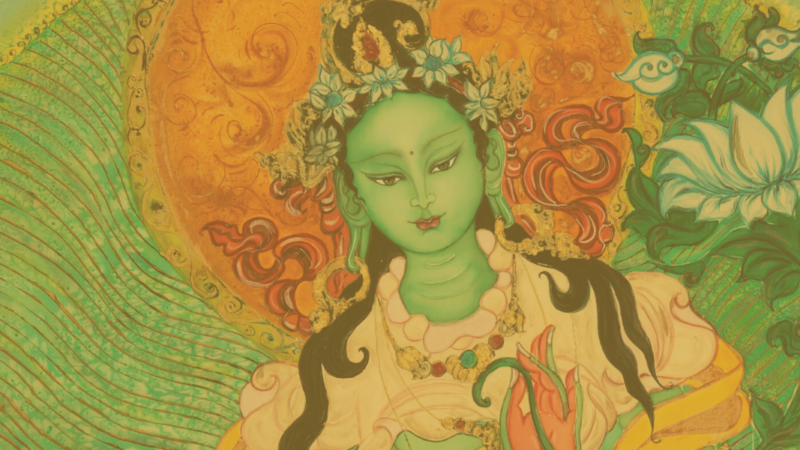
Golden Tara appears as the life-giving female buddha in a body of radiant golden light. She embodies the light of life itself. The vase in Golden Tara’s hand contains the power to increase our life energy, power, and material and spiritual resources. These resources support us in times of ease and times of difficulty, enabling us to discover and fulfill the purposes of our life on a moment-to-moment basis and over the arc of our lives.
For centuries, artists have created statues and thangka paintings of Tara, always adorned with jewelry. These sacred paintings, usually done on fabric and surrounded by brocade, portray the qualities of their subjects and convey teachings as well. Thus we take special note of Tara’s adornments. A crown rests atop her head. Necklaces of varying lengths cascade from her neck to her waist. Bracelets encircle her wrists. All have been crafted from gold with deep red and blue jewels woven into the designs.
Gold has been the preferred precious metal of jewelry makers for thousands of years. Gold is malleable; gold doesn’t tarnish. Golden light is associated with increasing life-force, healing, and holiness. Holy people of many faiths are often painted in an aura of golden radiance.
Many years ago, I heard a teaching that Tara’s jewels represent her experiences over lifetimes on her way to enlightenment and buddhahood. Profound understanding of the Buddhist teachings and her experiences as a woman led Wisdom Moon to vow to attain enlightenment as a woman and to persevere toward her goal. Tara’s life events were surely difficult and awe-inspiring, ordinary and phenomenal. All of them were precious contributions to her journey, which has benefited countless beings over hundreds of years.
The Mantra
Om Tare Tuttare Ture Sarva Ayur Punye Pushtam Kuru Soha!
“Ohm Tahray Tootahray Tooray Sarwah Ahyoor Poonyay Pushtahm Kooroo Soha!”
When you recite the mantra of Golden Tara, you are urging (kuru) Tara to increase (pushtam) your life energies (ayur) and merit (punye), your contributions to adding positive energy to beings around the world, near and far. Mantra recitations need not be limited to formal practice. Use them throughout the day to slow down and focus on whatever task is at hand.
The Practice
First, visualize the entire mandala of Green Tara emerging into the space in front of you. You are surrounded by your friends, loved ones, and supporters, and she is surrounded by your teachers and all the twenty-one emanations. After the opening prayers, imagine Golden Tara coming into the foreground of the mandala. Recall her praise while visualizing golden rays of light streaming from her heart as well as the golden vase in her right hand, which rests on her right knee, palm open in the gesture of supreme giving.
As you recite her mantra, Om Tare Tuttare Ture Sarva Ayur Punye Pushtam Kuru Soha, imagine that you are absorbing this light and that other beings and other places are receiving the light of Tara as well.
Kuru, which appears in seven of the Tara mantras, carries a particularly bold tone. You’re not meekly asking Tara to help—you’re putting your whole heart and body into this request. “Tara, please do this for me. Remove blockages so more energy flows into my life and work! I’m counting on you!” The same tasks that feel overwhelming in one moment seem entirely possible in the next.
Tara can help you discern the wisdom inherent in the obstacles you encounter in your life and practice. Meditate on the continuity in your life—the joyful moments, the extremely painful moments, and everything in between. Your experiences are not meaningless fragments. Imagine a mosaic forming as you piece the fragments together into a beautiful coherent pattern. Invoke Tara’s wisdom to give you greater clarity about your life purpose and the means to fulfill it.
Recite the mantra at least 21 times or 108 times whenever possible. Then rest in the vibrational field created by your chanting. Allow frustration and doubt to dissolve, releasing energy for healing. You become richer in inner resources, which leads to enriched outer resources as well, both material and spiritual. Affirm your connection to all life forms in the universe. Know that the benefits of your heartfelt wishes and efforts will flow from you into the world.
As you bring the session to a close, visualize Golden Tara receding into her place among the twenty-one emanations. See the whole mandala dissolve into radiant light, which flows into you and merges with your inner light. Dedicate the merit or positive potential generated by the practice to the healing of all beings—with no exceptions.
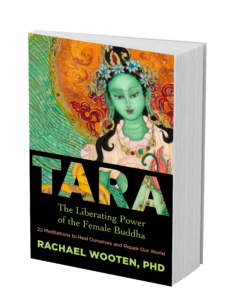
This is an adapted excerpt from Tara: The Liberating Power of the Female Buddha by Dr. Rachael Wooten.

Rachael Wooten, PhD, is a Zürich—trained Jungian analyst and psychologist who has been in private practice as a therapist for more than 40 years. An enthusiastic interfaith activist, she has studied and practiced in Buddhist, Jewish, Christian, and indigenous traditions throughout her adult life.
Rachael has been mentored by spiritual teachers such as her Tibetan root guru Lodrö Tulku Rinpoche and Rabbi Zalman Schachter-Shalomi. She has taught Tara practices under the authorization of Lodrö Rinpoche for more than 20 years. Rachael has offered Tara workshops through the Resource Center for Women and Ministry in the South, ALEPH: Alliance for Jewish Renewal, and C. G. Jung Society of the Triangle. She currently teaches a monthly Tara meditation group at Pullen Memorial Baptist Church in her hometown of Raleigh, North Carolina. To learn more, visit rachaelwootenauthor.com.
Learn More
Sounds True | Amazon | Barnes & Noble | Bookshop | Indiebound
Black Tara Who Destroys All Negativities
In the fall of 2010, our monthly Tara practice began at sundown at the end of Rosh Hashanah, the beginning of the Jewish new year, 5771. The days between Rosh Hashanah and Yom Kippur are known as the Days of Awe. During these ten days, observant practitioners reflect on the past year to repair harm they may have inflicted on friends, family, or members of the greater family of the planet. They apologize to others and seek to do t’shuvah to make amends if possible. People work consciously to repair and let go of past negativity and set intentions for the coming year to prevent further mischief.
Black Tara Who Destroys All Negativities was on the calendar for that night. We appreciated the synchronistic timing of the two events. I noted that Tara protects us from negativity, internal and external, and helps us release the effects of negative energies we’ve encountered or generated. This protection occurs in part from remembering our connection to the Whole—that we are nurtured and contained by a multilayered universe. When we help another, we are helped. If we harm another, we harm ourselves. Perhaps harder to grasp—if we harm ourselves, we harm the whole universe.
The teaching centered around the meaning of the mantra, which refers explicitly to ingrained behaviors operating outside of consciousness that wreak havoc in interpersonal relationships. Negative energies transferred from one individual to another are potent and destructive, and often have lasting effects.
Tara’s Appearance
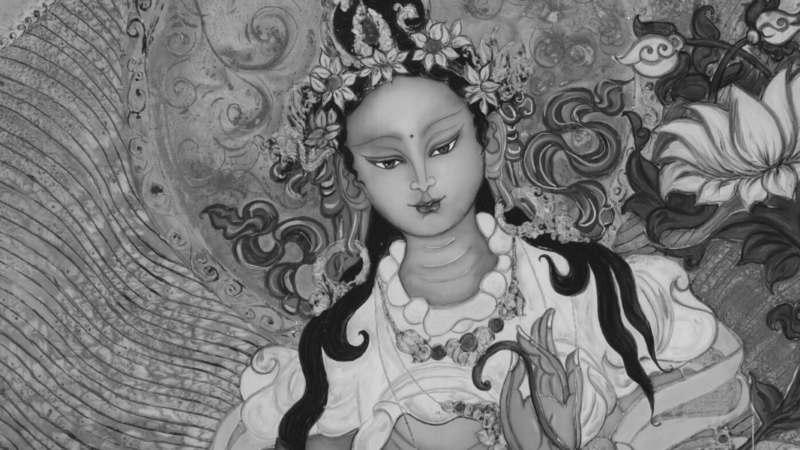
Black Tara appears with her mouth wide open in a fierce expression. Like all the wrathful emanations, she sits on a fiery sun disc, which rests in the center of her lotus throne. The sun disc replaces the usual soothing moon disc. She holds a black vase, which contains the power to overcome even the most destructive and negative powers. In this aspect, Tara is known as the Destroyer of All Negativities.
The Mantra
Om Tare Tuttare Ture Sarva Vidya Avarana Ye Bhye Phat Soha!
“Ohm Tahray Tootahray Tooray Sarwah Veedyah Ahvahrahnah Yay Bay Peyt Soha!”
This mantra sheds more light on the meaning of the practice, when you might need to use it, and how to align your own intentions with those of Tara. It insists that Tara remove mental obstacles that block insight into your complexes or the emotional forces that obscure your understanding. Avarana refers to the causes underlying negative tendencies in yourself or others. These instincts, imprints, or potencies are ingrained, influencing behavior outside of awareness. They are unconscious, unquestioned, and unprocessed. They have been denied, repressed, or avoided. You or others around you might struggle to bring them to consciousness or have no wish to do that whatsoever.
As with many words in Sanskrit, vidya has multiple meanings depending on the context. Vidya often means “wisdom”; in this instance, it means “intentions,” particularly negative intentions. Bhye phat urges Tara to destroy these obstacles or difficulties!
The mantra asks Tara to overcome the negative intentions of the enemy. Use it when you want her complete protection in order to fully grasp the difficulties in your situation. Watch for signs that you are being infected or possessed by internal negativity, which would be a natural response to the energy coming at you. Don’t be naive about actual outer dangers you might be facing; you have to remove yourself from harmful situations.
The Practice
Visualize the entire mandala of the twenty-one Taras arising out of vast space in front of you. Green Tara appears in the center in her radiant body of green light. Imagine your teachers surrounding her and all her other emanations in the background behind them. Finally, invite your friends and supporters and all beings you wish to receive the blessings of your practice. Recite the preliminary prayers. Then imagine that Black Tara Who Destroys All Negativities moves into the foreground, seated on her lotus throne with a sun disc in the center. She holds a black vase, which contains the power to destroy even the most virulent forces in the universe. See light streaming out of her heart and from her seed syllable Tam (“Tahm”) standing on a moon disc inside the vase. Just as a seed contains the entire essence of the plant it will become, the seed syllable Tam contains the entire essence of Tara’s infinite powers.

If visualizing a Tibetan syllable proves difficult initially, simply visualize light streaming out instead. The light destroys all malice and negativity.
Invite Black Tara to protect you from the negative intentions and actions of others. Set your own intentions to release the shock of the impact of such energies on your body, psyche, and spirit. Ofer Tara all of your dark emotions; ask her to protect you inside and out as you engage with our imperfect world in which aggression and hatred are too easily encountered.
Recite the mantra, Om Tare Tuttare Ture Sarva Vidya Avarana Ye Bhye Phat Soha, at least 21 times or 108 times whenever possible. Then rest in the subtle vibration created by the mantra recitation. Notice the qualities of the energy around you. Remember and be grateful for the inherent goodness in the universe that is continuously giving birth to positive impulses inside of you and other beings in the world.
Black Tara brings you back to the radiant spaciousness at the core of your being. As she dissolves obstacles created by negativity, try to identify the signs of true knowing versus the cynical and damaging commentary of the complex. Learn to distinguish what’s coming from inside, what’s coming at you from outside, and how the two are related. Reach out to the cosmic Mother Protector in the form of Tara. Reach inward to her indwelling presence and open yourself to access wisdom and compassion, which offers the greatest protection no matter the circumstances.
As you bring the meditation to a close, visualize Black Tara receding into the background among all the other emanations. See the light streaming out of the entire mandala and then allow the mandala with all its beings to dissolve into space. The light flows into your body and heart, vivifying and stabilizing the essence of Tara within you, and then disperses into the universe. Dedicate the positive potential of the practice to the healing and awakening of all beings everywhere, with no exceptions.
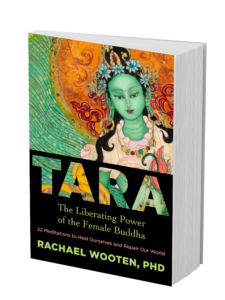
This is an adapted excerpt from Tara: The Liberating Power of the Female Buddha by Dr. Rachael Wooten.
Rachael Wooten, PhD, is a Zürich—trained Jungian analyst and psychologist who has been in private practice as a therapist for more than 40 years. An enthusiastic interfaith activist, she has studied and practiced in Buddhist, Jewish, Christian, and indigenous traditions throughout her adult life.
Rachael has been mentored by spiritual teachers such as her Tibetan root guru Lodrö Tulku Rinpoche and Rabbi Zalman Schachter-Shalomi. She has taught Tara practices under the authorization of Lodrö Rinpoche for more than 20 years. Rachael has offered Tara workshops through the Resource Center for Women and Ministry in the South, ALEPH: Alliance for Jewish Renewal, and C. G. Jung Society of the Triangle. She currently teaches a monthly Tara meditation group at Pullen Memorial Baptist Church in her hometown of Raleigh, North Carolina. To learn more, visit rachaelwootenauthor.com.
Learn More
Sounds True | Amazon | Barnes & Noble | Bookshop | Indiebound

5 Neurosculpting Practices for Lasting Brain Change
Incorporating these five best neuroplasticity practices can open the doors to a more graceful, resilient, and lasting experience of change.

The Way of the Feminine to Save the World
You feel special. Sometimes this feels like a curse. Like no one will understand you. Ever. Like you will always be an alien walking among regular humans, pretending to blend in. You have learned to live with this gulf, but what you really crave is community. You long to belong to the human family. To Mother Earth.
Participating in the human condition can be bewildering. It is just not always cozy and easy—rather, it’s humbling at best, downright humiliating when it is not flowing. It can seem so much simpler to ride solo, slaying your own dragons and singing the ballads you wrote about yourself. Collaboration can be tedious, and the prevailing masculine value system may have conditioned you to feel like you are giving away your power when you share it with others.
So what? Give it away. The time of the singular sage bestowing his unique wisdom is over. That was a method devised by the men in charge who sought to regulate wisdom. They taught us to suffer alone in the desert for forty years, collecting our insights in a secret box called “Esoteric Knowledge.” Then, we were supposed to dispense those insights stingily to those who proved themselves worthy by also suffering alone for the requisite forty years in the desert.
It turns out that the world is filled with special beings, grappling our way through the anxiety of solitary conundrums and tasting the occasional reprieve of connection. When you realize this, your body lets out its breath and relaxes. The curse lifts. You come in from the cold. You hold out your cup, and some other special being fills it with sweet, milky tea spiced with fragrant herbs. You drink.
Our way, the way of the feminine, is to find out what everyone is good at and praise them for it and get them to teach it to one another. Maybe you know something about the hidden meaning of the Hebrew letters, or how to build a sustainable home from recycled tires and rammed soil, or loving-kindness meditation. You, the one who knows the Islamic call to prayer, climb this minaret and call us all to prayer. You, the one who knows how to sit quietly at the bedside of the dying, show us the way to bear witness. You, the one who knows how to get us to wake up to the shadow of privilege, please wake us the #*#@ up. It will be chaotic, all this community building, but your cooperation will save the world.
Besides, it will be fun.

I Did a 40-Day Rest Cleanse and Here’s What Happened
For 40 days, I had the most soulful rest. And I did it in the comfort of my own home, with a full-time job, a family, and a social life.
Every day I awoke around 5:30 am and tiptoed to my Rest Cave (set up in a corner of our spare room). I laid on my back on an exercise mat (under my favorite blanket with a sleep mask) and plugged earbuds into my phone. Then I hit play on Karen Brody’s Daring to Rest yoga nidra meditation and let her soothing guidance lull me into a state of deep rest—or as Karen puts it, a return to myself. If you’re not familiar with yoga nidra, it’s a meditative practice for entering one of the deepest states of relaxation imaginable. And you do it lying down.
I’m not a morning person, but getting up to lie down (ironic, right?) was lovely. The stillness of the early morning quickly became my friend.
For the first 15 days, I listened to the Rest Meditation (20 minutes) to shed physical exhaustion, followed by 15 days of the Release Meditation (30 minutes) to let go of limiting beliefs. The last 10 days consist of the Rise Meditation (40 minutes), allowing life purpose exhaustion to lift, so that you can hone in on your true-hearted desires. Every five days I read a chapter in the book itself, Daring to Rest, for insight into what I was experiencing and supportive practices.
Gradually these aspects of my life began to shift—providing a depth of experience new to me, and oh so, beautiful.
- An underlying sense of sweetness in my day. I discovered a natural flow to my day, felt light and at ease in my skin, and second-guessed myself less.
- Deep intuition. Karen guided me to breathe in through my heart, then follow my breath, see where it landed, and listen for what she calls a “soul whisper”—a word or image that offers a clue to how you’re really feeling. Some days all I could think about was my to-do list or obsess over a worry. But when my soul whispers did arrive, they were often crystal clear and I journaled about them.
- Patience and connection. Mornings were less frantic. When my seven-year old son had stressful moments getting ready for school, I felt calmer and more present for him. When we walked to the bus stop, my awareness of the outdoor world was more acute—the blue sky, cloud formations, the crescent of a morning moon.
- Craving control. On days when I felt overwhelmed or anxious, my inclination to relieve those feelings with a glass of wine or binging on television lessened. Sometimes I would simply sit, gaze outdoors, and do nothing more. In those moments, I loved not feeling the need to do anything—not clean, not sort the mail, not check Facebook. I began to understand rest outside of my Rest Cave.
- A connection to beyond. This was a big one. Karen calls it your “council of women” and teaches you to summon it for love and support. It can be women in your circle, women who have passed, even women you don’t know personally. I saw my grandmother (who died before I was born) looking at me lovingly and felt my sister-in-law, who I’ve known since I was a baby, standing beside me. At times the feeling of these and other women was so strong that tears ran down my cheeks.
While my life became deeper and rosier, it was not until I went cold turkey for a few weeks that I realized just how powerful this rest cleanse was. I’ve always been someone who can go the distance, then neglect the sustaining part, like training for a half-marathon but not running for months after the race. And it’s so easy to fall back into old habits.
So now I’m learning how to translate this cleanse into an ongoing practice, for which Daring to Rest offers sound insights. My Rest Cave is an essential element. It’s not only a dedicated space for yoga nidra, but one for self-care in general—to journal, to listen to music, to just be.
Karen ends every yoga nidra meditation with the words, “Be good to yourself.” And in that spirit, I invite you to download her free Rest Cave Guide to create your own. And once you do, I dare you to rest and see what happens!
Christine Day has been a member of Sounds True’s sales and marketing team for more than five years and loves diving into our books on a personal level to learn both theory and practice. She also works on Sounds True’s children’s books and enjoys doing storytimes at her son’s elementary school.

