Customer Favorites

Nicki Scully: Becoming an Oracle

Tami Simon speaks with Nicki Scully, an author, healer, and teacher. She has been teaching shamanic arts and the Egyptian mysteries since 1983 and is the author of several books, including the Sounds True audio learning program Becoming an Oracle: Connecting to the Divine Source for Information and Healing. Nicki discusses her role in which she facilitates people engaging with shamanic journeys, or “oracular journeys.” Visit https://becominganoracle.com/ (52 minutes)

Memories of Cats I Loved: Brother David Steindl-Rast


Mietzi, 1980s, New York City

For millennia, humans have speculated why some of us are born into riches, others into rags. If
we can’t answer this question for humans, how shall we answer it for cats? Bad karma, you
say? If so, Mietzi must have misbehaved quite badly in a previous incarnation to be born in a
flooded basement this time around. No one knows. What we do know, however, is that the most
disadvantaged pull most strongly on our heartstrings, and so someone rescued Mietzi and her
siblings from their sunless island of soggy rags. No one ever mentioned the mother cat, and I
don’t know what happened to the other kittens of that litter. All I know is that little Lisa
persuaded her reluctant grandmother, and so Mietzi became my mother’s cat.

After that deluged basement, even a tenth-floor New York apartment that was never designed
for pets must have appeared like paradise to the poor kitten. Or so we were hoping. Lisa
delivered Mietzi in a soft-cushioned basket, and the cat was still sitting in that basket when, after
an elaborate farewell from the cat, Lisa kissed her grandmother goodbye at the door. The door
closed, Mother turned around, and the basket was empty.

That the cat was gone was bad enough, but her pitiful meow was not gone. It kept haunting the
apartment for the next hour, while Mother, eventually with the help of her neighbors on both
sides, searched every corner so methodically that Scotland Yard would have been proud of that
job. The voice, unaccountably, always seemed to come from nowhere; yet it persisted.
When the ladies finally dismantled the Sony radio and hi-fi record player my mother won at a
raffle, Mietzi emerged from the only place where she could have gotten as covered with dust as

she did: one of the loudspeaker boxes. A bad start, especially since Mother felt that the kitten
needed a bath. (There must have been lots of water signs in Mietzi’s natal chart.)
No cat could have been more loved, more talked about in telephone conversations with children
and grandchildren, more lovingly reported on at length in every letter.

Mietzi wasn’t young anymore when Mother was diagnosed with leukemia. Mother was still at
home, and I was with her during the decisive days when the doctor was testing whether or not
medication could help her. I was sitting by Mother’s bed then, when Mietzi seemed to get ready
for an acrobatic stunt. Balancing on the back of the rocking chair, she was clearly considering
jumping from there onto a high chest of drawers.
Never before had she tried this. Ears laid back, Mietzi was measuring the distance. “Is she
going to make it?” I asked—and the moment the words were out, I realized that this was the
question my brothers and I were anxiously asking about Mother at that time. “Let’s see,” Mother
replied. Nothing else was said—neither then nor later—but both of us knew what was at stake.
There was no tinge of superstition about this. Everything hangs together with everything; we
know that. In principle then, we may look at one event and find in it a clue for quite a different
one, unconnected though they may appear to be. Some try this with tea leaves or planets;
others think that, in practice, this is too complex an art. There are moments, however, when an
omen lights up with such clarity that it would be difficult to deny its foreboding. Not wanting this
to be true, Mother and I knew, nevertheless, what was going on here.
Mietzi steadied herself on the back of the rocking chair, crouched, jumped, and missed. Have
you ever noticed the embarrassment of a cat when something like this happens? We tried to
console Mietzi, Mother and I, but we couldn’t quite console ourselves that evening.
The verdict was in. What was not decided was how we would handle it, and that is what really
matters.

Mother handled it with grace. Two days later, she was in the hospital again, never to return
home to Mietzi. Her mind was clear to the last, as she took care of unfinished business calmly
and efficiently. She knew in which folder important papers were kept, in which dresser; she
handed my brother the keys with a smile. Only once did she break down and cry: when Mietzi’s
future was to be decided. But a solution was found: since Mother’s apartment was at the same
time the office for her charitable work, which my brother would continue, Mietzi could stay where
she was. The “super” of the building, who was fond of Mietzi anyway, would look after her when
my brother wasn’t there.

Mother was at peace.
I sat next to her bed holding her hand, and she said, “This is how I’d like to die. You ought to sit
there holding my hand and I’d just fall asleep.”

“Well,” I said, “I’d like that, too, but we can’t plan it with such precision.” Not many hours later, I
was sitting in that very spot holding Mother’s hand when she went to sleep for good. So
peacefully did she breathe her last that there was no telling exactly when she passed from time
into the great Now.

Mietzi outlived her by a year or two, mercifully among her accustomed surroundings: the potted
plants on which she nibbled once in a while, the old rugs of which she knew every square inch
by their smell, and my mother’s empty armchair on which she curled up when she got lonely.

This is an excerpt from a story written by Brother David Steindl-Rast and featured in The Karma
of Cats: Spiritual Wisdom from Our Feline Friends, a compilation of original stories by Kelly
McGonigal, Alice Walker, Andrew Harvey, and many more!

Brother David Steindl-Rast was born in Vienna, Austria, and holds a PhD from the
Psychological Institute at the University of Vienna. After 12 years of training in the 1,500-year-
old Benedictine monastic tradition, Brother David received permission to practice Zen with
Buddhist masters. An international lecturer and author, Brother David is a leader in the monastic
renewal movement as well as the dialogue between Eastern and Western religions. His most
recent book is i am through you so i. He is the founder of A Network for Grateful Living. Learn
more at gratefulness.org.


Read The Karma of Cats today!

Sounds True | Amazon | Barnes&Noble | IndieBound


The Remedy We Are Excited To Try in the New Year: Flow...

What are flower essences?

The goals of flower essence therapy include: ease in accessing higher vibratory states like joy and gratitude; enhanced mind-body-spirit balance, presence, acceptance of emotions and integration of difficult vibratory states; encouraging flow states like creativity; manifesting; supporting balance; expanding awareness of self and the Universe, ancestral connection and healing; and helping us to be of greater service to ourselves, others, and the Earth.

Flower essences work by way of the following:

  • synchronicities—helping us connect seemingly unrelated or previously unseen opportunities or happenings
  • indirect occurrences—positively affecting different environments and interpersonal dynamics
  • insights—supporting mental, emotional, physical, and/or astral awakening; new ideas, solutions, or information may present
  • physical changes—bringing up new sensations, shifts in organ/system functioning or in symptoms
  • emotional responses—bringing up new feelings or memories; stabilizing or releasing them
  • expression—inspiring artistic, verbal, and kinesthetic expression
  • dreamtime—bringing about new or recurring dreams, insights, and subconscious resolution
  • invoking intention—the more time and space you can offer, the more likely you’ll be able to feel flower essences. For example, taking them with a light meditation, a visualization, while doing yoga or some other kind of bodywork or prayer  

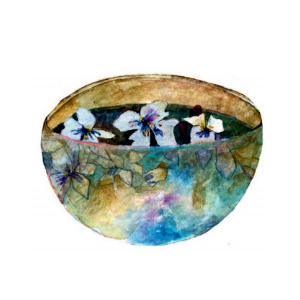
flower essence illustration

How to Select a Flower Essence

Flower essences can be purchased from a quality producer, or you can make your own. Here, I will discuss how to select and apply ready-made flower essence remedies. You can learn how to wildcraft your own flower essences with me in this video.

When you’re starting out with flower essences, it can be overwhelming—so many producers and so many essences! I like to encourage people to remember that it’s your relationship with the plant that is the most important thing in selection. Your relationship with the remedy is the co-creation with that plant. The more you work with flowers, the more you will be able to feel and trust this part of the process.


The following are some ways to begin exploring flower essences:

  • Depending on what issue(s) you’d like to address, begin by taking one to three essences that resonate with you. Many producers offer sets of remedies that have a particular focus. You may want to purchase a set to experiment with, such as the FES’s Range of Light, Delta Gardens’ Protection Set, Alaskan Essences, or the Bach Essences.
  • Consider flower essences that invite presence, relaxation, protection, and grounding.
  • If you want to study the essences more carefully, consider making flashcards or purchasing the flower cards (Alaskan Essences, FES, and Bach make sets).
  • If you’re curious to learn more about how a plant might connect with your ancestry, consider doing some research on how it was used historically.
  • Perhaps there’s a flower you’re curious about, or have seen in nature. Ask this plant if it would like to work with you.

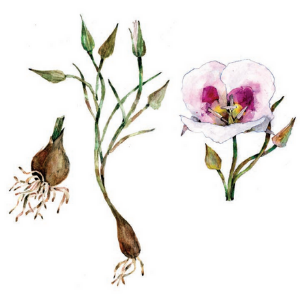
flower essence


Here are five basic ways to select a flower essence:

  • Intuitively: A flower essence might come to you by way of revealing itself in nature, or appearing in a dream.
  • By dowsing: Using a tool of resonance, such a pendulum, to test for essences.
  • Through muscle testing: A simple way to muscle test is to make a ring with the index finger and thumb of your nondominant hand. If you would like to test for a yes for an essence, say the name of the plant and flick the circle with your dominant hand. If the circle holds, that’s a yes. If it breaks open, that is a no.
  • By consulting reference literature: Books, repertories, or flower affirmation cards.
  • Through blind testing: By drawing a card or randomly selecting an essence from a set. This method works well with children.

Any of these methods can be integrated into your ritual. Before making remedies for other people, it’s a good idea to spend some time with the flower essences yourself. The flowers will have much to share with you. Also, the more experience you have with the essences yourself, the better you will understand how the essences will work for others.

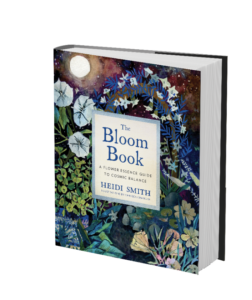
This is an excerpt from The Bloom Book: A Flower Essence Guide to Cosmic Balance by Heidi Smith.


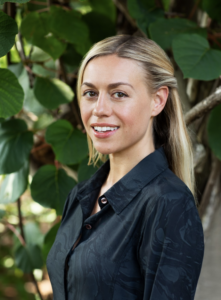
Heidi Smith, MA, RH (AHG), is a psychosomatic therapist, registered herbalist, and flower essence practitioner. Within her private practice, Moon & Bloom, Heidi works collaboratively with her clients to empower greater balance, actualization, and soul-level healing within themselves. She is passionate about engaging both the spiritual and scientific dimensions of the plant kingdom, and sees plant medicine and ritual as radical ways to promote individual, collective, and planetary healing. She lives in Brooklyn, New York, with her partner and two cats. For more, visit moonandbloom.com.


Learn More

Sounds True | Amazon | Barnes & Noble | Bookshop


LiYana Silver: “We Are Embodied Light” – Discove...

LiYana Silver is a life coach and public speaker devoted to helping women embrace their innate feminine strengths in every area of their lives. With Sounds True, she has released the new book Feminine Genius: The Provocative Path to Waking Up and Turning On the Wisdom of Being a Woman. In this episode of Insights at the Edge, LiYana and Tami Simon talk about the importance of listening to one’s deepest inner intuition—your own inner “Oracle,” and LiYana guides listeners through a meditation to invoke this Oracle. Tami and LiYana also speak on enduring difficult times and the lessons contained in the dark patches of our lives, including LiYana’s own “Year of Hell.” Finally, they discuss the necessity of accepting pleasure and how to relate to other women in their own unique embodiments of Feminine Genius. (65 minutes)

The Radiance Sutras

Lorin Roche began meditating in 1968, and has sought to bring the joy of the practice to society at large ever since. As the developer of Instinctive Meditation, Lorin has created multiple book and audio projects on the subject—including Sounds True’s Meditation for Yoga Lovers. In this episode, Lorin and Tami Simon discuss his new book, The Radiance Sutras: 112 Gateways to the Yoga of Wonder and Delight and the process that went into its creation. They talk about the hard work of crafting a unique poetic interpretation and the insights Lorin has gained from listening to the personal stories of thousands of meditators. Finally, Lorin shares excerpts from some of his favorite poems within The Radiance Sutras.(71 minutes)

Andrew Holecek: The Path of Dream Yoga

Tami Simon speaks with Andrew Holecek, an author, humanitarian, and spiritual teacher from the Tibetan Buddhist tradition who is adept at blending ancient wisdom with modern knowledge from the West. Andrew is author of the books The Power and the Pain and Preparing to Die, and with Sounds True he has created the audio course Dream Yoga: The Tibetan Path of Awakening Through Lucid Dreaming. In this episode, Tami speaks with Andrew about the stages of dream yoga practice; how it is complemented by a daytime practice called “illusory form practice;” what it teaches us about ourselves, fear, and the nature of form; and how to begin by having a lucid dream tonight. (65 minutes)