The wounds, scars, and pain we carry as men have a place in our lives. A function that can lead us directly to the core of deep meaning and fulfillment and provide a positive path forward. This is what initiation was supposed to teach us as men—how to descend into the depths of our own darkness and return a more complete and contributive participant in society.
However, this is where a man’s real problem resides: He has not been taught the skill or alchemy of initiation. He has not learned how to deal with his pain, or the pain of the world, and so he bucks against it.
I realized over the years of grappling with how to heal that not only was I ill-equipped to deal with the hurt I’d been given, but I also seemed to be woefully ill-equipped to reconcile with, and put a halt to, the perpetual hurt I passed on to others. Like many men, I was good at inflicting pain—and men who are good at something tend to do that thing a lot.
Not only was I undereducated in the alchemical craft of turning pain into purpose, but almost every man I knew was in relatively the same situation. Most men simply haven’t been taught how to deal with their pain and use it to become something better.
And this aspect of the journey is the missing link in male initiation, which has historically played the role of guiding a man through the transitory period between adolescence and adulthood, teaching him the skills of discipline, sovereignty, and the ability to face some of the most challenging aspects of his own life.
In fact, I began to see that not only have most men not been given the tools or resources to deal with the pain and suffering in their lives, but we as men are actively taught the opposite—the idiotic tactic of constant emotional avoidance. Not only this, but our emotional avoidance is seen as a theoretical and rational strength in certain circles.
Seeing this brings about a multitude of questions that both illuminate the foundational cracks within current masculine culture and also highlight the work we must embark on if we are to do our individual and collective parts as men in building a thriving society.
There’s more: I began to see the direct correlation between a man’s ability and willingness to face his own darkness and having a clear purpose, deep fulfillment, and clarity of contribution to the things that matter most to him.
But how can we as men give our pain a purpose in a culture where we are largely devoid of emotional permissions? Where the archetype of man, in order to be classified or quantified as a man, must do the impossible task of being brave and courageous without being vulnerable?
This is one of the biggest masculine myths—the false idea that you can be courageous without being inherently vulnerable. When we are rewarded for giving our lives, our hearts, and our emotional bodies up for sacrifice to maintain the illusion of invulnerable strength, we prioritize victory over connection. We praise ourselves for performance in the boardroom, bedroom, and bars, but we lack recognition for our performance in reconciliation, repair, and reparation.
There’s another way. A way where victory is found within the work, and part of that work is facing our own darkness.
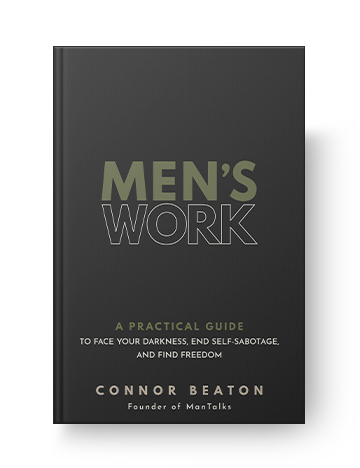
Excerpted from Men’s Work: A Practical Guide to Face Your Darkness, End Self-Sabotage, and Find Freedom by Connor Beaton.
CONNOR BEATON is the founder of ManTalks, an international organization dedicated to the personal growth of men. He is a facilitator dedicated to building better men, an entrepreneur, a writer, and a keynote speaker. Connor has spoken to large corporate brands, nonprofits, schools, and international organizations such as the United Nations, Microsoft, Johnson & Johnson, Apple, TED, and Entrepreneurs' Organization. For more, visit mantalks.com.
Connor Beaton is the founder of ManTalks, an international organization dedicated to the personal and professional growth of men. He is an entrepreneur, writer, keynote speaker, and facilitator dedicated to building better men. Connor has spoken to large corporate brands, nonprofits, schools, and international organizations such as the United Nations, Microsoft, Johnson & Johnson, Apple, TED, and Entrepreneurs’ Organization. He lives in New York. For more, visit connorbeaton.com.
What does it look like to connect to our own masculinity, our own masculine core, in a healthy way? How as men do we welcome the parts of ourselves we dislike the most? Where can we find the validation and recognition we seek? These are the questions that Connor Beaton addresses in his new book, Men’s Work: A Practical Guide to Face Your Darkness, End Self-Sabotage, and Find Freedom.
In this podcast, Tami Simon speaks with Connor about his life and work, discussing why the work of men begins with pain; the consequences of the belief that strength equals suppression; “fathering yourself” and carrying your pain more effectively; welcoming and healing a hurtful inner dialogue; breaking the erroneous rule that blocks real intimacy; transforming the spirit of competition into a positive force for mutual support; the conundrum of male vulnerability; the skill of opening up; leadership, self-respect, and how we conduct ourselves in hard times; emotional sovereignty; self-regulation and the practice of moving from rationalizing into sensation; infidelity and porn; building your own system of self-validation and recognition; and more.
Note: This episode originally aired on Sounds True One, where these special episodes of Insights at the Edge are available to watch live on video and with exclusive access to Q&As with our guests. Learn more at join.soundstrue.com.
The wounds, scars, and pain we carry as men have a place in our lives. A function that can lead us directly to the core of deep meaning and fulfillment and provide a positive path forward. This is what initiation was supposed to teach us as men—how to descend into the depths of our own darkness and return a more complete and contributive participant in society.
However, this is where a man’s real problem resides: He has not been taught the skill or alchemy of initiation. He has not learned how to deal with his pain, or the pain of the world, and so he bucks against it.
I realized over the years of grappling with how to heal that not only was I ill-equipped to deal with the hurt I’d been given, but I also seemed to be woefully ill-equipped to reconcile with, and put a halt to, the perpetual hurt I passed on to others. Like many men, I was good at inflicting pain—and men who are good at something tend to do that thing a lot.
Not only was I undereducated in the alchemical craft of turning pain into purpose, but almost every man I knew was in relatively the same situation. Most men simply haven’t been taught how to deal with their pain and use it to become something better.
And this aspect of the journey is the missing link in male initiation, which has historically played the role of guiding a man through the transitory period between adolescence and adulthood, teaching him the skills of discipline, sovereignty, and the ability to face some of the most challenging aspects of his own life.
In fact, I began to see that not only have most men not been given the tools or resources to deal with the pain and suffering in their lives, but we as men are actively taught the opposite—the idiotic tactic of constant emotional avoidance. Not only this, but our emotional avoidance is seen as a theoretical and rational strength in certain circles.
Seeing this brings about a multitude of questions that both illuminate the foundational cracks within current masculine culture and also highlight the work we must embark on if we are to do our individual and collective parts as men in building a thriving society.
There’s more: I began to see the direct correlation between a man’s ability and willingness to face his own darkness and having a clear purpose, deep fulfillment, and clarity of contribution to the things that matter most to him.
But how can we as men give our pain a purpose in a culture where we are largely devoid of emotional permissions? Where the archetype of man, in order to be classified or quantified as a man, must do the impossible task of being brave and courageous without being vulnerable?
This is one of the biggest masculine myths—the false idea that you can be courageous without being inherently vulnerable. When we are rewarded for giving our lives, our hearts, and our emotional bodies up for sacrifice to maintain the illusion of invulnerable strength, we prioritize victory over connection. We praise ourselves for performance in the boardroom, bedroom, and bars, but we lack recognition for our performance in reconciliation, repair, and reparation.
There’s another way. A way where victory is found within the work, and part of that work is facing our own darkness.
Excerpted from Men’s Work: A Practical Guide to Face Your Darkness, End Self-Sabotage, and Find Freedom by Connor Beaton.
CONNOR BEATON is the founder of ManTalks, an international organization dedicated to the personal growth of men. He is a facilitator dedicated to building better men, an entrepreneur, a writer, and a keynote speaker. Connor has spoken to large corporate brands, nonprofits, schools, and international organizations such as the United Nations, Microsoft, Johnson & Johnson, Apple, TED, and Entrepreneurs’ Organization. For more, visit mantalks.com.
Is a spiritual awakening only real if it completely rearranges your life? That’s the question Tami Simon puts to Adyashanti in this episode, and his answer digs into something a lot of seekers wrestle with: the gap between a powerful glimpse of clarity and the ongoing work of actually living from it.
Adya, the American-born teacher behind books like The End of Your World and Falling into Grace, walks through why those temporary tastes of awakening are real, even when they fade, and offers a surprisingly practical way to hold onto what they revealed without grasping at them. Then he does something rare: he tells the story of his own first major awakening, a moment he describes as feeling like a nuclear explosion going off inside him.
Here’s what we cover:
Why a fleeting shift still counts as a real awakening, even if it doesn’t stick
The two (seemingly contradictory) pieces of advice Adya gives people chasing a past peak experience
How the first awakening can feel like a “freebie,” while everything after asks you to participate consciously
Adya’s own account of the night everything fell away and the still, small voice that told him, “This isn’t all of it. Keep going.”
What if aging isn’t the slow closing of your erotic life, but the doorway into its most alive season?
This week, Tami Simon speaks with Kimberly Ann Johnson—sexological body worker, somatic experiencing practitioner, birth doula, and author of the new Sounds True book Erotic Seasons: Tuning In to the Rhythms of Women’s Sexuality and Spirituality—about what she calls erotic sovereignty, and the sentence that closes her book: the female body is its own spiritual path.
Join Tami and Kimberly to explore:
Erotic sovereignty—your relationship to your own life force, and why it stays with you across every season
Why the goal isn’t a more regulated nervous system, but a more responsive one, and what it means to run more charge
The four erotic seasons—maiden, mother, virgin, crone—and the surprising reason virgin comes after mother
Why hormonal transitions are “wet clay”: golden opportunities for repatterning that our culture teaches us to rush past
Menopause as a death rehearsal, and the life review that arrives decades before we expect it
Hot sex and warm sex—widening the range beyond adrenaline, and learning the language of the pause
“Hormones are gods”: the collective endocrine system, and why living intergenerationally may be the original hormone therapy
Becoming a sexual alchemist—arousal as healing energy, and why care is the whole ethic
Whether you are 25 or 75, Kimberly offers a map for meeting your body’s changes as thresholds rather than losses.
Please note: this episode includes candid discussion of sexual abuse and sexual wounding, including Kimberly Ann Johnson’s own experience.
Listen now, and meet your body as the path. →
This conversation offers genuine transmission, not just concepts about awakening, but the palpable presence of realized teachers exploring the growing edge of spiritual understanding together, and it originally aired on Sounds True One.
What if the very thing that wounded you is the source of the medicine you’re here to give?
In this month’s Point of Insight, Tami Simon shares a personal story: minutes before going live with an archetypal astrologer, she was told—correctly, and within seconds—that she carried “the mother of all mother wounds.” That single moment became the culmination of a much longer, gradual unfolding: a lifetime’s worth of “drops,” from a mentor she called the Queen of the Reframe, to an interview with yoga teacher and activist Seane Corn titled “Your Pain Is Your Purpose,” to an email from a business coach whose four simple words reframed everything—your karma is your dharma.
Join Tami as she reflects on:
How a lifelong feeling of not belonging became the soil for a life’s work helping others feel connected
The difference between sudden insight and the slow, gradual “boiling water” of a tipping point
Why real breakthrough requires going all the way through pain, not around it
Joanna Macy’s question—”What breaks your heart?”—and how grief and care become fuel for service
Why “never turn away” may be one of the most important spiritual instructions there is
This is a shorter, solo reflection from Tami—released once a month on the Insights at the Edge feed—on where our deepest wounds and our clearest purpose meet.