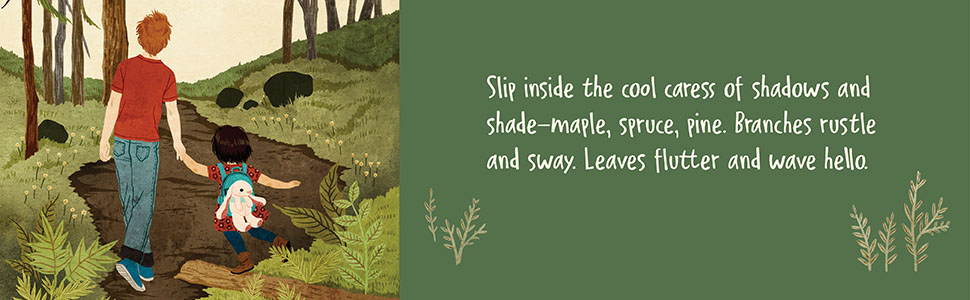
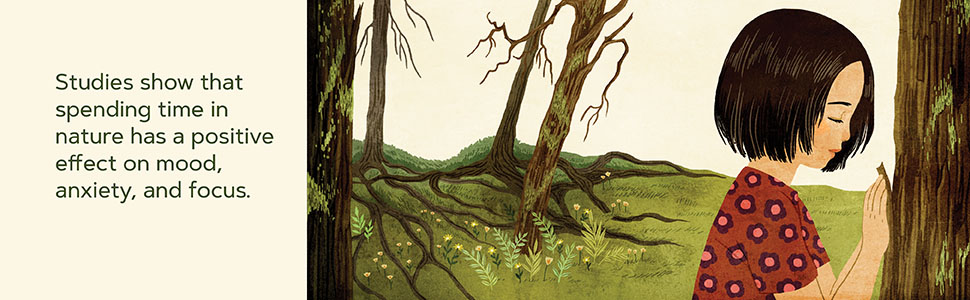
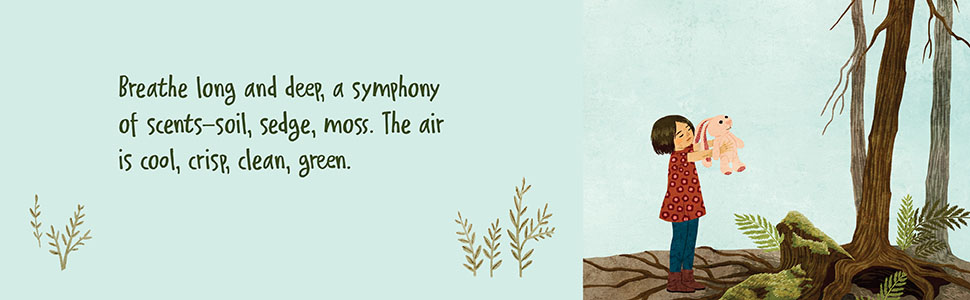
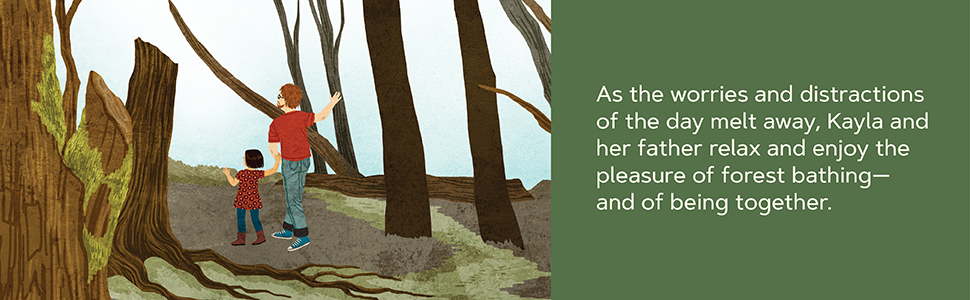
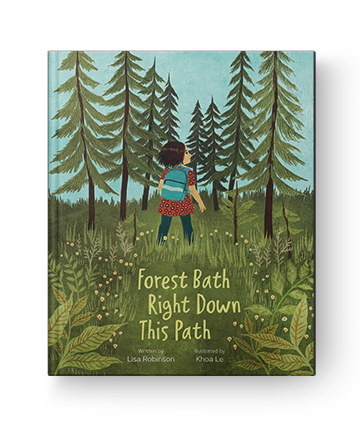
Dear Readers,I’m excited that my new picture book Forest Bath Right Down this Path is part of the Sounds True Kids collection. It’s a book of my heart as it portrays a fog forest—Barred Island Preserve—that my family and I hike every year on our summer vacation in Maine. I’m thrilled that you can enjoy this forest through the window of Khoa Le’s gorgeous illustrations.
As we wander the forest’s moss-lined paths, we smell pines and firs, touch bark and berries, and listen to birds and chipmunks. The hike ends at a rocky beach where we swim and explore tidepools. When we leave, we feel peaceful and calm. The name for this kind of soothing experience is forest bathing.
There’s evidence that smelling chemicals from trees called phytoncides and microbes from soil called mycobacterium vaccae may reduce stress and boost immune function.
I work as a child psychiatrist to help children, teens, and adults, and I’m always looking for ways to help people manage stress and anxiety. Some of the recommendations I make for doing this include exercise, taking time away from screens, meditating, and connecting with family and friends. I try to do these things myself, too! Every morning I take a half hour walk through the woods near my home.
I’m also a parent of two children (now young adults), and I’ve been concerned about the ways phones and screens are interfering with paying attention to the natural world as well as one another. It’s known that spending a lot of time on social media is contributing to the worsening of teens’ mental health. Adults need to take time away from their phones, too. That’s why the main character of my book, Kayla, encourages her father to put away his phone and fully engage in their walk through their forest. Children want their parents’ undivided attention; often they’re the ones encouraging adults to turn off their phones and be present.
I hope this book inspires you to spend time with your loved ones outdoors and soak in all its beauty and mental health benefits. Happy forest bathing!
Wishing you fresh air and sunshine,
Lisa Robinson
P.S. I invite you to download the free story time kit with five activities for children to learn more about forest bathing—from heading out on a sensory expedition to exploring their senses to making art in nature.
Lisa Robinson is a therapist, picture book writer, and nature enthusiast. She lives in Newton, Massachusetts. Every summer her family travels to coastal Maine for two weeks. The highlight of the trip is a walk through Barred Island Preserve on Deer Isle. The animals and plants mentioned in her new children’s book, Forest Bath Right Down This Path, are all found there. Learn more about Lisa and her work at author-lisa-robinson.com.
Lisa Robinson has a BA in psychology from Cornell University, an MD from Tufts University, and an MFA in Writing for Young People from Lesley University. She works as a therapist for children, teenagers, and adults, and is the author of numerous picture books. Lisa lives in Newton, Massachusetts. Learn more at author-lisa-robinson.com.
Dear Readers,
I’m excited that my new picture book Forest Bath Right Down this Path is part of the Sounds True Kids collection. It’s a book of my heart as it portrays a fog forest—Barred Island Preserve—that my family and I hike every year on our summer vacation in Maine. I’m thrilled that you can enjoy this forest through the window of Khoa Le’s gorgeous illustrations.
As we wander the forest’s moss-lined paths, we smell pines and firs, touch bark and berries, and listen to birds and chipmunks. The hike ends at a rocky beach where we swim and explore tidepools. When we leave, we feel peaceful and calm. The name for this kind of soothing experience is forest bathing.
There’s evidence that smelling chemicals from trees called phytoncides and microbes from soil called mycobacterium vaccae may reduce stress and boost immune function.
I work as a child psychiatrist to help children, teens, and adults, and I’m always looking for ways to help people manage stress and anxiety. Some of the recommendations I make for doing this include exercise, taking time away from screens, meditating, and connecting with family and friends. I try to do these things myself, too! Every morning I take a half hour walk through the woods near my home.
I’m also a parent of two children (now young adults), and I’ve been concerned about the ways phones and screens are interfering with paying attention to the natural world as well as one another. It’s known that spending a lot of time on social media is contributing to the worsening of teens’ mental health. Adults need to take time away from their phones, too. That’s why the main character of my book, Kayla, encourages her father to put away his phone and fully engage in their walk through their forest. Children want their parents’ undivided attention; often they’re the ones encouraging adults to turn off their phones and be present.
I hope this book inspires you to spend time with your loved ones outdoors and soak in all its beauty and mental health benefits. Happy forest bathing!
Wishing you fresh air and sunshine,
Lisa Robinson
P.S. I invite you to download the free story time kit with five activities for children to learn more about forest bathing—from heading out on a sensory expedition to exploring their senses to making art in nature.
Lisa Robinson is a therapist, picture book writer, and nature enthusiast. She lives in Newton, Massachusetts. Every summer her family travels to coastal Maine for two weeks. The highlight of the trip is a walk through Barred Island Preserve on Deer Isle. The animals and plants mentioned in her new children’s book, Forest Bath Right Down This Path, are all found there. Learn more about Lisa and her work at author-lisa-robinson.com.
What if aging isn’t the slow closing of your erotic life, but the doorway into its most alive season?
This week, Tami Simon speaks with Kimberly Ann Johnson—sexological body worker, somatic experiencing practitioner, birth doula, and author of the new Sounds True book Erotic Seasons: Tuning In to the Rhythms of Women’s Sexuality and Spirituality—about what she calls erotic sovereignty, and the sentence that closes her book: the female body is its own spiritual path.
Join Tami and Kimberly to explore:
Erotic sovereignty—your relationship to your own life force, and why it stays with you across every season
Why the goal isn’t a more regulated nervous system, but a more responsive one, and what it means to run more charge
The four erotic seasons—maiden, mother, virgin, crone—and the surprising reason virgin comes after mother
Why hormonal transitions are “wet clay”: golden opportunities for repatterning that our culture teaches us to rush past
Menopause as a death rehearsal, and the life review that arrives decades before we expect it
Hot sex and warm sex—widening the range beyond adrenaline, and learning the language of the pause
“Hormones are gods”: the collective endocrine system, and why living intergenerationally may be the original hormone therapy
Becoming a sexual alchemist—arousal as healing energy, and why care is the whole ethic
Whether you are 25 or 75, Kimberly offers a map for meeting your body’s changes as thresholds rather than losses.
Please note: this episode includes candid discussion of sexual abuse and sexual wounding, including Kimberly Ann Johnson’s own experience.
Listen now, and meet your body as the path. →
This conversation offers genuine transmission, not just concepts about awakening, but the palpable presence of realized teachers exploring the growing edge of spiritual understanding together, and it originally aired on Sounds True One.
What if the very thing that wounded you is the source of the medicine you’re here to give?
In this month’s Point of Insight, Tami Simon shares a personal story: minutes before going live with an archetypal astrologer, she was told—correctly, and within seconds—that she carried “the mother of all mother wounds.” That single moment became the culmination of a much longer, gradual unfolding: a lifetime’s worth of “drops,” from a mentor she called the Queen of the Reframe, to an interview with yoga teacher and activist Seane Corn titled “Your Pain Is Your Purpose,” to an email from a business coach whose four simple words reframed everything—your karma is your dharma.
Join Tami as she reflects on:
How a lifelong feeling of not belonging became the soil for a life’s work helping others feel connected
The difference between sudden insight and the slow, gradual “boiling water” of a tipping point
Why real breakthrough requires going all the way through pain, not around it
Joanna Macy’s question—”What breaks your heart?”—and how grief and care become fuel for service
Why “never turn away” may be one of the most important spiritual instructions there is
This is a shorter, solo reflection from Tami—released once a month on the Insights at the Edge feed—on where our deepest wounds and our clearest purpose meet.
Bayo Akomolafe invites us to consider what can happen when urgency gives way to slowing down and healing. His conversation with Tami Simon reflects on sanctuary, grief, ancestry, and finding different ways to meet times of change.
At Sounds True, spiritual wisdom and transformational teachings have been shared since 1985, connecting seekers with respected teachers through books, audio, courses, events, and podcasts.
In this piece, Bayo Akomolafe: Let Us Make Sanctuary and its reflections on sanctuary, slowing down and healing, grief, and ancestry will be discussed.
Key Takeaways:
Sanctuary: Learn how Akomolafe frames sanctuary as a space for reconsidering our relationships with change, grief, and uncertainty.
Ancestry: Consider how ancestral relationships and Yoruba-influenced practices contribute to Akomolafe’s reflections on connection and belonging.
Spiritual Inquiry: Understand how contemplation, activism, historical trauma, and social change intersect throughout the conversation.
Making Sanctuary in Times of Change
Born in Nigeria and shaped by Yoruba teachings as well as Western academia, Bayo Akomolafe brings an unconventional perspective to questions of crisis and social change.
In our conversation, Bayo Akomolafe: Let Us Make Sanctuary, he speaks with Tami Simon about sanctuary as a place where slowing down and healing can happen. Their discussion moves through ancestry, grief, trauma, spiritual contemplation, and the crossroads at which familiar ways of responding may no longer be sufficient.
What Let Us Make Sanctuary Means
Sanctuary, as it emerges in this conversation, is closely connected to the practice of slowing down. Akomolafe challenges the idea that a pause simply helps us recover enough energy to keep moving in the same direction.
Instead, slowing down can create space for deeper inquiry. It gives us an opportunity to question where we are going, what has shaped that direction, and what other possibilities might become visible when forward movement is no longer our only priority.
Slowing Down and Healing in Difficult Times
Urgent circumstances often create pressure to respond immediately. Akomolafe offers another possibility: slowing down and healing can become part of how we meet a crisis rather than something postponed until the crisis has passed.
This kind of slowing asks for attention. It makes room for questions that can be difficult to hear amid constant movement and gives us time to reconsider the paths we have inherited.
Let Us Make Sanctuary Through Slowing Down and Healing
Akomolafe also draws attention to our relationships with those who came before us. The conversation considers the African spiritual practice of pouring drink to the earth as an expression of indebtedness to ancestors and to everything that makes life possible.
From this perspective, sanctuary is relational. Slowing down and healing can involve remembering the connections that hold us and recognizing that our lives do not exist independently of the people, histories, and living world around us.
Finding New Possibilities Through Slowing Down and Healing
The image of standing at a crossroads runs through Akomolafe’s reflections. He suggests that the ground beneath familiar assumptions is shifting, creating conditions in which what once went unsaid may become possible to speak and understand.
Slowing down gives us time to remain with that uncertainty. Rather than rushing toward a familiar answer, we can pay attention to what a changing landscape might reveal.
Bayo Akomolafe on How We Make Sanctuary
Grief also has a meaningful place in Akomolafe’s understanding of sanctuary. His conversation with Simon considers grief in relation to activism, along with the possibility of approaching sites of historical trauma as places for spiritual contemplation and renewed connection with loss and tragedy.
To make sanctuary, then, can mean creating room to stay present with experiences we might otherwise hurry past. Akomolafe’s invitation asks us to consider what becomes possible when we slow down enough to listen, grieve, question our direction, and encounter the world from another place.
Final Thoughts
Bayo Akomolafe’s invitation to make sanctuary encourages us to reconsider our relationship with urgency, grief, and change. Through slowing down and healing, we can create space to listen more deeply, honor our connections, and remain open to possibilities that may emerge when we pause.
Frequently Asked Questions About Bayo Akomolafe: Let Us Make Sanctuary
Who is Bayo Akomolafe?
Bayo Akomolafe is a thinker, writer, speaker, and trained clinical psychologist whose work engages questions of social change, spirituality, community, and the ways people respond to challenging circumstances.
Who speaks with Bayo Akomolafe in Let Us Make Sanctuary?
Bayo Akomolafe speaks with Sounds True founder Tami Simon. Their conversation brings his ideas into a reflective exchange centered on sanctuary, change, grief, and spiritual inquiry.
What traditions influence Bayo Akomolafe’s perspective?
Akomolafe’s perspective is informed in part by Yoruba teachings and his Nigerian background, alongside his experience with Western academic thought. These influences contribute to his distinctive approach to spirituality and social questions.
What role does ancestry play in Bayo Akomolafe’s teachings?
Ancestry provides a way to consider our relationship with those who came before us. Akomolafe speaks about practices that acknowledge indebtedness to ancestors and the many relationships that make our lives possible.
How does Bayo Akomolafe connect spirituality and activism?
Akomolafe considers how spiritual contemplation can inform our relationship with activism. Rather than treating inner reflection and collective concerns as entirely separate, his perspective creates room for them to meet.
Why does Bayo Akomolafe discuss historical trauma?
Historical trauma offers an opportunity to consider how places marked by suffering might be approached differently. Akomolafe reflects on visiting such sites as spaces for contemplation and engagement with histories of loss.
What is the significance of the crossroads in Akomolafe’s thinking?
The crossroads represents a place where established directions may become uncertain and different possibilities can emerge. It provides a useful image for considering periods of cultural and personal transition.
How does Let Us Make Sanctuary approach interconnectedness?
The conversation recognizes that individual lives are shaped by relationships, histories, ancestors, communities, and the living world. This perspective invites a broader understanding of how people belong to one another and their surroundings.
Is Let Us Make Sanctuary intended only for experienced spiritual practitioners?
No. The conversation can speak to both longtime spiritual seekers and people who are newly curious about contemplative ideas. Sounds True shares teachings in an accessible, heart-led way for people at different points in their learning journeys.
Where can I listen to Bayo Akomolafe: Let Us Make Sanctuary?
You can listen to the full Bayo Akomolafe: Let Us Make Sanctuary podcast conversation through Sounds True.
Michelle Cassandra Johnson is an author, activist, spiritual teacher, racial equity consultant, and intuitive healer. She is the author of six books, including Skill in Action and Finding Refuge. Amy Burtaine is a leadership coach and racial equity trainer. With Robin DiAngelo, she is the coauthor of The Facilitator’s Guide for White Affinity Groups. For more, visit https://www.michellecjohnson.com/wisdom-of-the-hive.