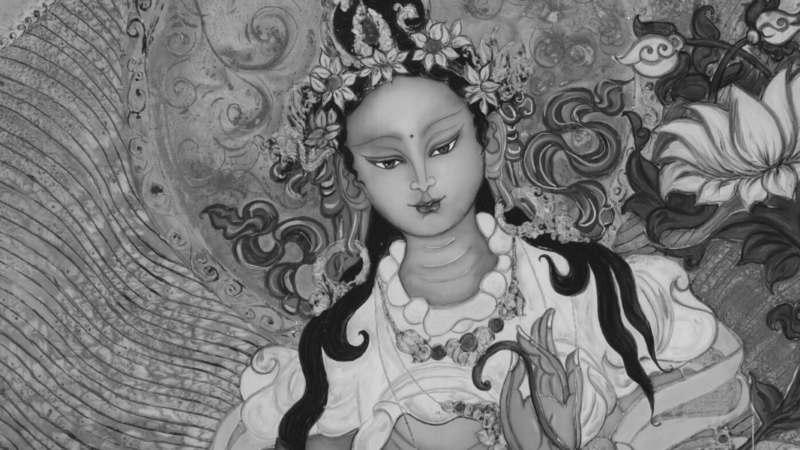
Black Tara Who Destroys All Negativities

    —
December 17, 2020

In the fall of 2010, our monthly Tara practice began at sundown at the end of Rosh Hashanah, the beginning of the Jewish new year, 5771. The days between Rosh Hashanah and Yom Kippur are known as the Days of Awe. During these ten days, observant practitioners reflect on the past year to repair harm they may have inflicted on friends, family, or members of the greater family of the planet. They apologize to others and seek to do t’shuvah to make amends if possible. People work consciously to repair and let go of past negativity and set intentions for the coming year to prevent further mischief.

Black Tara Who Destroys All Negativities was on the calendar for that night. We appreciated the synchronistic timing of the two events. I noted that Tara protects us from negativity, internal and external, and helps us release the effects of negative energies we’ve encountered or generated. This protection occurs in part from remembering our connection to the Whole—that we are nurtured and contained by a multilayered universe. When we help another, we are helped. If we harm another, we harm ourselves. Perhaps harder to grasp—if we harm ourselves, we harm the whole universe.

The teaching centered around the meaning of the mantra, which refers explicitly to ingrained behaviors operating outside of consciousness that wreak havoc in interpersonal relationships. Negative energies transferred from one individual to another are potent and destructive, and often have lasting effects.

Tara’s Appearance

Black Tara appears with her mouth wide open in a fierce expression. Like all the wrathful emanations, she sits on a fiery sun disc, which rests in the center of her lotus throne. The sun disc replaces the usual soothing moon disc. She holds a black vase, which contains the power to overcome even the most destructive and negative powers. In this aspect, Tara is known as the Destroyer of All Negativities.

The Mantra

Om Tare Tuttare Ture Sarva Vidya Avarana Ye Bhye Phat Soha!

“Ohm Tahray Tootahray Tooray Sarwah Veedyah Ahvahrahnah Yay Bay Peyt Soha!”

This mantra sheds more light on the meaning of the practice, when you might need to use it, and how to align your own intentions with those of Tara. It insists that Tara remove mental obstacles that block insight into your complexes or the emotional forces that obscure your understanding. Avarana refers to the causes underlying negative tendencies in yourself or others. These instincts, imprints, or potencies are ingrained, influencing behavior outside of awareness. They are unconscious, unquestioned, and unprocessed. They have been denied, repressed, or avoided. You or others around you might struggle to bring them to consciousness or have no wish to do that whatsoever.

As with many words in Sanskrit, vidya has multiple meanings depending on the context. Vidya often means “wisdom”; in this instance, it means “intentions,” particularly negative intentions. Bhye phat urges Tara to destroy these obstacles or difficulties!

The mantra asks Tara to overcome the negative intentions of the enemy. Use it when you want her complete protection in order to fully grasp the difficulties in your situation. Watch for signs that you are being infected or possessed by internal negativity, which would be a natural response to the energy coming at you. Don’t be naive about actual outer dangers you might be facing; you have to remove yourself from harmful situations.

The Practice

Visualize the entire mandala of the twenty-one Taras arising out of vast space in front of you. Green Tara appears in the center in her radiant body of green light. Imagine your teachers surrounding her and all her other emanations in the background behind them. Finally, invite your friends and supporters and all beings you wish to receive the blessings of your practice. Recite the preliminary prayers. Then imagine that Black Tara Who Destroys All Negativities moves into the foreground, seated on her lotus throne with a sun disc in the center. She holds a black vase, which contains the power to destroy even the most virulent forces in the universe. See light streaming out of her heart and from her seed syllable Tam (“Tahm”) standing on a moon disc inside the vase. Just as a seed contains the entire essence of the plant it will become, the seed syllable Tam contains the entire essence of Tara’s infinite powers.

tam

If visualizing a Tibetan syllable proves difficult initially, simply visualize light streaming out instead. The light destroys all malice and negativity.

Invite Black Tara to protect you from the negative intentions and actions of others. Set your own intentions to release the shock of the impact of such energies on your body, psyche, and spirit. Ofer Tara all of your dark emotions; ask her to protect you inside and out as you engage with our imperfect world in which aggression and hatred are too easily encountered.

Recite the mantra, Om Tare Tuttare Ture Sarva Vidya Avarana Ye Bhye Phat Soha, at least 21 times or 108 times whenever possible. Then rest in the subtle vibration created by the mantra recitation. Notice the qualities of the energy around you. Remember and be grateful for the inherent goodness in the universe that is continuously giving birth to positive impulses inside of you and other beings in the world.

Black Tara brings you back to the radiant spaciousness at the core of your being. As she dissolves obstacles created by negativity, try to identify the signs of true knowing versus the cynical and damaging commentary of the complex. Learn to distinguish what’s coming from inside, what’s coming at you from outside, and how the two are related. Reach out to the cosmic Mother Protector in the form of Tara. Reach inward to her indwelling presence and open yourself to access wisdom and compassion, which offers the greatest protection no matter the circumstances.

As you bring the meditation to a close, visualize Black Tara receding into the background among all the other emanations. See the light streaming out of the entire mandala and then allow the mandala with all its beings to dissolve into space. The light flows into your body and heart, vivifying and stabilizing the essence of Tara within you, and then disperses into the universe. Dedicate the positive potential of the practice to the healing and awakening of all beings everywhere, with no exceptions.

This is an adapted excerpt from Tara: The Liberating Power of the Female Buddha by Dr. Rachael Wooten.

rachael wooten

Rachael Wooten, PhD, is a Zürich—trained Jungian analyst and psychologist who has been in private practice as a therapist for more than 40 years. An enthusiastic interfaith activist, she has studied and practiced in Buddhist, Jewish, Christian, and indigenous traditions throughout her adult life.

Rachael has been mentored by spiritual teachers such as her Tibetan root guru Lodrö Tulku Rinpoche and Rabbi Zalman Schachter-Shalomi. She has taught Tara practices under the authorization of Lodrö Rinpoche for more than 20 years. Rachael has offered Tara workshops through the Resource Center for Women and Ministry in the South, ALEPH: Alliance for Jewish Renewal, and C. G. Jung Society of the Triangle. She currently teaches a monthly Tara meditation group at Pullen Memorial Baptist Church in her hometown of Raleigh, North Carolina. To learn more, visit rachaelwootenauthor.com.


tara 3d cover

Learn More

Sounds True | Amazon | Barnes & Noble | Bookshop | Indiebound

Rachael Wooten

Rachael Wooten, PhD, is a Zürich—trained Jungian analyst and psychologist who has been in private practice as a therapist for more than 40 years. An enthusiastic interfaith activist, she has studied and practiced in Buddhist, Jewish, Christian, and indigenous traditions throughout her adult life.

Rachael has been mentored by spiritual teachers such as her Tibetan root guru Lodrö Tulku Rinpoche and Rabbi Zalman Schachter-Shalomi. She has taught Tara practices under the authorization of Lodrö Rinpoche for more than 20 years. Rachael has offered Tara workshops through the Resource Center for Women and Ministry in the South, ALEPH: Alliance for Jewish Renewal, and C. G. Jung Society of the Triangle. She currently teaches a monthly Tara meditation group at Pullen Memorial Baptist Church in her hometown of Raleigh, North Carolina. To learn more, visit rachaelwootenauthor.com.

Author photo © Teresa Porter

Listen to Tami Simon's in-depth audio podcast interviews with Dr. Rachael Wooten:
The Liberating Power of Tara >>

Also By Author

Golden Tara to Who Helps Manifest and Fulfill Purpose

Meditating on Golden Tara shifts your sense of identity away from the smaller self that experiences itself as a separate being. When you identify with Tara in meditation and throughout the day, you realize that you are always in relationship with a fantastic, complex universe. Your energy increases because you no longer feel alone. You have Tara’s help, the help of friends, and countless other beings as well.

On the one hand, you are an infinitesimally tiny part of the grand whole. On the other hand, you have a role to play in the continuing creation of this complex universe. As you deepen and stabilize your inner Tara consciousness, your actions are imbued with love and compassion, arising from your understanding that you are an integral part of whatever you seek to change.

Remembering Tara also helps preserve your energies when you encounter unexpected obstacles; her golden light reveals the treasures hidden in the unwelcome stumbling blocks of life. Difficult challenges hold keys to awakening. Tara helps you approach problems as an inherent part of the journey, supporting you as you move toward them to uncover wisdom they might offer. They often provide a wake-up call to send you in a new direction, offering greater clarity about your life purpose.

This inclusive attitude creates more health in your personal ecosystem as well as the universal ecosystem. Ask Golden Tara to transform your challenging emotions into love and to increase your energy for discovering meaning and purpose in your life.

Tara’s Appearance

Golden Tara appears as the life-giving female buddha in a body of radiant golden light. She embodies the light of life itself. The vase in Golden Tara’s hand contains the power to increase our life energy, power, and material and spiritual resources. These resources support us in times of ease and times of difficulty, enabling us to discover and fulfill the purposes of our life on a moment-to-moment basis and over the arc of our lives.

For centuries, artists have created statues and thangka paintings of Tara, always adorned with jewelry. These sacred paintings, usually done on fabric and surrounded by brocade, portray the qualities of their subjects and convey teachings as well. Thus we take special note of Tara’s adornments. A crown rests atop her head. Necklaces of varying lengths cascade from her neck to her waist. Bracelets encircle her wrists. All have been crafted from gold with deep red and blue jewels woven into the designs.

Gold has been the preferred precious metal of jewelry makers for thousands of years. Gold is malleable; gold doesn’t tarnish. Golden light is associated with increasing life-force, healing, and holiness. Holy people of many faiths are often painted in an aura of golden radiance.

Many years ago, I heard a teaching that Tara’s jewels represent her experiences over lifetimes on her way to enlightenment and buddhahood. Profound understanding of the Buddhist teachings and her experiences as a woman led Wisdom Moon to vow to attain enlightenment as a woman and to persevere toward her goal. Tara’s life events were surely difficult and awe-inspiring, ordinary and phenomenal. All of them were precious contributions to her journey, which has benefited countless beings over hundreds of years.

The Mantra

Om Tare Tuttare Ture Sarva Ayur Punye Pushtam Kuru Soha!

“Ohm Tahray Tootahray Tooray Sarwah Ahyoor Poonyay Pushtahm Kooroo Soha!”

When you recite the mantra of Golden Tara, you are urging (kuru) Tara to increase (pushtam) your life energies (ayur) and merit (punye), your contributions to adding positive energy to beings around the world, near and far. Mantra recitations need not be limited to formal practice. Use them throughout the day to slow down and focus on whatever task is at hand.

The Practice

First, visualize the entire mandala of Green Tara emerging into the space in front of you. You are surrounded by your friends, loved ones, and supporters, and she is surrounded by your teachers and all the twenty-one emanations. After the opening prayers, imagine Golden Tara coming into the foreground of the mandala. Recall her praise while visualizing golden rays of light streaming from her heart as well as the golden vase in her right hand, which rests on her right knee, palm open in the gesture of supreme giving.

As you recite her mantra, Om Tare Tuttare Ture Sarva Ayur Punye Pushtam Kuru Soha, imagine that you are absorbing this light and that other beings and other places are receiving the light of Tara as well.

Kuru, which appears in seven of the Tara mantras, carries a particularly bold tone. You’re not meekly asking Tara to help—you’re putting your whole heart and body into this request. “Tara, please do this for me. Remove blockages so more energy flows into my life and work! I’m counting on you!” The same tasks that feel overwhelming in one moment seem entirely possible in the next.

Tara can help you discern the wisdom inherent in the obstacles you encounter in your life and practice. Meditate on the continuity in your life—the joyful moments, the extremely painful moments, and everything in between. Your experiences are not meaningless fragments. Imagine a mosaic forming as you piece the fragments together into a beautiful coherent pattern. Invoke Tara’s wisdom to give you greater clarity about your life purpose and the means to fulfill it.

Recite the mantra at least 21 times or 108 times whenever possible. Then rest in the vibrational field created by your chanting. Allow frustration and doubt to dissolve, releasing energy for healing. You become richer in inner resources, which leads to enriched outer resources as well, both material and spiritual. Affirm your connection to all life forms in the universe. Know that the benefits of your heartfelt wishes and efforts will flow from you into the world.

As you bring the session to a close, visualize Golden Tara receding into her place among the twenty-one emanations. See the whole mandala dissolve into radiant light, which flows into you and merges with your inner light. Dedicate the merit or positive potential generated by the practice to the healing of all beings—with no exceptions.

This is an adapted excerpt from Tara: The Liberating Power of the Female Buddha by Dr. Rachael Wooten.


rachael wooten

Rachael Wooten, PhD, is a Zürich—trained Jungian analyst and psychologist who has been in private practice as a therapist for more than 40 years. An enthusiastic interfaith activist, she has studied and practiced in Buddhist, Jewish, Christian, and indigenous traditions throughout her adult life.

Rachael has been mentored by spiritual teachers such as her Tibetan root guru Lodrö Tulku Rinpoche and Rabbi Zalman Schachter-Shalomi. She has taught Tara practices under the authorization of Lodrö Rinpoche for more than 20 years. Rachael has offered Tara workshops through the Resource Center for Women and Ministry in the South, ALEPH: Alliance for Jewish Renewal, and C. G. Jung Society of the Triangle. She currently teaches a monthly Tara meditation group at Pullen Memorial Baptist Church in her hometown of Raleigh, North Carolina. To learn more, visit rachaelwootenauthor.com.


book cover

Learn More

Sounds True | Amazon | Barnes & Noble | Bookshop | Indiebound
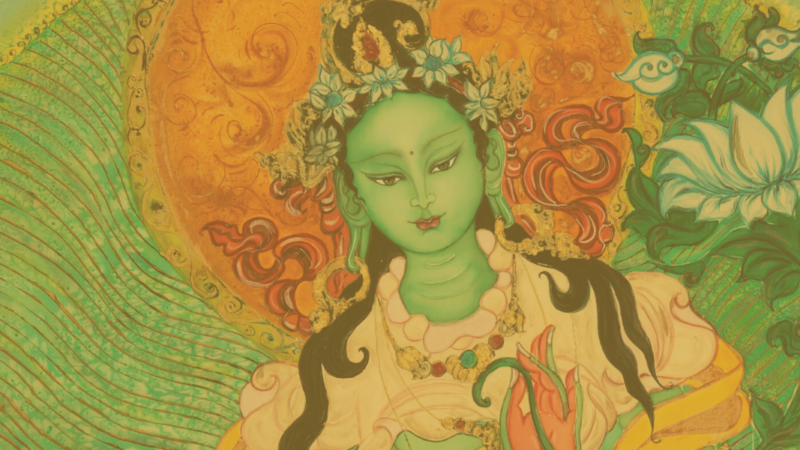
Black Tara Who Destroys All Negativities

In the fall of 2010, our monthly Tara practice began at sundown at the end of Rosh Hashanah, the beginning of the Jewish new year, 5771. The days between Rosh Hashanah and Yom Kippur are known as the Days of Awe. During these ten days, observant practitioners reflect on the past year to repair harm they may have inflicted on friends, family, or members of the greater family of the planet. They apologize to others and seek to do t’shuvah to make amends if possible. People work consciously to repair and let go of past negativity and set intentions for the coming year to prevent further mischief.

Black Tara Who Destroys All Negativities was on the calendar for that night. We appreciated the synchronistic timing of the two events. I noted that Tara protects us from negativity, internal and external, and helps us release the effects of negative energies we’ve encountered or generated. This protection occurs in part from remembering our connection to the Whole—that we are nurtured and contained by a multilayered universe. When we help another, we are helped. If we harm another, we harm ourselves. Perhaps harder to grasp—if we harm ourselves, we harm the whole universe.

The teaching centered around the meaning of the mantra, which refers explicitly to ingrained behaviors operating outside of consciousness that wreak havoc in interpersonal relationships. Negative energies transferred from one individual to another are potent and destructive, and often have lasting effects.

Tara’s Appearance

Black Tara appears with her mouth wide open in a fierce expression. Like all the wrathful emanations, she sits on a fiery sun disc, which rests in the center of her lotus throne. The sun disc replaces the usual soothing moon disc. She holds a black vase, which contains the power to overcome even the most destructive and negative powers. In this aspect, Tara is known as the Destroyer of All Negativities.

The Mantra

Om Tare Tuttare Ture Sarva Vidya Avarana Ye Bhye Phat Soha!

“Ohm Tahray Tootahray Tooray Sarwah Veedyah Ahvahrahnah Yay Bay Peyt Soha!”

This mantra sheds more light on the meaning of the practice, when you might need to use it, and how to align your own intentions with those of Tara. It insists that Tara remove mental obstacles that block insight into your complexes or the emotional forces that obscure your understanding. Avarana refers to the causes underlying negative tendencies in yourself or others. These instincts, imprints, or potencies are ingrained, influencing behavior outside of awareness. They are unconscious, unquestioned, and unprocessed. They have been denied, repressed, or avoided. You or others around you might struggle to bring them to consciousness or have no wish to do that whatsoever.

As with many words in Sanskrit, vidya has multiple meanings depending on the context. Vidya often means “wisdom”; in this instance, it means “intentions,” particularly negative intentions. Bhye phat urges Tara to destroy these obstacles or difficulties!

The mantra asks Tara to overcome the negative intentions of the enemy. Use it when you want her complete protection in order to fully grasp the difficulties in your situation. Watch for signs that you are being infected or possessed by internal negativity, which would be a natural response to the energy coming at you. Don’t be naive about actual outer dangers you might be facing; you have to remove yourself from harmful situations.

The Practice

Visualize the entire mandala of the twenty-one Taras arising out of vast space in front of you. Green Tara appears in the center in her radiant body of green light. Imagine your teachers surrounding her and all her other emanations in the background behind them. Finally, invite your friends and supporters and all beings you wish to receive the blessings of your practice. Recite the preliminary prayers. Then imagine that Black Tara Who Destroys All Negativities moves into the foreground, seated on her lotus throne with a sun disc in the center. She holds a black vase, which contains the power to destroy even the most virulent forces in the universe. See light streaming out of her heart and from her seed syllable Tam (“Tahm”) standing on a moon disc inside the vase. Just as a seed contains the entire essence of the plant it will become, the seed syllable Tam contains the entire essence of Tara’s infinite powers.

tam

If visualizing a Tibetan syllable proves difficult initially, simply visualize light streaming out instead. The light destroys all malice and negativity.

Invite Black Tara to protect you from the negative intentions and actions of others. Set your own intentions to release the shock of the impact of such energies on your body, psyche, and spirit. Ofer Tara all of your dark emotions; ask her to protect you inside and out as you engage with our imperfect world in which aggression and hatred are too easily encountered.

Recite the mantra, Om Tare Tuttare Ture Sarva Vidya Avarana Ye Bhye Phat Soha, at least 21 times or 108 times whenever possible. Then rest in the subtle vibration created by the mantra recitation. Notice the qualities of the energy around you. Remember and be grateful for the inherent goodness in the universe that is continuously giving birth to positive impulses inside of you and other beings in the world.

Black Tara brings you back to the radiant spaciousness at the core of your being. As she dissolves obstacles created by negativity, try to identify the signs of true knowing versus the cynical and damaging commentary of the complex. Learn to distinguish what’s coming from inside, what’s coming at you from outside, and how the two are related. Reach out to the cosmic Mother Protector in the form of Tara. Reach inward to her indwelling presence and open yourself to access wisdom and compassion, which offers the greatest protection no matter the circumstances.

As you bring the meditation to a close, visualize Black Tara receding into the background among all the other emanations. See the light streaming out of the entire mandala and then allow the mandala with all its beings to dissolve into space. The light flows into your body and heart, vivifying and stabilizing the essence of Tara within you, and then disperses into the universe. Dedicate the positive potential of the practice to the healing and awakening of all beings everywhere, with no exceptions.

This is an adapted excerpt from Tara: The Liberating Power of the Female Buddha by Dr. Rachael Wooten.

rachael wooten

Rachael Wooten, PhD, is a Zürich—trained Jungian analyst and psychologist who has been in private practice as a therapist for more than 40 years. An enthusiastic interfaith activist, she has studied and practiced in Buddhist, Jewish, Christian, and indigenous traditions throughout her adult life.

Rachael has been mentored by spiritual teachers such as her Tibetan root guru Lodrö Tulku Rinpoche and Rabbi Zalman Schachter-Shalomi. She has taught Tara practices under the authorization of Lodrö Rinpoche for more than 20 years. Rachael has offered Tara workshops through the Resource Center for Women and Ministry in the South, ALEPH: Alliance for Jewish Renewal, and C. G. Jung Society of the Triangle. She currently teaches a monthly Tara meditation group at Pullen Memorial Baptist Church in her hometown of Raleigh, North Carolina. To learn more, visit rachaelwootenauthor.com.


tara 3d cover

Learn More

Sounds True | Amazon | Barnes & Noble | Bookshop | Indiebound
You Might Also Enjoy

Tracee Stanley: What We Need in These Threshold Times

What if the antidote to a world coming apart isn’t a bigger plan, but a smaller, daily act of devotion?

This week, Tami Simon speaks with Tracee Stanley—teacher of yoga nidra, meditation, and self-inquiry, founder of Empowered Life Circle, and author of the new Sounds True book Living Ritual: Infuse Each Day with Purpose and Spirit—about why ritual may be the most important practice we have during what she calls threshold times.

Join Tami and Tracee to explore:

  • The threshold question at the heart of ritual: what within me is dying, and what is waiting to be born?
  • Why devotion, not discipline, is the doorway—and how to weave practice through an ordinary householder’s day without shame
  • Tracee’s shard of light in Cape Town, and the years it took to find language for it
  • The body as shrine: the origins of yoga nidra in nyasa, the ancient practice of anointing the body as a divine temple
  • Earth dreaming—lying on the land and letting the land dream through you
  • Her reframe of the four Purusharthas, turning prosperity into support and pleasure into relationship
  • Sankalpa as a vow that leads to dharma, not a manifestation wish list
  • The analog cocoon and the night school: reclaiming sleep and dream time from the phone
  • Why enlightenment may be less a permanent state than a moment available in the space between two breaths

Tracee also speaks candidly about walking away from a successful film career, and what a surgery taught her about the ego that refuses to let the body rest.

Tracee opens and closes this interview with a short guided ritual you can practice along with.

Listen now, and let something be reshaped. →

This conversation offers genuine transmission, not just concepts about awakening, but the palpable presence of realized teachers exploring the growing edge of spiritual understanding together, and it originally aired on Sounds True One.

Get a FREE month of membership at https://bit.ly/STOne-Free-Month.

Reverend angel Kyodo williams: Warrior Spirit

Most people come to meditation looking for a break, a few quiet minutes away from a world that rarely slows down on its own. Reverend angel Kyodo williams spends much of this conversation gently taking apart that assumption, suggesting that real stillness was never about leaving the world behind at all. It’s a small shift in framing that ends up changing everything about how the rest of her teaching lands.

Rev. angel is an ordained Zen priest, activist, and founder of the Center for Transformative Change, recognized as the world’s second female Zen teacher of African descent and the author of Being Black and Radical Dharma. 

Sounds True has featured her teaching across our Meditation Summit and A Year of Mindfulness precisely because she refuses to separate inner practice from outer justice, treating the two as a single continuous act rather than competing priorities. What follows traces her case for a warrior spirit built on presence rather than escape, and the meditation practice she offers as its foundation.

Key Takeaways:

  • Retreat Isn’t the Goal: Learn why angel Kyodo williams reframes meditation as engagement, not escape.
  • Effort Meets Release: Understand the meditation practice she developed for people doing social change work.
  • A Different Kind of Fearlessness: See what warrior spirit means when it’s rooted in love rather than force.

Retreat Is Not What It Looks Like From Outside

Rev. angel opens by naming something many practitioners feel but rarely say aloud: the pull toward meditation often comes wrapped in a longing to retreat from an overwhelming world. She doesn’t dismiss that longing, but she does redirect it, suggesting that genuine practice engages our inner fullness rather than fleeing from outer noise. What looks like withdrawal from the outside, she argues, is closer to a deepening than a departure, a distinction that reframes the entire purpose of sitting down to practice in the first place.

Learn Practices for Self-Compassion with Sounds True.

Effort and Release Meditation: A Practice Born From Movement Work

Rev. angel developed a specific meditation practice she calls Effort and Release after years spent working alongside people doing demanding social change work. The practice blends deliberate effort with intentional letting go, addressing a pattern she noticed constantly among activists and organizers: a strong pull toward doing, accomplishing, and pushing that rarely leaves room for rest. She describes meditation and social change as inseparable, since the way a person relates to their own mind directly shapes what they find themselves willing to engage with in the wider world.

  • Naming the Pattern: Many changemakers carry a constant urgency that outlasts any single campaign, even during rest.
  • Effort With Purpose: The practice doesn’t reject action, only unconscious, exhausting overdrive.
  • Release as Skill: Letting go is treated as an active discipline, not passive collapse or avoidance.

Hear the complete teaching in her episode, Reverend angel Kyodo williams: Warrior Spirit

Inner Life and Outer World as One Continuous Fabric

A central thread running through Rev. Angel’s teaching rejects any hard line between internal awareness and external action. She describes our self-talk, the noise level of our minds, and our capacity for presence as directly shaping how we show up for others and what we find acceptable in the wider world. This isn’t a metaphor for her; it’s closer to a working principle behind everything she teaches, from meditation instruction to movement strategy. 

What we tolerate in the world outside us, she suggests, tends to trace directly back to what we’ve grown accustomed to tolerating within our own minds first, which is why she treats internal clarity as a precondition for meaningful external change rather than a separate, optional pursuit.

Warrior Spirit Rooted in Fearlessness, Not Force

The phrase “warrior spirit,” drawn from her earlier book Being Black, describes something quite different from combativeness or aggression directed outward at the world. For Rev. Angel, this spirit is built on truth-telling and responsibility, a foundation for genuine happiness rather than a posture of defensiveness. It asks practitioners to stay engaged with difficulty, including the difficulty of racism, patriarchy, and other inherited harms, rather than looking away or numbing out. This framing has resonated widely since the book’s original publication, offering readers across many backgrounds a way to hold fearlessness and tenderness together rather than treating them as opposites.

  • Truth Before Comfort: Warrior spirit requires naming what’s actually happening, even when it’s unwelcome.
  • Grace Alongside Fearlessness: Strength and tenderness are treated as complementary, not opposites.
  • Responsibility as Practice: Taking ownership of one’s own patterns becomes part of the discipline itself.

Build Relationships That Nourish and Sustain.

Bridging Personal Transformation and Collective Justice

Rev. angel has spent more than fifteen years shaping what she calls Transformative Social Change, a field built on the belief that lasting justice work requires equally serious inner work. She resists treating meditation as a private escape hatch separate from activism, instead framing contemplative practice as fuel for sustained, clear-eyed engagement with collective harm. Burnout among organizers, in her view, often stems from skipping this inner dimension entirely, treating stillness as optional rather than structural to the work itself. She has described this field as one she helped name and shape, watching it grow from a personal conviction into a recognized approach embraced across activist and spiritual communities alike.

What Radical Dharma Adds to This Conversation

Rev. Angel’s later book, Radical Dharma, co-written with Lama Rod Owens and Jasmine Syedullah, extends this same warrior spirit into a direct examination of race, love, and liberation within Buddhist communities themselves. The book argues that spiritual communities are not exempt from the patterns of harm found elsewhere in society, and that genuine awakening has to include an honest reckoning with those patterns rather than a spiritual bypass around them. This willingness to hold institutions, including her own tradition, accountable runs consistently through everything she teaches, from her earliest writing through her more recent contributions to Sounds True’s programming.

Awaken Your Inner Healing Power

Final Thoughts

Reverend angel Kyodo williams doesn’t offer meditation as a rest stop from the world’s demands. She offers it as a training ground for staying present with those demands without losing ourselves inside them. That distinction, subtle but significant, may be exactly what separates spiritual bypass from spiritual maturity, and it’s the thread that ties her meditation teaching to her justice work without contradiction. Listeners who come looking for a quick escape often leave with something more durable instead: a practice for staying rooted precisely where things are hardest. 

Sounds True continues sharing her teaching because our mission to wake up the world has never meant looking away from what’s hardest to face, and few teachers hold that tension as steadily as she does. Her books and audio programs remain in our library for anyone ready to bring the same steadiness into their own life and work.

Frequently Asked Questions About angel Kyodo williams

Who is Reverend angel Kyodo williams?

She is an ordained Zen priest, activist, author, and founder of the Center for Transformative Change.

What books has she written?

Her books include Being Black: Zen and the Art of Living with Fearlessness and Grace and Radical Dharma.

What is the Effort and Release practice?

A meditation method blending deliberate effort with intentional letting go, developed for activists and organizers.

Is this teaching only relevant to activists?

No, her ideas on presence and inner work apply to anyone navigating stress, urgency, or burnout in daily life.

What does warrior spirit mean in her teaching?

A fearless, truth-telling posture grounded in responsibility and grace, not aggression or combativeness.

Has Sounds True featured her in other programs?

Yes, she has appeared in Sounds True’s Meditation Summit and A Year of Mindfulness series.

What is the Center for Transformative Change?

An organization she founded connecting inner personal work with large-scale social transformation.

Where can I hear more conversations like this one?

Explore our Insights at the Edge Podcast for further interviews on mindfulness, justice, and social engagement.

Michelle Cassandra Johnson is an author, activist, spiritual teacher, racial equity consultant, and intuitive healer. She is the author of six books, including Skill in Action and Finding Refuge. Amy Burtaine is a leadership coach and racial equity trainer. With Robin DiAngelo, she is the coauthor of The Facilitator's Guide for White Affinity Groups. For more, visit https://www.michellecjohnson.com/wisdom-of-the-hive.

Iyanla Vanzant On Truth Is Light

What happens when the world around you feels like it has lost its grip on truth, and you’re left wondering how to hold onto faith anyway? That question sits at the heart of the exchange between Tami Simon and Iyanla Vanzant, one of the most trusted voices in personal empowerment today. 

Over 40 years, we at Sounds True have been devoted to bringing you the living wisdom of teachers like Iyanla Vanzant, an author of five New York Times bestsellers and a familiar face to millions as the host of Iyanla: Fix My Life. As the world’s largest living library of transformational teachings, and home to Tami Simon’s Insights at the Edge, we exist to preserve these conversations in their true, unscripted form. 

What Iyanla and Tami uncovered reaches into territory many of us have been quietly longing to name: intimacy with the divine, the erosion of trust and integrity, and the calling that shapes who you really are. 

Key Takeaways:

  • Faith Is a Practice, Not a Belief: Intimacy with the divine is a relationship you return to daily. Iyanla Vanzant reminds us that faith in difficult times is the practice that keeps you grounded when certainty runs out and the path forward feels unclear. 
  • Reclaiming Values We’ve Lost: Integrity, accountability, and trust are slipping quietly from modern life. Iyanla Vanzant and Tami Simon reflect on what this costs us personally and collectively, and what it takes to reclaim these values through honest daily living. 
  • Your Calling Reveals Your True Self: Rather than searching for purpose separately from identity, Iyanla Vanzant teaches that answering your calling is what gives birth to your most authentic self, with truth as the light that makes the path visible.

Cultivating Intimacy With The Divine

At the heart of what Iyanla Vanzant shares is something many of us long for but rarely name aloud: an intimate, ongoing relationship with God. A living connection you return to daily, the way you would a trusted friend. This is where everything else begins. 

Iyanla Vanzant reminds us that faith is lived, returned to moment by moment, a practice built most steadily through the very times when doubt feels easier than trust. That distinction matters more than it might first appear. Trying times reveal whether your faith is a story you tell about yourself or a relationship you live inside, moment by moment, choice by choice. 

We invite you to sit with that difference for a moment. Where in your life are you being asked to move from believing in something to actually leaning into it, even when the outcome is not yet clear, and even when trust feels like the harder path?

Find Teachings that Speak to You With Sounds True.

Values We’re Losing And Why They Matter

Beyond the personal work of faith, Iyanla Vanzant and Tami Simon turn their attention outward to something both women see slipping away in modern life. It is a quiet loss, the kind that shows up in small daily interactions long before it becomes a headline. Their conversation names three specific casualties worth sitting with:

Integrity

Iyanla Vanzant speaks to integrity as something deeper than simply telling the truth. The alignment between what you say, what you believe, and how you show up in the world each day. When that alignment breaks down, even in small ways, something essential within a community begins to quietly erode. A person who values honesty but withholds difficult truths from the people they love is already living out of alignment. 

Accountability

Accountability emerges as a value that seems increasingly rare: the willingness to own your actions and their consequences without deflecting or minimizing what happened. Iyanla Vanzant and Tami Simon reflect on what it costs a society when people stop holding themselves responsible to one another and to the truth. When accountability disappears from daily life, trust erodes alongside it, and the small moments of honesty that rebuild it become more vital. 

Trust

Perhaps most tender is their reflection on trust itself. Iyanla Vanzant speaks to how trust, once assumed as a baseline of human connection, now feels harder to extend and even harder to earn back. That raises an honest question about what it truly takes to rebuild something so foundational to how we relate. 

Build Relationships That Nourish and Sustain.

Your Unique Calling And The Self It Reveals

The exchange moves toward something deeply personal: the idea that every person carries a calling that is theirs alone to discover. Iyanla Vanzant and Tami Simon treat this as a truth available to anyone willing to sit with it. Three related threads open from there: 

  • Everyone Carries A Calling: Iyanla Vanzant speaks to the idea that a calling is not something reserved for the chosen few. It belongs to every person, waiting to be recognized rather than invented. This reframes the search for purpose as less about creating something entirely new and more about quietly uncovering what was already there within you all along.
  • Calling As The Birthplace Of Authenticity: Iyanla Vanzant and Tami Simon reflect on how answering your calling is what gives rise to your most authentic self. Purpose and identity are born together. The calling gradually shapes who you become, gently and surely, as you live in closer alignment with what you are here to do. Many of us spend years trying to figure out who we are before we feel ready to act. 
  • Truth As The Light That Reveals The Path: This is where Iyanla Vanzant on Truth Is Light offers its most grounding insight: truth is the light that makes your calling visible. Living honestly, with yourself and with what you believe, is what allows your calling to come into focus, clearing away the confusion and doubt that keep it hidden.

Center Yourself With Meditative Teachings by Sounds True

Final Thoughts

What stays with you is a felt sense of what it means to live honestly, with yourself, with the divine, and with the people around you. Iyanla Vanzant and Tami Simon remind us that faith in difficult times is about staying in relationship with something larger than the moment you are in, even when that moment feels unresolved. The quiet challenge they leave us with is this: notice where integrity, accountability, and trust have faded in your own life, and consider what living in closer alignment with your true calling might look like.

The teachings Iyanla Vanzant brings forward are part of a larger body of work we have been honored to carry for over 40 years. At Sounds True, we believe that wisdom shared becomes wisdom lived. Wherever these ideas meet something real in you, we encourage you to keep going. Our courses, community, and programs are here to hold you as you do.

Frequently Asked Questions About Iyanla Vanzant On Truth Is Light

Who is Iyanla Vanzant?

Iyanla Vanzant is an author and television host known for five New York Times bestsellers and her role as host of Iyanla: Fix My Life, along with several audio programs created with Sounds True.

What is this Iyanla Vanzant episode about?

This episode is a conversation between Iyanla Vanzant and Tami Simon exploring intimacy with the divine, fading values like trust and integrity, and the unique calling that shapes your most authentic self.

How do I hold onto faith when life feels hard?

Iyanla Vanzant reminds us that faith is not something you simply have but something you practice daily, especially when life gives you every reason to doubt and lose your footing.

Why do integrity, accountability, and trust matter so much right now?

Iyanla Vanzant and Tami Simon reflect on these values as ones quietly fading from modern life, and what is lost personally and collectively when we stop holding each other accountable.

How do I discover my own calling?

Iyanla Vanzant teaches that your calling is uncovered through living in truth with yourself, not invented from scratch. Our online courses offer structured paths for going deeper into this kind of work.

What does it mean to cultivate intimacy with God?

For Iyanla Vanzant, intimacy with the divine means a living, ongoing connection you return to daily, much like a trusted friendship, rather than a distant faith reserved only for hard times.

Where can I listen to more conversations like this one?

You can hear the full episode on Insights at the Edge, and find more conversations like it through Sounds True One, our community membership for ongoing teachings.

Michelle Cassandra Johnson is an author, activist, spiritual teacher, racial equity consultant, and intuitive healer. She is the author of six books, including Skill in Action and Finding Refuge. Amy Burtaine is a leadership coach and racial equity trainer. With Robin DiAngelo, she is the coauthor of The Facilitator's Guide for White Affinity Groups. For more, visit https://www.michellecjohnson.com/wisdom-of-the-hive.

Leave a Reply

Your email address will not be published. Required fields are marked *