There is a saying that goes “hurt people hurt people.” I believe this to be true. We have been conditioned, in environments of scarcity and violence, to react more with fear and self-protection than curiosity and connection. As a result, we live in a world that is deeply in need of more kindness, more ease, more connection, more sweetness. It’s time we offer more sweetness and ease to ourselves, to one another, to our planet.
Now, this does not mean being a Pollyanna or “sickly sweet.” It does not mean being addicted to sugar and finding other ways to hurt ourselves. It means moving through the world and offering sweetness to ourselves and others. It means setting good boundaries and protecting our community and the hive from those who would “rob” us of our sweetness, of the sustenance (love, connection, inclusion, belonging) that helps us endure.
But first, we have to allow ourselves to taste and feel the sweetness on our own. We have to practice being deeply grateful for what is sweet in our life, holding it with reverence, and freely sharing it with others.
We invite you to build your own relationship with, and deep worthiness of, sweetness. We invite you to find and taste the sweetness in your life. Times of abundance and sweetness are special, and we must remember to taste them fully and live into them. We must also remember to share them.
What sweetness do you have in your life? What sweetness can you share with others? What sweetness do you crave from others? How can you cultivate more sweetness in your life? What does that look, sound, and feel like? Where do you deny yourself sweetness? How can you give yourself permission to taste and share all of the sweetness that comes to you? How can you bring sweetness into the lives of others?
Honey Tasting Meditation
For this practice, you’ll need some (ideally) local honey. If possible, find out what you can about where it came from and what was in bloom at the time it was made. This will help deepen your relationship to the place you live. If you cannot find local honey, that is okay; you can still complete the meditation as instructed.
Find a quiet spot in a quiet moment and sit with your jar of honey. Before opening it, sit in a few moments of conscious breathing to quiet your mind.
Start with your sense of sight and smell. Hold the jar of honey up in front of you and observe its color and viscosity. Take note of how it looks in the light, in the dark.
Next, open the jar of honey and bring it to your nose. Inhale deeply. Notice the sensations, images, or thoughts that come to you as you breathe in the aromatherapy of the honey.
Now, reverently taste the honey. Take a small amount on a spoon and meditatively savor the flavors, sensations, feelings, and images that come to you. Chew the honey. Hold it on your tongue. Allow yourself to indulge in its many flavors. Do this again with another spoonful (or as many as you want) but take your time.
When you’re done, write down any messages or insights you received from the experience and the nurturing and healing power of the honey. Take this moment of sweetness with you into your day.
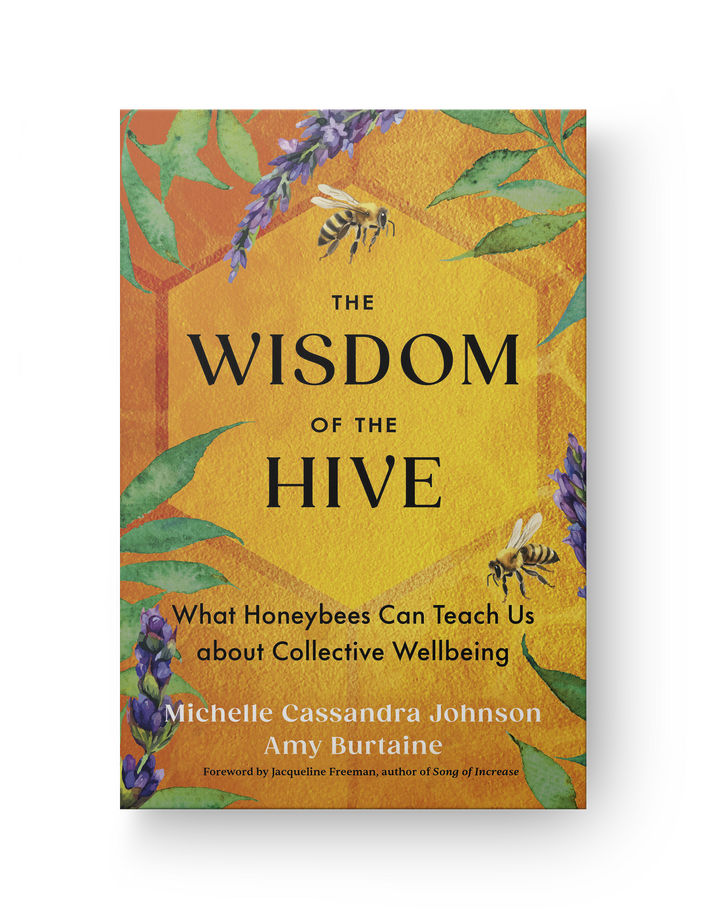
Excerpted from The Wisdom of the Hive: What Honeybees Can Teach Us about Collective Wellbeing.
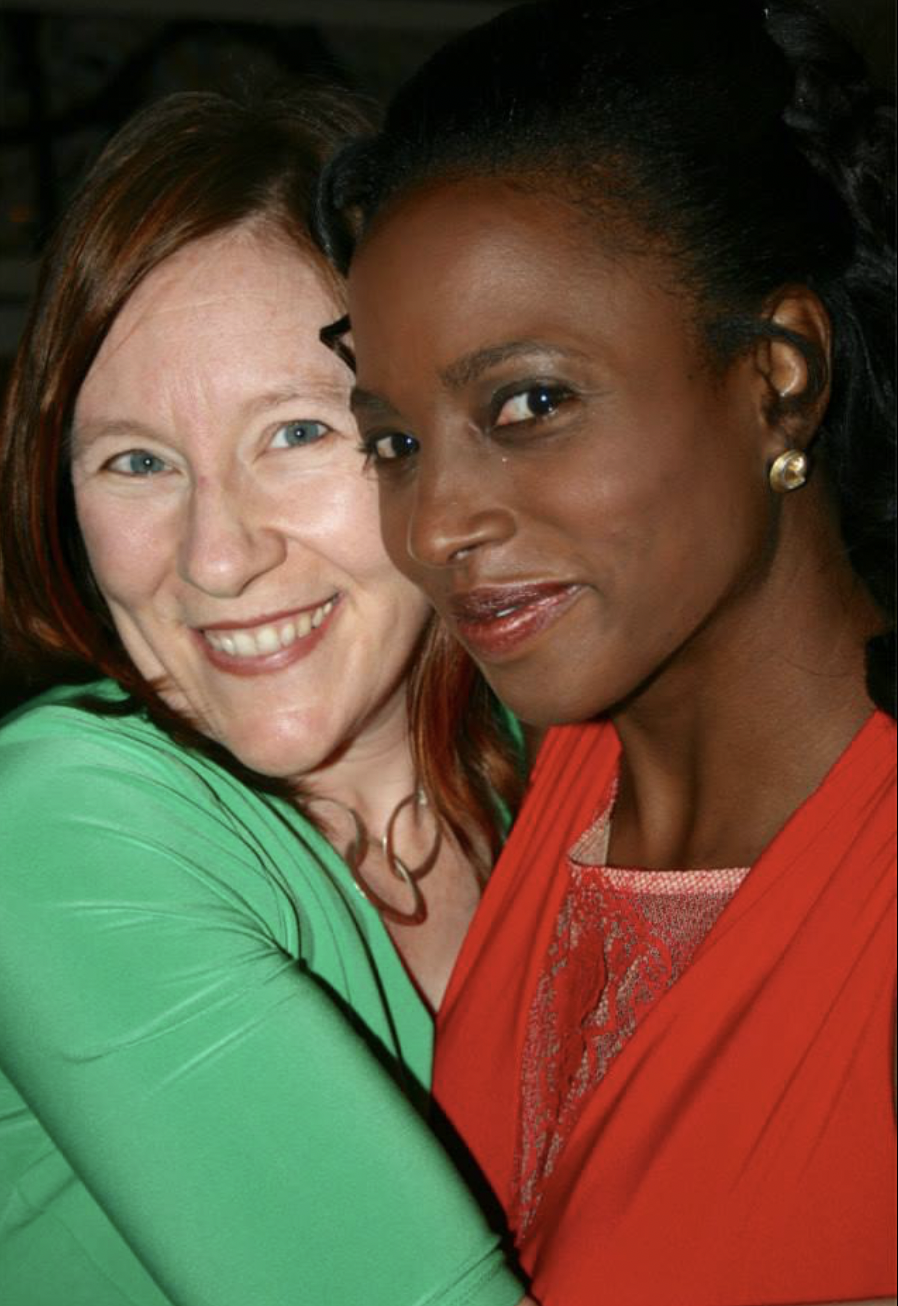
Michelle Cassandra Johnson is an author, activist, spiritual teacher, racial equity consultant, and intuitive healer. She is the author of six books, including Skill in Action and Finding Refuge. Amy Burtaine is a leadership coach and racial equity trainer. With Robin DiAngelo, she is the coauthor of The Facilitator's Guide for White Affinity Groups. For more, visit https://www.michellecjohnson.com/wisdom-of-the-hive.
Amy Burtaine is a leadership coach and racial equity trainer. Her trainings for meaningful social change include work with Google, the DNC, and the ACLU. With Robin DiAngelo, she is the coauthor of The Facilitator's Guide for White Affinity Groups.
Michelle Cassandra Johnson is an author, activist, spiritual teacher, racial equity consultant, and intuitive healer. She teaches workshops and leads retreats and transformative experiences nationwide. She is the author of six books, including Skill in Action and Finding Refuge.
There is a particular kind of tiredness that comes from trying to hold a fixed idea of who we are, year after year, as everything around us keeps changing anyway. David Whyte built an entire body of work around that tension, and Sounds True founder Tami Simon has called her conversation with him one of the most beloved episodes in Insights at the Edge history, still resonating with new listeners more than a decade after it first aired. Something about the way Whyte speaks, unhurried and image-rich, seems to reach people in exactly the season of life where old answers have quietly stopped working.
Sounds True has carried David Whyte’s poetry, prose, and audio programs for years because few voices manage to speak so plainly to both the individual soul and the modern workplace at once. His willingness to bring genuine poetry into rooms built for spreadsheets and quarterly targets reflects the same spirit our founder set out to preserve back in 1985: teaching captured in its own unscripted, living voice.
What follows traces the frontier Whyte describes between who we were and who we are becoming, how exile trains us for that edge, and why a Yorkshire poet ended up teaching creativity inside boardrooms at Boeing and American Express.
Key Takeaways:
Originality Has an Address: Learn why David Whyte locates creativity at the frontier of identity, not behind it.
Exile Is a Skill: Understand why Whyte treats feeling like an outsider as something to develop, not escape.
Poetry Enters the Boardroom: See how poetry and leadership intersect in Whyte’s decades of corporate work.
Originality Lives at the Edge, Not the Center
Whyte traces originality back to what he calls an edge identity, a frontier conversation that shows up across many of the world’s wisdom traditions. Reality itself, in his framing, is conversational rather than fixed, which means the self is never a finished project so much as an ongoing exchange with everything it meets.
Sounds True’s founder has described sitting with fourteen pages of notes on his teaching and underlining nearly every line, a reaction that says something about how differently Whyte approaches familiar questions of purpose and change, treating originality as a place a person stands rather than a trait they possess.
Rather than treating exile, the felt sense of not quite belonging, as a wound to heal, Whyte reframes it as a competency worth developing on purpose. Most people spend enormous energy trying to eliminate the feeling of being an outsider, whereas Whyte suggests the more useful move is to learn to work with it deliberately. A few ideas anchor this reframing:
Exile Sharpens Perception: Standing slightly outside a group often reveals what belonging obscures.
Competency, Not Condition: Whyte treats exile as a trainable skill rather than permanent exclusion.
Frontier Over Center: Growth tends to happen at edges, not in comfortable middles.
This distinction matters because it removes the shame often attached to feeling like an outsider. Instead of a problem to solve, exile becomes a vantage point worth returning to on purpose.
The Frontier of Identity as a Living Threshold
The frontier of identity, Whyte’s central image, is not a line crossed once and left behind. It is a threshold a person returns to repeatedly, every time old certainties no longer fit a new season of life. Whyte suggests that vulnerability, often treated as weakness, actually functions here as enhanced perception, a heightened sensitivity that lets a person notice what a settled identity tends to miss.
He describes reality itself as conversational, meaning the self is shaped less by fixed traits and more by an ongoing exchange with circumstances, relationships, and unexpected turns. Standing at this frontier repeatedly, rather than resolving it once, is what Whyte considers the actual work of a lived, honest life.
Poetry and Leadership: An Unlikely Partnership
Long before this conversation, Whyte had already built a second career inside corporate life, consulting for companies including Boeing, Kodak, and American Express. His bestselling book, The Heart Aroused, argued that corporations suffered from too little poetry and too little humanity, a critique that landed him on business bestseller lists rather than only poetry shelves. This pairing of poetry and leadership runs through nearly everything Whyte has written since, treating verse not as decoration for executives but as a discipline for genuine reflection.
Whyte has predicted that the very word manager will eventually give way to something more alive with possibility, a shift he sees poetry as uniquely equipped to prepare leaders for. Rather than offering leadership frameworks or checklists, his workshops use verse to slow a room down enough to notice what usual business language tends to skip over entirely.
Work as Pilgrimage: Whyte frames a career less as a task list and more as a journey of identity.
Burnout Reconsidered: He suggests exhaustion can signal a need for renewal, not simple failure.
Conversational Leadership: Genuine leadership, in his view, requires ongoing dialogue, not fixed authority.
Tapping the Invisible Support That Surrounds Us
Whyte closes much of his teaching on a note of quiet reassurance: that unseen support often surrounds a person exactly when they feel most exposed at the frontier of their own becoming. Recognizing this support, rather than assuming isolation, changes how a person approaches uncertainty, whether it shows up as a career change, a creative block, or a simple shift in how someone sees themselves.
Where Poetry Meets Everyday Attention
Whyte often describes a good poem as revelatory, something that takes hold of a reader and surprises them into new understanding rather than confirming what they already believed. This distinction matters for how he teaches: poetry, in his hands, is not a retreat from ordinary life but a way of paying closer attention to it. A single well-chosen image, he suggests, can reorganize how someone relates to a problem that logic alone has failed to move.
Final Thoughts
David Whyte’s teaching never promises a finished self waiting somewhere ahead. It offers something steadier: the frontier itself as home ground, revisited again and again across a lifetime of work and relationship. What makes this conversation endure, more than a decade after it first aired, may be exactly that refusal to offer a tidy arrival point.
Sounds True keeps returning to this conversation because it captures exactly what our mission asks of us, waking up to the edges we usually try to avoid rather than the comfortable center we think we want.
If Whyte’s words found you today, his fuller catalog of poetry and prose is waiting to keep the conversation going, one frontier at a time.
Frequently Asked Questions About David Whyte
Who is David Whyte?
He is a Yorkshire-born poet, author, and Fortune 500 consultant known for blending poetry with leadership.
What Sounds True programs feature David Whyte?
Sounds True has released Clear Mind, Wild Heart and What to Remember When Waking with David Whyte.
Does David Whyte only write poetry?
No, he has also authored prose books, including Crossing the Unknown Sea and The Heart Aroused.
What companies has Whyte worked with as a consultant?
He has led workshops at Boeing, Kodak, American Express, and Bristol-Myers Squibb, among others.
What podcast features this conversation with Whyte?
It appears on Insights at the Edge, hosted by Sounds True founder Tami Simon.
Is this conversation relevant outside creative fields?
Yes, Whyte’s ideas on identity and leadership apply broadly across careers, relationships, and life stages.
Where can I explore more spiritual teachers like David Whyte?
Visit our All Teachers & Authors page to browse voices across many traditions and disciplines.
Does Sounds True offer related content on purpose and vocation?
Yes, related titles appear throughout our Conscious Business and Spirituality & Awakening collections.
Michelle Cassandra Johnson is an author, activist, spiritual teacher, racial equity consultant, and intuitive healer. She is the author of six books, including Skill in Action and Finding Refuge. Amy Burtaine is a leadership coach and racial equity trainer. With Robin DiAngelo, she is the coauthor of The Facilitator’s Guide for White Affinity Groups. For more, visit https://www.michellecjohnson.com/wisdom-of-the-hive.
Most people come to meditation looking for a break, a few quiet minutes away from a world that rarely slows down on its own. Reverend angel Kyodo williams spends much of this conversation gently taking apart that assumption, suggesting that real stillness was never about leaving the world behind at all. It’s a small shift in framing that ends up changing everything about how the rest of her teaching lands.
Rev. angel is an ordained Zen priest, activist, and founder of the Center for Transformative Change, recognized as the world’s second female Zen teacher of African descent and the author of Being Black and Radical Dharma.
Sounds True has featured her teaching across our Meditation Summit and A Year of Mindfulness precisely because she refuses to separate inner practice from outer justice, treating the two as a single continuous act rather than competing priorities. What follows traces her case for a warrior spirit built on presence rather than escape, and the meditation practice she offers as its foundation.
Key Takeaways:
Retreat Isn’t the Goal: Learn why angel Kyodo williams reframes meditation as engagement, not escape.
Effort Meets Release: Understand the meditation practice she developed for people doing social change work.
A Different Kind of Fearlessness: See what warrior spirit means when it’s rooted in love rather than force.
Retreat Is Not What It Looks Like From Outside
Rev. angel opens by naming something many practitioners feel but rarely say aloud: the pull toward meditation often comes wrapped in a longing to retreat from an overwhelming world. She doesn’t dismiss that longing, but she does redirect it, suggesting that genuine practice engages our inner fullness rather than fleeing from outer noise. What looks like withdrawal from the outside, she argues, is closer to a deepening than a departure, a distinction that reframes the entire purpose of sitting down to practice in the first place.
Effort and Release Meditation: A Practice Born From Movement Work
Rev. angel developed a specific meditation practice she calls Effort and Release after years spent working alongside people doing demanding social change work. The practice blends deliberate effort with intentional letting go, addressing a pattern she noticed constantly among activists and organizers: a strong pull toward doing, accomplishing, and pushing that rarely leaves room for rest. She describes meditation and social change as inseparable, since the way a person relates to their own mind directly shapes what they find themselves willing to engage with in the wider world.
Naming the Pattern: Many changemakers carry a constant urgency that outlasts any single campaign, even during rest.
Effort With Purpose: The practice doesn’t reject action, only unconscious, exhausting overdrive.
Release as Skill: Letting go is treated as an active discipline, not passive collapse or avoidance.
Inner Life and Outer World as One Continuous Fabric
A central thread running through Rev. Angel’s teaching rejects any hard line between internal awareness and external action. She describes our self-talk, the noise level of our minds, and our capacity for presence as directly shaping how we show up for others and what we find acceptable in the wider world. This isn’t a metaphor for her; it’s closer to a working principle behind everything she teaches, from meditation instruction to movement strategy.
What we tolerate in the world outside us, she suggests, tends to trace directly back to what we’ve grown accustomed to tolerating within our own minds first, which is why she treats internal clarity as a precondition for meaningful external change rather than a separate, optional pursuit.
Warrior Spirit Rooted in Fearlessness, Not Force
The phrase “warrior spirit,” drawn from her earlier book Being Black, describes something quite different from combativeness or aggression directed outward at the world. For Rev. Angel, this spirit is built on truth-telling and responsibility, a foundation for genuine happiness rather than a posture of defensiveness. It asks practitioners to stay engaged with difficulty, including the difficulty of racism, patriarchy, and other inherited harms, rather than looking away or numbing out. This framing has resonated widely since the book’s original publication, offering readers across many backgrounds a way to hold fearlessness and tenderness together rather than treating them as opposites.
Truth Before Comfort: Warrior spirit requires naming what’s actually happening, even when it’s unwelcome.
Grace Alongside Fearlessness: Strength and tenderness are treated as complementary, not opposites.
Responsibility as Practice: Taking ownership of one’s own patterns becomes part of the discipline itself.
Bridging Personal Transformation and Collective Justice
Rev. angel has spent more than fifteen years shaping what she calls Transformative Social Change, a field built on the belief that lasting justice work requires equally serious inner work. She resists treating meditation as a private escape hatch separate from activism, instead framing contemplative practice as fuel for sustained, clear-eyed engagement with collective harm. Burnout among organizers, in her view, often stems from skipping this inner dimension entirely, treating stillness as optional rather than structural to the work itself. She has described this field as one she helped name and shape, watching it grow from a personal conviction into a recognized approach embraced across activist and spiritual communities alike.
What Radical Dharma Adds to This Conversation
Rev. Angel’s later book, Radical Dharma, co-written with Lama Rod Owens and Jasmine Syedullah, extends this same warrior spirit into a direct examination of race, love, and liberation within Buddhist communities themselves. The book argues that spiritual communities are not exempt from the patterns of harm found elsewhere in society, and that genuine awakening has to include an honest reckoning with those patterns rather than a spiritual bypass around them. This willingness to hold institutions, including her own tradition, accountable runs consistently through everything she teaches, from her earliest writing through her more recent contributions to Sounds True’s programming.
Final Thoughts
Reverend angel Kyodo williams doesn’t offer meditation as a rest stop from the world’s demands. She offers it as a training ground for staying present with those demands without losing ourselves inside them. That distinction, subtle but significant, may be exactly what separates spiritual bypass from spiritual maturity, and it’s the thread that ties her meditation teaching to her justice work without contradiction. Listeners who come looking for a quick escape often leave with something more durable instead: a practice for staying rooted precisely where things are hardest.
Sounds True continues sharing her teaching because our mission to wake up the world has never meant looking away from what’s hardest to face, and few teachers hold that tension as steadily as she does. Her books and audio programs remain in our library for anyone ready to bring the same steadiness into their own life and work.
Frequently Asked Questions About angel Kyodo williams
Who is Reverend angel Kyodo williams?
She is an ordained Zen priest, activist, author, and founder of the Center for Transformative Change.
What books has she written?
Her books include Being Black: Zen and the Art of Living with Fearlessness and Grace and Radical Dharma.
What is the Effort and Release practice?
A meditation method blending deliberate effort with intentional letting go, developed for activists and organizers.
Is this teaching only relevant to activists?
No, her ideas on presence and inner work apply to anyone navigating stress, urgency, or burnout in daily life.
What does warrior spirit mean in her teaching?
A fearless, truth-telling posture grounded in responsibility and grace, not aggression or combativeness.
Has Sounds True featured her in other programs?
Yes, she has appeared in Sounds True’s Meditation Summit and A Year of Mindfulness series.
What is the Center for Transformative Change?
An organization she founded connecting inner personal work with large-scale social transformation.
Where can I hear more conversations like this one?
Explore our Insights at the Edge Podcast for further interviews on mindfulness, justice, and social engagement.
Michelle Cassandra Johnson is an author, activist, spiritual teacher, racial equity consultant, and intuitive healer. She is the author of six books, including Skill in Action and Finding Refuge. Amy Burtaine is a leadership coach and racial equity trainer. With Robin DiAngelo, she is the coauthor of The Facilitator’s Guide for White Affinity Groups. For more, visit https://www.michellecjohnson.com/wisdom-of-the-hive.
Autism is so often described in terms of what seems to be missing: eye contact, small talk, the expected social rhythms most people move through without thinking. This two-part conversation asks a different question entirely: what if the very traits read as absence are actually signs of a deeper, more intense form of connection than most neurotypical people ever access. It’s a reframing that asks listeners to set aside a familiar deficit lens and try on a considerably more generous one.
Sounds True brought Guy Shahar and Dr. Melinda Edwards together for this special episode of our Being Open series precisely because both speak from lived experience rather than from clinical distance alone, one as a father and later as a self-identified autistic adult, the other as a psychiatrist and mother of an autistic daughter. Their combined perspective reflects something Sounds True has believed since 1985: that the most transformative teaching often comes from people who have lived the question, not simply studied it.
In this piece, we look at what each of them learned, how their perspectives echo and diverge, and what it might mean to depathologize neurodiversity rather than simply manage it.
Key Takeaways:
A Late Discovery: Learn how Guy Shahar found out at age forty-six that he is autistic himself.
Connection, Not Absence: Understand why Dr. Melinda Edwards challenges the idea that autism means disconnection.
Three Practical Keys: See the approach Shahar offers parents and caregivers for genuinely connecting.
A Conversation in Two Parts
This episode unfolds across two connected conversations, each offering a different vantage point on the same central idea. Guy Shahar, author of Transforming Autism, opens the discussion focused on parenting and connection.
Part Two: Dr. Edwards continues the conversation, focusing on the overlooked spiritual gifts and interconnection autism can reveal.
Guy Shahar: A Discovery That Reframed His Own Life
Shahar’s path into this work began with his son, whose autism led the family to unconventional and unusually effective treatments detailed in Transforming Autism. His son, once written off by parts of the medical establishment as severely disabled, went on to thrive in a mainstream school by age six, an outcome Shahar attributes to focusing on inherent strengths rather than symptom correction. What makes his perspective unusual is what came next: at age forty-six, Shahar discovered he was autistic himself, a revelation that suddenly explained decades of experiences he had never quite understood, from communication struggles to a persistent sense of not fitting expected molds.
This late discovery reshaped how Shahar approaches his own book’s central argument. Rather than treating autism as a problem requiring correction, Transforming Autism proposes understanding the inherent characteristics of autistic children and bringing out their natural strengths instead, a philosophy Shahar later carried into founding a charity dedicated to the same principle.
Autism Sensitivity: What Looks Like Withdrawal Often Isn’t
A central theme threading through both conversations is autism sensitivity, the idea that heightened perception, not deficit, sits at the core of many autistic experiences. What often reads to outside observers as withdrawal or overwhelm may actually reflect a nervous system taking in far more information than a typical environment accounts for.
Overwhelm as Overload: Shutdown often signals sensory flooding rather than disinterest in connection.
Intuitive Attunement: Many autistic children show unusual sensitivity to the emotional energy of people around them.
Idealism and Values: Shahar notes a strong pull toward altruism and idealistic values among many autistic individuals he has met.
Three Keys to Connecting with Autistic Children
Rather than offering another behavioral checklist, Shahar frames connection around three keys that emerged from years of trial, error, and eventual breakthrough with his own son:
Flexibility Over Correction: Meeting a child’s actual state rather than insisting on typical behavior first.
Play as a Bridge: Following a child’s own interests as the doorway into shared connection.
Presence Over Performance: Showing up authentically, since autistic children often sense forced or anxious energy quickly.
Dr. Melinda Edwards: Connection Where Others See Its Absence
Dr. Edwards approaches the same territory as both a psychiatrist and the mother of an autistic daughter, and her central claim reframes the entire conversation. Rather than reading her daughter’s symptoms as disconnection, Dr. Edwards has come to understand them as reflections of a connection so deep it exceeds what conventional language typically describes. Her clinical training and personal experience together let her speak to something rarely voiced this plainly: that autism may offer neurotypical people a glimpse of interconnection they have simply lost access to.
Dr. Edwards’s perspective carries particular weight because it bridges two worlds that don’t often speak to each other candidly: the clinical framework she was trained in and the lived reality of raising a daughter whose experience didn’t fit neatly into that framework. Rather than discarding one for the other, she has spent years holding both, letting each inform and complicate the other.
From Anxiety to Faith
Both guests describe a similar arc within their own families: an initial period defined by anxiety, fear about diagnosis, fear about the future, gradually giving way to something closer to faith. This shift doesn’t erase real challenges, but it does change how those challenges are met, with curiosity rather than dread, and with trust that difficulty can carry its own unexpected gift.
Shahar describes this shift as one of the hardest and most necessary parts of his own journey, since fear tends to narrow attention exactly when openness is most needed. Faith, in the way both guests use the term, isn’t about certainty that things will turn out fine. It’s closer to a willingness to stay present with a child, or with oneself, without needing to fix everything first.
Spiritual Gifts and Evolutionary Guides
One of the more striking claims in this conversation is the idea that autistic individuals may serve as spiritual and evolutionary guides for the wider human community. Rather than framing this as a burden placed on autistic people to be exceptional, both guests present it as an invitation for neurotypical listeners to notice qualities, sensitivity, intuitive attunement, and resistance to social pretense that the broader culture has undervalued for generations.
Final Thoughts
Guy Shahar and Dr. Melinda Edwards offer something rarer than advice: two honest accounts of watching a label reorganize itself into something closer to reverence. Neither pretends the path is simple, but both suggest that sensitivity itself, so often treated as a burden, may be the very quality worth protecting and learning from. What lingers longest from this conversation may be the quiet suggestion that connection was never actually missing, only expressed in a register most of us were never taught to hear.
Sounds True shares conversations like this one because waking up the world sometimes means waking up to the people already sitting closest to us. If this conversation moved you, Guy Shahar’s book and the broader Being Open series carry it further.
Frequently Asked Questions About Guy Shahar
Who is Guy Shahar?
He is the author of Transforming Autism and co-founder of a charity supporting autistic children and their families.
When did Guy Shahar learn he was autistic?
He discovered his own autism at age forty-six, years after his son’s diagnosis.
What is the Being Open podcast series?
A special Insights at the Edge series exploring connection, consciousness, and openness across different life experiences.
Is Dr. Melinda Edwards a parent of an autistic child?
Yes, she is a psychiatrist and the mother of an autistic daughter, informing her perspective directly.
Does this conversation offer parenting techniques?
Yes, Shahar outlines three practical keys for connecting more effectively with autistic children.
What is Transforming Autism about?
It follows Shahar’s family journey as they support their son and reframes autism around inherent strengths.
Where can I find more Sounds True content on neurodiversity?
Related conversations continue throughout our Insights at the Edge Podcast archive and Relationships collection.
Is this conversation only relevant to parents?
No, its themes of sensitivity and connection speak to caregivers, clinicians, and curious listeners alike.
Michelle Cassandra Johnson is an author, activist, spiritual teacher, racial equity consultant, and intuitive healer. She is the author of six books, including Skill in Action and Finding Refuge. Amy Burtaine is a leadership coach and racial equity trainer. With Robin DiAngelo, she is the coauthor of The Facilitator’s Guide for White Affinity Groups. For more, visit https://www.michellecjohnson.com/wisdom-of-the-hive.
Is a spiritual awakening only real if it completely rearranges your life? That’s the question Tami Simon puts to Adyashanti in this episode, and his answer digs into something a lot of seekers wrestle with: the gap between a powerful glimpse of clarity and the ongoing work of actually living from it.
Adya, the American-born teacher behind books like The End of Your World and Falling into Grace, walks through why those temporary tastes of awakening are real, even when they fade, and offers a surprisingly practical way to hold onto what they revealed without grasping at them. Then he does something rare: he tells the story of his own first major awakening, a moment he describes as feeling like a nuclear explosion going off inside him.
Here’s what we cover:
Why a fleeting shift still counts as a real awakening, even if it doesn’t stick
The two (seemingly contradictory) pieces of advice Adya gives people chasing a past peak experience
How the first awakening can feel like a “freebie,” while everything after asks you to participate consciously
Adya’s own account of the night everything fell away and the still, small voice that told him, “This isn’t all of it. Keep going.”
What if the antidote to a world coming apart isn’t a bigger plan, but a smaller, daily act of devotion?
This week, Tami Simon speaks with Tracee Stanley—teacher of yoga nidra, meditation, and self-inquiry, founder of Empowered Life Circle, and author of the new Sounds True book Living Ritual: Infuse Each Day with Purpose and Spirit—about why ritual may be the most important practice we have during what she calls threshold times.
Join Tami and Tracee to explore:
The threshold question at the heart of ritual: what within me is dying, and what is waiting to be born?
Why devotion, not discipline, is the doorway—and how to weave practice through an ordinary householder’s day without shame
Tracee’s shard of light in Cape Town, and the years it took to find language for it
The body as shrine: the origins of yoga nidra in nyasa, the ancient practice of anointing the body as a divine temple
Earth dreaming—lying on the land and letting the land dream through you
Her reframe of the four Purusharthas, turning prosperity into support and pleasure into relationship
Sankalpa as a vow that leads to dharma, not a manifestation wish list
The analog cocoon and the night school: reclaiming sleep and dream time from the phone
Why enlightenment may be less a permanent state than a moment available in the space between two breaths
Tracee also speaks candidly about walking away from a successful film career, and what a surgery taught her about the ego that refuses to let the body rest.
Tracee opens and closes this interview with a short guided ritual you can practice along with.
Listen now, and let something be reshaped. →
This conversation offers genuine transmission, not just concepts about awakening, but the palpable presence of realized teachers exploring the growing edge of spiritual understanding together, and it originally aired on Sounds True One.
Most people come to meditation looking for a break, a few quiet minutes away from a world that rarely slows down on its own. Reverend angel Kyodo williams spends much of this conversation gently taking apart that assumption, suggesting that real stillness was never about leaving the world behind at all. It’s a small shift in framing that ends up changing everything about how the rest of her teaching lands.
Rev. angel is an ordained Zen priest, activist, and founder of the Center for Transformative Change, recognized as the world’s second female Zen teacher of African descent and the author of Being Black and Radical Dharma.
Sounds True has featured her teaching across our Meditation Summit and A Year of Mindfulness precisely because she refuses to separate inner practice from outer justice, treating the two as a single continuous act rather than competing priorities. What follows traces her case for a warrior spirit built on presence rather than escape, and the meditation practice she offers as its foundation.
Key Takeaways:
Retreat Isn’t the Goal: Learn why angel Kyodo williams reframes meditation as engagement, not escape.
Effort Meets Release: Understand the meditation practice she developed for people doing social change work.
A Different Kind of Fearlessness: See what warrior spirit means when it’s rooted in love rather than force.
Retreat Is Not What It Looks Like From Outside
Rev. angel opens by naming something many practitioners feel but rarely say aloud: the pull toward meditation often comes wrapped in a longing to retreat from an overwhelming world. She doesn’t dismiss that longing, but she does redirect it, suggesting that genuine practice engages our inner fullness rather than fleeing from outer noise. What looks like withdrawal from the outside, she argues, is closer to a deepening than a departure, a distinction that reframes the entire purpose of sitting down to practice in the first place.
Effort and Release Meditation: A Practice Born From Movement Work
Rev. angel developed a specific meditation practice she calls Effort and Release after years spent working alongside people doing demanding social change work. The practice blends deliberate effort with intentional letting go, addressing a pattern she noticed constantly among activists and organizers: a strong pull toward doing, accomplishing, and pushing that rarely leaves room for rest. She describes meditation and social change as inseparable, since the way a person relates to their own mind directly shapes what they find themselves willing to engage with in the wider world.
Naming the Pattern: Many changemakers carry a constant urgency that outlasts any single campaign, even during rest.
Effort With Purpose: The practice doesn’t reject action, only unconscious, exhausting overdrive.
Release as Skill: Letting go is treated as an active discipline, not passive collapse or avoidance.
Inner Life and Outer World as One Continuous Fabric
A central thread running through Rev. Angel’s teaching rejects any hard line between internal awareness and external action. She describes our self-talk, the noise level of our minds, and our capacity for presence as directly shaping how we show up for others and what we find acceptable in the wider world. This isn’t a metaphor for her; it’s closer to a working principle behind everything she teaches, from meditation instruction to movement strategy.
What we tolerate in the world outside us, she suggests, tends to trace directly back to what we’ve grown accustomed to tolerating within our own minds first, which is why she treats internal clarity as a precondition for meaningful external change rather than a separate, optional pursuit.
Warrior Spirit Rooted in Fearlessness, Not Force
The phrase “warrior spirit,” drawn from her earlier book Being Black, describes something quite different from combativeness or aggression directed outward at the world. For Rev. Angel, this spirit is built on truth-telling and responsibility, a foundation for genuine happiness rather than a posture of defensiveness. It asks practitioners to stay engaged with difficulty, including the difficulty of racism, patriarchy, and other inherited harms, rather than looking away or numbing out. This framing has resonated widely since the book’s original publication, offering readers across many backgrounds a way to hold fearlessness and tenderness together rather than treating them as opposites.
Truth Before Comfort: Warrior spirit requires naming what’s actually happening, even when it’s unwelcome.
Grace Alongside Fearlessness: Strength and tenderness are treated as complementary, not opposites.
Responsibility as Practice: Taking ownership of one’s own patterns becomes part of the discipline itself.
Bridging Personal Transformation and Collective Justice
Rev. angel has spent more than fifteen years shaping what she calls Transformative Social Change, a field built on the belief that lasting justice work requires equally serious inner work. She resists treating meditation as a private escape hatch separate from activism, instead framing contemplative practice as fuel for sustained, clear-eyed engagement with collective harm. Burnout among organizers, in her view, often stems from skipping this inner dimension entirely, treating stillness as optional rather than structural to the work itself. She has described this field as one she helped name and shape, watching it grow from a personal conviction into a recognized approach embraced across activist and spiritual communities alike.
What Radical Dharma Adds to This Conversation
Rev. Angel’s later book, Radical Dharma, co-written with Lama Rod Owens and Jasmine Syedullah, extends this same warrior spirit into a direct examination of race, love, and liberation within Buddhist communities themselves. The book argues that spiritual communities are not exempt from the patterns of harm found elsewhere in society, and that genuine awakening has to include an honest reckoning with those patterns rather than a spiritual bypass around them. This willingness to hold institutions, including her own tradition, accountable runs consistently through everything she teaches, from her earliest writing through her more recent contributions to Sounds True’s programming.
Final Thoughts
Reverend angel Kyodo williams doesn’t offer meditation as a rest stop from the world’s demands. She offers it as a training ground for staying present with those demands without losing ourselves inside them. That distinction, subtle but significant, may be exactly what separates spiritual bypass from spiritual maturity, and it’s the thread that ties her meditation teaching to her justice work without contradiction. Listeners who come looking for a quick escape often leave with something more durable instead: a practice for staying rooted precisely where things are hardest.
Sounds True continues sharing her teaching because our mission to wake up the world has never meant looking away from what’s hardest to face, and few teachers hold that tension as steadily as she does. Her books and audio programs remain in our library for anyone ready to bring the same steadiness into their own life and work.
Frequently Asked Questions About angel Kyodo williams
Who is Reverend angel Kyodo williams?
She is an ordained Zen priest, activist, author, and founder of the Center for Transformative Change.
What books has she written?
Her books include Being Black: Zen and the Art of Living with Fearlessness and Grace and Radical Dharma.
What is the Effort and Release practice?
A meditation method blending deliberate effort with intentional letting go, developed for activists and organizers.
Is this teaching only relevant to activists?
No, her ideas on presence and inner work apply to anyone navigating stress, urgency, or burnout in daily life.
What does warrior spirit mean in her teaching?
A fearless, truth-telling posture grounded in responsibility and grace, not aggression or combativeness.
Has Sounds True featured her in other programs?
Yes, she has appeared in Sounds True’s Meditation Summit and A Year of Mindfulness series.
What is the Center for Transformative Change?
An organization she founded connecting inner personal work with large-scale social transformation.
Where can I hear more conversations like this one?
Explore our Insights at the Edge Podcast for further interviews on mindfulness, justice, and social engagement.
Michelle Cassandra Johnson is an author, activist, spiritual teacher, racial equity consultant, and intuitive healer. She is the author of six books, including Skill in Action and Finding Refuge. Amy Burtaine is a leadership coach and racial equity trainer. With Robin DiAngelo, she is the coauthor of The Facilitator’s Guide for White Affinity Groups. For more, visit https://www.michellecjohnson.com/wisdom-of-the-hive.