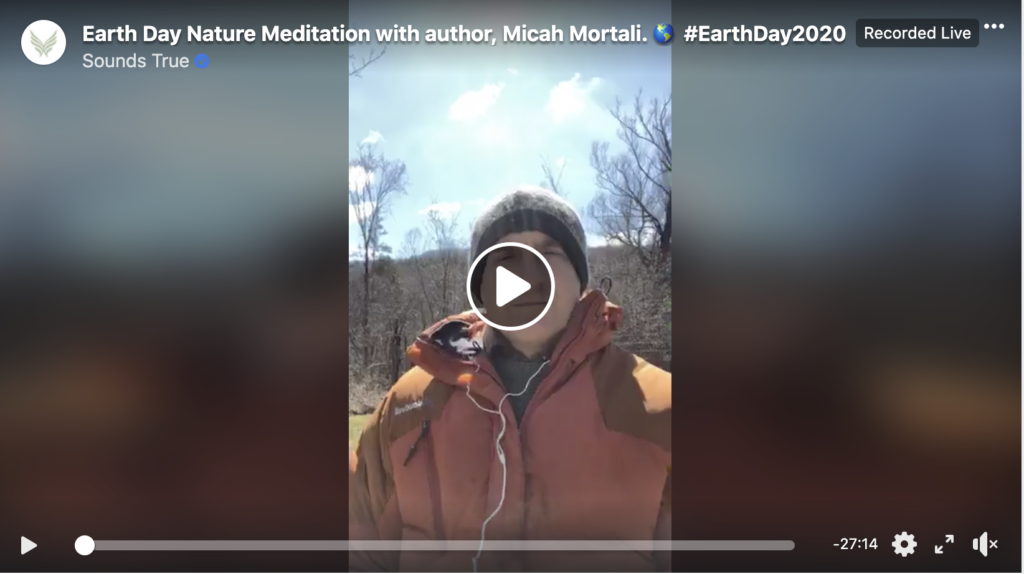
With many people home-bound, we may need to get creative in seeking ways to connect with the natural world. Sitting by an open window is one excellent practice for connecting with the outdoors, and it can be a powerful form of nature meditation as well.
“What is life? It is the flash of a firefly in the night. It is the breath of a buffalo in the wintertime. It is the little shadow which runs across the grass and loses itself in the sunset.”
Crowfoot, Orator of the Blackfoot Confederacy
Find a comfortable seat by an open window that looks outdoors.
Morning, during the dawn chorus when birds are most active, can be a perfect time to enjoy your morning coffee or tea as you observe a new day emerge.
Set an intention to stay present, letting go of thoughts or stories in your mind as they arise, and instead focusing your attention on whatever is fascinating in your environment.
Sit for at least 15-30 minutes if you can. Practice regularly to help alleviate stress, increase your sense of connection with your local environment, and awaken your senses.
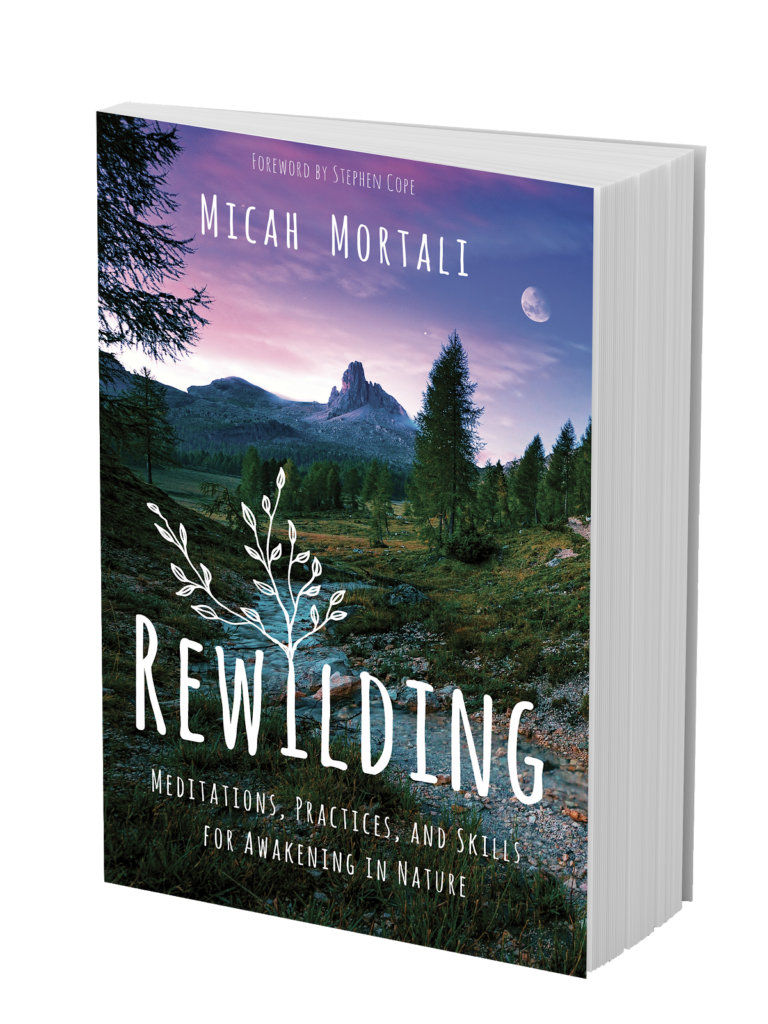
Micah Mortali is director of the Kripalu Schools, one of the largest and most established centers for yoga-based education in the world. An avid outdoorsman, mindful wilderness guide, 500-hour Kripalu yoga teacher, and popular meditation teacher, Mortali has been leading groups in wilderness and retreat settings for 20 years. In 2018, he founded the Kripalu School of Mindful Outdoor Leadership. Mortali has a passion for helping people come home to themselves and the earth, and he is finishing his Master’s at Goddard College on nature awareness and mindfulness practices. He lives with his wife and children in the Berkshires. For more, visit kripalu.org.
Establishing a place for regular outdoor meditation and nature observation is often referred to as a “sit spot” or “medicine spot”. Like the Buddha, who found his own tree of awakening, we too can go to nature and practice being awake to the reality of the present moment. This practice can also help us become more intimate with all the qualities of the land we live with.
“If one day I see a small bird and recognize it, a thin thread will form between me and that bird. If I just see it but don’t really recognize it, there is no thin thread. If I go out tomorrow and see and really recognize that same individual small bird again, the thread will thicken and strengthen just a little. Every time I see and recognize that bird, the thread strengthens. Eventually it will grow into a string, then a cord, and finally a rope. This is what it means to be a Bushman. We make ropes with all aspects of the creation in this way.”
San bushman
Guided Sit Spot Practice
Go to a place in nature that is close to where you live and that you can visit regularly.
Take a few moments to center yourself, breathing in and out, and arriving fully in the present moment.
As you are ready begin to walk mindfully with an intention to find a spot that calls out to you, a place you can sit and deepen your relationship with this place. The spot should feel welcoming, safe and comfortable. It could be under a tree, beside a boulder or in an open space. Often, east facing spots can be nice for early morning sits.
When you find a spot that feels good, in your own way, ask permission of that place and wait to see what comes to you. If you feel invited, sit. If not, keep looking.
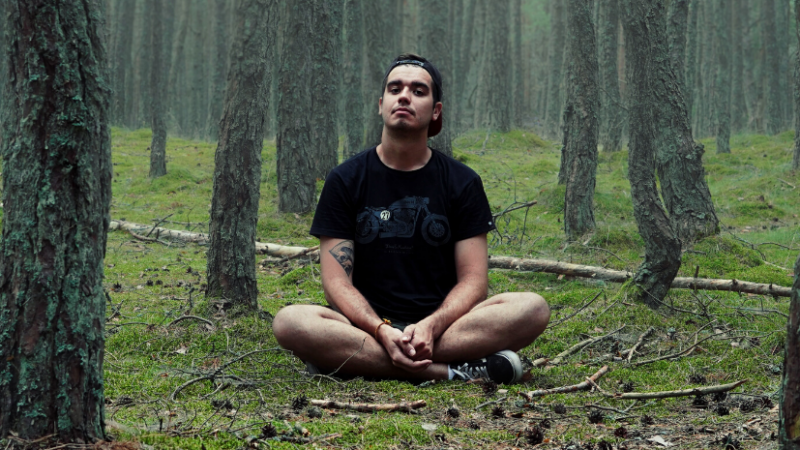
Once in your spot, sit comfortably and become as still as you can. Imagine that you are melting into the earth, becoming a part of the land. Sit for at least 15-30 minutes, noticing any movement, sounds, or other sensations and activities.
With many people home-bound, we may need to get creative in seeking ways to connect with the natural world. Sitting by an open window is one excellent practice for connecting with the outdoors, and it can be a powerful form of nature meditation as well.
“What is life? It is the flash of a firefly in the night. It is the breath of a buffalo in the wintertime. It is the little shadow which runs across the grass and loses itself in the sunset.”
Crowfoot, Orator of the Blackfoot Confederacy
Find a comfortable seat by an open window that looks outdoors.
Morning, during the dawn chorus when birds are most active, can be a perfect time to enjoy your morning coffee or tea as you observe a new day emerge.
Set an intention to stay present, letting go of thoughts or stories in your mind as they arise, and instead focusing your attention on whatever is fascinating in your environment.
Sit for at least 15-30 minutes if you can. Practice regularly to help alleviate stress, increase your sense of connection with your local environment, and awaken your senses.
Many years ago, a bear sat down next to me while I was meditating in the woods. It was an afternoon in mid-October in the Berkshires, and I had been mountain biking in my favorite preserve. I took a break from riding to enjoy the perfect fall afternoon. I was overflowing with gratitude. My life was going well.
I sat under a strong oak tree and closed my eyes. I asked Spirit to come and sit with me, to share in my heartfelt thanksgiving. I spoke the words aloud and immediately heard footsteps in the woods behind me. They got closer, but I continued with my meditation, until directly behind me, I heard a twig snap and a loud exhalation through a very big nose. I knew in that moment, in every cell of my body, that a bear was behind me.
My heart pounded, and adrenaline surged through my body. I was totally alert and aware. I very slowly turned my head to look behind me and saw shining black fur from shoulder to rump, close enough to reach out and touch. It was a large black bear. Immediately my mind provided options for survival. Get up and run away? Get up and yell to scare the bear away? Climb a tree? Those ideas seemed bad. Sit still, do nothing, and breathe? Yes, that made sense. And so I did. I slowed my breathing and meditated on the intensity of my body’s response to this perceived threat.
In my yoga I had learned that strong sensations and emotions, including fear, can be powerful doorways into meditation. Rather than turning away from an uncomfortable experience, I had learned to breathe into what I was feeling. In this case, the fight-or-flight response was a huge wave washing over my mind, body, and soul. Instead of making a big story about what was happening, I remembered to face the experience in all of its raw power. I had the thought, This is the coolest thing that has ever happened to me! I had another thought, too: This might be the worst thing that has ever happened to me! Many hundreds of hours, I had practiced breathing through the intense sensations of yoga postures, watching my experience without reaction and allowing things to be the way they are. All that training on the mat was now being put to the test in a pose I had never tried before, Bear Pose, or Ursasana.
For a moment, I wondered how it might feel to be bitten by a bear. That was not a helpful thought, so I returned to my breathing. Moments seemed to stretch into hours. The bear walked out from behind the tree and sat next to me. It was smelling me. Still I remained motionless. In time, the bear walked away. I turned to look as it walked away. It turned to look back at me. Our eyes met, and then it disappeared down the hill. I stood up and fell down, my legs weak and wobbly. I stood again and got to my bike. I climbed on board and pedaled out of those woods like a bat out of hell!
For days, I was in a state of profound shock and elation. My life was filled with magic, possibility, and power. Anything could happen. I felt incredibly alive. The presence of the bear stayed with me—even to this day. I have never been a thrill seeker or adrenaline junkie. I’ve never jumped out of an airplane or tried bungee jumping. I’ve always been drawn to more meditative outdoor activities, like canoeing, archery, or watching birds. But sitting in meditation with a bear gave me an unexpected adrenaline jolt.
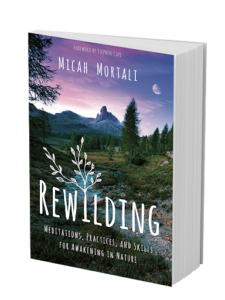
While sitting with a bear is not likely to happen to many people, you may encounter other life-forms or elements that can help you awaken and experience a greater degree of aliveness. We long for connection with our relatives who roam the forests and wildlands, and we still find nourishment in their company. In mindful rewilding, we open ourselves up to the sensations and life-giving experiences that the land holds for us. Such moments of communion between you and the living earth can open doorways into a more magical, mysterious, and meaningful life. And it makes all the difference to have the right mental tools and preparation to help you ride the waves of powerful energies you will encounter in both the human and the more-than-human worlds.
When sitting with that bear, I used a technique we lovingly call “BRFWA”: Breathe, Relax, Feel, Watch, and Allow. You might use BRFWA on your first walk in a park or a wood that is new to you. You might use it during your first solo camping experience or when you see an animal that frightens you. I once used BRFWA when I got caught in a rip current while swimming off the Big Island of Hawaii. It allowed me to remain calm and to act skillfully, possibly saving my life. In any survival situation, the first advice is almost always to remain calm and think, not to react or panic. But how we are supposed to do that is not often explained.
By practicing mindful rewilding, you are not looking to put yourself in a survival situation, though many of these skills can help you feel more confident and capable when you’re away from the conveniences of modern society. Inevitably, the more time we spend outdoors, the more likely we are to come up against our comfort zone or find ourselves in a situation where remaining calm and being skillful are necessary. In these moments, BRFWA can be a great ally.
I recommend that you use BRFWA regularly as a moment-to-moment practice. Using it daily will support your developing a general state of mindfulness. You can also use BRFWA to go deeper into a pleasant experience. Maybe you practice it when you take a walk or when you dip your feet in a cool stream or when you feel a fresh breeze moving through your neighborhood. Practice BRFWA regularly so that when something truly challenging happens, it is second nature for you, as it was for me when I had my encounters with the bear and the rip current.
BRFWA: Breathe, Relax, Feel, Watch, Allow
To begin working with BRFWA outdoors, try the following steps:
Go outside. Find a place where you can sit comfortably and have a view of a natural, outdoor space. (This might also be the place where you want to establish your daily nature meditation.)
Get grounded. Feel your sitz bones and imagine they are plugging in to the earth. As you ground down through your seat, also lengthen your spine and let it rise up through the crown of your head. Imagine that your spine is the trunk of a great tree and you are the bridge that connects the heavens and the earth.
Breathe. Soften your belly, and slowly deepen your breathing with each inhalation and exhalation. If possible, breathe in and out through the nose. A good ratio for this breath is to inhale for four counts and hold the breath gently for seven counts; then exhale for eight counts, and repeat the cycle. As you breathe, notice the qualities of the air. What is the temperature? Is it hot, cold, or somewhere in between? How moist or dry is the air? What can you smell? Leaves, pine needles, the smoke from nearby fireplaces? In which direction is the wind moving? What can you hear? Your breath, your heartbeat, your joints settling? Branches creaking against each other, leaves rustling in the breeze, dew dripping to the ground, chipmunks or squirrels scampering, crows cawing, pigeons cooing, an airplane passing overhead?
Relax. As you breathe, begin to consciously scan your body. Notice any places where you are holding tension. Focus on each of these places, as you continue to breathe calmly and deeply, and invite these places to soften and let go. Maybe your forehead is tense, and your brow is furrowed. Maybe your shoulders are tight and raised with tension. Perhaps your jaw is clenched. See if you can allow your jaw to relax, so that your teeth are parted. Invite your tongue to sit heavy and relaxed in your mouth, with the tip of the tongue resting against the ridge of skin behind your two front top teeth. With each exhalation, feel tension melting out of your body, mind, and spirit. Relax into the support of the earth element. Feel the earth beneath you and within your bones and muscles.
Feel. As you continue to breathe and relax, notice what you can feel. Notice your body and what your body can feel—the air on your skin, the earth against your buttocks and legs, the light on your skin or coming through your clothing. Notice your heart and how you are feeling right now, not from a place of judgment, but from a place of compassion for yourself, and from a larger perspective, from your witness. Notice how the breath moving in and out helps you to feel more. This is one of the great secrets of yoga: the more deeply you breathe, the more of your own life you can feel.
Watch. Be the witness. Observe your experience and allow as much space as you can for whatever is happening to be the way it is. Simply observe the land around you. Notice movement wherever it may be. Watch the play of light and the subtle movement created by the atmosphere’s constant state of motion. Watch everything, and be curious about any life you see, whether birds in the bushes or trees, ants crawling on the ground, or a squirrel leaping from limb to limb. When you come into the present moment using these steps, doors of perception will open to you. You will see the world through new eyes.
Allow. Let it be. Let the moment be exactly the way that it is. Let go of grasping to your idea of what this moment should be. Let go of any aversion to things as they are. See if you can simply allow this moment to be as it is, and give yourself the opportunity to experience this moment right now in its pure expression. No matter the weather, no matter the terrain, can you allow this living earth and your relationship with it to be the way that it is? Moment by moment, can you keep letting go of your opinions, preferences, and judgments? It’s not easy for any of us, which is why we practice. This awareness is something to come back to moment after moment after moment, always beginning again.
How do you hold true to your convictions to be good in a world that’s on fire?
This week, Tami Simon speaks with Lodro Rinzler—Buddhist meditation teacher, founder of the Basic Goodness Collective, and author of seven books including the international bestseller The Buddha Walks into a Bar—about his new book, You Are Good. You Are Enough: Free Yourself from the Trap of Doubt and Return to Basic Goodness. Together, they move through the book’s three arcs: seeing the goodness in ourselves, in others, and in society itself.
Join Tami and Lodro to explore:
The concept of basic goodness—what it actually means, where it comes from in the Tibetan Buddhist tradition, and why you don’t have to be a Buddhist to recognize it in yourself
How capitalism profits from the lie of not-enoughness—and what it would mean to collectively stop believing it
The “trap of doubt”: that insidious inner voice that keeps us striving, comparing, and withholding self-acceptance
How to extend compassion toward people who drive us crazy—including world-threatening politicians—without excusing harm or collapsing into Pollyanna thinking
The parrot and the forest fire: a jataka tale about what it means to name what’s broken and show up anyway
Chögyam Trungpa Rinpoche’s teaching that seeing the phenomenal world as sacred is “the first and last practice of all”
A closing guided meditation to help listeners touch basic goodness in their own direct experience
Whether you’ve been carrying shame for decades or are simply exhausted by a world that feels on fire, Lodro offers something rare: not a pep talk, but a genuine shift in view.
Listen now and find your way back to what was always there. →
This conversation offers genuine transmission—not just concepts about awakening, but the palpable presence of realized teachers exploring the growing edge of spiritual understanding together. Originally aired on Sounds True One.
Meditation is often understood as a way to find calm by turning inward. Yet for many people, that inward focus can feel overwhelming instead of grounding. The body may tighten, emotions may rise quickly, or the mind may feel harder to settle. These responses are not a sign of failure. They reflect how the nervous system holds and processes past experiences. Trauma sensitive mindfulness offers a way to approach awareness with more care, allowing space for safety, pacing, and choice.
At Sounds True, we have spent decades sharing the living wisdom of teachers who speak to real human experience with honesty and depth. Through voices like Elizabeth Stanley, we bring forward teachings that integrate science, mindfulness, and compassion, offering practices that support meaningful and lasting inner growth.
Here, we look at trauma sensitive mindfulness through Elizabeth Stanley’s perspective, including why meditation is not always enough and how a more supportive approach can help.
Key Takeaways:
Nervous System Awareness: Trauma sensitive mindfulness centers on regulating the body, not just observing thoughts
Flexible Practice: Meditation can include movement, choice, and external focus to support safety
Healing Approach: Awareness becomes effective when paired with pacing, care, and nervous system support
What Is Trauma Sensitive Mindfulness and How It Differs from Traditional Mindfulness
Trauma sensitive mindfulness begins with a simple truth. The present moment does not feel safe for everyone. Turning inward can bring up intense sensations or emotions, and traditional mindfulness does not always account for how trauma shapes this experience.
This approach offers a gentler entry point. It considers how the body responds before asking it to be still. Instead of pushing through discomfort, it allows for choice, movement, and grounding.
Mindfulness then becomes less about doing it right and more about building a relationship with our experience. We learn to notice what feels supportive, pause when needed, and meet ourselves with care.
Elizabeth Stanley’s Approach to Trauma Sensitive Mindfulness and Healing
Elizabeth Stanley’s work brings clarity to why trauma sensitive mindfulness matters and how it can be practiced in a way that truly supports healing. Her perspective is grounded in both research and lived experience, creating a bridge between science and personal transformation.
Her Background in Trauma and Resilience
Stanley’s background includes years of studying resilience under extreme stress, alongside her own journey through trauma recovery. She emphasizes that resilience is not simply about mental strength. It is about the capacity of the nervous system to return to balance after disruption.
Through trauma sensitive mindfulness, she highlights how this capacity can be strengthened over time. The practice becomes less about observing thoughts and more about learning how to stay connected to the body without becoming overwhelmed.
The Limits of Traditional Mindfulness Practices
In her teaching, Stanley also speaks to the limitations of traditional mindfulness approaches. Many practices assume that the body can tolerate sustained attention. For someone carrying unresolved trauma, that assumption may not hold true.
Trauma sensitive mindfulness acknowledges that awareness alone is not always enough. Without support, attention can amplify distress rather than ease it. By integrating regulation and pacing, this approach creates a more supportive path that allows mindfulness to unfold gradually.
Why Trauma Sensitive Mindfulness Changes the Way We Practice Meditation
When we begin to understand mindfulness through the lens of trauma sensitivity, the practice itself starts to shift. Meditation is no longer about holding attention in one place at all costs. It becomes a responsive and adaptive experience.
Meditation Through the Lens of Trauma Sensitivity
In trauma sensitive mindfulness, meditation can include a wide range of options. A person might keep their eyes open, shift their focus between internal and external awareness, or engage in gentle movement. These choices are not distractions from the practice. They are part of the practice.
This flexibility helps create a sense of stability. It allows the practitioner to remain engaged without pushing beyond their capacity.
Creating Safety Within the Practice
Safety is not treated as an outcome. It is the foundation. Trauma sensitive mindfulness invites us to notice when something feels supportive and when it does not. That noticing becomes a form of guidance.
Over time, this builds trust. The practitioner begins to feel that they can stay present without losing themselves in the experience. Meditation then becomes a space where healing can happen at a natural pace.
When Trauma Sensitive Mindfulness Is Needed Beyond Standard Meditation
There are times when traditional mindfulness practices may not provide the support someone needs. Trauma sensitive mindfulness helps us recognize those moments with clarity and care.
Recognizing Signs That Mindfulness Alone Is Not Enough
Some people notice that meditation brings up anxiety, numbness, or a sense of disconnection. Others may feel flooded by emotion or unable to stay grounded. These experiences are not signs of failure. They are signals from the nervous system.
Trauma sensitive mindfulness encourages us to respond to these signals rather than push through them.
Expanding Beyond Stillness Into Regulation
In these moments, the practice may shift. Instead of remaining still, a person might focus on their surroundings, engage in movement, or connect with a steady rhythm like walking or breathing with sound.
These forms of regulation help restore balance. They create a pathway back to presence that feels supportive rather than overwhelming.
The Role of the Nervous System in Trauma Sensitive Mindfulness Practice
Trauma sensitive mindfulness recognizes that the nervous system plays a central role in how we experience awareness. Before we can rest in presence, the body needs to sense that it is safe enough to do so.
The nervous system constantly interprets signals of safety and threat, often outside of conscious awareness
Trauma can leave the body in patterns of activation or shutdown that shape how mindfulness feels
Trauma sensitive mindfulness introduces gentle ways to support regulation before deep attention is invited
Small moments of ease help the nervous system learn that presence can be safe
Choice allows the practitioner to stay connected without feeling trapped in the experience
As these patterns begin to shift, mindfulness becomes more accessible. The body no longer experiences awareness as something to defend against. Instead, it becomes a place where steadiness can grow.
How to Practice Trauma Sensitive Mindfulness Safely and Effectively
Practicing trauma sensitive mindfulness begins with a willingness to move at the pace of the body. There is no need to force stillness or sustain attention beyond what feels manageable. Instead, we begin by noticing what feels supportive in the moment.
This might include grounding attention in the senses, feeling the contact of the body with a chair, or simply noticing the environment. At times, it may mean stepping away from internal awareness and focusing outward. These choices are not interruptions. They are expressions of care.
Over time, this approach builds a sense of trust. The practitioner learns that they can engage with mindfulness without becoming overwhelmed. Safety becomes something that is felt, not something that is assumed. From this foundation, awareness can deepen in a way that feels steady and sustainable.
Bringing Trauma Sensitive Mindfulness into Daily Life and Relationships
Trauma sensitive mindfulness does not remain confined to formal practice. It naturally extends into daily life. It can be present in the way we pause before responding, in how we notice tension in the body, or in the decision to take a moment of rest.
In relationships, this awareness can create space. Instead of reacting automatically, we begin to sense what is happening within us. This allows for more thoughtful responses and a greater sense of connection.
These small moments matter. They reflect a shift from striving to be present toward allowing presence to emerge. In this way, mindfulness becomes integrated into the rhythm of everyday life.
Building Resilience Through Trauma Sensitive Mindfulness Over Time
Resilience develops gradually. It is shaped through repeated experiences of safety, awareness, and regulation. Trauma sensitive mindfulness supports this process by honoring the body’s natural pace.
Each moment of grounded awareness strengthens the nervous system’s capacity to remain present. Over time, this creates a sense of stability that can hold a wider range of experiences.
This path is not about reaching a fixed state. It is about developing a relationship with ourselves that is steady, responsive, and compassionate. Through trauma sensitive mindfulness, we begin to discover that presence is not something we force. It is something that becomes possible as the body learns it is safe to be here.
Final Thoughts
Trauma sensitive mindfulness invites a more compassionate way of being present. Rather than pushing through discomfort, it encourages us to listen to the body and move at a pace that feels supportive.
Elizabeth Stanley’s insights remind us that awareness and regulation go hand in hand. As we honor both, mindfulness becomes a steady, healing practice that meets us exactly where we are.
Frequently Asked Questions About Trauma Sensitive Mindfulness
What makes trauma sensitive mindfulness different from trauma informed care?
Trauma sensitive mindfulness is a specific approach within the broader framework of trauma informed care. While trauma informed care can apply to many fields, such as healthcare or education, trauma sensitive mindfulness focuses directly on how mindfulness practices are adapted to support nervous system safety and regulation.
Can trauma sensitive mindfulness be practiced without a teacher?
Yes, it can be practiced individually, especially with gentle awareness and self-guided pacing. However, some people benefit from working with a trained practitioner who understands trauma and can offer guidance when difficult experiences arise.
Is trauma sensitive mindfulness suitable for beginners?
Yes, it is often more accessible for beginners because it emphasizes choice and flexibility. Instead of requiring strict focus, it allows people to ease into awareness in a way that feels manageable.
How long does it take to see benefits from trauma sensitive mindfulness?
The experience varies from person to person. Some may notice small shifts in awareness and calm within a short time, while bigger changes in resilience and regulation tend to develop gradually through consistent practice.
Can trauma sensitive mindfulness replace therapy?
It is not a replacement for therapy, especially for those working through significant trauma. It can be a supportive complement to therapeutic work, helping individuals build awareness and regulation skills alongside professional support.
What types of practices are included in trauma sensitive mindfulness?
Practices may include grounding exercises, sensory awareness, gentle movement, and flexible attention techniques. The focus is on what supports stability rather than following a fixed method.
How does trauma sensitive mindfulness support physical well-being?
By helping regulate the nervous system, this approach can reduce chronic stress responses in the body. Over time, this may support improved sleep, reduced tension, and a greater sense of ease.
Is it normal to feel discomfort during trauma sensitive mindfulness?
Some discomfort can arise, especially when becoming more aware of internal experiences. The key difference is that this approach encourages responding to discomfort with care, rather than pushing through it.
Can trauma sensitive mindfulness be practiced in short moments?
Yes, it is well suited for brief, everyday moments. Even a few seconds of grounding or awareness can support regulation and help build consistency over time.
Who can benefit most from trauma sensitive mindfulness?
Anyone can benefit, but it is especially supportive for individuals who find traditional meditation challenging or overwhelming. It offers an alternative path that honors personal capacity.
Michelle Cassandra Johnson is an author, activist, spiritual teacher, racial equity consultant, and intuitive healer. She is the author of six books, including Skill in Action and Finding Refuge. Amy Burtaine is a leadership coach and racial equity trainer. With Robin DiAngelo, she is the coauthor of The Facilitator’s Guide for White Affinity Groups. For more, visit https://www.michellecjohnson.com/wisdom-of-the-hive.
Finding purpose often begins as a quiet question. It can show up in moments when life feels uncertain or when something familiar no longer feels meaningful. There is a natural pull toward something deeper, a sense that fulfillment is connected to more than personal success. A purpose driven life starts to emerge when we begin to notice this pull and stay open to meaning beyond self in our everyday experience.
At Sounds True, we have spent decades sharing spiritual wisdom and amplifying the voices of teachers who guide people toward deeper awareness and authentic living. Through our living library of teachings, we support individuals in connecting with life purpose, spiritual insight, and experiencing fulfillment and purpose in a grounded and meaningful way.
Here, we look at how finding purpose can unfold through alignment with something larger than ourselves and how that shapes the way we live each day.
Key Takeaways:
Purpose as Practice: Finding purpose is an ongoing experience shaped by awareness, not a one-time realization.
Beyond the Self: Meaning beyond self deepens fulfillment and purpose through connection and contribution.
Daily Alignment: A purpose driven life is built through small, consistent choices rooted in presence.
Finding Purpose Through a Purpose Driven Life and Meaning Beyond Self
A quiet question often guides our choices, even if we cannot fully name it. Finding purpose begins not by searching outward, but by listening more deeply to life itself.
A purpose driven life grows from this shift. Instead of asking what we can gain, we begin to sense what is being asked of us, opening us to meaning beyond self through connection and presence.
Fulfillment purpose unfolds through this participation. It is not a fixed destination, but an ongoing experience shaped by our willingness to stay present and respond to what is emerging.
Life Purpose Spiritual Insights for a Purpose Driven Life
A life purpose spiritual path often begins with a quiet sense that something deeper is calling. This awareness invites us to look beyond surface-level goals and move toward a purpose driven life rooted in meaning beyond self.
Listening Beyond the Surface
Clarity comes from slowing down and listening within. As we become more present, meaning beyond self begins to emerge naturally, supporting a deeper sense of fulfillment and purpose.
Recognizing Inner Alignment
Inner alignment often feels steady and grounded, even during uncertainty. A purpose driven life grows as we trust this feeling and allow fulfillment to unfold over time.
How Fulfillment Purpose Emerges When You Embrace Meaning Beyond Self
There comes a point when personal achievement no longer feels like enough. This shift opens the door to meaning beyond self and a deeper sense of fulfillment and purpose.
Expanding Beyond Personal Identity
As we move beyond roles and labels, we begin to see ourselves as part of something larger. A purpose driven life grows from this awareness, allowing fulfillment to emerge naturally.
Allowing Contribution to Arise Naturally
Contribution becomes more authentic when it is not forced. By embracing meaning beyond self, fulfillment purpose unfolds through simple, genuine ways of showing up.
Living a Purpose Driven Life Rooted in Life Purpose Spiritual Awareness
Living a purpose driven life does not require us to step away from our everyday responsibilities. It invites us to meet them with a different quality of awareness. A life purpose spiritual perspective brings attention to how we are being, not just what we are doing.
Bringing Awareness Into Daily Life
Meaning beyond self is not limited to major decisions or life transitions. It is present in the ordinary moments that make up our day. In how we listen to someone. In how we respond when something does not go as planned.
When we bring awareness into these moments, we begin to see that fulfilling purpose is already woven into our lives. Finding purpose becomes less about searching and more about noticing.
A purpose driven life grows through this kind of attention. It is shaped by small, consistent moments of presence.
Staying Grounded in What Matters
Distraction is a natural part of being human. We are constantly pulled in different directions, both externally and internally. A life purpose spiritual path invites us to return, again and again, to what feels meaningful.
This return does not require perfection. It asks for willingness. When we stay connected to meaning beyond self, we create a foundation for fulfilling purpose to deepen over time.
A purpose driven life is sustained not by constant clarity, but by a steady commitment to what matters most.
Meaning Beyond Self as the Heart of Fulfillment Purpose
As our awareness deepens, we begin to recognize that fulfilling purpose is not separate from meaning beyond self. It is rooted in it. This understanding gently reshapes how we move through our lives and how we relate to our choices.
We begin to notice where our attention is going and gently guide it toward what feels aligned with meaning beyond self. This supports a purpose driven life that is intentional and responsive.
We create space for reflection, allowing life purpose spiritual insight to arise without pressure. In this openness, the fulfillment of purpose becomes clearer over time.
We recognize that contribution does not need to be large to be meaningful. Small, sincere actions can carry a deep sense of connection.
We allow our understanding of purpose to evolve, rather than holding it too tightly. A purpose driven life is not fixed. It is living and dynamic.
We stay connected to our inner experience, using it as a guide as we continue finding purpose in an ongoing way.
As these ways of being take root, fulfilling purpose becomes less something we seek and more something we live. Meaning beyond self is no longer an idea. It becomes a quiet, steady presence in how we relate to the world.
In this way, a purpose driven life is not defined by a single direction. It is defined by the quality of attention we bring to each moment and the sincerity with which we respond.
Life Purpose Spiritual Practices That Support a Purpose Driven Life
A life purpose spiritual path is supported by simple, consistent practices that help us return to ourselves. These moments create space to listen and notice what is true.
A purpose driven life grows through this steady awareness. As we pause and stay present, meaning beyond self becomes more accessible.
Fulfillment purpose develops gradually. Finding purpose becomes less about searching and more about staying connected to life as it unfolds.
Finding Purpose by Aligning With Meaning Beyond Self and Fulfillment Purpose
Finding purpose is often described as a goal, something we eventually arrive at. Yet in lived experience, it feels more like an ongoing alignment. It is something we return to again and again, especially in moments when we feel disconnected or uncertain.
When we orient toward meaning beyond self, we begin to experience life differently. A purpose driven life is not defined by having everything figured out. It is defined by a willingness to stay open and engaged with what is present.
Life purpose spiritual awareness supports this openness. It reminds us that we do not need to control every step of the path. We can trust the unfolding, even when it is not clear. Fulfillment purpose reveals itself in moments of connection, in the quiet sense that what we are doing matters in a deeper way.
This alignment is not something we hold onto tightly. It is something we return to with care and attention. Each time we reconnect, we strengthen our relationship with purpose.
Purpose Driven Life as an Expression of Life Purpose Spiritual Growth and Fulfillment Purpose
A purpose driven life is not separate from our growth. It is one of the ways that growth expresses itself. As we deepen in life purpose spiritual awareness, we begin to see that fulfillment of purpose is not something outside of us. It is reflected in how we live, how we relate, and how we respond to the world.
Meaning beyond self becomes a quiet guide. It shapes our choices in ways that may not always be visible to others, but feel deeply true within us. Finding purpose is no longer about defining a single path. It becomes a living process that continues to evolve.
At Sounds True, we have seen again and again that this process is not about perfection. It is about sincerity. It is about showing up, listening deeply, and allowing ourselves to be shaped by something larger than our individual concerns.
Fulfillment purpose, in this sense, is not something we reach at the end of the journey. It is something we participate in, moment by moment. As we continue to live in alignment with a purpose driven life, we begin to recognize that the very act of being present, aware, and connected is already an expression of meaning beyond self.
Final Thoughts
Finding purpose is less about having clear answers and more about staying in a relationship with what feels true. A purpose driven life unfolds through presence, not perfection. As we return to meaning beyond self, fulfillment purpose becomes something we live into each day, shaped by awareness, sincerity, and a willingness to listen.
Frequently Asked Questions About Finding Purpose
What is the difference between finding purpose and setting goals?
Finding purpose is about aligning with a deeper sense of meaning, while goals are specific outcomes you aim to achieve. Purpose can guide your goals, but it is not limited to them or dependent on success.
Can your purpose change over time?
Yes, purpose can evolve as you grow and your awareness deepens. Different life stages may bring new expressions of purpose without losing the underlying sense of meaning.
Is finding purpose tied to a specific career or role?
Not necessarily. Purpose can be expressed through many areas of life, including relationships, creativity, and service. It is not confined to a job or title.
How do you know if you are living with purpose?
You may notice a sense of connection, engagement, or quiet fulfillment in what you do. It often feels less about external validation and more about inner resonance.
Can someone have more than one purpose?
Yes, purpose can have multiple expressions. Rather than a single fixed direction, it can show up in different ways across various parts of your life.
What if you feel lost and unsure about your purpose?
Feeling lost can be part of the process. It may signal a transition or an invitation to pause and reflect rather than push for immediate clarity.
Does finding purpose require spiritual belief?
No, although many people connect purpose with spirituality. It can also be experienced through personal values, connection, and a sense of contribution.
How does purpose relate to happiness?
Purpose and happiness are connected but not the same. Purpose can bring a deeper sense of fulfillment, even during challenging or uncomfortable moments.
Can purpose exist without helping others?
Purpose often includes some form of connection or contribution, but it does not always have to be outwardly focused. Inner growth and self-understanding can also be meaningful expressions.
How long does it take to find your purpose?
There is no set timeline. Finding purpose is often an ongoing process that unfolds gradually rather than something achieved at a specific moment.
Michelle Cassandra Johnson is an author, activist, spiritual teacher, racial equity consultant, and intuitive healer. She is the author of six books, including Skill in Action and Finding Refuge. Amy Burtaine is a leadership coach and racial equity trainer. With Robin DiAngelo, she is the coauthor of The Facilitator’s Guide for White Affinity Groups. For more, visit https://www.michellecjohnson.com/wisdom-of-the-hive.

 >
>