Joan Ranquet is an animal communicator and energy healer who teaches workshops nationwide. With Sounds True, she has published Energy Healing for Animals: A Hands-On Guide for Enhancing the Health, Longevity, and Happiness of Your Pets. In this episode of Insights at the Edge, Joan and Tami Simon speak on the baseline concepts of animal communication—its history, evidence, and various applications. They also talk about the use of energy healing with animals, including the similarities between the energetic bodies of people and their pets. Finally, Tami and Joan discuss the many ways we can use energy healing to enhance the health and well-being of our pets—especially during times of stress or transition. (71 minutes)
Tami Simon speaks with Joseph Goldstein, who is the cofounder of the Insight Meditation Society in Barre, Massachusetts, and has been teaching insight and lovingkindness meditation worldwide since 1974. He is the coauthor of the Sounds True audio learning course Insight Meditation (with Sharon Salzberg), and has recently released the third volume of his landmark audio course of advanced teachings and practical guidance on the Satipatthāna Sutta, Abiding in Mindfulness. In this episode, Tami speaks with Joseph about his study of the Satipatthāna Sutta as the Buddha’s central teaching of mindfulness meditation, the evolution of his own practice over the past four decades, and what it might mean to live without any sense of there being an “I” or a “me.” (60 minutes)
Tami Simon speaks with Father Thomas Keating, a Trappist monk in the Cistercian Order who has served as abbot of Saint Joseph’s Abbey Monastery in Spencer, MA, for 20 years. He now resides at Saint Benedict’s Monastery in Snowmass, CO. He is the author 20 books, as well as the Sounds True audio-learning course The Contemplative Journey. Father Keating is one of the architects of the contemporary Centering Prayer movement. In the first of a two-part series, Father Keating discusses his personal monastic path, prayer, doubt, and how he has dealt with both little deaths and big deaths in his own life. (28 minutes)
Have you been curious about meditation and how it helps to reduce stress and anxiety? Or how it might help you to relax, sleep better, or improve your relationships? Or how it has been shown to stimulate healing of mind and body, and bring about profound new levels of joy, peace, and well-being?
Though you may have often heard of the many benefits of meditation, perhaps you’ve not had the time or resources to learn more and to actually start a meditation practice of your own. Or even if you’ve dabbled a bit in meditation, perhaps you did not have the support to continue or to find a meditation practice suitable for you and your unique approach to life?
If any of this sounds familiar, we’d like to welcome you to The Meditation Experience, a free, eight-part online course designed for those new to meditation, as well as for those with some experience who are looking to deepen their practice or learn about other kinds of meditation. The goal of our course is to help you start meditating right away and to teach you a variety of meditation practices, so that you may experience for yourself the profound benefits of meditation in your daily life.
In addition to written material, questions for reflection, and weekly homework, each session of our course will include one or more guided meditations on audio or video, allowing the course material to come alive in your own personal experience.
*Access The Meditation Experience, a free online course, here*
The Meditation Experience was created to help you learn to meditate right now, and you can join the many millions around the planet whose lives have been radically transformed through learning the inner art of meditation.
The practice of meditation has been used for thousands of years by people in all cultures and of all religions (or no religious inclination at all) to reduce stress, to bring about relaxation, and to experience expanded states of consciousness and well-being. You need not have any background in spirituality, prayer, or religion to benefit from the practice of meditation, nor take on any new beliefs or ideologies. Meditation is a scientifically proven technique that can be applied by anyone, regardless of their religious or spiritual affiliations. Begin your own exploration of this revered art today, with The Meditation Experience.
Human communication, even on a good day, is really terrible. It really is. We misunderstand each other much of the time.
Do you really know whether your partner understands what you are saying? Does your partner get the nuances or understand the purpose of the words you are using? Do you think they know exactly how you feel about your words or the meaning of the words? When you’re listening to someone, do you think you really understand them? Do you understand their mind? Their context? More often than not, you are approximating each other. You’re getting close.
Most of our communication is implicit, nonverbal. Our verbal communication, which we all love and adore and depend on, is really the culprit. It gets us into a lot of trouble.
When you were dating, I’m sure you were much more careful about the words you used. How careful are you now? Many couples grow sloppy with each other in terms of their verbal communication. They take shortcuts because they think they know each other.
You’re probably taking a lot of shortcuts, assuming your partner understands the meaning of your words, and you’re getting into trouble. Do you even have each other’s attention when you are communicating? Many times, you don’t. You both are busy, you are moving, and your lives are only getting busier. And then you find yourselves saying, as many couples do, “Oh, it’s my partner’s problem. They’re not listening.” Right?
When it comes to communication, you both must take responsibility for making sure that your speech is clear and understood by the other person. As you will read in this section, just because you say something, doesn’t mean your partner is translating it as you intend.
Here’s an example:
Partner A: I want more intimacy in our relationship.
Partner B: I want that, too!
The problem here is that to Partner A intimacy means “more sex.” Partner B, on the other hand, thinks that agreeing to intimacy will mean more interpersonal talk. What is more is that sex actually means “only intercourse,” and interpersonal talk specifically means “more questions about how I’m doing.” That is how we talk to each other—as if the other person knows exactly what we mean. Much of the time, we don’t even know exactly what we mean.
Remember the good old days (of course you don’t) when speech was simpler? We would just say, “Duck!” or “Eat!” or “Sleep!” or “Run!” or “Lion!” Fast forward to today’s linguistic complexities and consider for a moment all the nuances in our talk, all the lingo, all the changing meanings for regular words. Take the word sick, for example. Today it could mean physically ill, mentally ill, disgusting, or amazing. And the language couples use with each other can seem even more confusing. “I want to know you deeply” could mean many different things. “I want you to show me your soul” could make a person’s head spin. “I want you to say what you really feel” can, for some, seem like a trick or an insurmountable task. We use a great many words and phrases that mean a great many things, none of which partners clarify with each other. This is a terrific error.
The human brain is always trying to conserve energy; it does as little as possible until it must. Most people, particularly partners, will treat clarification as unnecessary and, in fact, frustrating. “You should know what I mean,” a partner might say. “My meaning is obvious.” Or, “Everyone knows what that means.” Both speaker and listener feel persecuted by the chasm between meaning and understanding. Minds misattune, which leads to heightened arousal (faster heartbeat, higher blood pressure), which leads to threat perception, which leads to fight, flight, or freeze.
Rinse and repeat.
Check and Recheck This common and frankly annoying error is easily avoidable by returning to the formality likely present at the beginning of the relationship. Check in with simple, nonthreatening questions or requests:
“Are you saying . . . ?”
“I want your eyes because this is important . . .”
“Let me make sure I understand . . .”
“Say back what you heard . . .”
“Let me repeat that.”
“What do you think I meant by . . . ?”
“We may not be talking about the same thing. Are you saying . . . ?”
Checking and rechecking is vital to daily governance and the proper running of a two-person system. If you were two astronauts communicating out in space while tethered to the mothership, would you be incredibly careful with your communication? You bet you would. Your lives would be at stake. If you were two generals deciding a war plan, would you talk in shorthand or assume you were on the same page? If you did, people would die. You are no different. If you and your partner continue to use shoddy communication to share information, your relationship will suffer badly.
These errors, if repeated again and again, go right into your respective personal narratives about what’s wrong with the other partner and why you’re unhappy. Remember, our personal narratives form to protect our interests only and are almost always based on faulty data—like errors in communication!
Be orderly. Be precise. Be responsible. Be a two-person system.
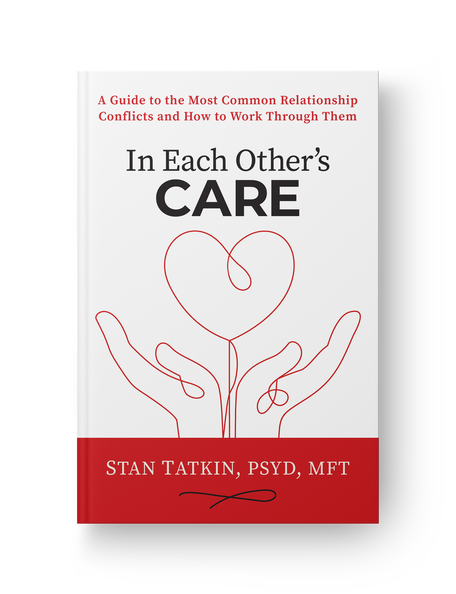
This excerpt is adapted from In Each Other’s Care: A Guide to the Most Common Relationship Conflicts and How to Work Through Them by Stan Taktin, PsyD, MFT.
Stan Tatkin, PsyD, MFT, is a clinician, researcher, teacher, and developer of A Psychobiological Approach to Couple Therapy® (PACT). He has a clinical practice in Calabasas, California, and with his wife, Dr. Tracey Tatkin, cofounded the PACT Institute for the purpose of training other psychotherapists to use this method in their clinical practices. For more information, visit thepactinstitute.com.
Need some tunes for rest and relaxation? Check out our Singing Bowl Meditation Playlist! A variety of artists who make a soothing mix of infinite rhythms using Tibetan singing bowls. Perfect throughout a meditative practice.