Customer Favorites

Nataly Kogan: Happier Now

Nataly Kogan is a public speaker, author, and the founder of the training organization Happier. With Sounds True, she has published the book Happier Now: How to Stop Chasing Perfection and Embrace Everyday Moments (Even the Difficult Ones). In this edition of Insights at the Edge, Tami Simon speaks with Nataly about redefining happiness not as a state where we experience no negative feelings whatsoever, but as a skill we must constantly hone. Nataly shares some of her life story, including her childhood experiences as a refugee and why she spent much of her life chasing the unattainable goal of “I’ll be happy when . . .” Tami and Nataly also discuss the benefits of maintaining a regular gratitude practice, then walk listeners through a five-minute “happiness workout” that can be done on the spot. Finally, they talk about how personally fulfilling creative activities can actually make us more productive and help us practice the everyday skills of happiness. (67 minutes)

The Extraordinary Power of the Imagination in Healing

Tami Simon speaks with Dr. Martin L. Rossman, a physician, acupuncturist, and co-founder of the Academy for Guided Imagery. Dr. Rossman is the author of the award-winning book Guided Imagery for Self-Healing, and with Sounds True he has created several guided imagery programs including Anxiety Relief, Stress Relief, Pain Relief, and Self-Healing with Guided Imagery with Dr. Andrew Weil. In this episode, Tami speaks with Martin about the reasons guided imagery is not more present in mainstream use in spite of its clinically proven effectiveness, what the placebo effect tells us about the mind-body connection, and how you can enhance the power of guided imagery by using personal imagery. (65 minutes)

Andrew Harvey: Evolutionary Mysticism

Tami Simon speaks with Andrew Harvey a poet, teacher, writer, mystic, and sacred activist. His work is deeply involved with the transformative nature of the spiritual path and the call in our time for mystics to become what Andrew calls, sacred activists—sacred activists in a world that needs us. He has created several powerful audio programs with Sounds True including Radiant Heart, Song of the Sun, and The Direct Path. Andrew discusses the birth of universal mysticism, the dark night of the soul, and the transfiguration of the body that occurs as we progress on the spiritual path.

The Basics of Nature Mindfulness

Ursasana: Bear Posture

Many years ago, a bear sat down next to me while I was meditating in the woods. It was an afternoon in mid-October in the Berkshires, and I had been mountain biking in my favorite preserve. I took a break from riding to enjoy the perfect fall afternoon. I was overflowing with gratitude. My life was going well.

I sat under a strong oak tree and closed my eyes. I asked Spirit to come and sit with me, to share in my heartfelt thanksgiving. I spoke the words aloud and immediately heard footsteps in the woods behind me. They got closer, but I continued with my meditation, until directly behind me, I heard a twig snap and a loud exhalation through a very big nose. I knew in that moment, in every cell of my body, that a bear was behind me.

My heart pounded, and adrenaline surged through my body. I was totally alert and aware. I very slowly turned my head to look behind me and saw shining black fur from shoulder to rump, close enough to reach out and touch. It was a large black bear. Immediately my mind provided options for survival. Get up and run away? Get up and yell to scare the bear away? Climb a tree? Those ideas seemed bad. Sit still, do nothing, and breathe? Yes, that made sense. And so I did. I slowed my breathing and meditated on the intensity of my body’s response to this perceived threat.

In my yoga I had learned that strong sensations and emotions, including fear, can be powerful doorways into meditation. Rather than turning away from an uncomfortable experience, I had learned to breathe into what I was feeling. In this case, the fight-or-flight response was a huge wave washing over my mind, body, and soul. Instead of making a big story about what was happening, I remembered to face the experience in all of its raw power. I had the thought, This is the coolest thing that has ever happened to me! I had another thought, too: This might be the worst thing that has ever happened to me! Many hundreds of hours, I had practiced breathing through the intense sensations of yoga postures, watching my experience without reaction and allowing things to be the way they are. All that training on the mat was now being put to the test in a pose I had never tried before, Bear Pose, or Ursasana.

For a moment, I wondered how it might feel to be bitten by a bear. That was not a helpful thought, so I returned to my breathing. Moments seemed to stretch into hours. The bear walked out from behind the tree and sat next to me. It was smelling me. Still I remained motionless. In time, the bear walked away. I turned to look as it walked away. It turned to look back at me. Our eyes met, and then it disappeared down the hill. I stood up and fell down, my legs weak and wobbly. I stood again and got to my bike. I climbed on board and pedaled out of those woods like a bat out of hell!

For days, I was in a state of profound shock and elation. My life was filled with magic, possibility, and power. Anything could happen. I felt incredibly alive. The presence of the bear stayed with me—even to this day. I have never been a thrill seeker or adrenaline junkie. I’ve never jumped out of an airplane or tried bungee jumping. I’ve always been drawn to more meditative outdoor activities, like canoeing, archery, or watching birds. But sitting in meditation with a bear gave me an unexpected adrenaline jolt.

While sitting with a bear is not likely to happen to many people, you may encounter other life-forms or elements that can help you awaken and experience a greater degree of aliveness. We long for connection with our relatives who roam the forests and wildlands, and we still find nourishment in their company. In mindful rewilding, we open ourselves up to the sensations and life-giving experiences that the land holds for us. Such moments of communion between you and the living earth can open doorways into a more magical, mysterious, and meaningful life. And it makes all the difference to have the right mental tools and preparation to help you ride the waves of powerful energies you will encounter in both the human and the more-than-human worlds.

When sitting with that bear, I used a technique we lovingly call “BRFWA”: Breathe, Relax, Feel, Watch, and Allow. You might use BRFWA on your first walk in a park or a wood that is new to you. You might use it during your first solo camping experience or when you see an animal that frightens you. I once used BRFWA when I got caught in a rip current while swimming off the Big Island of Hawaii. It allowed me to remain calm and to act skillfully, possibly saving my life. In any survival situation, the first advice is almost always to remain calm and think, not to react or panic. But how we are supposed to do that is not often explained. 

By practicing mindful rewilding, you are not looking to put yourself in a survival situation, though many of these skills can help you feel more confident and capable when you’re away from the conveniences of modern society. Inevitably, the more time we spend outdoors, the more likely we are to come up against our comfort zone or find ourselves in a situation where remaining calm and being skillful are necessary. In these moments, BRFWA can be a great ally.

I recommend that you use BRFWA regularly as a moment-to-moment practice. Using it daily will support your developing a general state of mindfulness. You can also use BRFWA to go deeper into a pleasant experience. Maybe you practice it when you take a walk or when you dip your feet in a cool stream or when you feel a fresh breeze moving through your neighborhood. Practice BRFWA regularly so that when something truly challenging happens, it is second nature for you, as it was for me when I had my encounters with the bear and the rip current.

BRFWA: Breathe, Relax, Feel, Watch, Allow

To begin working with BRFWA outdoors, try the following steps:

  1. Go outside. Find a place where you can sit comfortably and have a view of a natural, outdoor space. (This might also be the place where you want to establish your daily nature meditation.)
  2. Get grounded. Feel your sitz bones and imagine they are plugging in to the earth. As you ground down through your seat, also lengthen your spine and let it rise up through the crown of your head. Imagine that your spine is the trunk of a great tree and you are the bridge that connects the heavens and the earth.
  3. Breathe. Soften your belly, and slowly deepen your breathing with each inhalation and exhalation. If possible, breathe in and out through the nose. A good ratio for this breath is to inhale for four counts and hold the breath gently for seven counts; then exhale for eight counts, and repeat the cycle. As you breathe, notice the qualities of the air. What is the temperature? Is it hot, cold, or somewhere in between? How moist or dry is the air? What can you smell? Leaves, pine needles, the smoke from nearby fireplaces? In which direction is the wind moving? What can you hear? Your breath, your heartbeat, your joints settling? Branches creaking against each other, leaves rustling in the breeze, dew dripping to the ground, chipmunks or squirrels scampering, crows cawing, pigeons cooing, an airplane passing overhead?
  4. Relax. As you breathe, begin to consciously scan your body. Notice any places where you are holding tension. Focus on each of these places, as you continue to breathe calmly and deeply, and invite these places to soften and let go. Maybe your forehead is tense, and your brow is furrowed. Maybe your shoulders are tight and raised with tension. Perhaps your jaw is clenched. See if you can allow your jaw to relax, so that your teeth are parted. Invite your tongue to sit heavy and relaxed in your mouth, with the tip of the tongue resting against the ridge of skin behind your two front top teeth. With each exhalation, feel tension melting out of your body, mind, and spirit. Relax into the support of the earth element. Feel the earth beneath you and within your bones and muscles.
  5. Feel. As you continue to breathe and relax, notice what you can feel. Notice your body and what your body can feel—the air on your skin, the earth against your buttocks and legs, the light on your skin or coming through your clothing. Notice your heart and how you are feeling right now, not from a place of judgment, but from a place of compassion for yourself, and from a larger perspective, from your witness. Notice how the breath moving in and out helps you to feel more. This is one of the great secrets of yoga: the more deeply you breathe, the more of your own life you can feel.
  6. Watch. Be the witness. Observe your experience and allow as much space as you can for whatever is happening to be the way it is. Simply observe the land around you. Notice movement wherever it may be. Watch the play of light and the subtle movement created by the atmosphere’s constant state of motion. Watch everything, and be curious about any life you see, whether birds in the bushes or trees, ants crawling on the ground, or a squirrel leaping from limb to limb. When you come into the present moment using these steps, doors of perception will open to you. You will see the world through new eyes.
  7. Allow. Let it be. Let the moment be exactly the way that it is. Let go of grasping to your idea of what this moment should be. Let go of any aversion to things as they are. See if you can simply allow this moment to be as it is, and give yourself the opportunity to experience this moment right now in its pure expression. No matter the weather, no matter the terrain, can you allow this living earth and your relationship with it to be the way that it is? Moment by moment, can you keep letting go of your opinions, preferences, and judgments? It’s not easy for any of us, which is why we practice. This awareness is something to come back to moment after moment after moment, always beginning again.
  8. This is an excerpt from Rewilding: Meditations, Practices, and Skills for Awakening in Nature by Micah Mortali.

A Doctor’s Simple Tips on How to Get Better Sleep

Thanks to groundbreaking research, we have recently learned that every cell has its own timekeeper that can be thought of as a local clock. Deep within the brain, in the hypothalamus, lies a master clock that regulates all the local clocks, making sure that each one is set to the same time. This complex, coordinated process is in sync with the alternating cycles of day and night and with all the degrees of changing light that occur in a 24-hour period as Earth rotates on its axis. Called the “circadian rhythm”—from the Latin words circa, which means “going around,” and diem, meaning “day”—this internal process regulates the human body’s sleep-wake cycle, among many other functions. 

The master clock (think of it as circadian rhythm central) sends hormonal and nerve signals throughout the body, synchronizing the cells’ clocks to the day-night, light-dark cycle of life. On a continuous basis, the master clock can determine what time it is based on messages from photoreceptor cells in the retina that register light conditions outside and report these to the brain via specialized pathways. 
Meanwhile, the cellular clocks keep local time, making sure that various activities locally are timed right and are appropriately coordinated with other cells and organs. This is why, for example, key enzymes are produced at certain times, blood pressure and body temperature are controlled, hormones are secreted, the gut microbiome is populated with the right balance of bacteria, and gut motility is appropriate for the hour. 

Living in harmony with the way we have evolved brings physiological and emotional balance, creating a good fit between our bodies and minds, between what we’re doing and how we’re designed to function. Honoring our body’s natural rhythms helps stabilize our mood, become more resistant to stress, feel less physical pain, and generally feel and function better physically and mentally. It’s an essential step in cooling and calming emotional inflammation. 

The following are some ways you can adjust your habits so that they support your body’s inherent rhythms: 

  • Put yourself on a sleep schedule. Establish a regular sleep-wake schedule so that you go to bed at approximately the same time each night and wake up at the same time each morning. It’s fine to vary your bedtime by an hour or two occasionally, but don’t sleep in more than an extra hour on the weekends (unless you’re sick); otherwise, you will end up disrupting your sleep pattern for the next night. 
  • Identify your slumber sweet spot. Most adults need seven to nine hours of sleep per night to feel and function at their best. Once you figure out how much you need, determine what time you need to get up in the morning and work backward to set an appropriate bedtime; or, you can identify what time of night you typically feel sleepy and then set a wake-up time accordingly. 
  • Brighten your mornings. When you get up in the morning, expose yourself to bright, natural light to stimulate alertness, enhance your mood, and help calibrate your circadian rhythms. Take a brisk walk outside or have breakfast in a sunny spot. If you struggle to reset your internal clock to the “awake” setting in the morning, consider buying a commercial light box that emits 10,000 lux, which mimics a bright, sunny day. Sitting in front of such a light box for 30 minutes in the morning, perhaps while you have breakfast or read the newspaper or newsfeeds, has been found to stimulate alertness and improve mood. Alternatively, you could opt for a desk-lamp-style light box for your desk at work. 
  • Adjust your indoor lighting. Fascinating research has found that office workers who are exposed to greater amounts of light in the morning fall asleep more quickly at night. They also have better sleep quality and better moods, including less depression and stress, than those who are exposed to low light in the morning. 
  • Darken your evenings. There is another good reason to make sure that your bedroom (or wherever you sleep) is dark: When people are exposed to light during the night, their total daily melatonin production is suppressed dramatically, by as much as 50 percent. In other words, that nighttime light exposure throws the body’s 24-hour hormone production schedule off-kilter. It’s also wise to install a dimmer switch on the overhead light in the bathroom—or use a dim night-light—so that bright vanity lights don’t stimulate your senses and alertness while you’re taking care of bathroom business before hitting the sack or if you get up during the night.

Ultimately, honoring your body’s natural rhythms requires taking back control of your nights and days. It’s about putting time on your side and making conscious choices about the way you want to live so that you can restore your internal equilibrium, physiologically and psychologically. 

Yes, changing your behavior requires giving up the patterns you chose, consciously or not, in the past, and making the switch does take some effort and resolve. But if you make it a priority to stop upsetting your body’s internal rhythms and start living in sync with your body’s inherent needs, the payoffs will be well worth the effort. Your mood is likely to end up on a more even keel, and your energy will increase. Your physical health will probably improve and your emotional equilibrium will, too. Think of it this way: By respecting your body’s rhythms and doing whatever you can to maintain their regularity, you’ll be resetting your internal emotional thermostat, which will improve the way you react to and deal with the stresses and strains that are unavoidable in our modern world.

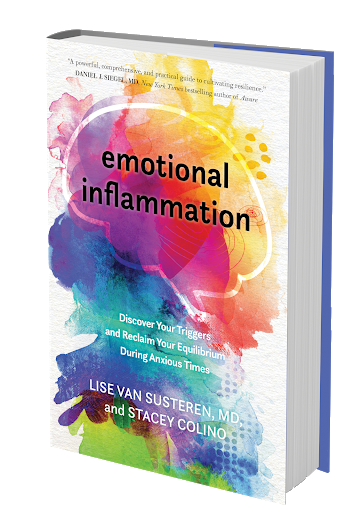
This is an excerpt from Emotional Inflammation: Discover Your Triggers and Reclaim Your Equilibrium During Anxious Times by Lise Van Susteren, MD, and Stacey Colino.

A Music Playlist for Better Sleep

To help you achieve the best night of rest, we recommend falling asleep to this relaxing music playlist, Music for Better Sleep, available through Sounds True on Spotify.


Lise Van Susteren, MD, previously served as a clinical professor of psychiatry at Georgetown University. She is a go-to commentator about anxiety and trauma for television (including CNN, Good Morning America, NBC, VOA, and Fox News), radio (NPR, Minnesota Public Radio, and others), print media (including the Washington Post, the Wall Street Journal, Newsweek, the Huffington Post, and CQ Magazine), and online outlets (such as Live Science, U.S. News & World Report, Global Health NOW, and many others).

As a thought leader and activist, Dr. Van Susteren addresses issues related to trauma and emotional inflammation through her roles at the Earth Day Network and Physicians for Social Responsibility. She is considered an expert in the psychological effects of climate change.

Stacey Colino is an award-winning writer specializing in health and psychology. In addition to her work as a book collaborator, she is a regular contributor to U.S. News & World Report and AARP.org. Her work has appeared in the Washington Post Health section, Newsweek, Parade, Cosmopolitan, Real Simple, Health, Prevention, Woman’s Day, Harper’s Bazaar, Parents, and Good Housekeeping, among other magazines and newspapers.

Buy your copy of Emotional Inflammation at your favorite bookseller!

Sounds True | Amazon | Barnes & Noble | Bookshop

The Michael Singer Podcast: Season 3 Trailer

Are you ready for the next chapter in Michael Singer’s profound (and often irreverent) wisdom? Check out this audio trailer from Sounds True founder Tami Simon, announcing Season Three of The Michael Singer Podcast.

Join us on [September 13th] for the first new episode of this acclaimed podcast.