Customer Favorites

Creating an Altar in Your Home

Creating An Altar in Your Home Sounds True Blog

Most of us come from secularized backgrounds from which spiritual forms, practices, and rituals have been scrubbed away, and we tend to have an aversion toward things like altars. However, most members of the world’s religious population keep a personal altar or shrine in their home, where they connect with and perform rituals to ancestors, saints, and the Divine, even amid modern, urban lives. In Western secular culture, altars have morphed into man caves, home theaters, or packed closets where we worship the gods of fame, beauty, and success. Consider how much time, energy, and prioritization we give these. Sound judgmental? Would it be judgmental for me to say a crisp, fresh kale salad is healthier than a bucket of fried chicken, or a run in the park more vitalizing than a television binge? We’ve been trained to abandon discernment—some things are better for us than others. It’s not all good.

If you can see an altar as psychological or emotional equipment—a bench press for the mind, augmentation for the heart—it might change your opinion. One of my teachers once said, “Clean your house as if the Dalai Lama was coming to visit for tea.” Now imagine sitting down at your altar with the Dalai Lama. It makes for an incredibly different experience if you picture an inspiring person right there with you. This may change your mind, not because of anything magical or special that is out there, but because the visualization shifts the quality of your experience. This altar is not for anybody else. Whose mind improves if you look at your altar and see a real Buddha instead of a bronze statue of a Buddha? Yours.

When Tibetan Buddhists set up altars, they put many objects on them, but three are central:

  • Buddha statue (symbolizing awakened body)
  • Scripture or other text (symbolizing awakened speech)
  • Stupa or other shrine (symbolizing awakened mind)

So when you sit facing an altar, you become familiar with transforming your own body, speech, and mind.

The body or form of a Buddha (rupakaya), particularly the aspects of compassion and engagement, is represented by a statue placed in the middle of the altar. Your Buddha might be a Tibetan thangka painting or a simple stone. It might be a photograph of the Dalai Lama or Pope Francis, an image of Pema Chödrön or Martin Luther King, Jr. No matter who or what it is, imagine it’s the embodiment of a real, living Buddha inviting you to practice, inspiring you to evolve.

Here is how I set up my Buddhist altar, but you can always arrange things and add or take away things as it works for you:

Create Your Own Altar Sounds True Blog

Excerpted from Gradual Awakening: The Tibetan Buddhist Path of Becoming Fully Human, by Miles Neale.

Miles Neale Creating An Alta in Your Home Sounds True Blog

MILES NEALE, PSYD, is among the leading voices of the current generation of Buddhist teachers and a forerunner in the emerging field of contemplative psychotherapy. He is a Buddhist psychotherapist in private practice, assistant director of the Nalanda Institute for Contemplative Science, and faculty at Tibet House US and Weill Cornell Medical College.

Dr. Neale is co-editor of and contributor to the groundbreaking volume Advances in Contemplative Psychotherapy: Accelerated Healing and Transformation and author of Gradual Awakening: The Tibetan Buddhist Path of Becoming Fully Human. For more visit milesneale.com.


Gradual Awakening Creating An Altar in Your Home Sounds True Blog


Buy your copy of Gradual Awakening at your favorite bookseller!

Sounds True | Amazon | Barnes & Noble | Indiebound


Creating An Altar in Your Home Sounds True Blog

Effortless Mindfulness for Pain Relief

Effortless Mindfulness For Pain ReliefWhat Is Pain?

Pain is a normal part of human life. And pain hurts. Although pain feels like a threat, pain is not attacking us. Pain is designed to help us survive. Pain and pleasure are signals. Pain is a signal that something is out of balance in your emotional, mental, spiritual, or physical life and that something needs attention. It is meant to be unpleasant, for a good reason: to bring our attention to a potentially dangerous situation until the issue is treated. The sharp, unpleasant signal is designed that way to make sure we drop everything else and attend to the situation immediately. When pain continues unabated after our best healthy efforts to tend to it in a physical way, we look for ways of stopping it, reducing it, or escaping it in any way we can.

For example, if you’re walking barefoot, thoroughly engaged in a conversation with a friend, and you step on a piece of wood and get a splinter, the strong unpleasant pain signal is meant to get you to immediately stop all other interests and attend to the wound. If you had a sharp piece of wood in your foot and it didn’t cause pain, you might not bother to take it out, resulting in infection or worse. Once you take care of the immediate problem, or source, the nature of pain is to eventually go away. Pain by itself is not an entity or an enemy that has any motivation of hurting you. It is an important survival mechanism of our body—a communication tool.

By way of our senses, we have contact with experience in and outside of our body that tends to feel either pleasant, unpleasant, or neutral. We tend to like pleasant sensations, which leads to craving what we like and trying to get more pleasure, and we tend to dislike unpleasant sensations, which leads to rejecting what we don’t like. When that strong craving or rejection happens, there is a contraction of our greater sense of self into a specific identity of “craver” or “rejecter”: we configure our consciousness into a “me” that is a “thinker” or “manager” that has a strategy to get its goals and desires met, and believes that that strategy is real and right. Craving and rejection are a normal part of our physical survival, like craving food when we’re hungry, but they also become our primary source of suffering when they become our identity.

Rather than reacting to the pain, we must treat the underlying condition that is causing pain in order for it to subside. It is important to first check out the cause of the pain in every way possible so as not to ignore, overlook, or deny a potentially dangerous condition. In some types of chronic pain that we know the cause of, like arthritis or sciatica, the nerve signal system is alerting us of an issue, but there’s no splinter to be removed from our back or foot. If we’ve attended to all the medical and alternative diagnoses and treatments, and the pain still persists, we still have the opportunity to learn some approaches using our own consciousness to relate to pain differently. Effortless mindfulness is a wonderful approach that does not in any way attempt to replace or deny diagnosing the cause of pain and working to cure it through any and all means. I am simply sharing this practice as a suggestion of what can be done in conjunction with any medical treatment.

With effortless mindfulness, we can learn to become present with the unpleasant—an important skill that we often avoid learning until we experience inescapable pain. We may already have experienced, through effortless mindfulness, how chattering thoughts recede into background awareness or can be met by open-hearted awareness. The great news is that we can do this with pain signals as well! They can become like thoughts and go into the background of awake awareness. When the pain signals recede to the background or significantly lessen, we no longer have to suffer silently or try to escape the pain through behaviors of shutting down, numbing, addiction, or acting out. By changing how we relate to pain, we can find a doorway to a freedom that allows us to respond to pain from courage and intimacy. We can learn to be present with the unpleasant, remain sensitive without being defensive, and be responsive but not reactive. When the intelligence of awake awareness knows directly that there is no immediate danger, the pain signal can go into the background.

In this video below, join me as I guide you through this practice of using effortless mindfulness to help you be present and work with your pain for lasting relief.

This is an excerpt from The Way of Effortless Mindfulness: A Revolutionary Guide for Living an Awakened Life by Loch Kelly.

Loch Kelly HeadshotWay of Effortless Loch KellyLoch Kelly, MDiv, LCSW, is a leader in the field of meditation and psychotherapy. He is author of the award-winning Shift into Freedom and founder of the Open-Hearted Awareness Institute. Loch is an emerging voice in modernizing meditation, social engagement, and collaborating with neuroscientists. For more, visit lochkelly.org.

Buy your copy of The Way of Effortless Mindfulness at your favorite bookseller!

Sounds True | Amazon | Barnes & Noble | Indiebound


Effortless Mindfulness Pain Relief Pinterest

5 Ways to Combat Energy Vampires This Holiday Season

For empaths and sensitive people, the holidays can be extra stressful because they are exposed to more socializing and holiday events. This means interacting with relatives, friends or acquaintances who may be energy vampires. Since empaths are emotional sponges, they tend to absorb other people’s negative energy unless they have a plan to approach the holiday season. Here are some tips from my book: Thriving as an Empath: 365 Days of Self-Care for Sensitive People.

Identify the energy vampires in your life

In your journal, write down the name of five energy vampires in your life that you may encounter over the holiday season. Then, write down what type of energy vampire they are so you know exactly how they drain your energy. For instance, The Criticizer: For instance they might say, “Oh dear, it looks like you’ve put on a few pounds!.” Or the Drama Queen, Controller, Narcissist or Passive Aggressive.

Journal about strategies to use

It’s important to pre-plan the strategies you use with these people. Write these in your journal. For instance, if you’re going to encounter a drama queen/king, tell yourself “I will not ask them how they are doing or look deeply into their eyes to encourage long stories. I will not feed into the drama queen/kings antics.” Map out your strategies so you are prepared.

Set clear boundaries

Boundaries are essential for all empaths and sensitive people to learn. Because we wear invisible signs around our necks saying “I can help you”, people flock from far and wide to tell us their life stories. Thus, it is important to set boundaries with energy vampires, and limit the time you interact with them. If necessary, escape into the bathroom for some quiet time.

No is a complete sentence

When dealing with energy vampires, such as rageaholics, it is important to learn how to say “no” to someone dumping anger on you. As an empath, anger feels toxic to me so I don’t allow it in my vicinity. If you’re going to encounter an angry person who tends to dump, be prepared to say “no” to them and politely excuse yourself to talk to someone else.

Notice your emotional triggers

We tend to be drained if our own unresolved issues are activated. So, it is healthy to examine your emotional triggers so you can’t be drained by people pushing your buttons. For instance, are you triggered by sadness, depression or anxiety? Or when someone tries to control you? Identify your triggers and begin to heal them in your private meditations or with a guide. This self-healing will help you be a more empowered empath!

Judith OrloffJudith Orloff, MD, is a leading voice in the fields of medicine, psychiatry, and intuitive development. An assistant clinical professor of psychiatry at UCLA, her bestselling books include Emotional Freedom, Positive Energy, Dr. Judith Orloff’s Guide to Intuitive Healing, and Second Sight. Find more inspiration at Dr. Orloff’s website drjudithorloff.com.


The community here at Sounds True wishes you a lovely holiday season! We are happy to collaborate with some of our Sounds True authors to offer you wisdom and practices as we move into this time together; please enjoy this blog series for your holiday season. 

To help encourage you and your loved ones to explore new possibilities this holiday season, we’re offering 40% off nearly all of our programs, books, and courses sitewide. May you find the wisdom to light your way.

EXPLORE NOW

Tools for Cultivating Supportive Friendships & Re...

Tools for Cultivating Supportive Friendships & Relationships:

CHRISTOPHE ANDRÉ:

For this toolbox I’d like to put forward a little bit of theory about how we are supported by relationships — that is, to offer an overall look at what we receive from our relationships with others.

The five benefits of relationships. Studies show that social support can be broken down into several families of benefits:

  1. Material support: Others can help us in concrete ways. If I’ve broken my leg, I will be glad if somebody will do my shopping for me. If I have to move, I will be happy to have my friends help me transport the boxes.
  2. Informational support: Others can advise us, give us useful infor- mation, and play the role of human search engines — as intelligent as Google but alive and compassionate — and they won’t resell our personal information afterward.
  3. Emotional support: Others are the source of positive emotions; they give us affection, love, friendship, trust, admiration.
  4. The support of esteem. Others can remind us of our value and good qualities, tell us what they like about us, and sustain our self-esteem at moments of uncertainty.
  5. The inspiration of their example: This is more difficult to evaluate scientifically, but it’s quite real, as we have indicated.

The four varieties of relationships. Another important point is that it is helpful to cultivate varied social relationships, just as it is important to have a varied diet. There are four families of relationships, distributed in four concentric circles:

  1. Our intimates: the people we live with, whom we touch and embrace practically every day. This means mostly our family and best friends.
  2. Our close relations: our friends and colleagues, people with whom we regularly have close and regular exchanges.
  3. Our acquaintances: the whole network of people with whom we have a connection, even occasional, and who we keep track of and who keep track of us.
  4. Unknowns: those who we might also have relationships with, depending on our character. This includes people we might speak to on the street, on public transport, in stores. They can also be sources of help or information for us, as we can for them.

Specialists in social relations remind us that it is important to draw sup- port from these four circles — not only from our intimate and close relations—and to sustain our connections with these four relational spheres by giving and receiving help, information, support, eye contact, advice, and smiles. Because the idea is not only to receive but also to give, by speaking to unknowns and maintaining warm relations with our acquaintances, neighbors, and shopkeepers, we do ourselves good. And we embellish the world, improve it, and make it more human!


MATTHIEU RICARD:

The importance of social connection. We should choose to live in an environment where people are warm, altruistic, and compassionate. If this isn’t the case in all areas of our living space, we should progressively try to establish these values or, if it’s possible, we should leave the toxic environment.

In this connection, I like to cite the case of a community on the Japanese island of Okinawa, which claims to have one of the world’s highest concentrations of people aged a hundred or over. It appears that the main factor in this exceptional longevity is not the climate or the food, but the power of this community, where people maintain particularly rich social relationships. From cradle to grave, they relate very closely with one another. The elderly people in particular get together several times a week to sing, dance, and have a good time. Almost every day they go to schools to greet the children (whether they have familial links with them or not) at the end of the school day. The elders take the children in their arms and give them treats.

Draw inspiration from the righteous, from people who, in our eyes, embody the values of impartiality, tolerance, compassion, love, and kindness. In these times of the migratory crisis, I think of all those who have taken great risks, and I remember those who protected Jewish people during the Nazi persecutions of World War II, particularly those who hid Jews in their homes. These people have since come to be called “The Righteous.” The only common point that emerges from their many accounts is a view of others based on recognition of their common human- ity. All human beings deserved to be treated with kindness. Where we saw a stranger, they saw a human being.

Meditate on altruistic love. Studies in psychology have shown that meditating on altruistic love increases people’s feelings of belonging to a community; it enhances the quality of social connections and compassionate attitudes toward unknown people, while at the same reduc- ing discrimination toward particular groups, like people of color, homeless people, and immigrants.

Draw inspiration from friends in the good and spiritual masters. I recommend that everyone see a historical documentary made in India by Arnaud Desjardins at the end of the 1960s, in which we are shown the most respected of the Tibetan masters who took refuge on the Indian slopes of the Himalayas following the Chinese invasion of their country. The film is called The Message of the Tibetans.


ALEXANDRE JOLLIEN:

The audacity to live. Existing, opening oneself to the other, is running a risk. It means dropping one’s armor, one’s protective coverings, and opening one’s eyes and daring to give oneself to the other and to the entire world. There’s no way you can invest in a relationship, so throw out your logic of profit and loss! What if we were to embark on our day without any idea of gain or of using our fellow human beings? What if we stayed attentive to all the women and men it is given to us to encoun- ter on that day, looking to find among them masters in being human? 

Identify our profound aspirations. Helping others can often amount to imposing a view of the world on them without really paying any attention to what they really want in their hearts. A man bought an elephant without giving any thought in advance to how he was going to feed it. At a loss, he was obliged to turn for help to those around him, and what he got from them was, “You never should have bought such a big animal!” What does it mean to help others? Does it mean committing completely to being there for them? Does it mean going all the way with them?

Authentic compassion. A will to power might enter into our move- ment toward the other—a thirst for recognition, a twisted attempt to redeem ourselves. Daring a true encounter means quitting the sphere of your neurosis and walking the path of freedom together. There’s no more “me,” no more “you,” but a coalescent “us,” a primordial solidarity.

Coming out of the bunker. As a result of having been burned in our relationship with another, the temptation is great to put on armor, to completely shut ourselves up in a bunker-like fortress, even to the point of suffocation. Don’t our passions, our griefs, our loves, and the fierce- ness of our desire remind us that we are essentially turned toward the other, in perpetual communication? Is there a way to live the thousand and one contacts of daily life without our ego appropriating them?

This is excerpted from the newest book from Matthieu Ricard, Christophe André, and Alexandre Jollien, Freedom For All Of Us: A Monk, A Philosopher, and a Psychiatrist on Finding Inner Freedom.
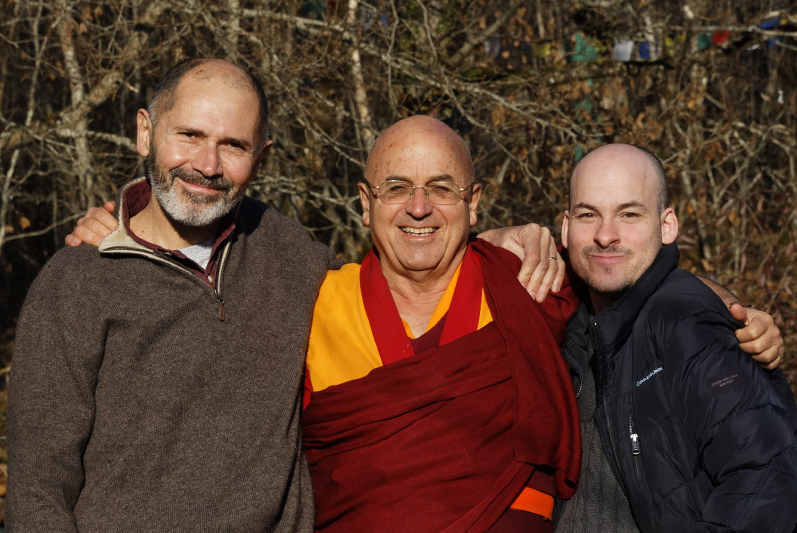
Copy of MatthieuRicard-AlexandreJollien-ChristopheAndré©PhilippeDanais2017


Matthieu Ricard is a Buddhist monk, a photographer, and a molecular geneticist who has served as an interpreter for the Dalai Lama. 

Christophe André is a psychiatrist and one of the primary French specialists in the psychology of emotions and feelings.

 Alexandre Jollien is a philosopher and a writer whose work has been attracting an ever-growing readership. Together, they are the authors of In Search of Wisdom and Freedom For All of Us.
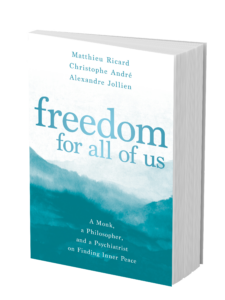
picture of the book titles Freedom for All of Us

Learn More

Sounds True | Amazon | Barnes & Noble | Bookshop | IndieBound

 

Rolf Gates: How Spiritual Friendship Allowed Me to Exi...

Rolf Gates is a yoga teacher, counselor, and author who cofounded the Yoga, Meditation, and Recovery Conference and currently teaches at Spirit Rock Insight Meditation Center. With Sounds True, he has published the audio program Meditations on the Mat: Practices for Living from the Heart and co-wrote the children’s book Yoga Friends. In this episode of Insights at the Edge, Tami Simon speaks with Rolf about his unique background as a former US Army Airborne Ranger and addictions counselor, as well as how those experiences brought him to contemplative practice. They discuss how yoga can soothe both mental and physical agitation, bringing the mind and body into greater harmony. Finally, Rolf explains how he discovered the power of prayer and opening to grace, and why that discovery led him to embrace gratitude as a way of life. (63 minutes)

Valerie Gangas: In Deep Shift

When our lives are unexpectedly overturned, how do we regain our footing and make something new and better of ourselves? In this podcast, Tami Simon speaks with author Valerie Gangas about her book, In Deep Shift: Riding the Waves of Change to Find Peace, Fulfillment, and Freedom, an empowering guide to help us navigate those times when life turns upside down and inside out. Give a listen as they talk about spontaneous awakenings and spiritual “emergencies,” the connection between deep despair and deep shifts, spiritual sensitivity and how to stay grounded, the power of complete surrender, the practice of transcendental meditation, “opposite land” and the discovery that nothing is at is seems, out-of-body experiences versus embodied presence, cultivating your intuition, manifestation and listening for that which wants to be created through you, removing the distractions on the path to living your purpose, and more.