We were honored at the 2012 Wake Up Festival to have with us film maker Louie Schwartzberg, to introduce and show us his short piece on gratitude. While this life has so many challenges, uncertainties and, as the Buddha has taught, will inevitably involve suffering and the breaking-open of our hearts, there is an underlying preciousness here. Just by looking up into the sky or into the eyes of someone we love, or listening to the birds, or watching a flower bloom, we enter into timelessness and eternity. Something more than meets the eye is happening here… the miracle that is this life is waiting around every corner, is part of every conversation, and is unfolding throughout every minute of every day.
Enjoy this lovely short film on the power of gratitude and the preciousness of this one sweet life, narrated by our dear friend, Brother David Steindl-Rast:
We are all faced with events in life that make it seem like we have no choice in the matter. Think of a time in your life when you thought the situation you faced gave you no choice. As you reflect back on this event, do you still feel that way? Do you still believe you had no choice, or can you now see choices you could not see then? What can you change and what is not in your power to change?
From a shamanic perspective, there are always many more options than we thought we had because, like a quantum physicist, a shaman does not accept the outward appearance of anything. Our solid appearing bodies are anything but solid at the subatomic level. They are mostly empty space—and if that is so, what might we be able to do with them that we thought we could not?
Walk over hot coals? Pass through a wall? Travel great distances in the blink of an eye? Consider what you have resigned yourself to in your life? Is it just a reality to be endured or is it an essence-created test—an initiatory challenge to motivate you to move beyond it?
Examine your feelings about your fate closely. Is there grief? Is there anger and bitterness—perhaps resentment? These emotions can be clues to your fatalism about certain aspects of your life. Who are you trying to punish with your victim stance? Who are you trying to prove wrong or right in the matter?
If you wish, go back and choose a current situation where you feel you are stuck and do the process again.
This process is just one I’ve learned over the years as I’ve sought out extraordinary healers across the globe. I’ve had terrifying, enlightening, and at times hugely entertaining adventures. Power can destroy us or it can raise us up by teaching us and nourishing us. I may not be a master, but I have learned a few things that you may find helpful on your own quest. I share all of this in my new book, Encounters with Power: Adventures and Misadventures on the Shamanic Path of Healing.
We often find metaphors for life in our yoga practice, and those of us who come to yoga stiff or weak are only too familiar with confronting our edges. In most urban, contemporary societies, we are frequently exposed to confrontation: in our communities, our relationships, our jobs—the list goes on. Our success in dealing with confrontation and the stress it generates depends on our ability to recognize and adjust to what presents itself in those situations. It is often easy to avoid dealing with confrontation until it reaches a certain level of intensity and we are forced to address what stands in our way.
The Hidden Gift of Obstacles in Yoga
When our tools for dealing with confrontation are overwhelmed and when what we perceive as our very nature becomes threatened, our life systems—mental, emotional, and physical—begin to contract. If we ignore this contraction for too long, it can color the way we perceive our reality, and what is very unnatural to a healthy body begins to seem natural. Because this process occurs over extended periods, as in the aging process, we often lack the awareness that it is happening until we are beyond simple fixes.
Difficult Poses
Consider the beginner’s approach to difficult poses—even the relatively simple ones—that challenge flexibility, balance, or strength. These poses take our attention directly into areas of our body that are unfamiliar, painful, or unresponsive. This is often confronting. Stiff people have to learn how to work with pain, which is often intense, in order to remove the obstructions found in tight muscles or joints. Typically, this work is associated with movement where previously no movement existed or where it was extremely limited. The weak or overly flexible have to learn how to work without overworking, to create the support or resistance necessary to bring about the subtle movement of energy in the body to build stamina or strength.
It is a common experience for beginners to question why they lack movement or feeling in these areas in the first place and to wonder if there will ever come a day when it could be different. This is the beauty of the confrontation found in yoga, where opposites attract and working simultaneously with effort and non-effort is a very important lesson to learn.
Overcoming Resistance In Yoga
With many of the asanas that a beginner tackles for the first time, it is common to struggle with the opposing forces of particular actions found in a pose. Attempting to relax tight muscles is not easy when we are receiving a steady stream (or scream) of more demanding messages in the seemingly undecipherable language of pain. It can feel like the very resistance we experience has been protecting us from injury or overdoing something and that to surrender into this discomfort would be unwise.
Likewise, working with weak muscles to stay in a pose, to dig a little deeper, even for one more breath, seems to go against all of the yogic principles of nonviolence (ahimsa), and the anxiety that this can produce is real. Fatigue (mental and physical) seems to threaten our very existence, and every cell in our body is convinced that we’re approaching an injury or a near-death experience.
Hatha Yoga Is A Confrontational Journey
By its very nature, though, hatha yoga takes us on a confrontational journey that can produce the awareness required to overcome ingrained resistance and penetrate the dense matter of our consciousness. For those with chronically tight or weak muscles, the correct practice of asana with conscious breathing forces the mind into a very alert state and very quickly fills the gaps typically found in a beginner’s attention. This is a very important place to be. In it, we are given an opportunity to feel the power of this situation physically, to observe the dynamics of stress in an intense environment, and to overcome the mental or emotional struggle inherent in that predicament.
Of course, entering these situations in your practice requires a little preparation, and in the event of any preexisting conditions, it is beneficial and highly recommended to work with an experienced teacher who can suggest modifications to challenging poses. However, once you become familiar enough with your edge to gaze at what lies beyond it, an exterior guide will only be a distraction. Instead, you can reach inside yourself—toward your inner teacher—for guidance.
Peter Sterios is a popular yoga teacher and trainer with over four decades of experience. He’s the founder of LEVITYoGA™ and MANDUKA™, as well as KarmaNICA™, a charitable organization for underprivileged children in rural Nicaragua. Sterios taught yoga at the White House for Michelle Obama’s anti-obesity initiatives for three years, and in 2018 he was invited to the Pentagon to share yoga’s therapeutic effects with the US Marine Corps. He resides in San Luis Obispo, CA. For more, visit LEVITYoGA.com.
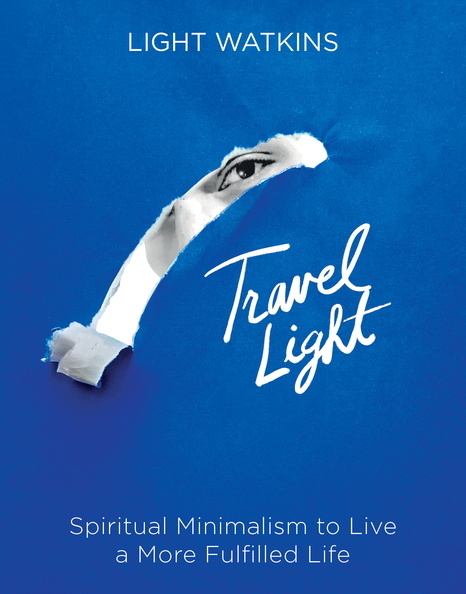
My recent book Travel Light is a how-to guide for the practice of what I call “Spiritual Minimalism,” which is not to be confused with regular old minimalism.
Long story short, in 2018, I was living in a beautiful two-bedroom apartment in Venice Beach when I felt an inner calling to get rid of everything that didn’t fit inside of my 22-inch carry-on bag. My bag would effectively become my new apartment as I would begin living nomadically around the world.
It took me 30 days’ worth of yard sales and Craigslist posts to get rid of over four decades of furniture, art, photo albums, yearbooks, letters, clothing, knickknacks, winter coats, books, my cars, Vespa, and everything else.
And about six months into my nomadic journey, I realized something: I still had too much stuff. So I got rid of the carry-on bag and downsized into a backpack. And now, five-plus years later, I’m still happily living from a backpack as I continue to hop around the world, from hotels to Airbnbs to friends’ extra bedrooms.
Travel Light is written for those who also feel called to live with less, but you’re not sure where or how to start. Truth be told, there are numerous ways to start, depending on your individual situation.
If this approach intrigues you, I want to share five common mistakes many new minimalists make—and a handful of simple recommendations to get you started on a more mindful, purposeful minimalism journey:
Don’t get rid of too much too fast
Although I completely emptied my entire two-bedroom apartment within 30 days, I had been intentionally prepping to live from a carry-on bag over the previous year by experimenting with taking only what I actually used while on my dozens of work trips. So in 2018, getting rid of my stuff was merely the final step in a long progression of steps.
My first recommendation is to go slow. Decide what sort of end result you desire, and start experimenting with what it would be like to only use what you envision keeping. Maybe get a storage room and put a handful of items in it each week until you run out of things you don’t use. Otherwise, going too fast could prove to be unsustainable and discouraging.
Don’t make it about the external space
Getting rid of clutter doesn’t resolve deep emotional wounds or past trauma. And some of that could be the root cause of why you engage in retail therapy or why you may cling to stuff you don’t use or wear. And until you start doing deeper work on yourself, you can live in the most minimal-looking setting, but still feel cluttered inside.
Commit to daily meditation as a means of efficiently releasing stress, and engage in other inner work, such as therapy, journaling, seva (service), and daily gratitude practices to clear away the internal clutter. This is what is meant by Spiritual Minimalism. It’s minimalism practiced from the inside-out.
Don’t treat minimalism as a one-time experience
Minimalism is less of an act, like Spring cleaning, and more of a lifestyle, like getting into shape. It doesn’t end once you get rid of your stuff. Like being in shape, minimalism continues to inform what you do, how you do it, where you go, why, and pretty much every other choice you make in life. In other words, you recognize that every choice you make is either supporting the lifestyle or taking away from the lifestyle.
Start seeing everything you do (big and small) as an opportunity to reinforce the minimalist mindset, and make choices that support your desired mindset.
Don’t forget to adopt a larger purpose
Getting rid of stuff for the sake of looking like a minimalist is ultimately unfulfilling, and it’s recommended to adopt a larger purpose for your minimalism adventure. That way, you will bring more enthusiasm and passion into your minimalism choices. You’re not just getting rid of something for the sake of getting rid of it. It’s going to help you by making space to exercise, create content, or to use as the meditation corner of your home.
My recommendation is to answer this question: How does becoming a minimalist help you help others? The answer is a clue into your purpose, and just know that there is no wrong answer. Or rather, it’s an ever-evolving answer that will come into greater focus as you begin your journey. All you need for now is a loose idea of your why.
Don’t compare yourself to others
The quickest way to make minimalism a drag is to compare yourself to other, more popular minimalists. It’s certainly good to be informed of best minimalism practices and get tips from minimalist influencers, but their paths or suggestions may not work as well for your situation.
Be open to blazing your own path into minimalism, and be willing to adjust along the way. If you treat the entire thing as a learning experience, there are no mistakes. And you’ll have a lot more fun along the way.
For more tips and insights on the ways of the Spiritual Minimalist, I invite you to check out Travel Light: Spiritual Minimalism to Live a More Fulfilled Life.
True witness consciousness is not willfully watching, analyzing, or trying to let go of thoughts and emotions; it is the effortless state of simply seeing whatever arises without touching it. There is a vast difference between passive “seeing” and intentional “looking.” If you catch a thought or emotion to decide whether it is good or bad, you are using your mind as a “gatekeeper” rather than experiencing true witness consciousness. As you evolve spiritually, thoughts, emotions, and other inner experiences simply pass through like writing on water, there is no need to touch them. You can reach this state when you are willing to go through life’s experiences. You become increasingly able to simply flow with life, serve what is in front of you, and eventually experience the deep spiritual state of liberated consciousness.
It is okay to be broken, to allow yourself to fall apart
You need not hold it together any longer for you were never together to begin with
Fall apart and resist the temptation to put yourself back together again
See what is forever untouched by the concepts “together” and “apart”
It is okay to be broken, for it is through the cracks in you that light can pour through