
Customer Favorites

How to Cope with Shame, the Master Emotion

Shame has been called the master emotion because it takes over our bodies and our minds.  It can freeze our nervous system.  It can place us in a fog, unable to seek help, reassess a situation or reassess what is really going on. Shame defeats our ability to reflect on ourselves, get some support, and move on. Shame can be overwhelming, but if we can look at it clearly and catch it before it takes over, we can cope with it and create conditions that can transform it from an enemy into a friend.

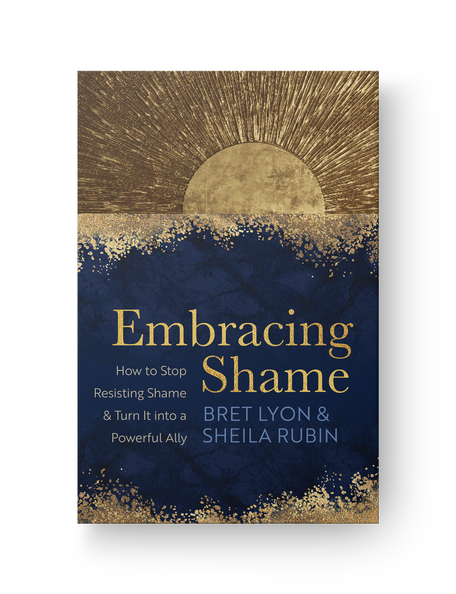
This is not academic to us.  We are both well-acquainted with the experience of shame. Co-author of Embracing Shame, Sheila Rubin has been researching shame since she was a shy five-year-old. “In my twenties, I remember having a new job and being so worried about being late for a first meeting that I showed up early and accidentally interrupted a lunch that was happening in the room,” notes Sheila. “I froze in embarrassment. I remember the shame voice saying to me: ‘What’s wrong with me?  Maybe they shouldn’t hire me because something is wrong with me.’  Fortunately, while I was holding the door knob, frozen in shame, someone opened the door and invited me in with kindness.”

Embracing Shame co-author, Bret Lyon, remembers that, as a kid, when the gym teacher blew the whistle and said to pick teams. Everyone else was picked first. He still remembers trying to pretend it didn’t matter while he felt like dying inside.

One client accepted extra work even though he does not want to work weekends because he wants to be liked and couldn’t say “no” because it would be embarrassing.

Another client spoke of shame seeping into her mind about the changes in her body since giving birth. She is happy to be a mother, but the changes in her body and the inner dialogue in her mind keep her in shame circles. The differences between how she experienced her body and how she feels now is shame.

Our inner conversations may say a variety of unhelpful things. For many of us, it is the voice of not being good enough. Or we might feel like an imposter. If our partner or boss says that we made a mistake, that may be a trigger for a shame attack.

Here are some clues to know when shame may be operating in your mind and body:

Thoughts: There’s something wrong with me and I don’t want anyone to know. Maybe I am an imposter and I need to hide.

Sensations: Feeling shy, face flushed, brain can freeze, difficulty having a conversation.

Reactions: Embarrassed, going blank, blaming others, using activity to numb, withdrawing. Not able to write or think clearly and not know why.

Coping with shame

If, instead of letting shame take over, we can be with and observe our shame, we can actually begin to learn something from it.  We can begin to transform shame from a toxic disruptor to a useful informant, from a devastating foe to a useful ally.

Here are a few experiments to try when you notice shame coming up. Instead of putting yourself down, try one, then reflect on the results and write them down in a journal or in your notes app:

Be kind to yourself. Say something kind to yourself to ease the shame.

Pause and take a breath. Pausing for even a few seconds or one minute can offer a new perspective. How might this allow you to set a new boundary or reframe your story in a healthier way?

Set boundaries. Is there an extra shift you cannot take this week? Can you say stop or politely decline?

Name your feelings. Notice what didn’t feel good in your reaction. Can you talk about what you’re feeling in a different way?

Ground yourself. Tap your feet or feel the earth under your feet.

Get support. Talk to a friend who is kind and who can hear your feelings.

Spend time in nature. Take a few minutes to bathe in nature to refresh and replenish.

Understand that change happens slowly. Talk back to the shame inside yourself for a bit and find if the shame can be a little less toxic. Even a small shift or change can help you move forward rather than staying stuck.

Being friends with your shame can begin to change yourself and your life. When toxic shame lifts there can be access to creativity and new doors can open. The weight of heaviness can be put down and we can have new hope for the future. The reason we do this work is so others can find hope when there is shame and they can transform it and heal it.

Sheila Rubin, MA, LMFT, RDT/BCT, has been researching shame since she was five years old. Along with her husband and colleague, Bret Lyon, she is a founder and codirector of the Center for Healing Shame, and cocreator of the Healing Shame–Lyon/Rubin Method. Through their popular workshops, they have taught thousands of psychotherapists, coaches, and other helping professionals across the world to more effectively identify and work with shame. Sheila is a Licensed Marriage and Family Therapist, a Registered Drama Therapist, and has taught at JFK University and CIIS, as well as being the eating disorder specialist at a hospital and directing Embodied Life Stories performances. For more, visit healingshame.com.

Bret Lyon, PhD, SEP has devoted almost two decades of his life to healing shame. Along with his wife and colleague, Sheila Rubin, he is a founder and codirector of the Center for Healing Shame, and cocreator of the Healing Shame–Lyon/Rubin Method. Through their popular workshops, they have taught thousands of psychotherapists, coaches, and other helping professionals across the world how to more effectively identify and work with shame. Bret holds doctorates in both psychology and drama and has taught at Tufts University, Pomona College, and the American Academy of Dramatic Arts, as well as writing and directing plays in regional theater and off-off Broadway. For more, visit healingshame.com.
Amazon | Barnes and Noble | Bookshop | Sounds True

E49: Breaking Barriers: Finding Joy Within

There are two very different approaches to achieving a beautiful, love-filled life. The first is externally focused—seeking joy, love, and peace through outside circumstances, people, or actions. The second is inward, asking why these very natural states are blocked internally and taking responsibility for removing those blockages. Love and joy are inherent to everyone but are obscured by stored emotional pain, fears, and responses conditioned by past experiences. By letting go of these internal blockages and facing life’s challenges with openness rather than resistance, you can cultivate love and inner freedom as your unconditional state of being.

For more information, go to michaelsingerpodcast.com.

© Sounds True Inc. Episodes: © 2025 Michael A. Singer. All Rights Reserved.


E88: The Power of Nonresistance

Resistance is the inner act of opposing what is, and it is the root cause of all suffering. Whether you are resisting emotions, thoughts, or life events, it is this opposition—not the events themselves—that causes disturbance. Spiritual freedom comes through a deep state of nonresistance: allowing reality to pass through you without blocking it. Once you reach this state, you are truly ready to interact with life instead of reacting to it.

For more information, go to michaelsingerpodcast.com.

© Sounds True Inc. Episodes: © 2025 Michael A. Singer. All Rights Reserved.

Tian Dayton: If You Grew Up with Addicts, Healing Is a...

Trauma doesn’t show up in what we remember. It shows up in how we react.

This week, Tami Simon speaks with Dr. Tian Dayton—award-winning scholar, senior fellow at The Meadows, and author of Growing Up with Addiction: How Adult Children of Addicts Can Heal Family Trauma, Complex PTSD and Codependency—about what it means to grow up inside a family shaped by addiction, and what it actually takes to heal.

Drawing on decades of clinical work, her own lived experience, and her innovative Relational Trauma Repair (RTR) method, Dr. Dayton explores the neuroscience of relational trauma and the embodied, experiential path through it.

Join Tami and Tian to explore:

  • Why addiction is a family disease—and how process addictions like workaholism and overeating leave the same marks as substance use
  • How childhood trauma gets stored in the body, not the story—and why you can’t think your way out of complex PTSD
  • The neuroscience of overreaction: why triggers feel present-tense even when they’re decades old
  • Cognitive and somatic distortions—and how to recognize when the past is hijacking the present
  • Psychodrama and Relational Trauma Repair: the power of talking to instead of about
  • Timelines, social atoms, and letter writing as tools for putting fragmented memories back in order
  • Why healing is a discipline—and what it means to take ownership of your own darkness as a path to freedom

Whether you grew up in a home shaped by addiction or simply recognize the patterns Dr. Dayton describes, this interview offers both a map and the courage to begin the journey.

Listen now and start where you are. 

This conversation offers genuine transmission—not just concepts about awakening, but the palpable presence of realized teachers exploring the growing edge of spiritual understanding together. Originally aired on Sounds True One.

Mindful Kids in Context


Mindful eating, mindful burgers, mindful sex . . . pretty much everything is mindful lately. Paying attention has value, but what’s the goal of all that mindfulness?

Defining mindfulness exactly is like trying to define psychology or exercise in one line; you can do it, but it never quite captures everything. To summarize, mindfulness means aiming to be more aware of our immediate experience, with less reactive habit. Even that language may feel abstract to the average parent or child trying to find some peace and happiness. More than any single definition, what matters most is that there’s an intention. We spend an awful lot of our lives reacting to things we like or dislike in ways that aren’t always useful. When we break patterns and handle the uncertainty of life more easily, that’s beneficial. However you define it, mindfulness means living with less mindless habit and more ability to manage the fact that life is awfully hard sometimes.

So what does mindfulness with kids mean? Another way of framing mindfulness is as a group of mental traits. It’s not that anything specifically gets fixed by a practice of mindfulness; it’s guiding children toward long-term skills that make life easier. We teach children to become more attentive, less reactive, more compassionate, and resilient. From that perspective, mindfulness is a way to build life management abilities, but far from the only one. We offer children tools to handle the challenging road ahead through any means that fit.

When we say that mindfulness means “paying attention to what we’re doing,” we transfer this to our children by paying more attention to them when we’re together. “Staying calm under pressure” means taking a few breaths and not blowing a gasket when homework falls apart. When we say to treat others with compassion, that starts with how we speak to the frazzled guy at the airport dealing with our flight cancellation. Acknowledging honestly and openly that no one is perfect, we also recognize that we won’t stick to our own intentions all the time. We make mistakes and learn from them and keep going. Drawing our children into that part of life teaches them something too.

When it comes to teaching mindfulness, focus on the skills you want your children to develop. That matters more than whether they commit to a “mindfulness practice.” We build resilience by developing EF (Executive Function) and attention, emotional awareness, self-confidence, self-compassion, positive relationships, and all the rest that comes from being raised in a mindful, aware household. That doesn’t mean specifically meditating, but it does mean emphasizing a balanced lifestyle.

Mindfulness implies living with clarity in a certain way. We guide kids to pay attention every way we can — by taking moments to pause and look at a sea shell or by prioritizing activities that build attention (like reading, chess, and board games) over those that disrupt attention (excessive screen time). We discuss emotions and describe our own emotions. We live compassionately, read books that reflect other people’s perspectives, and generally immerse kids in compassion, while gradually considering if they’re ready for a compassion-based mindfulness practice.

Mindfulness is a tool kit for a different way of living, one that provides kids skills to manage life on their own one day. The good news is, kids don’t even have to practice it themselves to get there. They learn from watching us and from the overall way they live themselves. Of course, they eventually can learn from their own practice of mindfulness too. As you practice yourself, you’ll know exactly how to encourage your children to join you (links to books supporting mindfulness in kids can be found at howchildrenthrive.com). But it’s the big picture of how they are raised that counts most.

Consider This:

Imagine yourself from your child’s point of view. How would your child describe you to a friend? What’s fun and easy about you, what are your strengths, and what areas might you want to change?


Excerpted from How Children Thrive: The Practical Science of Raising Independent, Resilient, and Happy Kids.


Mark Bertin, MD, is a bestselling author who specializes in integrating mindfulness with other evidence-based neurodevelopmental care. His previous books include Mindful Parenting for ADHD and The Family ADHD Solution.


Buy your copy of How Children Thrive at your favorite bookseller!

Sounds True | Amazon | Barnes & Noble | Indiebound


Carl Johan Calleman: Shifting Through the Underworlds

Tami Simon interviews scientist Carl Johan Calleman, PhD about his unique take on the significance of the Mayan Calendar. He shares with us some of the keystones of his view, including the 9 galactic underworlds and the all-important tree of life. (37 minutes)