In many contemplative traditions, it is said that we can practice meditation during the most ordinary activities, such as taking a walk, washing the dishes, or even in the midst of a busy day of emails. Here, our friend and Sounds True author Dr. Andrew Weil shows how the simple art of cooking – when engaged in a present, mindful, and open way – can offer a gateway into the experience of meditation.
We’d love to hear from you on how cooking and other so-called “ordinary” activities offer you a portal into deeper love, awakening, and aliveness in the present moment.
Friends we are so happy to announce and invite you to the 2014 Wake Up Festival!
The Wake Up Festival is a five-day immersion experience in personal and collective transformation. It’s the largest and only festival of its kind, uniting renowned spiritual teachers, bestselling authors, healers, scientists, poets, yogis, and lovers of life within the context of an open-hearted, uplifting community.
The Wake Up Festival is not your usual “festival.” It’s not about outer activities; it’s about inner exploration and discovery. We think of it as a feast of life-changing insights with just the right amount of practice to enable us to truly embody what we learn. You’ll be invited to approach awakening through meditation, personal writing, qigong, yoga, dance, shadow work, and more. And we will do it as individuals each supported by our Wake Up community.
Confirmed presenters include Jack Kornfield, Elizabeth Gilbert, Rick Hanson, Jill Bolte Taylor, Mark Nepo, Snatam Kaur, Malidoma Somé, Robert Augustus Masters, Bruce Tift, and many others.
We hope to see you all in August. Save $200 if you register by May 1st!
Featuring:
k.d. lang
Jack Kornfield
Elizabeth Gilbert
Jill Bolte Taylor
Snatam Kaur
Rick Hanson
Seane Corn
Mark Nepo
Joseph Marshall III
Malidoma Somé
Robert Peng
Tami Simon
And many more!
As I write this blog post we’re days away from the 2014 Wake Up Festival, and I’m thinking about all of the things I have to do before heading up to Estes Park for four days of camping and “WUFing” as we like to call it. But I’m also thinking about what my intentions are and why I am excited to be fortunate enough to be able to attend. Having experienced the last two Wake Up Festivals, I’m looking forward to immersing myself in the unique energy field that is created by all of the participants. You can feel it the second you get out of your car on the grounds of the YMCA. It’s as if the coming together of several hundred people with the shared intention of becoming more conscious, present, and authentic generates the perfect environment in which such aspirations can become reality. It’s powerful and infectious. And it needs to be if it’s going to fuel changes that continue long after the conclusion of the Wake Up Festival. After all, it’s one thing to spend a week practicing with others but another matter to live what we learn when we return to our everyday lives.
So as I deal with the details of packing and travel and so on, I hope that I’m able to remember why I’m going in the first place, to go with the flow once I get up there without attachment to programs and agendas, and to stay present with the beautiful people and surroundings. And if I’m lucky, the energy of transformation that all of us create will indeed support positive developments for each of us as we move toward the end of another year.
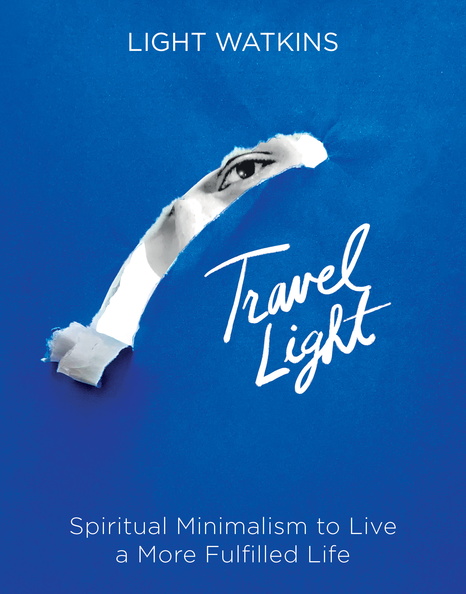
My recent book Travel Light is a how-to guide for the practice of what I call “Spiritual Minimalism,” which is not to be confused with regular old minimalism.
Long story short, in 2018, I was living in a beautiful two-bedroom apartment in Venice Beach when I felt an inner calling to get rid of everything that didn’t fit inside of my 22-inch carry-on bag. My bag would effectively become my new apartment as I would begin living nomadically around the world.
It took me 30 days’ worth of yard sales and Craigslist posts to get rid of over four decades of furniture, art, photo albums, yearbooks, letters, clothing, knickknacks, winter coats, books, my cars, Vespa, and everything else.
And about six months into my nomadic journey, I realized something: I still had too much stuff. So I got rid of the carry-on bag and downsized into a backpack. And now, five-plus years later, I’m still happily living from a backpack as I continue to hop around the world, from hotels to Airbnbs to friends’ extra bedrooms.
Travel Light is written for those who also feel called to live with less, but you’re not sure where or how to start. Truth be told, there are numerous ways to start, depending on your individual situation.
If this approach intrigues you, I want to share five common mistakes many new minimalists make—and a handful of simple recommendations to get you started on a more mindful, purposeful minimalism journey:
Don’t get rid of too much too fast
Although I completely emptied my entire two-bedroom apartment within 30 days, I had been intentionally prepping to live from a carry-on bag over the previous year by experimenting with taking only what I actually used while on my dozens of work trips. So in 2018, getting rid of my stuff was merely the final step in a long progression of steps.
My first recommendation is to go slow. Decide what sort of end result you desire, and start experimenting with what it would be like to only use what you envision keeping. Maybe get a storage room and put a handful of items in it each week until you run out of things you don’t use. Otherwise, going too fast could prove to be unsustainable and discouraging.
Don’t make it about the external space
Getting rid of clutter doesn’t resolve deep emotional wounds or past trauma. And some of that could be the root cause of why you engage in retail therapy or why you may cling to stuff you don’t use or wear. And until you start doing deeper work on yourself, you can live in the most minimal-looking setting, but still feel cluttered inside.
Commit to daily meditation as a means of efficiently releasing stress, and engage in other inner work, such as therapy, journaling, seva (service), and daily gratitude practices to clear away the internal clutter. This is what is meant by Spiritual Minimalism. It’s minimalism practiced from the inside-out.
Don’t treat minimalism as a one-time experience
Minimalism is less of an act, like Spring cleaning, and more of a lifestyle, like getting into shape. It doesn’t end once you get rid of your stuff. Like being in shape, minimalism continues to inform what you do, how you do it, where you go, why, and pretty much every other choice you make in life. In other words, you recognize that every choice you make is either supporting the lifestyle or taking away from the lifestyle.
Start seeing everything you do (big and small) as an opportunity to reinforce the minimalist mindset, and make choices that support your desired mindset.
Don’t forget to adopt a larger purpose
Getting rid of stuff for the sake of looking like a minimalist is ultimately unfulfilling, and it’s recommended to adopt a larger purpose for your minimalism adventure. That way, you will bring more enthusiasm and passion into your minimalism choices. You’re not just getting rid of something for the sake of getting rid of it. It’s going to help you by making space to exercise, create content, or to use as the meditation corner of your home.
My recommendation is to answer this question: How does becoming a minimalist help you help others? The answer is a clue into your purpose, and just know that there is no wrong answer. Or rather, it’s an ever-evolving answer that will come into greater focus as you begin your journey. All you need for now is a loose idea of your why.
Don’t compare yourself to others
The quickest way to make minimalism a drag is to compare yourself to other, more popular minimalists. It’s certainly good to be informed of best minimalism practices and get tips from minimalist influencers, but their paths or suggestions may not work as well for your situation.
Be open to blazing your own path into minimalism, and be willing to adjust along the way. If you treat the entire thing as a learning experience, there are no mistakes. And you’ll have a lot more fun along the way.
For more tips and insights on the ways of the Spiritual Minimalist, I invite you to check out Travel Light: Spiritual Minimalism to Live a More Fulfilled Life.
Modern physics has shown us that all form, including our bodies, is simply vibrations in an underlying omnipresent field, the quantum field. Through deep meditation, ancient yogis also found an underlying omnipresent field, consciousness. Could these fields end up being the same? The key to exploring this for yourself is to realize that you are not your thoughts, emotions, or experiences—you are the consciousness observing them. To remain seated in this state of awareness, you must learn not to be distracted by these objects of consciousness. Spiritual evolution is not about becoming something; it’s about ceasing to identify with what you are not.