Customer Favorites

Andrew Holecek: Dream Yoga, Part 2

Andrew Holecek is an author and spiritual teacher whose work blends a background in ancient Tibetan Buddhism with the leading edge of contemporary Western thought. With Sounds True, he has released the book Dream Yoga: Illuminating Your Life Through Lucid Dreaming and the Tibetan Yogas of Sleep. In the fascinating second part of his interview on Insights at the Edge, Andrew speaks with Tami Simon about pressing beyond lucid dreaming and into the actual nighttime practice of dream yoga. They talk about illusory form yoga and invoking specific imagery within dreams to cultivate positive qualities. Finally, Andrew describes the ability to actually meditate within dreams—as well as the doorways to personal inquiry this practice can unlock. (78 minutes)

Christian Conte: Healing Conflict: Listen, Validate, T...

How do we fully meet and support someone experiencing emotional distress—anger, in particular? In this episode of Insights at the Edge, Tami Simon talks with Dr. Christian Conte about his Yield Theory of emotional management, focusing on the process of “listen, validate, and explore options.” Dr. Conte explains the events that led to his interest in anger management, as well as the origins of Yield Theory. He emphasizes the importance of meeting others where they are, giving them the opportunity to drain anger’s charge from their limbic system. Dr. Conte and Tami discuss why it’s necessary to cultivate humility and how Yield Theory might be applied to our currently divisive culture. Finally, they speak on the “cartoon world” that angry responses often create, as well as the importance of watching what we add to our minds.

Shinzen Young: The Science of Enlightenment, Part 1

Shinzen Young is a renowned mindfulness teacher known for his live gatherings, where he uses a scientific, “algorithmic” approach to explain the many aspects of meditation. With Sounds True, he has published the decades-in-the-making book The Science of Enlightenment: How Meditation Works. In this episode of Insights at the Edge, Tami Simon and Shinzen speak on his approach to mindfulness, including a method of breaking down sensory experience into easily parsed categories. They talk about the three core powers of focused attention—sensory clarity, concentration, and equanimity—and how mindfulness can free us of the impression that our selves are static and unchanging. Finally, Shinzen and Tami discuss the different ways in which we can understand the concept of enlightenment, including an in-depth consideration of what Shinzen calls “classical enlightenment.” (66 minutes)

Invoking the Goddesses of Yoga

Tami Simon speaks with Sally Kempton, a teacher who has practiced, studied, and written about meditation and spiritual philosophy for more than 40 years. With Sounds True, Sally has authored Meditation for the Love of It and the recently released book Awakening Shakti: The Transformative Power of the Goddesses of Yoga. In this episode, Tami speaks with Sally about how we can seek guidance and blessing from a goddess, the role of imagination in invoking goddess energy, the light and shadow sides of each goddess, and the relationship between goddess energy and the awakening of Kundalini in the human experience. (69 minutes)

The Courage to Stand Alone

The Courage to Stand Alone

It can be scary when we are called to confront our aloneness, the seemingly infinite depths of that empty, homeless feeling inside of us. When all our old protections fall away and the abandoned and neglected ones inside come begging for our love and attention. It can feel sometimes as though there’s nowhere to turn, like we want to crawl out of our own skin, urgently get out of the Now and into some other time or place.

It takes bravery to stop, breathe, and—slowly, slowly, slowly—turn back toward the lonely, dark, empty “void” inside (in reality, there is no void). To actually turn to face the sense of abandonment buried deep within our guts, to soften into the sense of separation that has been with us for as long as we can remember. We don’t have to make the feeling go away today, only lean into it, breathe into it, begin to make room for it, maybe even learn to trust its presence. 

quote image

Perhaps loneliness is like a cosmic nostalgia, a preverbal memory of a deep womb-connection, with ourselves, with the planet, with every being who has ever lived. In leaning into our own loneliness, shame, and existential anxiety, we may be able to touch into compassion for the loneliness of every human being, for every heart longing to connect, for every grieving heart, every frightened heart. 

We are alone, yet never alone. This is the great paradox of existence. Our loneliness, when not resisted or numbed away, may actually end up connecting us more deeply to life and each other, like it did for me and my sweet father that winter evening. 

Let us learn to be alone, then! Alone, without distraction, which is true meditation. Alone, communing with the breath as it rises and falls. Alone with the mind and its incredible dance. Alone with the rain and the morning sun. Alone with the crackle of autumn leaves under our feet, or the crunch of winter snow. Alone with the hopes and joys and anxieties of this human form, living a single day on this remarkable planet. Alone with our precious selves, with this unfathomable sense of connection to all things, with birth and loss and death and their myriad mysteries. 

Alone, with all of life.

This is an excerpt from You Were Never Broken: Poems to Save Your Life by Jeff Foster.

jeff fosterJeff Foster shares from his own awakened experience a way out of seeking fulfillment in the future and into the acceptance of “all this, here and now.” He studied astrophysics at Cambridge University. Following a period of depression and physical illness, he embarked on an intensive spiritual search that came to an end with the discovery that life itself was what he had always been seeking.
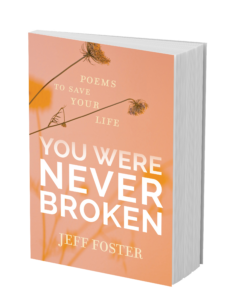


book image of excerpt on lonliness

Learn More

Sounds True | Amazon | Barnes & Noble | Bookshop

The Place You Awaken

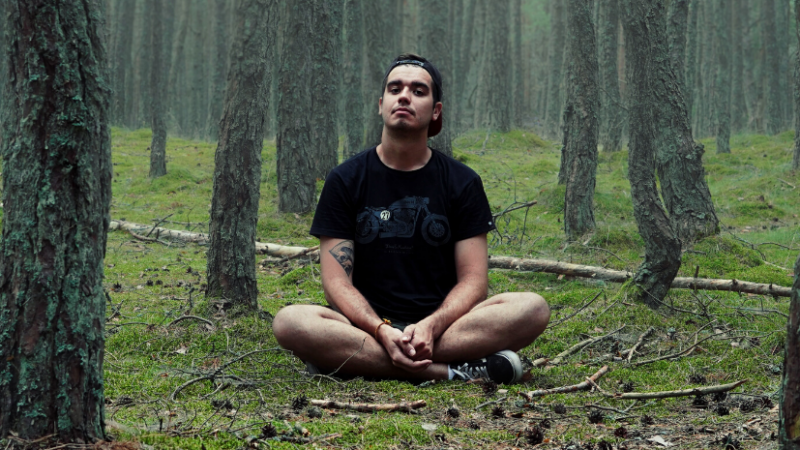
Establishing a place for regular outdoor meditation and nature observation is often referred to as a “sit spot” or “medicine spot”.  Like the Buddha, who found his own tree of awakening, we too can go to nature and practice being awake to the reality of the present moment.  This practice can also help us become more intimate with all the qualities of the land we live with.  

If one day I see a small bird and recognize it, a thin thread will form between me and that bird. If I just see it but don’t really recognize it, there is no thin thread. If I go out tomorrow and see and really recognize that same individual small bird again, the thread will thicken and strengthen just a little. Every time I see and recognize that bird, the thread strengthens. Eventually it will grow into a string, then a cord, and finally a rope. This is what it means to be a Bushman. We make ropes with all aspects of the creation in this way.” 

San bushman

Guided Sit Spot Practice

  1. Go to a place in nature that is close to where you live and that you can visit regularly.
  1. Take a few moments to center yourself, breathing in and out, and arriving fully in the present moment.
  1. As you are ready begin to walk mindfully with an intention to find a spot that calls out to you, a place you can sit and deepen your relationship with this place.  The spot should feel welcoming, safe and comfortable.  It could be under a tree, beside a boulder or in an open space.  Often, east facing spots can be nice for early morning sits.
  1. When you find a spot that feels good, in your own way, ask permission of that place and wait to see what comes to you.  If you feel invited, sit.  If not, keep looking.
  1. Once in your spot, sit comfortably and become as still as you can.  Imagine that you are melting into the earth, becoming a part of the land.  Sit for at least 15-30 minutes, noticing any movement, sounds, or other sensations and activities.
  1. Return often.

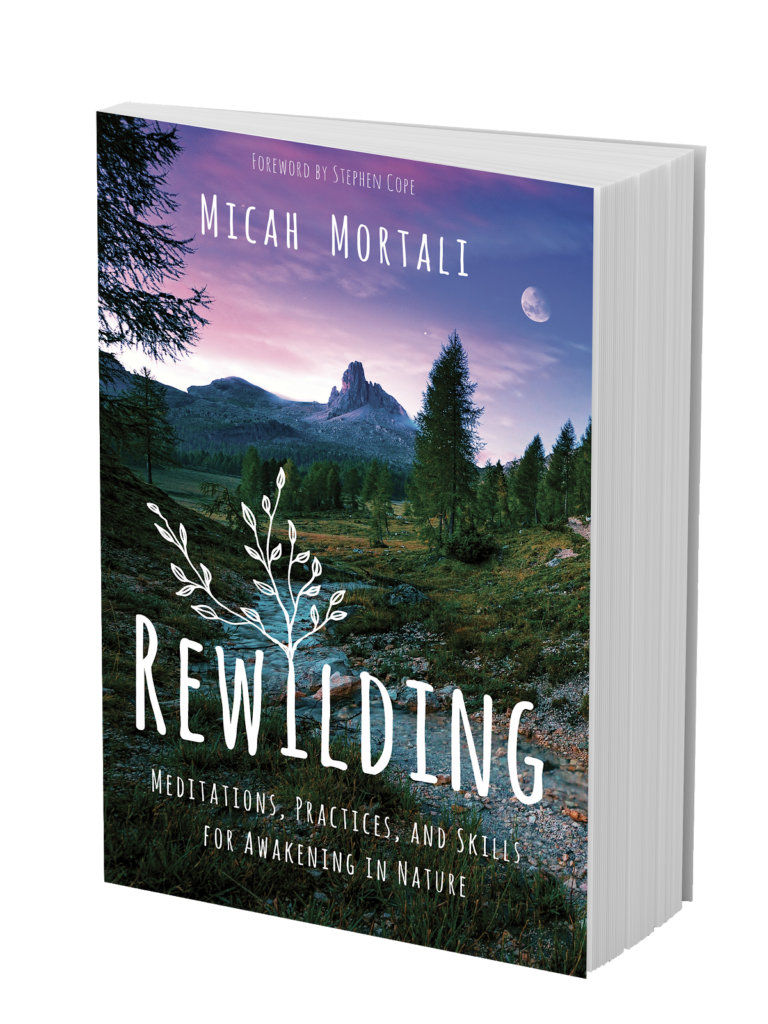
Find more practices for connecting to nature in Rewilding: Meditations, Practices, and Skills for Awakening in Nature by Micah Mortali.

Read Rewilding today!

Sounds True | Amazon | Barnes&Noble | Bookshop