Dr. Dilip Jeste is a professor of psychiatry and neurosciences and the director of the Center for Healthy Aging at UC San Diego. He’s spent the last 20 years studying aspects of healthy aging and the neurobiological roots of wisdom. With Sounds True, Dr. Jeste has written a new book titled Wiser: The Scientific Roots of Wisdom, Compassion, and What Makes Us Good. In this episode of Insights at the Edge, Tami Simon speaks with Dr. Jeste about wisdom—what it is, how we can cultivate more of it in our own lives, and how we can grow into a wiser society. They explore a new definition of wisdom that incorporates neurobiological and evolutionary components of what makes us wise, as well as the social and cultural ones we might be more familiar with. Dr. Jeste and Tami also discuss the future of wisdom, including the potential of a metaphorical “wisdom pill.” Finally, they speak on the importance of helping our society become wiser, faster.
Elise Museles is on the board of directors for the Environmental Working Group, a holistic health expert, and the host of the podcast Once Upon a Food Story. With Sounds True, she’s released the new book Food Story: Rewrite the Way You Eat, Think, and Live. In this episode of Insights at the Edge, Tami Simon speaks with Elise about the concept of “food stories”—your personal relationship with food and eating, defined not only by your own experiences but by the familial and cultural messages you grew up with. They discuss the different kinds of food stories, their origins, and what it takes to “rewrite” your own food story. Elise details different ways you can shift your attitudes toward food, including mindful eating, acceptance of your body’s needs, and cutting screens out of your meals. Finally, Tami and Elise talk about the therapeutic quality of food prep, how to tailor recipes to specific moods, and why “emotional eating” isn’t always a bad thing.
In the Internal Family Systems model, the practice of speaking for, rather than from, parts when they are triggered is an important aspect of Self-leadership. When people receive a message from you, it has two components: the content (the actual words) and the energy behind the words. When your protective parts are upset and speak directly to another person, invariably they will trigger parts in the other. When, on the other hand, you listen to your protectors and then speak for them, from your Self, the message is received in a very different way, even if you use the same words that your parts are saying. Your words lose their judgmental sting or their off-putting desperation and coerciveness. Instead, your respect and compassion for the other person will be heard in addition to the courage of your convictions.
Self energy has a soothing effect on any parts it touches, whether they are in you or in another person. When your parts trust that you will speak for them, they feel less driven to take over and explode at people. What they really want is to have a voice—to be listened to by you and to have their position represented to others.
Practice: SELF-LEADERSHIP AS A WAY OF INTERACTING IN A CONFLICT
These practices—remaining the “I” in the storm or the empty vessel, and speaking for rather than from your parts—can be combined into a general way of relating as a couple when you have conflict. When you begin to fight, each of you can try the following:
Pause
Focus inside and find the parts that are triggered
Ask those parts to relax and let you speak for them
Tell your partner about what you found inside (speak for your parts), and
Listen to your partner from your open-hearted Self
When a couple is embattled and each focuses inside, as in step 2, usually they only hear from their protectors. If it feels safe enough, moving an extra step toward vulnerability can reap big rewards. That step involves staying inside long enough to learn about the exiles that your protectors are guarding, and then telling your partner about these vulnerable parts. In most cases, when one partner has the courage to reveal the vulnerability that drives their protectiveness, the atmosphere immediately softens and the couple shifts toward Self-to-Self communication.
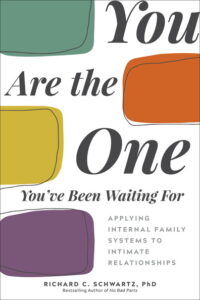
This is an excerpt from You Are the One You’ve Been Waiting For: Applying Internal Family Systems to Intimate Relationships by Richard C. Schwartz, PhD.
Dr. Jennifer Freed is an author, personal mediator, and an accredited psychological astrologist. With Sounds True, she has published Use Your Planets Wisely: Master Your Ultimate Cosmic Potential with Psychological Astrology. In this episode of Insights at the Edge, Tami Simon speaks with Dr. Freed about the tenets and practice of psychological astrology. Using 2020 as a guide, Dr. Freed examines Tami’s upcoming astrological chart and uses it to illustrate the deeper workings of the practice. They discuss the various heavenly bodies that influence psychological astrology (including some that might surprise you) and their archetypal functions. Tami and Dr. Freed also talk about cultivating confidence in astrological readings and “a litmus test for false prophets.” Finally, they explore some of the variable symbolism of the planets and what it truly means to “use your planets wisely.”(59 minutes)
Tami Simon speaks with Dr. Rubin Naiman, an internationally recognized leader in integrative sleep and dream medicine. Dr. Naiman serves as the sleep specialist at the University of Arizona’s Center for Integrative Medicine, directed by Dr. Andrew Weil. With Sounds True, he has produced the audio programs Healthy Sleep (with Dr. Weil) and The Yoga of Sleep, as well as the online course Ask the Sleep Doctor. In this rebroadcast of one of the most popular Insights at the Edge interviews, Tami speaks with Dr. Naiman about how hyperarousal interferes with healthy sleep, the power of weaning ourselves off the alarm clock, and how we can embrace the deeper dimensions of sleep and dreams. (58 minutes)
James Hollis, PhD, is a graduate of Zürich’s Jung Institute, a licensed Jungian analyst practicing in Houston, Texas, and author of 13 books, including Finding Meaning in the Second Half of Life and What Matters Most: Living a More Considered Life and the Sounds True audio learning program Through the Dark Wood: Finding Meaning in the Second Half of Life.
Here, Dr. Hollis invites us to discern directly what a “spiritual life” is for us personally, opening ourselves to the mystery of our time here as a human being. At the end of our life, shares Hollis, we want to be able to say we’ve been here, that it mattered, that we lived our journey and not someone else’s, and that we’ve touched the deepest part of who we are.