Customer Favorites

Ep 9 Bonus: The Bodhisattva Check-In

This bonus episode will support you to take the main insights from Episode 9: “Live the Questions Now” deeper into your life. 

Jess will guide you through an adaptation of the Work That Reconnects exercise called “The Bodhisattva Check-In.” In Buddhism, the bodhisattva is the archetype of the compassionate person who devotes themself to collective well-being. 

In this exercise, you will be invited to use your imagination to “step in” to each of the circumstances of your life in order to make the contribution to the Great Turning that is yours to make. 

All you’ll need for this bonus exercise is enough space to take slow meditative steps in a straight line or in a circle. A living room or a yard are great. If you don’t want to or can’t walk, there will be instructions on how to do this without moving. You’ll need a total of 20 minutes, including time after the recording has ended.

We recommend starting a podcast club with friends or family to do these practices together. Links and assets to help prompt reflection and build community can be found with every episode on WeAreTheGreatTurning.com.


What Causes Reactivity and How to Navigate it Skillful...

What Causes Reactivity Header Image

Our shadow-bound conditioning shows itself most often through reactivity. When we’re reactive, we’re automatically reverting to and acting out conditioned behavior, usually in ways that are emotionally disproportionate to what’s warranted in a given situation.

Reactivity is the knee-jerk dramatization of activated shadow material. Self-justifying and far from self-reflective, reactivity features a very predictable take on what’s going on, which we proceed with even if we know better.

The signs of reactivity include:

An exaggerated attachment to being right. If someone points out this attachment to us when we’re being reactive, it usually only amplifies our righteousness.

Emotional distortion and/or overload. More often than not, this behavior gets quite melodramatic. We may use emotional intensity to back up what we’re doing.

Using the same words and ideas from previous times we’ve been triggered. It’s as if we’re on stage saying our lines as dictated by the same old script. We’re acting and re-acting, even when we know we’re doing so.

A lack of—or an opposition to—self-reflection. The refusal to step back, even just a bit, from what’s happening fuels the continuation of our reactivity.

A loss of connection with whomever we’re upset with. Our heart closes.

A loss of connection with our core. We’re immersed instead in our reactivity.

Here’s an example of how to skillfully—and nonreactively—handle reactivity. Imagine you’re embroiled in a reactive argument with your partner or a close friend. You’re dangerously close to making a decision about your relationship to them that you vaguely sense you’ll later regret, but damned if you’re going to hold back now! After all, don’t you have a right to be heard?

Things are getting very edgy. Then, rather than continuing your righteous, over-the-top dramatics, you admit to yourself that you’re being reactive. Period. You step back just a bit from all the sound, fury, and pressure to make a decision about your relationship with this person. You’re still churning inside, but the context has shifted. You’re starting to make some space for the reactive you instead of continuing to identify with it. There’s no dissociation here — just a dose of healthy separation, some degree of holding space for yourself, perhaps even some trace of emerging care for the other person.

On the outside, you’re slowing down and ceasing to attack the other, saying nothing more than what you’re feeling, without blaming the other for this. You’re starting to allow yourself to be vulnerable with the other. You’re interrupting your own reactivity.

Your intuition begins to shine through all the fuss. You start to realize that, while you were being reactive, your voice sounded much like it did when you were seven or eight years old. The same desperation, the same drivenness, the same cadence. You were hurting considerably then and trying to keep your hurt out of sight, because earlier times of expressing it had been met with parental rejection and shaming.

You’re still on shaky ground, though, and could still easily slip back into your reactive stance. Just one more shaming or otherwise unskillful comment from the other could do the trick. So you soften your jaw and belly, bend your knees slightly, and take five deep breaths, making sure that you count each breath on the exhale. You know from previous experience that these somatic adjustments will help settle you; they are your go-to calming responses for stressful moments.

As the out-front reality of your reactivity is now in clear sight, you feel shame. Some of this is a beneficial shame, activating your conscience, letting you know that you crossed a line with the other and that a genuine expression of remorse is fitting. You say you’re sorry, with obvious vulnerability. Sadness surfaces in you. You don’t make excuses for your reactivity. Instead, you make your connection with the other more important than being right.

And a very different kind of shame also arises, one that’s far from beneficial. This shame activates not your conscience but your inner critic (heartlessly negative self-appraisal). It’s aimed not at your behavior but at your very being, taking the form of self-flagellation for having slipped—a self-condemnation that, if allowed to run free, mires you in guilt and keeps you from reconnecting with the other. You acknowledge the presence of this toxic shame, saying to yourself that your inner critic is present. It’s not nearly as strong as it usually is, fading quickly as you name it. You choose to address it in depth later on, outside of the argument you were just having, as part of your ongoing shadow work. Reconnecting with the other is a priority now, and it’s happening, bringing relief and gratitude to you both.

Excerpted from Bringing Your Shadow Out of the Dark: Breaking Free from the Hidden Forces That Drive You by Robert Augustus Masters.

Robert Augustus Masters

Robert Augustus Masters, PhD, is an integral psychotherapist, relationship expert, and spiritual teacher whose work blends the psychological and physical with the spiritual, emphasizing embodiment, emotional literacy, and the development of relational maturity. He is the author of thirteen books, including Transformation through Intimacy and Spiritual Bypassing. For more information, visit robertmasters.com.

Buy your copy of Bringing Your Shadow Out of the Dark at your favorite bookseller!

Sounds True | Amazon | Barnes & Noble | Indiebound


What Causes Reactivity Pinterest

Aaravindha Himadra: Recognizing the Field of Infinite ...

Aaravindha Himadra is a spiritual teacher and the founder of Sambodha, an international nonprofit organization dedicated to the awakening of human consciousness. With Sounds True, he has published the English-language edition of Immortal Self: A Journey to the Himalayan Valley of the Amartya Masters. In this episode of Insights at the Edge, Tami Simon speaks with Aaravindha about the events described in Immortal Self—after a grueling expedition into the interior of the Himalayan Mountains, Aaravindha found himself in the secluded valley home of a deeply secretive spiritual lineage. Aaravindha describes his tutelage under the valley’s long-lived Amartya monks and why he has become the spokesperson for this ancient wisdom tradition. Concluding this fascinating conversation, Tami and Aaravindha discuss the expansion of consciousness and what it means to “listen from the floor of creation.” (73 minutes)

Erica Djossa: Releasing the Mother Load

What have we done to our mothers? Sociologists call our times “the era of intensive mothering,” a period in which moms must be it all and do it all for their children and families. Psychotherapist and maternal mental health specialist Erica Djossa has made it her mission to teach today’s mothers how to take care of their well-being in a sustainable way. In this podcast, Tami Simon speaks with Erica about her much-needed new book, Releasing the Mother Load, and the steps we can take to challenge the norms and change the culture around mothering. 

Enjoy this empowering discussion of: values-centered mothering; mothers as martyrs; the pressures facing a generation of “overinformed, overeducated, and overwhelmed” moms; equally sharing our household duties; the cost of cognitive or invisible labor; boundaries; using the “load map” to redistribute the work; “mom rage,” its roots, and the unique nature of anger in motherhood; identifying the “red light and green light” times for difficult conversations with partners (and sticking to them); overcoming perfectionism; self-compassion; re-parenting yourself while you’re parenting your children; the disempowering belief that I’m failing as a mom; effective self-care for moms (it’s not just bubble baths!); advice for making changes—start small; and more.

Note: This episode originally aired on Sounds True One, where these special episodes of Insights at the Edge are available to watch live on video and with exclusive access to Q&As with our guests. Learn more at join.soundstrue.com.

The Reality of Co-Creation with Caroline Myss

Co-creation is a reality, but you have to understand what heaven means by reality. It is not a dynamic that serves our personality-it’s a dynamic that serves the soul. And if you were to understand that your soul and your personality generally make two different choices it would be easier to understand the unfolding of the dynamics of your life because they unfold according to the needs of your spirit and not the wants of your personality.

What if you were truly capable of releasing what you want to see happen in your life? Could you do that? Could you live a life where you created a million things and did it anonymously? Because that’s what it means to surrender, and be a partner in co-creation.

The liberation here is that no matter what the gods ask you to do, that ferocious ego that judges what is powerful and what isn’t—what is a big choice, what is a little choice—finally, you’ve silenced that voice. You enter into that profound state of grace that says, “I don’t know why you want me to do this, and quite frankly, I’m at a level of my life where I don’t have to know.” You say to Spirit, “I give you my will. I can’t figure life out anymore. It’s too big a mystery. I’d rather live life than figure it out.” I might suggest this is a better way to go.

– Excerpted from Advanced Energy Anatomy: The Science of Co-Creation and Your Power of Choice, by Caroline Myss

advancedenergy

Planting a Moon Garden

What does the moon have to do with flower essences and ritual? As we discussed in an earlier chapter, the moon represents a time before the dominant culture came into power. While the moon has no gender, it is a metaphor for the divine feminine and a symbol for the creative, the intuitive, the unconscious, and the shadow. Before the Gregorian calendar came into use in the sixteenth century, many cycles of time were measured on a lunar basis, as are the Islamic, Chinese, and Jewish calendars today. All ancient agriculture was organized around lunar and astrological transits, which is one of the basic practices of biodynamic farming today. Many of us feel a fascination with the moon, and I feel it beckons us back to a different consciousness, where much healing potential awaits.

Creating altars or sacred spaces outdoors can be another place for ritual work. While I can’t have a moon garden in the city, I can have a few lunar plants in my windowsill to catch the moonlight.

Not all flowers bloom in the sunlight. Some plants prefer the darkness, opening to the night. Moon plants can be cultivated in any terrain. Many night bloomers are also very fragrant. I consider all plants medicinal to some degree; however, some of the moon garden plants may be more therapeutic than others. These can also be plants that you use for making your own flower essences. Or, if you like to make dried sticks of herbs to burn, you can use the plants from your moon garden, such as mugwort.

You can see the lunar signature of mugwort by observing the underside of the leaf, which is silver. The Latin name for it is Artemisia vulgaris; Artemis, if you remember, was the Greek goddess of the moon! Plants with light and white blooms work best, as well as gray and silvery leaves.

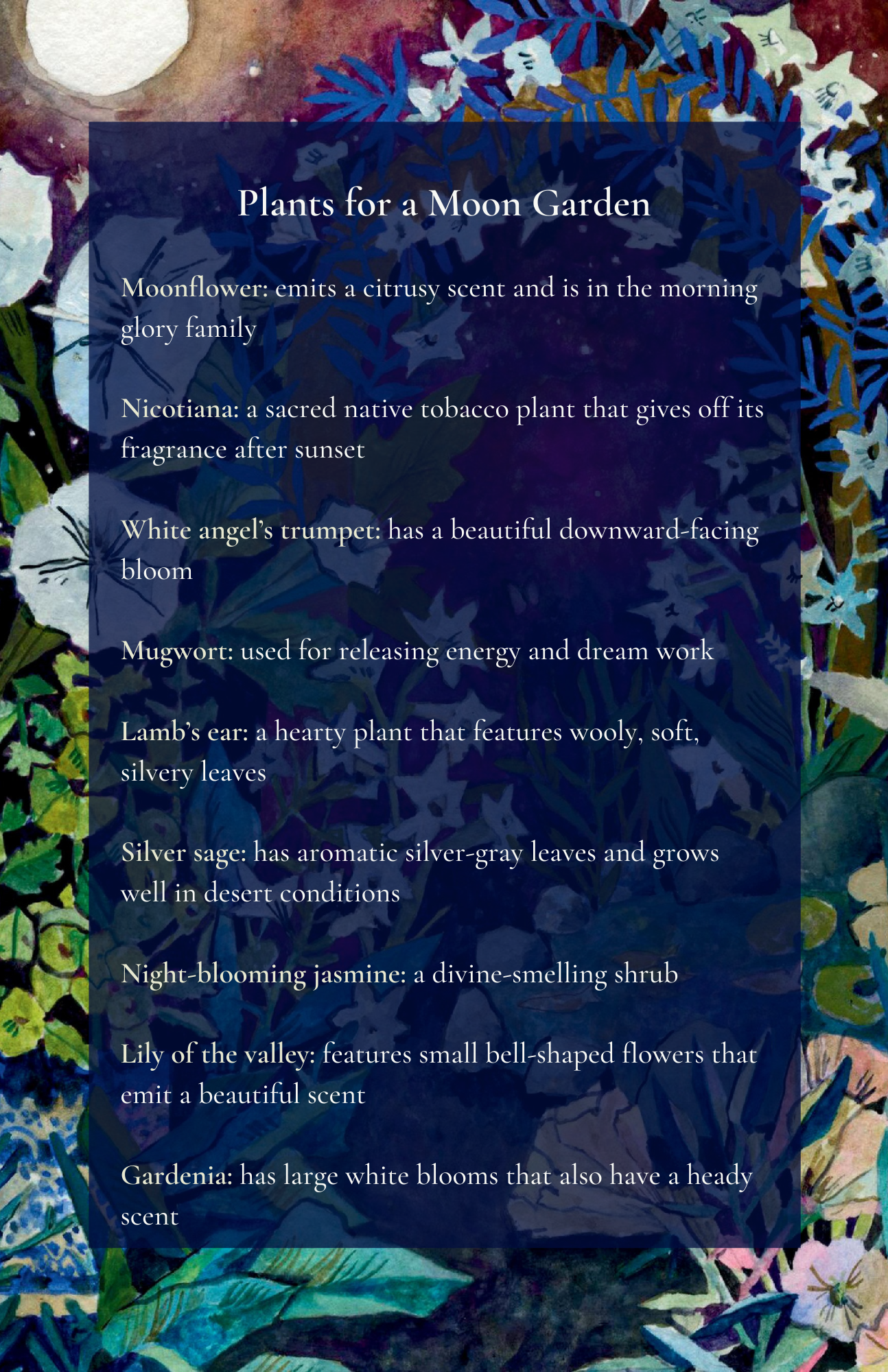
Here are some perfect moon garden plants:

plants for a moon garden


The video on how to make your own flower essence medicine can be found here.

This is an excerpt from The Bloom Book: A Flower Essence Guide to Cosmic Balance by Heidi Smith.


Heidi Smith, MA, RH (AHG), is a psychosomatic therapist, registered herbalist, and flower essence practitioner. Within her private practice, Moon & Bloom, Heidi works collaboratively with her clients to empower greater balance, actualization, and soul-level healing within themselves. She is passionate about engaging both the spiritual and scientific dimensions of the plant kingdom, and sees plant medicine and ritual as radical ways to promote individual, collective, and planetary healing. She lives in Brooklyn, New York, with her partner and two cats. For more, visit moonandbloom.com.


bloom book cover

Learn More

Sounds True | Amazon | Barnes & Noble | Bookshop