We’re all beautiful in different ways. To see this beauty in everyone around you only takes a little kindness and patience. This is just one of the many deep insights you’ll hear in this podcast with author and former supermodel Paulina Porizkova. Here, Tami Simon speaks with Paulina about her book No Filter, and how “the world is so full of beauty on every level if you stop to look for it.”
Give a listen as Tami and Paulina talk about the trouble with the word “still”; our cultural bias about youth and beauty; opposing the marketing forces deciding the standards of beauty; self-acceptance and confidence that comes from within; Paulina’s hashtag, “#BetweenJLoAndBettyWhite”; a new vision for the modeling industry; internal beauty; vulnerability and connection; the freedom of acceptance; starting from zero and rebuilding your life with the wisdom of age; and more.
Note: This episode originally aired on Sounds True One, where these special episodes of Insights at the Edge are available to watch live on video and with exclusive access to Q&As with our guests. Learn more at join.soundstrue.com.
It’s time to start unraveling the mystery of you by exploring your current state of mind. Think of this as an adventure, a path toward greater self-understanding and self-compassion—and an expanded appreciation of the complexity of you. To get a sense of the modern-world issues that tend to rile or upset you, put on your imaginary miner’s hat and head into the depths of your mind to see what lies below your conscious awareness. (You may want to do this with a trusted friend or partner.)
Consider your true feelings about the following subjects, without letting preconceived ideas about the right or politically correct way to think or feel about these subjects guide you; simply let your real feelings flow out of you in a free-association style.
Have a journal and a piece of paper ready. As you read the following words and phrases, jot down the first three to five words or phrases that come to your mind in response (don’t edit or change what occurs to you instinctively):
• Climate crises
• Me Too scandals
• Human rights abuses (on a grand scale)
• Political corruption
• Racial, religious, gender, or political discrimination
• Environmental threats (toxins in our midst)
• Volatile financial circumstances
• Natural disasters (wildfires, floods, storms)
• International threats
• Social divisiveness in this country
• Hate crimes
• Nuclear weapons threats
• Gun violence
If other current events are triggering emotional inflammation for you, write them down in your journal or on a piece of paper.
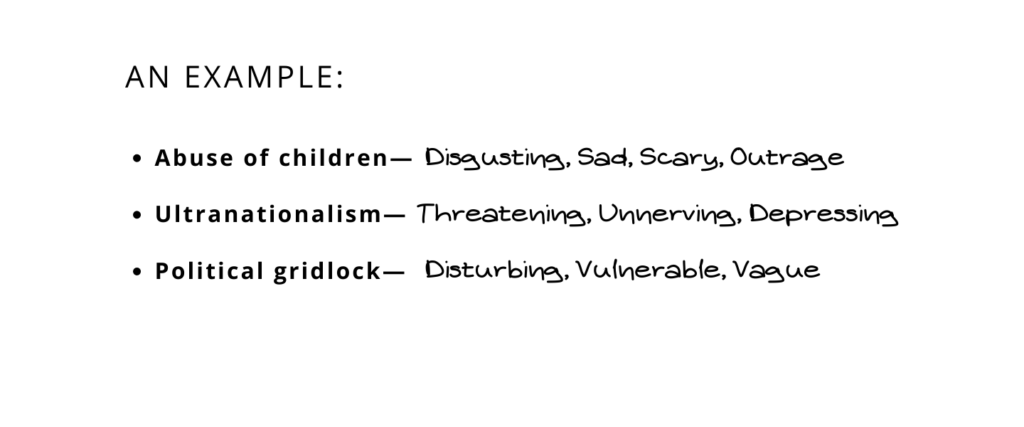
Don’t worry if you feel put on the spot, thought-tied, and unable to come up with the right words to describe how you feel in response to the prompts listed above. Take a deep breath, exhale, and peruse this sample response. Rather than letting this person’s examples sway or influence you, try to use them as inspiration to unlock the floodgates on your true feelings.
Now it’s your turn!
After you’ve completed your list, assign a value to each of these concerns in terms of their potency for you on a scale of 0 to 3 (with 0 being neutral and 3 being intense). Do this quickly so you don’t have too much time to think about it or second-guess your instinctive responses. Once you’ve finished this, place these triggers into a hierarchical list from a potency of 3 to 0, based on how they affect or resonate with you. This will give you a sense of what is likely to get you riled up these days.
If you want to dig a bit deeper, think about the way you responded to the descriptions of certain triggers—that you felt disgusted, violated, sad, and threatened when you thought about Me Too scandals, for example—then consider whether any situations from your past have evoked similar feelings for you. As you may see, emotional injuries or reverberations from the past can make you vulnerable to similar insults and assaults in the present. It’s almost as if you have an emotional ember lying beneath your consciousness, and it’s predisposed to flaring up from time to time. If you hear a single piece of distressing news and find yourself reacting surprisingly strongly to it, think about what else may be crashing around you or whether the news has somehow opened Pandora’s box and exposed you to a deep abyss of other fears and worries. Or it may be that a more superficial emotional injury is on the way to healing but then the scab gets ripped off and the wound bleeds again when another upsetting event occurs.
As it happens, we often experience emotions in our bodies, and sometimes our bodies register those feelings before our minds do. So if you have trouble pinpointing how you’re feeling with words, you may want to scan your body for clues. When researchers in Finland performed a series of cross-cultural studies with 701 people from West European and East Asian cultures, they had the participants view various words, stories, movies, or facial expressions, then color specific regions on silhouettes of bodies where they felt activity increasing or decreasing while they viewed each stimulus. This exercise in mapping bodily sensations in response to emotions revealed that basic emotions—including anger, fear, disgust, happiness, sadness, and surprise—were associated with sensations of elevated activity in the upper chest, which likely reflects changes in breathing and heart rate. Increased sensations in the arms and torso were associated with anger. Decreased sensations in the arms and legs corresponded to sadness. And increased sensations in the gut (the digestive system) and throat were found primarily with disgust. The most fascinating revelation was that these effects rang true among people cross-culturally.
So if you have a mental block that makes it difficult to recognize your emotional triggers (which some people do, in a subconscious effort to protect themselves from emotional discomfort), paying attention to your bodily sensations can give you clues about what you’re experiencing. Even if you are highly attuned to your emotional reactions, sometimes they can sneak up on you, and you might experience a particular bodily sensation before you are aware of the actual trigger or your response to it. That’s because we all have blind spots to reflexive emotional states we’re susceptible to experiencing.
Ruth King is a life coach and insight meditation teacher of the dedicated practitioner program at Spirit Rock Meditation Center. She’s the author of the book Healing Rage: Women Making Inner Peace Possible. In this special edition of Insights at the Edge hosted by Sounds True producer Kriste Peoples, Ruth explains the difference between anger and rage, as well as how examining the patterns of our rage can help us both understand its source and channel its animating energy. They talk about how rage covers over our soft spots and how the experience of it can lead into fruitful lovingkindness practice. Finally, Kriste and Ruth speak on how a deep understanding of these concepts can help craft healing conversations around racial difference and injustice. (69 minutes)
Dr. Friedemann Schaub is a physician best known for his breakthrough programs for the treatment of fear and anxiety disorders. The author of the Sounds True book The Fear and Anxiety Solution, Dr. Schaub has developed a method of self-empowerment that combines his medical expertise with NLP (Neuro-Linguistic Programming), timeline therapy, and clinical hypnotherapy. In the first half of a two-part conversation on Insights at the Edge, Tami Simon speaks with Friedemann about how we can develop a language that lets the subconscious and conscious mind work in harmony. Dr. Schaub also outlines the root causes of anxiety and leads us through the Pattern Resolution Process for resolving emotional wounds. (69 minutes)
What if the most transformative place you could go isn’t a retreat center or a therapist’s office—but complete and total darkness?
This week, Tami Simon speaks with Andrew Holecek—interdisciplinary scholar, longtime practitioner of Tibetan Buddhism, and author of the new Sounds True book Total Eclipse of the Mind: Unleashing the Power of Darkness for Creativity, Healing, and Transformation—about the practice of dark retreat: full immersion in sealed, lightless environments used by yogis for centuries to accelerate inner transformation.
Holecek calls it the single most transformative practice of his fifty years of meditation, psychedelic exploration, and three-year Tibetan retreat—and in this interview, he explains why.
Join Tami and Andrew to explore:
What actually happens to the mind in extended darkness—and the neurological science behind why it’s so transformative
The descent of the mind through conscious, subconscious, and collective unconscious layers—and what waits at the bottom
Dark retreat as a “sober psychedelic”: how the brain generates its own endogenous DMT in extended darkness
The practice of enantiodromia—when extreme contraction suddenly flips into extraordinary openness
How to work with panic, trauma, and unwanted experience using the “reverse meditation” principle: feel it, but don’t feed it
Why appearances don’t matter in the dark—and why so many people emerge in tears, feeling safe and held for the first time
The four-step process for integrating darkness into daily life, from sleep masks to dedicated dark rooms
This interview was recorded with both Tami and Andrew wearing blackout masks—making it one of the most immersive listening experiences in Insights at the Edge history.
Listen now and discover what’s been waiting in the dark. →
This conversation offers genuine transmission—not just concepts about awakening, but the palpable presence of realized teachers exploring the growing edge of spiritual understanding together. Originally aired on Sounds True One.
This episode is sponsored by Omega Institute, a global gathering hub for lifelong learning and spiritual exploration. Located in upstate New York’s beautiful Hudson Valley, Omega offers weekend workshops, special events, rest and rejuvenation retreats, professional trainings, online learning, and more. Discover what calls to you at eomega.org/true.
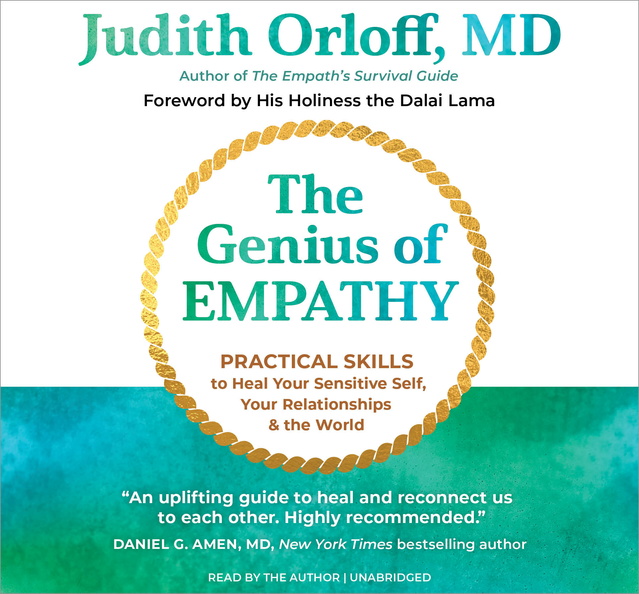
What do I do when a loved one is suffering? How do I have empathy if I’m getting a divorce or losing my job? If my family treats me unfairly? Or if I’m emotionally overwhelmed or in chronic pain?
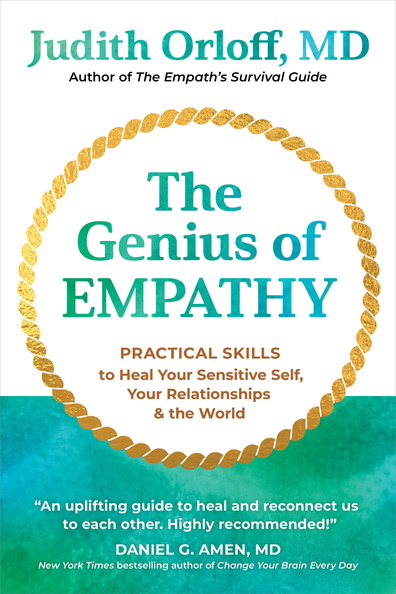
If you’ve ever asked yourself these questions, I’ve written The Genius of Empathy for you. It also includes a beautiful foreword by His Holiness the Dalai Lama.
In the book, I present empathy as a healing force that helps you overcome obstacles in your life with dignity, grace, and power. As a psychiatrist and empath, I draw from my insights and present techniques from my own life and from the healing journeys of my clients, students, and readers. As I say in the book, “Empathy softens the struggle, quiets the unkind voices, and lets you befriend yourself again.”
Empathy doesn’t mean being “on call” 24 hours a day for those in need. Empaths can often wear an invisible sign that says, “I can help you.” However, if you want to heal yourself, have better relationships, and contribute to healing our tumultuous world, you must learn how to set healthy boundaries and observe, not absorb, the energy of others.
To start taking a more proactive role in how much empathy you give others at any one time, I suggest that you keep in mind the following “rights.” They will help you maintain a healthy mindset and prevent or lessen any empathy overwhelm that might arise:
I have the right to say a loving, positive “no” or “no, thank-you.”
I have the right to set limits with how long I listen to people’s problems.
I have the right to rest and not be always available to everyone.
I have the right to quiet peacefulness in my home and in my heart.
Practice: Take a Sound Break to Repair Yourself
Plan periods of quiet to recover from our noisy, fast-paced world. This helps calm your nervous system and your mind, an act of self-empathy.
It’s rejuvenating to schedule at least five minutes of quiet or, even better, complete silence for an hour or more where no one can intrude. As I do, hang a Do Not Disturb sign on your office or bedroom door. During this reset period, you’ve officially escaped from the world. You’re free of demands and noxious sounds. You may also get noise canceling earbuds to block out noise.
If too much quiet is unsettling, go for a walk in a local park or a peaceful neighborhood to decompress from excessive sound stimulation. Simply focus on putting one foot in front of the other, which is called mindful walking. Nothing to do. Nothing to be. Move slowly and refrain from talking. If thoughts come, keep refocusing on your breath, each inhalation and exhalation. Just letting life settle will regenerate your body and empathic heart.
Embracing your empathy does require courage. It can feel scary. If you’re ready to discover its healing power, I would be honored to be your guide to helping you in overcoming your fears and obstacles, and enhancing this essential skill for long-term change.
Though many of us have never met, I feel connected to you. Connection is what fuels life. While empathy is what allows you to find peace. With both, we can make sense of this world together.
Digital Audio
Ignite empathy as a superpower for personal healing, deeper relationships, and more potent work in the world. New York Times bestselling author Dr. Judith Orloff draws on insights from neuroscience, psychology, and energy medicine to show us how to access our sensitivities, soothe our nervous systems, and embody our most fierce and authentic selves.