6 Principles for Befriending Yourself: Part III

June 8, 2019

6 Principles for Befriending Yourself, Matt Licata, Jeff Foster


Enjoy this third and final installment in our new mini-series of Befriending Yourself, written by Jeff Foster and Matt Licata. Ready to go deeper? Check out their new monthly online community! Get all the details here. 


In our previous excerpts (which you can view the first installment here and the second installment here if you missed it!), we discussed the first four principles of befriending yourself:

  1. STOP TRYING TO BE HAPPY (happiness is not something you can “do”)
  2. TRUE MEDITATION IS NOT WHAT YOU THINK (it’s what you are)
  3. “ONE MOMENT AT A TIME” (this one idea could save your life)
  4. SUFFERING IS OPTIONAL (but sometimes pain and grief are inevitable)


Here are the final two principles on befriending yourself…


 5. WORDS ARE MAGIC SPELLS  (so cast them wisely!)

We can get so tangled up in concepts and words, especially heavily weighted spiritual and psychological concepts such as “awareness,” “ego,” “integration,” and even “healing.” We forget that words – no matter how subtle and profound – can never, ever capture our first-hand embodied experience. Words always come after the fact. Concepts are general and abstract, and not subtle, nuanced, specific, or concrete enough to match the sheer uniqueness of what you are experiencing in one here-and-now moment.

Does the word “flower,” the idea of it, really capture the sheer inner mystery of a flower? Does the word “anxiety” really begin to capture the sheer LIFE surging through the body in a given moment?

For example, rather than saying to yourself, “I’m anxious,” (or scared or angry or lonely or bored, etc.), as an experiment, try dropping the word, and attuning to the actual lived experience you are encountering in the moment, which will be very unique for you. In other words, come out of the mind and its thoughts and ideas and judgements and stories and negativity about anxiety, and come back to your body in the present moment. Be a beginner. Meet the moment as if you didn’t know anything about anxiety, but wanted to connect with it for the first time. It is this “Beginner’s Mind,” as they say in Zen, that is the wellspring of meditation.

Ask yourself, “How do I know I’m anxious? What is my lived experience of anxiety? Where do I feel what I call “anxiety” most strongly in my body, RIGHT NOW? What is happening in my belly, chest, throat, head, RIGHT NOW? Can I begin to bring attention to the raw sensations in my body, without judging them, without trying to get rid of them, without trying to escape them or make them go away?”

What kind of sensations do you notice? Are they fluttering, pulsating, throbbing? Are they moving fast or slow? Do they feel shallow or deep in the body? Are they warm or cold? Are they intense or gentle? Are they moving in straight lines, circles, zig-zags? Are they sharp or dull? How far under the skin are they? Do they change when you bring awareness to them? Do they become more intense? Less intense? Do they expand or contract? Do they start moving around in the body?

Can you become curious about all this life in your body, without trying to fix or change it? Feel or imagine your breath moving into the sensations, so you are bringing the warmth of your presence and the gentleness of your breath to this contracted, aching, sore place. Perhaps this is just a part of your body that is starved of attention and oxygen. Breathe into that place that feels tight, contracted, bound-up. This is an act of love.

Say to yourself, “These are just sensations. They are just the intelligence of the body. They are not dangerous. They are just LIFE. They are not hurting me. They are not working against me. They are not a mistake. They are not a sign that there is something wrong in this moment, or that I have failed in some way. They are just parts of me longing for love and kindness. They are the abandoned parts, the parts I need to take care of right now..”.

Scientific research over the last couple of decades in the area of mindfulness and self-compassion suggests that courageously bringing curious, accepting, non-judgemental present-moment attention to sensations in our body, even if they are intense and uncomfortable (and therefore “unwanted”), can soothe our nervous system’s more urgent fight-or-flight response and help us to access the slower, empathic circuitry of the prefrontal cortex. Slowly, over time, we can build tolerance for difficult experience, come to discover its ultimate workability, and eventually use our hooks, triggers, and activations as invitations into deeper holding and compassion for ourselves and others. We can come to realise that feelings and sensations in our bodies are ultimately safe, even if they feel unsafe.

What is happening inside you is unique, unprecedented, vast, and majestic, and will never be captured by experience-distant concept words like “unworthy,” “anxious,” or “ashamed,” which – if you think about it – are all other people’s words, given to you when you were young, or by the medical community, or by a culture who has fallen out of touch with the wisdom of raw experience. There is a world before words, before the mind itself. And in that world, you may find the peace and wholeness you seek.

Even if the intensity of sensation does not diminish with our kind and curious attention, that intensity begins to occur in a much vaster space, in a larger context, one that is warmer, more open, and safer than we imagined. Instead of being caught up inside a feeling or mood or bundle of sensations, we recognise that these energies are actually caught up in us. We are actually bigger than any thought, sensation or feeling. We can begin to hold our fear and boredom and sorrow, so they don’t hold us. We are not the victims of our anger and confusion, we are the space for them, the vast open sky in which they can come and go. Some call this space Awareness, but we could also call it Love. Or Who You Really Are.


THE SECRET OF “HOLDING, NOT HEALING” (“negativity” as a call for love)

Imagine or visualise a difficult thought, feeling, urge, or emotion as a child knocking at your door. Allow your challenging present experience to take form, imaginatively, as a young child (or other figure) that you can enter into a relationship with.

If you are feeling sad, for example, imagine a sad child arriving at your door and knocking, wanting to come in. Perhaps they are cold, confused, shaking, and exhausted from a long journey. They have not come to harm you in any way, but just to be held, to be allowed back home, into the warmth of your heart. Once inside, we can sit with them and have a conversation: Why have you come? What do you need? What do you want to show me? We can listen to the wisdom they have to share, and help them to release any burden they have had to carry on our behalf.

How would you respond to this frightened little one when you opened the door?

Would you slam the door in his or her face and distract yourself with TV or food (or even spiritual beliefs and practices) and try to forget them? Would you lock the door? Would you look sternly at them and state that they are welcome to come in… once they have changed? Once the sadness has been transformed to joy, the anxiety to calm, the uncertainty to clear-knowing… ah, then yes you can enter?

Or would you allow this one in to the living room of your own heart, Now, where you can listen and tend to them with curious, loving awareness? Would you open your arms wide to them, and let them come home?

It can be helpful to turn a difficult thought, feeling, memory, urge, or impulse into a figure with which you can dialogue or have a conversation. Doing so allows us to open our hearts to our pain, our emotions, and our experience rather than relate to it merely conceptually or from a distance. It’s not easy or natural to cultivate a caring, interested, warm relationship with a concept, such as “grief,” “shame,” or “rage.” But to meet a grieving child, or figure who is ashamed or enraged, we can more naturally move closer to them, listen to them, open a dialogue with them, and bring movement into our experience where maybe it had become stuck. Rather than becoming flooded or swallowed up by this energy, imaginatively allow it to form in front of you where you can ask it why it has come, what it needs to show you, what it wants. This is how you can begin to reclaim your power in the face of a scary, uncomfortable, unknown, or difficult energy. See it as a lost and helpless and forgotten part of you, looking for your help, seeking love, not an enemy or a dangerous force from outside of you.

“Befriending” is not as much about “healing” as it is “holding.” In true befriending, we do not have a heavy agenda to change, shift, fix, cure, transform, or, surprisingly, even “heal” this energy. From this perspective, we are never “unhealed” or “untransformed”, really. We are not a project to be improved, but a mystery coming into form, moment by moment. We are always whole, even in moments of intensity and discomfort. We were never not whole (healed).

By “holding” our experience in any moment instead of rushing to try and fix it or run from it, we are inviting relationship with the present “visitors” – the thoughts, feelings, images, and impulses – that have come in a moment of activation, without falling into the extremes of either denying or repressing them on one hand, or becoming fused with or flooded by them on the other. We disentangle a bit from them so that we can enter into loving relationship. We can practice a certain kind of intimacy with them, but without fusing or identifying, or drowning in thoughts, feelings, and sensations. We can dialogue with them and even have boundaries with them, letting them know of our intention to move toward them, but only in a way and at a pace that works for us. We can take back our power from the ‘dark’ material within.

In our own unique ways, through experimentation and curiosity, we discover a sacred middle place between repressing a thought or feeling, or habitually and unconsciously expressing it or acting it out. In this middle place, this third possibility, we slow down, and breathe, and infuse the visitor with curiosity and loving breath:

“I am here to meet with you, to hold you, to listen to you, to care for you. But not to be flooded or fused with you. Let us be true friends. I trust that you are just a part of me, needing love. I want to get to know you, moment by moment. This is a beginning, not an end…”

Remember this image of holding in moments of activation and overwhelm, in both its personal and transpersonal dimensions. We can hold ourselves and parts of ourselves when we are triggered and hurting, but we can also relax into a kind of Sacred Holding that is always, already happening through something greater than us. We are holding and we are already being held – by the Earth, by the sky and the mountains and forests and oceans, by the Universe itself, by the Loving Mystery that is every living thing.

Even in the moments we feel we cannot “hold” ourselves, we are already being held by Life. Even in the moments the present moment feels “unbearable,” Life is bearing us. This is the true definition of surrender. It is not something we can understand with the mind.

 Ultimately we do not “do” healing. Healing is “done” to us in the moment where we stop struggling against life and our own thoughts and feelings and relax into the Mystery.

As we let go of the inner war with our experience, soften into this instant of life and open our heart and being to what’s here – even if what’s here is uncomfortable, raw, scary, and intense – we are no longer victims of the moment, but become the infinite and victorious Power that allows the moment to be, the Calm in the midst of life’s storm.

Our power lies not in refusing the moment, but softening into it. There is strength in our vulnerability, power in our willingness to open our arms to whatever the moment brings.


Thank you for reading this series on the mysterious dance of being and befriending! Our words are intended as “fingers pointing to the moon,” as they say in Zen. You will find your own way into the vastness and sheer mystery of your experience. May you honor your wildness, your individuality and eccentricity, as you take your own unique journey to the Home you never left. We hope these words have helped point you in the right direction… one that leads back to YOU.

As Rumi reminds us…

 “There are hundreds of ways

to kneel and kiss the ground.”


We hope you enjoyed our new mini-series of Befriending Yourself, written by Jeff Foster and Matt Licata.Ready to go deeper? Check out their new monthly online community! Get all the details here. 


ABOUT THE AUTHORS

JOIN JEFF FOSTER AND MATT LICATA EACH MONTH IN THEIR NEW “BEFRIENDING YOURSELF” MEMBERSHIP SITE: www.befriendingyourself.com

6 Principles for Befriending Yourself, Matt Licata, Jeff Foster

MATT LICATA

Matt Licata, PhD is a psychotherapist, writer, and independent researcher based in Boulder, Colorado. Over the last 25 years, he has been active in the ongoing dialogue between depth psychological and meditative approaches to emotional healing and spiritual transformation.

His psychotherapy and spiritual counseling practice has specialized in working with yogis, meditators, and seekers of all sorts who have come to a dead-end in their spiritual practice or therapy and are longing for a more embodied, creative, imaginative way to participate in their experience, in relationship with others, and in the sacred world.

Matt’s spiritual path and exploration has been interfaith in nature and includes three decades of study and practice in Vajrayana Buddhism, Sufism, Daoism, and Contemplative Christianity. His psychological training and influences have been in the larger field of relational psychoanalysis, Jung’s analytical and alchemical work, and Hillman’s archetypal psychology, to  name a few. He is the editor of A Healing Space blog and author of The Path is Everywhere: Uncovering the Jewels Hidden Within You (Wandering Yogi Press, 2017) and the forthcoming A Healing Space: Befriending Yourself in Difficult Times (Sounds True, 2020). His website is www.mattlicataphd.com


JEFF FOSTER

Jeff Foster studied Astrophysics at Cambridge University. In his mid-twenties, struggling with chronic shame and suicidal depression, he became addicted to the idea of “spiritual enlightenment” and began a near-obsessive spiritual quest for the ultimate truth of existence. The search came crashing down one day, unexpectedly, with the clear recognition of the non-dual nature of everything and the discovery of the “extraordinary in the ordinary.” Jeff fell in love with the simple present moment, and was given a deep understanding of the root illusion behind all human suffering and seeking.

For over a decade Jeff has been traveling the world offering meetings and retreats, inviting people into a place of radical self-acceptance and “Deep Rest.” He has published several books in over fifteen languages. His latest book is The Joy of True Meditation: Words of Encouragement for Tired Minds and Wild Hearts (New Sarum Press, 2019). His website is www.lifewithoutacentre.com


Jeff Foster

Photo of ()\

Jeff Foster shares from his own awakened experience a way out of seeking fulfillment in the future and into the acceptance of "all this, here and now." He studied astrophysics at Cambridge University. Following a period of depression and physical illness, he embarked on an intensive spiritual search that came to an end with the discovery that life itself was what he had always been seeking.

Foster, Jeff © Emily Goodman


Listen to Tami Simon's in-depth audio podcast interviews with Jeff Foster:
The Deepest Acceptance »
The Deepest Acceptance: Part 2 »
Unconditioned Awareness and the Challenges of Everyday Life »

Matt Licata

Matt Licata, PhD, is a practicing psychotherapist and hosts in-person retreats. His work incorporates developmental, psychoanalytic, and depth psychologies, as well as contemplative, meditative, and mindfulness-based approaches for transformation and healing. He co-facilitates a monthly online membership community called Befriending Yourself, is author of The Path Is Everywhere, and is the creator of the blog A Healing Space. He lives in Boulder, Colorado. For more, visit mattlicataphd.com.

Author photo © Krista Marleena

Listen to Tami Simon's in-depth audio podcast interview with Matt Licata:

The Alchemy Of Befriending Ourselves In Difficult Times  »

Also By Author

Victory! A Poem

Victory!

By Jeff Foster


You don’t have to be the best. 

You don’t have to win. 

You only have to be yourself.


You only have to be real. 

And speak from the heart. 

And know that you have the right to see how you see, 

and think how you think, and feel what you feel, 

and desire what you desire.


You don’t have to be a success in the eyes of the world 

and you don’t have to be an expert on living.


You only have to offer what you offer, 

breathe how you breathe, make mistakes and screw 

up 

and learn to love your stumbling and say the 

wrong thing 

and stop worrying so much about impressing anyone 

because in the end you only have to live with yourself


and joy is not given but found in the deepest 

recesses of your being 

so there can be joy in falling and joy in making 

mistakes 

and joy in making a fool of yourself and joy in 

forgetting joy 

and then holding yourself close as you crumble to 

the ground 

and weep out the old dreams.


Joy is closeness 

with the one you love: 

You.


You don’t have to be the best. 

You really don’t have to win.


You only have to remember this intimacy with 

the sky, the nearness of the mountains and feel the sun 

warming your shoulders and the nape of your neck


and know that you are alive, 

and that you are a success at being alive, 

and that you have won already, 

and you are victorious already, 

without having to prove 

a damn 

thing.


To anyone.

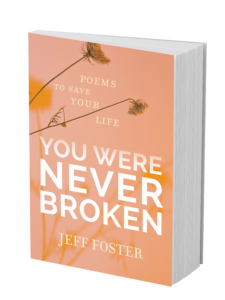
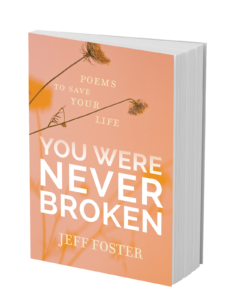
This poem is excerpted from You Were Never Broken: Poems to Save Your Life by Jeff Foster.


jeff fosterJeff Foster shares from his own awakened experience a way out of seeking fulfillment in the future and into the acceptance of “all this, here and now.” He studied astrophysics at Cambridge University. Following a period of depression and physical illness, he embarked on an intensive spiritual search that came to an end with the discovery that life itself was what he had always been seeking.


book cover

Learn More

Sounds True | Amazon | Barnes & Noble | Bookshop

The Courage to Stand Alone

The Courage to Stand Alone

It can be scary when we are called to confront our aloneness, the seemingly infinite depths of that empty, homeless feeling inside of us. When all our old protections fall away and the abandoned and neglected ones inside come begging for our love and attention. It can feel sometimes as though there’s nowhere to turn, like we want to crawl out of our own skin, urgently get out of the Now and into some other time or place.

It takes bravery to stop, breathe, and—slowly, slowly, slowly—turn back toward the lonely, dark, empty “void” inside (in reality, there is no void). To actually turn to face the sense of abandonment buried deep within our guts, to soften into the sense of separation that has been with us for as long as we can remember. We don’t have to make the feeling go away today, only lean into it, breathe into it, begin to make room for it, maybe even learn to trust its presence. 

quote image

Perhaps loneliness is like a cosmic nostalgia, a preverbal memory of a deep womb-connection, with ourselves, with the planet, with every being who has ever lived. In leaning into our own loneliness, shame, and existential anxiety, we may be able to touch into compassion for the loneliness of every human being, for every heart longing to connect, for every grieving heart, every frightened heart. 

We are alone, yet never alone. This is the great paradox of existence. Our loneliness, when not resisted or numbed away, may actually end up connecting us more deeply to life and each other, like it did for me and my sweet father that winter evening. 

Let us learn to be alone, then! Alone, without distraction, which is true meditation. Alone, communing with the breath as it rises and falls. Alone with the mind and its incredible dance. Alone with the rain and the morning sun. Alone with the crackle of autumn leaves under our feet, or the crunch of winter snow. Alone with the hopes and joys and anxieties of this human form, living a single day on this remarkable planet. Alone with our precious selves, with this unfathomable sense of connection to all things, with birth and loss and death and their myriad mysteries. 

Alone, with all of life.

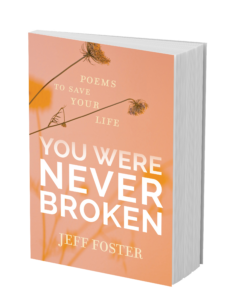
This is an excerpt from You Were Never Broken: Poems to Save Your Life by Jeff Foster.

jeff fosterJeff Foster shares from his own awakened experience a way out of seeking fulfillment in the future and into the acceptance of “all this, here and now.” He studied astrophysics at Cambridge University. Following a period of depression and physical illness, he embarked on an intensive spiritual search that came to an end with the discovery that life itself was what he had always been seeking.


book image of excerpt on lonliness

Learn More

Sounds True | Amazon | Barnes & Noble | Bookshop

Into the Belly of Meditation

Into the Belly of Meditation

By Jeff Foster


You are weary, friend. 

Sit. 

You are thirsty. 

Here. Drink.


You are hungry. Here. Take this. 

A piece of bread. 

A small bowl of soup. 

See how God has taken form! 

It is all I have but it will keep you alive.

image 1

I will light a fire that will never go out. 

A sacred flame. Unconditional in its burning. 

To illuminate us in the darkness.


Oh. I see you are wounded. 

Bruised. Bleeding.

Exhausted from the world. 

You have suffered much, I know.


image 2

Come. 

Take off these dirty rags. 

Don’t worry. It’s safe. 

There is strength in your nakedness.


Here. Wash. 

Rub this medicine onto your wounds.


Put on these robes, they are clean and dry. 

Lie down. Close your eyes. 

I will watch over us tonight.

image 3

Listen. You have not failed. 

I see new life breaking through. 

I see birth. An insurrection. 

The sharp edge of hope.


I have no teaching for you. 

No wise words.


I only want you to trust what you are going through. 

To bring this fire inside of you.

Until the end.


I have known this pain. Yes

This courage to keep moving. Yes

This courage to rest, too.

The sacrifice of the known world.

image 1

Friend. 

Drop into the belly of meditation now. 

The place you were always seeking. 

The vast silence at the Earth’s core which is your own core. 

Breathing into the gut now. 

The throat. The chest. 

Irradiating the nervous system with unspeakable 

tenderness. 

Flooding the body with soft, warm light. 

Drenching the human form with divine love. 

And sleep. 

And sleep.

image 2

I may not be here when you wake. 

We may not meet again in form.


Yet I leave you with all you need. 

Food. Water. A bed. 

A chance to rest. 

A touch of kindness.

And your unbreakable Self.

flowers

This poem is excerpted from You Were Never Broken: Poems to Save Your Life by Jeff Foster.


jeff fosterJeff Foster shares from his own awakened experience a way out of seeking fulfillment in the future and into the acceptance of “all this, here and now.” He studied astrophysics at Cambridge University. Following a period of depression and physical illness, he embarked on an intensive spiritual search that came to an end with the discovery that life itself was what he had always been seeking.


you were never broken cover

Learn More

Sounds True | Amazon | Barnes & Noble | Bookshop


You Might Also Enjoy

Feeding Your Demons: Lama Tsultrim Allione on Turning ...

Fear, self-doubt, and emotional pain have a way of showing up uninvited, and most of us spend enormous energy trying to push them away. What would shift for you if turning toward those experiences, with curiosity and care, became the most healing thing you could do? 

At Sounds True, we have spent four decades connecting people with teachers who ask exactly that kind of question. Our library of transformational teachings, digital courses, and programs exists to help you move through life’s harder moments with greater awareness and inner strength.

We will cover the feeding your demons practice, Lama Tsultrim Allione’s approach to turning towards difficulty, the ancient roots of Machig Labdron Chod and Tibetan shadow work, and how relating to demons as teachers can open a path toward lasting inner growth.

Key Takeaways:

  • Meet Fear with Compassion: The feeding your demons practice invites us to turn toward emotional pain with openness, creating a path toward genuine self-awareness and healing.
  • Ancient Roots, Modern Healing: Rooted in the Tibetan Buddhist lineage of Machig Labdrön, this practice draws from centuries of contemplative wisdom to help transform fear into freedom.
  • Demons Become Your Greatest Teachers: Lama Tsultrim Allione’s teachings reveal that our most difficult inner struggles often hold the most important lessons about where genuine growth is possible.

Discover how your mind really works

Lama Tsultrim Allione: Turning Towards Difficulty 

Lama Tsultrim Allione is a recognized Buddhist teacher, author, and the founder of Tara Mandala, a mountain retreat center dedicated to contemplative practice and spiritual study. She has spent decades teaching within the lineage of Machig Labdrön, the 11th-century Tibetan yogini who founded the Chöd tradition, and has brought her work on Dzogchen teachings to students around the world.

When we treat challenging emotions as teachers, space opens for greater awareness, resilience, and emotional freedom. Her teachings show that turning towards difficulty is one of the most courageous acts of self-care we can practice. Her work sits alongside that of many respected voices we are proud to carry, all of whom you can find on our All Teachers & Authors page.

What Is Feeding Your Demons and Why Do We Avoid What We Fear?

Most of us instinctively turn away from difficult emotions, painful memories, or persistent inner struggles. The practice of feeding your demons offers a different path. Meeting fear, anger, or shame with curiosity and compassion, and asking what those feelings truly need, can begin to shift even the most entrenched patterns.

Lama Tsultrim Allione developed a five-step process for working with disowned emotions without becoming pulled into spirals of negativity. Rooted in both shamanic and Buddhist traditions, this approach weaves ancient practices into a form that feels accessible to modern practitioners. 

Our Spirituality & Awakening collection brings together teachings like these, spanning presence, healing, and inner exploration for those ready to go deeper. Now, let’s see what makes this practice possible.

Map Your Inner Landscape

The practice teaches you to map your demons and recognize how they interconnect. A fear of failure, for example, often links to a deeper sense of unworthiness that surfaces across professional and personal life, creating patterns that repeat until they are met with awareness and care.

Tend, Don’t Fight

One of the practice’s most compelling insights is that tending to your demons can yield real physical results. Chronic tension, restless sleep, and emotional exhaustion often ease when we begin to meet what is present with openness. Practitioners describe a quality of release that resistance alone never creates.

A Gateway to Awakening 

Working with your demons can become a potent gateway to spiritual awakening. When we stop avoiding what frightens us, those very struggles often reveal where we are clinging, where healing is needed, and what genuine growth looks like in practice. These skills help subdue fear and embrace openness, laying the groundwork for deeper spiritual engagement.

Tibetan Shadow Work and Inner Growth 

Tibetan shadow work offers a compassionate framework for working with the parts of ourselves we often reject or ignore. When we meet uncomfortable thoughts with openness, we begin to recognize them as invitations for insight and transformation. The more willing we become to face these hidden aspects, the more inner balance we can cultivate.

The feeding your demons practice is rooted in the ancient tradition of Machig Labdron Chod, a Tibetan Buddhist lineage that teaches transformation through generosity and openness. Machig Labdrön’s teachings hold that we can learn to relate to suffering in a new way, meeting it with care. Symbolically offering nourishment to our fears softens habitual avoidance and creates conditions for lasting healing.

Alongside Chöd, other exercises within this tradition draw from both shamanic and Buddhist practice, including visualization techniques, body-centered awareness, and practices that help us move toward what we would avoid. 

Addressing our demons directly is one of the most powerful commitments we can make to personal growth and transformation. Our Subtle Energy collection supports this kind of inner work, bringing together teachings on energetic awareness for those ready to go deeper.

Discover the Power of Daily Meditation and Inner Stillness

Bringing the Feeding Your Demons Practice into Everyday Life

The principles behind this practice are available in ordinary moments, during daily challenges and quiet pauses alike. When stress surfaces in a difficult conversation, when anxiety arises before something uncertain, or when a familiar pattern pulls at you, meeting what is present with kindness and curiosity can create a real shift.

Start with Simple Awareness 

Begin by noticing when a difficult emotion arises, without immediately trying to resolve it. Naming what you are experiencing, whether fear, grief, or frustration, loosens its hold and creates just enough space to respond with care. This small pause can become one of the most transformative habits.

Work with a Structured Process

Returning to Lama Tsultrim Allione’s five-step approach during moments of emotional intensity gives the practice a clear container. Working with it consistently, even briefly, builds an inner capacity that makes responding to difficulty with compassion feel more natural. Pairing this with regular meditation can deepen the effects.

Engage with Teaching and Community

Connecting with teachers who share this path makes the practice feel less solitary. Many of our teachers share this kind of practical wisdom on the Insights at the Edge Podcast, where leading spiritual voices discuss awareness, compassion, and how to bring transformation into daily life.

Demons as teachers become most vivid when we commit to meeting them consistently, with the same warmth and curiosity we bring to any other form of inner work.

Awaken Your Inner Healing Power: Your Wellness Journey Starts Now

Final Thoughts

The practice of feeding your demons reminds us that lasting transformation often begins by turning toward the parts of ourselves we would rather avoid. Through Lama Tsultrim Allione’s teachings, the wisdom of Machig Labdron Chod, and the tools of Tibetan shadow work, we can learn to meet fear with compassion and recognize demons as teachers. 

As that relationship shifts, more space opens for healing, self-awareness, and inner peace. We are here to walk alongside you in that journey, with teachings, digital courses, and a community that meets you wherever you are on the path. 

Frequently Asked Questions About Feeding Your Demons

What is the purpose of practicing how to feed your demons?

The purpose of feeding your demons is to change your relationship with fear, emotional pain, and inner conflict. Instead of trying to eliminate these experiences, the practice encourages understanding and compassion as a path toward healing.

Do I need to be Buddhist to practice “befriending my demons?”

No. Many people practice feeding their demons regardless of their religious or spiritual background. The method focuses on self-awareness and emotional healing, making it accessible to anyone interested in personal growth.

Can facing your fears head-on help with anxiety?

Many practitioners find the practice helpful for understanding anxious thoughts and emotional patterns. It is intended to complement personal growth and is not a substitute for professional mental health care.

Why are demons described as teachers?

The term “demons as teachers” reflects the idea that our greatest challenges often reveal important lessons about our fears, habits, and unmet emotional needs.

Is feeding your demons the same as shadow work?

They share similar intentions but differ in approach. Tibetan shadow work draws from Buddhist teachings and guided visualization, while other forms of shadow work may use psychological or therapeutic methods.

Can beginners learn how to face their demons through practice?

Yes. Beginners can start by learning the core principles through books, guided audio practices, workshops, or teachings from qualified instructors before developing a regular practice.

How often should I practice Lama Tsultrim Allione’s spiritual exercises?

There is no fixed schedule. Some people use the practice during periods of emotional difficulty, while others include it as part of their ongoing spiritual or mindfulness routine.

Michelle Cassandra Johnson is an author, activist, spiritual teacher, racial equity consultant, and intuitive healer. She is the author of six books, including Skill in Action and Finding Refuge. Amy Burtaine is a leadership coach and racial equity trainer. With Robin DiAngelo, she is the coauthor of The Facilitator's Guide for White Affinity Groups. For more, visit https://www.michellecjohnson.com/wisdom-of-the-hive.

Matthew Fox on Original Blessing: Why You Were Born Go...

What if the first step on your spiritual path wasn’t about fixing something broken in you, but about recognizing how whole you already are? Matthew Fox has spent decades asking this question, and his answer, rooted in the teaching of original blessing, invites us to begin our spiritual lives with wonder rather than with shame.

At Sounds True, we are dedicated to sharing the living wisdom of trusted spiritual teachers through immersive podcasts, digital courses, and transformational programs that support personal growth and awakening.

Here, we’ll walk through Matthew Fox’s teachings on original blessing, creation spirituality, the influence of Meister Eckhart, and how these ideas offer a grounded, compassionate path forward for anyone who longs for a more reverent relationship with life.

Key Takeaways:

  • Learn Why You Were Born Good: Original blessing reframes the spiritual journey by centering humanity’s inherent goodness, offering a life-affirming path rooted in wonder rather than shame.
  • Creation as Sacred Ground: Creation spirituality teaches that the divine is woven into nature, community, and everyday life, inviting us to meet the sacred right where we are.
  • The Mystic Who Shaped Fox: Meister Eckhart’s vision of a God present in all things continues to shape Matthew Fox’s teachings on creativity, compassion, and sacred connection.

Awaken Your Inner Healing Power: Your Wellness Journey Starts Now

Matthew Fox and the Meaning of Original Blessing

Many spiritual traditions begin with the idea that humanity arrived in this world already broken, separated from the divine through original sin. Matthew Fox gently but firmly challenges this starting point. His teaching of original blessing asks us to return to the very beginning, to the opening pages of Genesis, where something far warmer is waiting.

In the first chapter of the Bible, God’s spirit hovers over the waters like a brood hen watching over her eggs, nurturing and alive with creative energy. Fox sees this image as living, not static. God here is a verb, a dynamic creator who calls all of life good. This reading opens with vitality, growth, and a love that precedes any misstep. When we begin from goodness, the spiritual journey takes on a different quality.

Readers who feel called to go deeper into this kind of spiritually grounded inquiry will find our Spirituality & Awakening collection brings together teachings that help cultivate that sense of sacred connection in daily life.

Original Blessing as an Original Sin Alternative

The original sin alternative that Fox offers is a reorientation, not a rejection of accountability or depth. Original blessing invites us to arrive in this life carrying a gift to live, and to let that gift be the foundation. This shifts the entire atmosphere of the spiritual journey.

When we start from goodness, compassion flows more naturally. Responsibility becomes something we can embrace openly. Care for the Earth, for one another, and for ourselves becomes an act of reverence. Fox honors the full complexity of being human. His invitation is simply to stop making the hard parts the foundation.

What Is Creation Spirituality?

Creation spirituality teaches that the sacred is woven into creation itself, present in a forest, in a conversation, in a piece of music that stops you mid-step. The divine isn’t something we reach only by turning away from the physical world. This path invites us to encounter God within it.

Fox describes creation spirituality as a recovery project, a return to the awe that the earliest humans felt standing inside a world too vast and beautiful to explain. That sense of wonder is still available to us. Readers drawn to practices that cultivate this kind of felt presence may find resonance in the teachings within our Subtle Energy collection, which opens pathways into the deeper dimensions of human experience.

Fall Redemption vs Creation Spirituality

The conversation around fall redemption vs creation spirituality highlights two distinct starting points. The fall/redemption framework begins with human failure, emphasizing original sin and the need for rescue. Creation spirituality begins with God’s creative energy already alive and generous in the world. While one starts in the wound, the other starts with the gift.

In fall redemption theology, faith centers on trust in an external authority to restore what was lost. Creation spirituality offers something complementary: faith as trust in the aliveness already present within you and around you. Compared to the fall redemption theory, creation spirituality is feminist and gender-balanced. To hear this conversation in Fox’s own voice, visit our Insights at the Edge Podcast, where he and other teachers speak openly about these ideas in conversation with host Tami Simon.

Uncover Hw Your Mind Really Works With Sounds True

How Meister Eckhart Shaped Matthew Fox’s Teachings

Few thinkers have shaped Matthew Fox’s work as deeply as Meister Eckhart, the 14th-century German Dominican mystic whose writings continue to stir spiritual imagination centuries after his death. Eckhart taught that the divine is not remote or indifferent but present at the very ground of every soul, a living God who dwells within all things.

Fox engaged with Eckhart as a living guide. He saw in Eckhart’s teachings a confirmation of what creation spirituality already sensed: that the sacred pervades the world, that creativity is a form of prayer, and that every person carries a spark of the divine. Fox’s deep engagement with Eckhart helped bring these 700-year-old ideas to contemporary seekers in language they could feel and act on.

Those who want to learn more about Matthew Fox and the many teachers whose work touches these themes can visit our All Teachers & Authors page for a full look at the voices in our community.

Living Original Blessing Through Creation Spirituality

Receiving original blessing isn’t a single moment of insight. Living it is an ongoing practice, a way of meeting each day with a different set of assumptions. Fox’s vision of creation spirituality gives us language for that practice and a few grounded ways to begin.

  • Start the Day with Gratitude: Pause before the mental inventory of what needs fixing. Acknowledge what is already here: your breath, the light, the life moving through you. This is a choice to place goodness at the center of the day before anything else takes over.
  • Let Nature Be a Teacher: Creation spirituality invites us to treat the natural world as a living text. A walk outside, a moment watching clouds shift, or tending a small garden becomes an act of communion. Fox’s work reminds us that the Earth participates in the sacred, and that paying attention to it is itself a form of prayer.
  • Create Without an Agenda: Fox views creativity as one of the most direct expressions of divine energy available to us. Cooking, drawing, writing, singing, building — any act of making can become a form of spiritual practice when approached with presence and care.

Discover the Power of Daily Meditation and Inner Stillness

Final Thoughts

Matthew Fox’s teachings ask us to do something both simple and radical: begin with ourselves as good. From that foundation, creation spirituality opens into a way of living that honors the sacred in everything, in other people, in the natural world, in the creativity and care we bring to ordinary days. The influence of Meister Eckhart runs through all of this as a reminder that this longing to find the divine close has deep roots.

Frequently Asked Questions About Matthew Fox on Original Blessing

What is Matthew Fox best known for?

Matthew Fox is a spiritual teacher, theologian, and author known for developing creation spirituality, a path that emphasizes the sacredness of creation and humanity’s inherent goodness.

Why did Matthew Fox write about original blessing?

Matthew Fox introduced the concept of original blessing to encourage a more life-affirming view of spirituality. His teachings invite people to begin with gratitude and sacred connection instead of focusing on human faults.

Is original blessing a religious belief?

Original blessing is a spiritual perspective that can resonate with people from many faith traditions. It emphasizes the goodness of creation and encourages a deeper relationship with the divine through everyday life.

How does creation spirituality relate to environmental care?

Creation spirituality teaches that the natural world is sacred. This perspective encourages respect for the Earth and inspires people to care for the environment as an expression of their spiritual values.

Who was Meister Eckhart, and why is he important?

Meister Eckhart was a Christian mystic whose teachings emphasized experiencing the divine within. His writings continue to influence spiritual thinkers, including Matthew Fox.

What can readers gain from Matthew Fox’s teachings?

Readers often find a renewed sense of purpose, compassion, and connection with the world. His teachings encourage a spiritual practice rooted in gratitude, creativity, and reverence for life.

Why does Matthew Fox emphasize creativity?

Matthew Fox views creativity as a reflection of the divine. Artistic expression, problem-solving, and innovation can all become meaningful spiritual practices that celebrate the gift of creation.

Michelle Cassandra Johnson is an author, activist, spiritual teacher, racial equity consultant, and intuitive healer. She is the author of six books, including Skill in Action and Finding Refuge. Amy Burtaine is a leadership coach and racial equity trainer. With Robin DiAngelo, she is the coauthor of The Facilitator's Guide for White Affinity Groups. For more, visit https://www.michellecjohnson.com/wisdom-of-the-hive.

Sharon Salzberg on Real Happiness: The Myth of Permane...

Happiness is often seen as a destination, but Sharon Salzberg reminds us that it is a practice we cultivate each day. Rather than seeking a life free from challenges, she encourages us to meet every experience with mindfulness, compassion, and an open heart. Her teachings offer a practical path toward greater peace and emotional resilience.

At Sounds True, we have been sharing the wisdom of trusted spiritual teachers for more than four decades, making transformational teachings accessible through audio recordings, digital courses, and programs that nurture personal growth and mindful living. 

In this piece, we’ll discuss Sharon Salzberg’s perspective on real happiness, the myth of permanent happiness, and how loving kindness meditation and metta meditation can help cultivate lasting well-being.

Key Takeaways:

  • Happiness Is a Daily Practice: Sharon Salzberg describes real happiness not as a fixed emotional state but as a living practice grown through awareness, presence, and an open heart.
  • Metta Opens Your Heart: Loving-kindness meditation and metta meditation build a foundation for compassion, soften self-judgment, and deepen your connection with those around you.
  • Consistency Builds Resilience: A regular loving kindness practice, even just a few quiet minutes each day, can reshape how you move through difficulty and strengthen the relationships that matter most.

Awaken Your Inner Healing Power: Your Wellness Journey Starts Now

Sharon Salzberg on Real Happiness and the Myth of Permanent Happiness

Sharon Salzberg has been a student of Buddhism since 1971 and began leading meditation retreats worldwide in 1974. Drawing on more than twenty-five years of deep study with Burmese, Indian, and Tibetan teachers, her work centers on two foundational traditions: vipassana, also known as insight meditation, and the cultivation of lovingkindness and compassion, called the Brahma Viharas. 

As one of the most respected insight meditation teachers, she brings ancient wisdom into language that is warm, accessible, and deeply practical for the rhythms of modern life.

The Foundations of Insight Meditation

Insight meditation is a practice rooted in direct observation of experience. Instead of trying to control or silence the mind, practitioners learn to witness thoughts, sensations, and emotions with steady, non-reactive awareness. That quality of clear seeing allows us to recognize that all experience, including the uncomfortable kind, is impermanent. 

Sharon Salzberg says that expecting permanent happiness often creates unnecessary suffering. Joy and sorrow naturally come and go, and trying to hold onto pleasant experiences only leads to frustration. Rather than measuring life by how often we feel happy, she encourages developing the inner stability to face every experience with openness and care.

Real happiness, in Sharon’s view, grows from acceptance rather than control. As we grow more aware of our thoughts and emotions, we come to see that difficult moments do not define us. Sharon’s teachings on this topic are part of an ongoing conversation we host through the Insights at the Edge Podcast, where leading spiritual teachers share practical wisdom for navigating everyday life with greater awareness and heart.

Loving Kindness Meditation and the Path to Inner Peace

One of Sharon’s most influential teachings is loving kindness meditation. This practice invites us to cultivate goodwill toward ourselves before extending that same warmth outward to others. Rather than forcing positive emotions, loving kindness meditation strengthens our capacity to respond with patience and compassion, even when life makes that difficult.

Sharon’s Loving-kindness program gets at something essential about why this practice matters. Metta meditation is a way to dissolve the mental barriers that quietly separate us from the people around us, and from ourselves. Through consistent practice, we can release feelings of isolation and awaken real compassion. We free ourselves from cycles of needless suffering while learning to trust the loving, wise heart that lives within each of us. 

Loving kindness meditation also helps soften self-criticism while opening the door to more connected, authentic relationships. The shift may be gradual, but it is real and lasting.

Discover the Power of Daily Meditation and Inner Stillness

How Metta Meditation Supports Compassion and Connection

Metta meditation is a structured practice of silently repeating phrases of well-being directed first toward yourself, then extending outward to a close friend, a neutral person, someone with whom you feel friction, and eventually to all beings. The phrases themselves are simple, something like “May you be safe. May you be at peace.” 

Sharon explains that these intentions may seem small at first, yet they reshape how we respond to ourselves and those around us. Rather than waiting for compassion to arise naturally, metta meditation gives us a way to practice it every day. With patience, kindness becomes less of an idea and more of a natural response to life’s changing circumstances.

To see how this works in real life, consider someone navigating tension with a family member after a disagreement. Compassion can feel out of reach in the middle of that kind of friction. A metta practice offers a place to begin, not by pretending the conflict does not exist, but by silently extending well-being first to yourself, acknowledging your own hurt, and then, when ready, to the other person. 

Resources in our Meditation & Mindfulness collection bring together teachings from Sharon and other respected guides, exploring both the depth and the daily application of these traditions to help you build a sustainable practice.

Building a Loving Kindness Practice for Everyday Life

A loving kindness practice does not require long formal sessions. Even a few quiet moments offering kind wishes can create real shifts in daily life. Sharon encourages beginning where we are, knowing consistency matters far more than perfection:

  • Start With Yourself Each Morning. Kindness toward yourself is often the most challenging part of a metta practice. Sharon teaches self-compassion is the ground from which all other compassion grows. Try sitting quietly for five minutes, silently offering words of care: “May I be at peace. May I be well.”
  • Extend Kindness Into Your Relationships. Once the practice becomes familiar, extending it outward grows more natural. A few silent phrases during a commute or before a difficult conversation can shift the texture of an ordinary moment. Compassion is not demanded on a timeline. The practice simply sets the conditions for it to arise.
  • Build Consistency With Short, Daily Sessions. Five to ten minutes of metta practice each morning, paired with brief moments of conscious kindness throughout the day, creates more lasting change than occasional longer sessions. 

Those looking to develop greater gentleness and emotional balance alongside their meditation journey will find resources in our Self-Compassion collection, which brings together teachings from some of the most respected voices in this space.

Discover how your mind really works

Final Thoughts

As Sharon Salzberg shares, real happiness grows through presence, compassion, and a willingness to meet each experience with an open heart. By embracing practices like loving kindness meditation and metta meditation, we can develop greater resilience, deepen our connection with others, and cultivate a more peaceful way of living.

If you would like to continue learning from Sharon and many other respected teachers, visit our All Teachers & Authors page to find teachings that support your own path toward greater presence and compassion.

Frequently Asked Questions About Sharon Salzberg on Real Happiness

What inspired Sharon Salzberg to begin teaching meditation?

Sharon Salzberg’s interest in meditation began during her studies in India, where she encountered Buddhist teachings that shaped her lifelong commitment to mindfulness and compassion.

Why has Sharon Salzberg’s work remained influential for so many years?

Her teachings combine timeless Buddhist wisdom with practical guidance that is accessible, compassionate, and relevant to everyday life, making them meaningful for both new and experienced meditators.

Is loving kindness meditation connected to Buddhism?

Yes. Loving kindness meditation originates from the Buddhist tradition and is based on cultivating unconditional goodwill. Today, it is practiced by people of many backgrounds, regardless of religious belief.

How long should I practice metta meditation each day?

Even five to ten minutes a day can be beneficial. Building a regular habit is generally more effective than practicing for long periods only occasionally.

Can beginners practice loving kindness meditation?

Absolutely. Loving kindness meditation is one of the most approachable meditation practices because it focuses on simple intentions of kindness instead of trying to quiet every thought.

Why do some people find it difficult to offer kindness to themselves?

Many people are accustomed to self-criticism and may initially feel uncomfortable directing compassion inward. Like any skill, self-kindness becomes more natural with consistent practice.

What is the difference between mindfulness meditation and metta meditation?

Mindfulness meditation focuses on observing present-moment experience with awareness, while metta meditation intentionally cultivates feelings of kindness, compassion, and goodwill.

Michelle Cassandra Johnson is an author, activist, spiritual teacher, racial equity consultant, and intuitive healer. She is the author of six books, including Skill in Action and Finding Refuge. Amy Burtaine is a leadership coach and racial equity trainer. With Robin DiAngelo, she is the coauthor of The Facilitator's Guide for White Affinity Groups. For more, visit https://www.michellecjohnson.com/wisdom-of-the-hive.

Leave a Reply

Your email address will not be published. Required fields are marked *