Into the Belly of Meditation

    —
December 21, 2020

Into the Belly of Meditation

By Jeff Foster


You are weary, friend. 

Sit. 

You are thirsty. 

Here. Drink.


You are hungry. Here. Take this. 

A piece of bread. 

A small bowl of soup. 

See how God has taken form! 

It is all I have but it will keep you alive.

image 1

I will light a fire that will never go out. 

A sacred flame. Unconditional in its burning. 

To illuminate us in the darkness.


Oh. I see you are wounded. 

Bruised. Bleeding.

Exhausted from the world. 

You have suffered much, I know.


image 2

Come. 

Take off these dirty rags. 

Don’t worry. It’s safe. 

There is strength in your nakedness.


Here. Wash. 

Rub this medicine onto your wounds.


Put on these robes, they are clean and dry. 

Lie down. Close your eyes. 

I will watch over us tonight.

image 3

Listen. You have not failed. 

I see new life breaking through. 

I see birth. An insurrection. 

The sharp edge of hope.


I have no teaching for you. 

No wise words.


I only want you to trust what you are going through. 

To bring this fire inside of you.

Until the end.


I have known this pain. Yes

This courage to keep moving. Yes

This courage to rest, too.

The sacrifice of the known world.

image 1

Friend. 

Drop into the belly of meditation now. 

The place you were always seeking. 

The vast silence at the Earth’s core which is your own core. 

Breathing into the gut now. 

The throat. The chest. 

Irradiating the nervous system with unspeakable 

tenderness. 

Flooding the body with soft, warm light. 

Drenching the human form with divine love. 

And sleep. 

And sleep.

image 2

I may not be here when you wake. 

We may not meet again in form.


Yet I leave you with all you need. 

Food. Water. A bed. 

A chance to rest. 

A touch of kindness.

And your unbreakable Self.

flowers

This poem is excerpted from You Were Never Broken: Poems to Save Your Life by Jeff Foster.


jeff fosterJeff Foster shares from his own awakened experience a way out of seeking fulfillment in the future and into the acceptance of “all this, here and now.” He studied astrophysics at Cambridge University. Following a period of depression and physical illness, he embarked on an intensive spiritual search that came to an end with the discovery that life itself was what he had always been seeking.
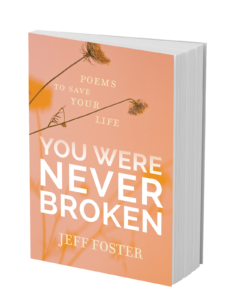



you were never broken cover

Learn More

Sounds True | Amazon | Barnes & Noble | Bookshop


Jeff Foster

Photo of ()\

Jeff Foster shares from his own awakened experience a way out of seeking fulfillment in the future and into the acceptance of "all this, here and now." He studied astrophysics at Cambridge University. Following a period of depression and physical illness, he embarked on an intensive spiritual search that came to an end with the discovery that life itself was what he had always been seeking.

Foster, Jeff © Emily Goodman


Listen to Tami Simon's in-depth audio podcast interviews with Jeff Foster:
The Deepest Acceptance »
The Deepest Acceptance: Part 2 »
Unconditioned Awareness and the Challenges of Everyday Life »

Also By Author

Victory! A Poem

Victory!

By Jeff Foster


You don’t have to be the best. 

You don’t have to win. 

You only have to be yourself.


You only have to be real. 

And speak from the heart. 

And know that you have the right to see how you see, 

and think how you think, and feel what you feel, 

and desire what you desire.


You don’t have to be a success in the eyes of the world 

and you don’t have to be an expert on living.


You only have to offer what you offer, 

breathe how you breathe, make mistakes and screw 

up 

and learn to love your stumbling and say the 

wrong thing 

and stop worrying so much about impressing anyone 

because in the end you only have to live with yourself


and joy is not given but found in the deepest 

recesses of your being 

so there can be joy in falling and joy in making 

mistakes 

and joy in making a fool of yourself and joy in 

forgetting joy 

and then holding yourself close as you crumble to 

the ground 

and weep out the old dreams.


Joy is closeness 

with the one you love: 

You.


You don’t have to be the best. 

You really don’t have to win.


You only have to remember this intimacy with 

the sky, the nearness of the mountains and feel the sun 

warming your shoulders and the nape of your neck


and know that you are alive, 

and that you are a success at being alive, 

and that you have won already, 

and you are victorious already, 

without having to prove 

a damn 

thing.


To anyone.

This poem is excerpted from You Were Never Broken: Poems to Save Your Life by Jeff Foster.


jeff fosterJeff Foster shares from his own awakened experience a way out of seeking fulfillment in the future and into the acceptance of “all this, here and now.” He studied astrophysics at Cambridge University. Following a period of depression and physical illness, he embarked on an intensive spiritual search that came to an end with the discovery that life itself was what he had always been seeking.


book cover

Learn More

Sounds True | Amazon | Barnes & Noble | Bookshop

The Courage to Stand Alone

The Courage to Stand Alone

It can be scary when we are called to confront our aloneness, the seemingly infinite depths of that empty, homeless feeling inside of us. When all our old protections fall away and the abandoned and neglected ones inside come begging for our love and attention. It can feel sometimes as though there’s nowhere to turn, like we want to crawl out of our own skin, urgently get out of the Now and into some other time or place.

It takes bravery to stop, breathe, and—slowly, slowly, slowly—turn back toward the lonely, dark, empty “void” inside (in reality, there is no void). To actually turn to face the sense of abandonment buried deep within our guts, to soften into the sense of separation that has been with us for as long as we can remember. We don’t have to make the feeling go away today, only lean into it, breathe into it, begin to make room for it, maybe even learn to trust its presence. 

quote image

Perhaps loneliness is like a cosmic nostalgia, a preverbal memory of a deep womb-connection, with ourselves, with the planet, with every being who has ever lived. In leaning into our own loneliness, shame, and existential anxiety, we may be able to touch into compassion for the loneliness of every human being, for every heart longing to connect, for every grieving heart, every frightened heart. 

We are alone, yet never alone. This is the great paradox of existence. Our loneliness, when not resisted or numbed away, may actually end up connecting us more deeply to life and each other, like it did for me and my sweet father that winter evening. 

Let us learn to be alone, then! Alone, without distraction, which is true meditation. Alone, communing with the breath as it rises and falls. Alone with the mind and its incredible dance. Alone with the rain and the morning sun. Alone with the crackle of autumn leaves under our feet, or the crunch of winter snow. Alone with the hopes and joys and anxieties of this human form, living a single day on this remarkable planet. Alone with our precious selves, with this unfathomable sense of connection to all things, with birth and loss and death and their myriad mysteries. 

Alone, with all of life.

This is an excerpt from You Were Never Broken: Poems to Save Your Life by Jeff Foster.

jeff fosterJeff Foster shares from his own awakened experience a way out of seeking fulfillment in the future and into the acceptance of “all this, here and now.” He studied astrophysics at Cambridge University. Following a period of depression and physical illness, he embarked on an intensive spiritual search that came to an end with the discovery that life itself was what he had always been seeking.


book image of excerpt on lonliness

Learn More

Sounds True | Amazon | Barnes & Noble | Bookshop

Into the Belly of Meditation

Into the Belly of Meditation

By Jeff Foster


You are weary, friend. 

Sit. 

You are thirsty. 

Here. Drink.


You are hungry. Here. Take this. 

A piece of bread. 

A small bowl of soup. 

See how God has taken form! 

It is all I have but it will keep you alive.

image 1

I will light a fire that will never go out. 

A sacred flame. Unconditional in its burning. 

To illuminate us in the darkness.


Oh. I see you are wounded. 

Bruised. Bleeding.

Exhausted from the world. 

You have suffered much, I know.


image 2

Come. 

Take off these dirty rags. 

Don’t worry. It’s safe. 

There is strength in your nakedness.


Here. Wash. 

Rub this medicine onto your wounds.


Put on these robes, they are clean and dry. 

Lie down. Close your eyes. 

I will watch over us tonight.

image 3

Listen. You have not failed. 

I see new life breaking through. 

I see birth. An insurrection. 

The sharp edge of hope.


I have no teaching for you. 

No wise words.


I only want you to trust what you are going through. 

To bring this fire inside of you.

Until the end.


I have known this pain. Yes

This courage to keep moving. Yes

This courage to rest, too.

The sacrifice of the known world.

image 1

Friend. 

Drop into the belly of meditation now. 

The place you were always seeking. 

The vast silence at the Earth’s core which is your own core. 

Breathing into the gut now. 

The throat. The chest. 

Irradiating the nervous system with unspeakable 

tenderness. 

Flooding the body with soft, warm light. 

Drenching the human form with divine love. 

And sleep. 

And sleep.

image 2

I may not be here when you wake. 

We may not meet again in form.


Yet I leave you with all you need. 

Food. Water. A bed. 

A chance to rest. 

A touch of kindness.

And your unbreakable Self.

flowers

This poem is excerpted from You Were Never Broken: Poems to Save Your Life by Jeff Foster.


jeff fosterJeff Foster shares from his own awakened experience a way out of seeking fulfillment in the future and into the acceptance of “all this, here and now.” He studied astrophysics at Cambridge University. Following a period of depression and physical illness, he embarked on an intensive spiritual search that came to an end with the discovery that life itself was what he had always been seeking.


you were never broken cover

Learn More

Sounds True | Amazon | Barnes & Noble | Bookshop


You Might Also Enjoy

The Deep Heart: How to Access Your Portal to Presence

Many people spend years searching for a deeper sense of peace, clarity, and connection. Even with meditation or spiritual practice, the mind can remain busy and restless. Deep heart meditation offers a gentler approach through heart awareness and embodied presence. Rather than trying to force stillness, this practice invites us to slow down, listen inwardly, and reconnect with the quiet wisdom already within us. Through the multidimensional heart, moments of openness and presence can begin to emerge naturally in everyday life.

At Sounds True, we have spent four decades sharing transformational teachings from respected spiritual teachers, contemplatives, and wisdom leaders. Through audio courses, digital programs, and learning experiences, we walk alongside people seeking greater mindfulness, emotional healing, and authentic spiritual growth. The teachings of John Prendergast and his reflections on the multidimensional heart align closely with our commitment to grounded, heart-centered wisdom.

Together, we’ll look at how deep heart meditation, heart awareness, and the portal to presence can open a more connected and compassionate way of living.

Key Takeaways:

  • Your Heart Already Knows: Deep heart meditation fosters a more compassionate relationship with thoughts, emotions, and embodied presence.
  • A Heart Beyond Emotion: John Prendergast describes the multidimensional heart as a space of intuition, openness, stillness, and connection.
  • Presence Lives Within You: Simple moments of listening, breathing, and receptivity can open the portal to presence in everyday life.

Discover the Power of Daily Meditation and Inner Stillness

The Deep Heart: What John Prendergast’s Work Reveals About Your Heart Center 

Much of what we explore draws from John Prendergast’s body of work, and his book The Deep Heart offers one of the most compassionate maps of the heart’s inner landscape. At its center is a simple but profound idea: the heart is not merely a seat of emotion. He describes the deep heart as a subtle center of emotional and energetic sensitivity, relational intimacy, profound inner knowing, and unconditional love. This is the territory that deep heart meditation is designed to help us access.

What makes Prendergast’s teaching so grounded is how it holds both sides of the heart’s reality. The heart is where kindness, gratitude, and appreciation land most deeply in us. Most people guard this place far more carefully than they realize, even as the longing to open it remains just as strong. That tension between protection and opening is something many of us carry quietly for years, and the practices of heart awareness offer a compassionate way to work with it.

This heart-centered lineage runs through many of the teachings we carry at Sounds True. Tara Brach’s work on radical compassion asks us to meet fear, grief, and pain with an open heart rather than turning away from them. Pema Chödrön’s teachings on unconditional friendliness toward oneself echo the same essential invitation to stop guarding and start softening. 

Looking to dive deeper into your heart? Our Presence Online Course is one structured way to continue that return, offering guided teachings that help bring these principles into the fabric of daily living.

The Wisdom of the Multidimensional Heart

Prendergast’s teaching bridges contemplative insight with emotional authenticity. His approach to the multidimensional heart offers a grounded way of experiencing presence directly through the body, emotions, and awareness itself.

The multidimensional heart is more than emotion alone. John Prendergast describes it as a spacious awareness that holds both vulnerability and clarity. Deep heart meditation helps people reconnect with this quieter inner wisdom beyond the analytical mind. As attention settles into the heart, the body often softens, breathing deepens, and thoughts lose their grip. Through heart awareness, experience can unfold with greater openness and ease.

The mind often looks for certainty and control, while the heart responds through openness and direct experience. During stress or uncertainty, heart awareness encourages compassionate listening instead of immediate reaction. In deep heart meditation, presence grows through allowing. The multidimensional heart creates space for emotions like grief, joy, fear, and tenderness without needing to judge or explain them.

How Heart Awareness Opens the Portal to Presence

Heart awareness begins with a willingness to slow down and listen more deeply. Presence often becomes accessible in the moments when we stop trying to escape ourselves or reshape experience into something more comfortable.

Presence Grows Through Receptive Attention

The portal to presence often opens through receptive awareness rather than effort. John Prendergast describes this as a relaxed and open quality of attention that allows stillness to arise naturally. Deep heart meditation helps people recognize that presence already exists beneath mental noise and tension. Simple experiences like breathing quietly, sensing the body, or listening without judgment can deepen heart awareness and create more space for reflection.

The Body as a Living Expression of Heart Awareness

The body plays a central role in deep heart meditation. Emotional protection and mental tension are often carried physically through the chest, shoulders, throat, and abdomen. Heart awareness invites us to meet these sensations gently rather than pushing past them. As the body softens, people experience a greater sense of groundedness and intimacy with life. 

The multidimensional heart goes beyond abstract idea or distant mystical state, revealing itself directly through the breath, the posture, and the quiet signals the body sends moment to moment. Sitting quietly, sensing the chest area, or simply noticing tension without judgment can begin opening the portal to presence in real and lasting ways. Those drawn to the relationship between the body and healing may find our Body as Healer program a natural companion to this practice.

Deep Heart Meditation and the Practice of Heart Awareness

Deep heart meditation encourages a different relationship with spiritual practice. Rather than emphasizing performance or attainment, it honors sincerity, openness, and inner listening.

Releasing the Pressure to Perform Spiritually

Many people unknowingly bring habits of striving into meditation. There can be pressure to remain peaceful, emotionally balanced, or spiritually insightful at all times. John Prendergast reminds us that genuine presence does not emerge from trying to appear awakened. Presence grows through authenticity.

Heart awareness allows us to meet ourselves without constantly evaluating our progress. Difficult emotions, distraction, uncertainty, and vulnerability are welcomed into awareness rather than rejected. This creates a more compassionate foundation for meditation and personal growth.

Deep heart meditation also softens the tendency to divide experience into spiritual and nonspiritual moments. Presence becomes something available during ordinary life — during a walk in the park, a quiet cup of tea, or an honest conversation.

Allowing Silence to Deepen Naturally

Silence within heart awareness carries warmth, spaciousness, and connection. In meditation, silence can become a place where emotional holding begins to loosen and deeper insight quietly emerges.

Some moments of practice may feel peaceful, while others may reveal discomfort or unresolved emotion. The multidimensional heart allows space for all of it. Rather than forcing silence or suppressing thoughts, deep heart meditation encourages patient presence with whatever arises.

Many people notice that this relationship with silence extends into daily life. The portal to presence begins appearing in simple moments that once felt unnoticed or rushed. For those looking for a structured path into this kind of stillness, our Insight Meditation program offers an approachable and grounded foundation to begin.

Learn How Your Mind and Heart Work With Sounds True

Exploring the Multidimensional Heart Through Deep Heart Meditation

The multidimensional heart can be supported through simple practices woven into everyday life. These moments of awareness help strengthen our connection to presence in practical and meaningful ways.

  • Pause and take several slow breaths before responding during emotional conversations.
  • Place gentle attention on the heart area for a few moments each morning.
  • Notice physical tension in the chest, shoulders, or jaw without trying to change it immediately.
  • Spend quiet time in nature while sensing the body and breath together.
  • Listen to another person fully before preparing a response.
  • Allow difficult emotions to move through awareness without immediate judgment or analysis.
  • Reflect on moments of gratitude, tenderness, or connection before going to sleep.

While these practices may appear simple, they help cultivate a more direct relationship with heart awareness. Deep heart meditation becomes less confined to formal practice and more integrated into the rhythm of daily living. Those drawn to deepening their relationship with the energetic and spiritual dimensions of the body may find The Subtle Body Online Training Program a rich and grounded place to continue.

Access Your Portal to Presence With Sounds True

Final Thoughts

Deep heart meditation invites us into a quieter and more compassionate relationship with ourselves. Through heart awareness, the portal to presence becomes something we can return to in ordinary moments of daily life. John Prendergast’s teaching on the multidimensional heart reminds us that presence is not distant or reserved for special experiences. Presence is available through openness, embodied awareness, and the willingness to listen deeply to what is already here.

At Sounds True, this is the work we have been devoted to for four decades. Our online courses and in-depth programs bring together the teachings of respected spiritual voices, from Tara Brach to Pema Chödrön, to help you build a practice that is grounded, personal, and lasting. The portal to presence does not require a perfect meditation cushion or a quiet mountain retreat. 

Through our programs, we walk with you into the heart of ordinary life, where the deepest transformation tends to happen.

Frequently Asked Questions About Deep Heart Meditation

What is deep heart meditation?

Deep heart meditation is a contemplative practice that focuses on awareness through the heart rather than through mental concentration alone. It encourages openness, emotional honesty, and embodied presence.

How does deep heart meditation differ from traditional meditation?

Many traditional meditation approaches emphasize focus or observation of thoughts. Deep heart meditation places greater attention on heart awareness, emotional receptivity, and connection with the body.

Who is John Prendergast?

John Prendergast is a spiritual teacher, psychotherapist, and author known for his teachings on presence, nonduality, and the multidimensional heart.

What does the phrase “portal to presence” mean?

The portal to presence refers to moments when awareness becomes more open, grounded, and connected to immediate experience instead of being consumed by mental distraction.

Can beginners practice deep heart meditation?

Yes. Deep heart meditation is approachable for beginners because it focuses on simple awareness, listening, breathing, and emotional openness rather than strict techniques.

What is the multidimensional heart?

The multidimensional heart refers to the deeper dimensions of awareness connected to intuition, compassion, stillness, embodiment, and spiritual insight.

How can heart awareness improve relationships?

Heart awareness can support deeper listening, emotional presence, and more compassionate communication by reducing reactive patterns and encouraging openness.

Is deep heart meditation connected to any religion?

Deep heart meditation may draw inspiration from contemplative traditions, but it can be practiced by people of any spiritual background or personal belief system.

How long should someone practice heart awareness each day?

Even a few quiet minutes each day can help strengthen heart awareness. Consistency and sincerity are often more important than long meditation sessions.

Can deep heart meditation help with emotional stress?

Many people find that deep heart meditation helps create space around emotional stress by encouraging grounded awareness, self-compassion, and embodied presence.

Michelle Cassandra Johnson is an author, activist, spiritual teacher, racial equity consultant, and intuitive healer. She is the author of six books, including Skill in Action and Finding Refuge. Amy Burtaine is a leadership coach and racial equity trainer. With Robin DiAngelo, she is the coauthor of The Facilitator's Guide for White Affinity Groups. For more, visit https://www.michellecjohnson.com/wisdom-of-the-hive.

Jack Kornfield on the Wise Heart: Buddhist Psychology ...

Jack Kornfield is one of the most respected voices in Western mindfulness and Buddhist psychology. After training as a Buddhist monk in Thailand, Burma, and India and earning a doctorate, he dedicated his life to making wisdom accessible to everyday people. He co-founded the Insight Meditation Society and Spirit Rock Meditation Center, and has spent decades guiding students toward a more honest relationship with their minds and hearts. 

His wise heart teachings weave together ancient Buddhist wisdom and modern psychology, creating a path that speaks to anyone navigating stress, grief, relational struggles, or a longing for greater presence and meaning in their daily life. At Sounds True, we have spent more than four decades gathering and sharing voices like Jack Kornfield’s because we believe that real transformation happens when wisdom reaches the heart. 

Here, we take a closer look at Jack Kornfield on the Wise Heart: Buddhist Psychology for Modern Life, covering mindfulness meditation, compassion, emotional healing, and what makes Jack Kornfield’s teachings so enduring.

Key Takeaways:

  • Mindfulness Opens Emotional Awareness: Mindfulness meditation builds emotional awareness, compassion, and inner balance by training the mind to stay present rather than react. 
  • Buddhist Psychology Meets Modern Healing: Buddhist psychology helps people make sense of suffering, move toward healing, and build a more grounded relationship with their inner life. 
  • Jack Kornfield’s Path to Compassion: Jack Kornfield’s teachings bridge spiritual wisdom with the realities of everyday life, showing how presence and compassion can reshape our relationships with ourselves and others, and help us live with greater clarity and care.

Jack Kornfield’s Teachings on The Wise Heart and Buddhist Psychology

What helps people stay openhearted during grief, uncertainty, or change? In The Wise Heart, Jack Kornfield addresses this question through Buddhist psychology and mindfulness meditation. His teachings encourage greater awareness, compassion, and emotional honesty while reflecting on relationships, healing, and personal growth. Through meditation practices and storytelling, The Wise Heart offers guidance for living with greater presence and care, reminding us that the capacity for a wise heart already lives within each of us. 

Discover the Power of Daily Meditation and Inner Stillness

How The Wise Heart Brings Buddhist Psychology Into Modern Life

The Wise Heart presents Buddhist psychology in a way that feels accessible and deeply personal. Jack Kornfield translates timeless teachings into reflections that speak to modern experiences, including stress, loneliness, emotional overwhelm, and the search for meaning.

Buddhist Psychology as a Path Toward Understanding

Buddhist psychology encourages people to become more aware of the patterns shaping their thoughts, emotions, and reactions. In Jack Kornfield’s teachings, awareness is rooted in curiosity and compassion rather than judgment. We are invited to notice moments of fear, anger, attachment, or self-criticism without turning away from them.

This perspective creates real space for emotional healing. Rather than suppressing difficult feelings, we learn how to acknowledge them with patience and honesty. Kornfield reminds us that suffering is a shared human experience, and recognizing this truth helps people feel less isolated and more connected to themselves and those around them. Buddhist psychology, as he presents it, becomes less a set of abstract principles and more a living practice that shapes how we show up in each moment.

Bringing Spiritual Wisdom Into Daily Life

A central theme in The Wise Heart is that spiritual practice does not exist separately from ordinary life. Jack Kornfield’s teachings encourage people to bring mindfulness meditation into conversations, relationships, work, and moments of uncertainty.

Simple experiences become openings for awareness. Listening carefully to another person, pausing before reacting in anger, or sitting quietly with difficult emotions can all become forms of practice. Kornfield presents spiritual growth as something deeply practical and human, woven into the texture of each day rather than reserved for retreat settings or formal study. 

Mindfulness Meditation Practices Inspired by Jack Kornfield’s Teachings

Mindfulness meditation remains one of the foundations of Jack Kornfield’s teachings. In The Wise Heart, meditation is described as a way to reconnect with the present moment while developing greater clarity and compassion.

Learning to Stay Present With Difficult Emotions

Many people begin mindfulness meditation hoping to quiet the mind completely, but Jack Kornfield teaches that meditation is about staying present with thoughts and emotions rather than forcing them away. Through awareness and patience, we learn to observe fear, grief, or restlessness without becoming overwhelmed by them. 

Over time, mindfulness meditation builds greater emotional balance, resilience, and inner steadiness. Jack Kornfield’s approach echoes the core principles found in Insight Meditation, a practice tradition centered on developing present-moment awareness, clarity, and compassion through sustained, patient attention to the nature of the mind.

Meditation as a Practice of Compassion

Compassion is woven throughout Jack Kornfield’s teachings on mindfulness meditation. As we become more aware of our own struggles, we often grow more tender toward ourselves and others.

Kornfield teaches that self-compassion is central to healing. Many of us move through life carrying harsh inner criticism or feelings of inadequacy. Meditation creates an opening to meet those experiences with kindness rather than shame. Over time, this gentleness begins to feel like a steady refuge rather than a fleeting moment of relief.

That compassion naturally reaches outward. The Wise Heart reminds us that meditation reaches far beyond personal insight and teaches us how to care more fully for the people and world around us. The Mindfulness and Meditation Summit carries that same spirit, bringing together leading voices in contemplative practice to help both beginners and longtime seekers deepen their practice.

The Role of Compassion in The Wise Heart and Mindfulness Meditation

Compassion stands at the center of The Wise Heart and shapes many of Jack Kornfield’s teachings. His reflections show that compassion is not weakness. It is the courage to remain openhearted in the presence of suffering.

Compassion Toward Ourselves

Buddhist psychology encourages people to notice painful thoughts and emotions without defining themselves through them. Mindfulness meditation becomes a way to sit with discomfort while also remembering personal worth and humanity.

This practice becomes a grounding force during moments of grief, loss, or uncertainty. Kornfield reminds us that every person experiences pain, and meeting that pain with gentleness opens a path toward growth and emotional balance. Anyone looking for a structured way to put these principles into practice will find that a radical compassion challenge is a powerful starting place, with tools and teachings that guide participants from patterns of self-criticism toward a more accepting relationship with themselves.

Compassion Within Relationships and Community

The Wise Heart also looks at how compassion transforms relationships. Jack Kornfield’s teachings encourage people to listen deeply, communicate honestly, and recognize the struggles carried by others.

Modern life can create distance and disconnection. Mindfulness meditation helps people return to presence, making relationships feel more grounded and sincere. Compassion builds empathy and allows people to respond with care rather than defensiveness. When we bring the wise heart into our closest connections, something shifts. We begin to see one another more fully, with less judgment and more genuine curiosity.

Uncover Hw Your Mind Really Works With Sounds True

Buddhist Psychology and Emotional Healing Through Jack Kornfield’s Teachings

Jack Kornfield’s teachings offer practical reflections for emotional healing and self-awareness. Several ideas from The Wise Heart continue to resonate with listeners seeking mindfulness, compassion, and greater emotional balance.

  • Awareness Interrupts Automatic Reactions: Mindfulness meditation encourages awareness of thoughts and emotions without immediate judgment. 
  • Pain Can Become a Teacher: Buddhist psychology teaches that suffering can become a doorway to insight and personal growth. Rather than treating pain as something to eliminate, Kornfield invites us to meet it with curiosity and learn what it has to offer.
  • Gentleness Builds Emotional Resilience: Self-compassion creates emotional resilience during grief, fear, or uncertainty. When we stop fighting against our own suffering, we often find that we carry it with more grace and less exhaustion.
  • Attention Deepens Every Connection: Presence and careful listening strengthen relationships and deepen empathy. Even small moments of genuine attention, a pause before responding or a question asked with real curiosity, can shift the quality of a connection entirely.
  • Wisdom Lives in Daily Moments: Spiritual practice becomes more alive when woven into ordinary experiences and daily routines. Kornfield teaches that wisdom does not wait for special circumstances. 
  • Healing Arrives in Small Steps: Jack Kornfield’s teachings remind us that healing is gradual and requires patience and honesty. Growth rarely arrives in dramatic leaps. More often, it comes through quiet recognitions and small moments of grace.

The Wise Heart as a Path to Relationships, Forgiveness, and Inner Peace

Relationships reveal both the beauty and difficulty of being human. In The Wise Heart, Jack Kornfield’s teachings encourage people to approach relationships with honesty, patience, and compassion. 

Buddhist psychology does not ask people to ignore suffering. Rather, it encourages us to meet difficult experiences with awareness and kindness. Kornfield reminds us that inner peace develops gradually through presence and honest self-reflection. Mindfulness meditation supports this process by helping people respond with greater care during moments of conflict or emotional overwhelm. 

Through compassion and careful listening, relationships can become spaces where healing and genuine connection keep deepening. Those who feel called to go further into Kornfield’s approach to Buddhist psychology and emotional healing will find The Psychology of the Awakened Heart a natural continuation of these teachings, exploring how compassion and awareness can transform the way we relate to our own minds and to the people we love.

Awaken Your Inner Healing Power: Your Wellness Journey Starts Now

Final Thoughts

The Wise Heart continues to resonate because Jack Kornfield’s teachings bring Buddhist psychology and mindfulness meditation into everyday life with warmth, clarity, and compassion. His reflections encourage us to meet ourselves and others with greater awareness, patience, and care. 

Through these teachings, mindfulness becomes more than a practice. Wisdom grows through presence, honesty, and the courage to remain openhearted even when life feels difficult. That is the heart of what Jack Kornfield offers, and it is the heart of what we share here at Sounds True. 

Frequently Asked Questions About Jack Kornfield on the Wise Heart

What is The Wise Heart by Jack Kornfield about?

The Wise Heart focuses on Buddhist psychology, mindfulness meditation, and emotional healing. Jack Kornfield shares teachings that help listeners cultivate compassion, awareness, and inner balance in everyday life.

How does Jack Kornfield explain Buddhist psychology?

Jack Kornfield presents Buddhist psychology as a practical approach to understanding thoughts, emotions, and suffering. His teachings emphasize awareness, compassion, and mindful living rather than abstract philosophy.

Is The Wise Heart suitable for beginners in mindfulness meditation?

Yes. The Wise Heart is approachable for both beginners and experienced practitioners. Jack Kornfield explains mindfulness meditation in clear and relatable ways that make the teachings accessible to a wide audience.

What makes Jack Kornfield’s teachings unique?

Jack Kornfield’s teachings combine spiritual wisdom with emotional honesty and real life experiences. His approach feels compassionate and grounded, making Buddhist psychology easier to apply in daily life.

Does The Wise Heart focus only on meditation?

No. While mindfulness meditation is an important part of the teachings, The Wise Heart also explores relationships, forgiveness, emotional healing, compassion, and personal growth.

How can mindfulness meditation support emotional well being?

Mindfulness meditation helps people become more aware of their thoughts and emotions without reacting impulsively. This awareness can encourage calmness, patience, and emotional clarity.

Why is compassion important in Buddhist psychology?

Compassion is central to Buddhist psychology because it encourages people to respond to suffering with understanding and care. Jack Kornfield’s teachings often highlight compassion as a foundation for healing and connection.

Can The Wise Heart help with stress and anxiety?

Many listeners turn to The Wise Heart for guidance during stressful or uncertain periods. The teachings encourage mindfulness, emotional awareness, and self compassion, which can support a greater sense of balance.

What themes are commonly discussed in Jack Kornfield’s teachings?

Common themes include mindfulness meditation, emotional healing, forgiveness, compassion, self awareness, and living with greater presence in everyday experiences.

Michelle Cassandra Johnson is an author, activist, spiritual teacher, racial equity consultant, and intuitive healer. She is the author of six books, including Skill in Action and Finding Refuge. Amy Burtaine is a leadership coach and racial equity trainer. With Robin DiAngelo, she is the coauthor of The Facilitator's Guide for White Affinity Groups. For more, visit https://www.michellecjohnson.com/wisdom-of-the-hive.

Lodro Rinzler: Basic Goodness in a World on Fire


How do you hold true to your convictions to be good in a world that’s on fire?

This week, Tami Simon speaks with Lodro Rinzler—Buddhist meditation teacher, founder of the Basic Goodness Collective, and author of seven books including the international bestseller The Buddha Walks into a Bar—about his new book, You Are Good. You Are Enough: Free Yourself from the Trap of Doubt and Return to Basic Goodness. Together, they move through the book’s three arcs: seeing the goodness in ourselves, in others, and in society itself.

Join Tami and Lodro to explore:

  • The concept of basic goodness—what it actually means, where it comes from in the Tibetan Buddhist tradition, and why you don’t have to be a Buddhist to recognize it in yourself
  • How capitalism profits from the lie of not-enoughness—and what it would mean to collectively stop believing it
  • The “trap of doubt”: that insidious inner voice that keeps us striving, comparing, and withholding self-acceptance
  • How to extend compassion toward people who drive us crazy—including world-threatening politicians—without excusing harm or collapsing into Pollyanna thinking
  • The parrot and the forest fire: a jataka tale about what it means to name what’s broken and show up anyway
  • Chögyam Trungpa Rinpoche’s teaching that seeing the phenomenal world as sacred is “the first and last practice of all”
  • A closing guided meditation to help listeners touch basic goodness in their own direct experience

Whether you’ve been carrying shame for decades or are simply exhausted by a world that feels on fire, Lodro offers something rare: not a pep talk, but a genuine shift in view.

Listen now and find your way back to what was always there. →

This conversation offers genuine transmission—not just concepts about awakening, but the palpable presence of realized teachers exploring the growing edge of spiritual understanding together. Originally aired on Sounds True One.

Leave a Reply

Your email address will not be published. Required fields are marked *