The New Science of Empathy and Empaths

    —
July 24, 2017

Dear friends,

The Dalai Lama says, “Empathy is the most precious human quality.” During these stressful times, it’s easy to get overwhelmed. I feel passionately that empathy is the medicine the world needs right now.

Empathy doesn’t make you a sentimental softy without discernment. It allows you to keep your heart open to foster tolerance and understanding. In my new book The Empath’s Survival Guide, I discuss the following intriguing scientific explanations of empathy and empaths. These will help us more deeply understand the power of empathy so we can utilize and honor it in our lives.

  1. The Mirror Neuron System

Researchers have discovered a specialized group of brain cells that are responsible for compassion. These cells enable everyone to mirror emotions—to share another person’s pain, fear, or joy. Because empaths are thought to have hyper-responsive mirror neurons, we deeply resonate with other people’s feelings.


  1. Electromagnetic Fields

The second finding is based on the fact that both the brain and the heart generate electromagnetic fields. According to the HeartMath Institute, these fields transmit information about people’s thoughts and emotions. Empaths may be particularly sensitive to this input and tend to become overwhelmed by it.


  1. Emotional Contagion

Research has shown that many people pick up the emotions of those around them. For instance, one crying infant will set off a wave of crying in a hospital ward. Or one person loudly expressing anxiety in the workplace can spread it to other workers. People commonly catch other people’s feelings in groups.


  1. Increased Dopamine Sensitivity

The fourth finding involves dopamine, a neurotransmitter that increases the activity of neurons and is associated with the pleasure response. Research has shown that introverted empaths tend to have a higher sensitivity to dopamine than extroverts. Basically, they need less dopamine to feel happy.


  1. Synesthesia

The fifth finding, which I find particularly compelling, is the extraordinary state called “mirror-touch synesthesia.” Synesthesia is a neurological condition in which two different senses are paired in the brain. For instance, you see colors when you hear a piece of music or you taste words. Famous synesthetics include Isaac Newton, Billy Joel, and violinist Itzhak Perlman. However, with mirror-touch synesthesia, people can actually feel the emotions and sensations of others in their own bodies as if these were their own.

Studies show that one out of every five people is highly sensitive. It is my heartfelt wish that you or someone you love will benefit from The Empath’s Survival Guide and gain the tools to cherish your precious sensitivities. Get your free chapter and download bonus gifts.

With gratitude,

Dr. Judith Orloff

Judith Orloff

Judith Orloff, MD, is a leading voice in the fields of medicine, psychiatry, empathy, and intuitive development. A member of the UCLA Psychiatric Clinical Staff, her bestselling books include The Empath’s Survival Guide, Thriving as an Empath, Emotional Freedom, Positive Energy, Dr. Judith Orloff’s Guide to Intuitive Healing, Second Sight, and The Genius of Empathy. She specializes in treating empaths and sensitive people in her private practice. Find more inspiration at Dr. Orloff’s website, drjudithorloff.com.

Author photo © Bob Riha Jr

Also By Author

Judith Orloff: The Healing Power of Empathy

When we think about those special traits or abilities we consider to be “superpowers,” empathy isn’t usually the first thing that comes to mind. In fact, empathy is often seen as a weakness, not a strength. Through her bestselling books and her work training new psychiatrists, Dr. Judith Orloff is helping to change the narrative around empathy. In this podcast, Tami Simon speaks with Dr. Orloff about her new book, The Genius of Empathy, and how we can each begin to cultivate an empathic style that supports a thriving life. 

Tune in now for their conversation on how empathy opens the heart and fosters healing, the beauty of self-empathy and how it differs from self-compassion, empathy overwhelm, the four styles of empathy and how to identify your own, boundary-setting tools for empaths, the empathy spectrum, empathy deficiency disorders, trauma and empathy, letting go of resentment and helping it let go of you, empathic attunement, the practice of shielding, transmitting empathic love to people and places in need, observing without absorbing, and more.

Note: This episode originally aired on Sounds True One, where these special episodes of Insights at the Edge are available to watch live on video and with exclusive access to Q&As with our guests. Learn more at join.soundstrue.com.

Embracing Empathy as Your Superpower

What do I do when a loved one is suffering? How do I have empathy if I’m getting a divorce or losing my job? If my family treats me unfairly? Or if I’m emotionally overwhelmed or in chronic pain?

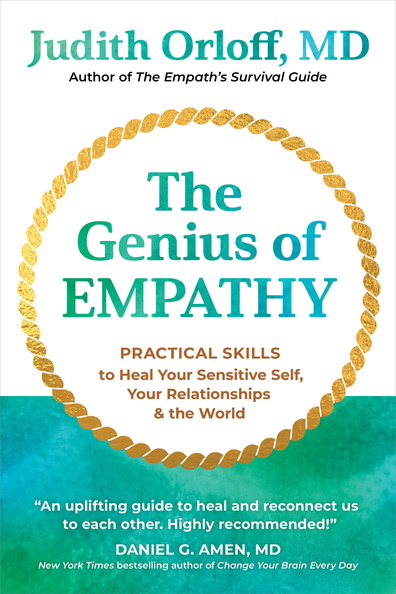
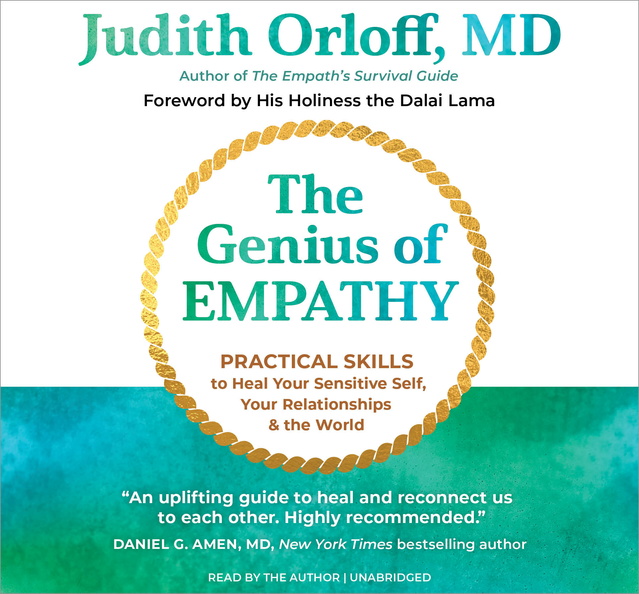
If you’ve ever asked yourself these questions, I’ve written The Genius of Empathy for you. It also includes a beautiful foreword by His Holiness the Dalai Lama.

In the book, I present empathy as a healing force that helps you overcome obstacles in your life with dignity, grace, and power. As a psychiatrist and empath, I draw from my insights and present techniques from my own life and from the healing journeys of my clients, students, and readers. As I say in the book, “Empathy softens the struggle, quiets the unkind voices, and lets you befriend yourself again.”

Empathy doesn’t mean being “on call” 24 hours a day for those in need. Empaths can often wear an invisible sign that says, “I can help you.” However, if you want to heal yourself, have better relationships, and contribute to healing our tumultuous world, you must learn how to set healthy boundaries and observe, not absorb, the energy of others.

To start taking a more proactive role in how much empathy you give others at any one time, I suggest that you keep in mind the following “rights.” They will help you maintain a healthy mindset and prevent or lessen any empathy overwhelm that might arise:

  • I have the right to say a loving, positive “no” or “no, thank-you.”
  • I have the right to set limits with how long I listen to people’s problems.
  • I have the right to rest and not be always available to everyone.
  • I have the right to quiet peacefulness in my home and in my heart.

Practice: Take a Sound Break to Repair Yourself

Plan periods of quiet to recover from our noisy, fast-paced world. This helps calm your nervous system and your mind, an act of self-empathy.

It’s rejuvenating to schedule at least five minutes of quiet or, even better, complete silence for an hour or more where no one can intrude. As I do, hang a Do Not Disturb sign on your office or bedroom door. During this reset period, you’ve officially escaped from the world. You’re free of demands and noxious sounds. You may also get noise canceling earbuds to block out noise.

If too much quiet is unsettling, go for a walk in a local park or a peaceful neighborhood to decompress from excessive sound stimulation. Simply focus on putting one foot in front of the other, which is called mindful walking. Nothing to do. Nothing to be. Move slowly and refrain from talking. If thoughts come, keep refocusing on your breath, each inhalation and exhalation. Just letting life settle will regenerate your body and empathic heart.

Embracing your empathy does require courage. It can feel scary. If you’re ready to discover its healing power, I would be honored to be your guide to helping you in overcoming your fears and obstacles, and enhancing this essential skill for long-term change.

Though many of us have never met, I feel connected to you. Connection is what fuels life. While empathy is what allows you to find peace. With both, we can make sense of this world together.

Book
Learn More
Amazon | Barnes & Noble | Bookshop | Sounds True

Digital Audio
Ignite empathy as a superpower for personal healing, deeper relationships, and more potent work in the world. New York Times bestselling author Dr. Judith Orloff draws on insights from neuroscience, psychology, and energy medicine to show us how to access our sensitivities, soothe our nervous systems, and embody our most fierce and authentic selves.

Learn More

5 Ways to Combat Energy Vampires This Holiday Season

For empaths and sensitive people, the holidays can be extra stressful because they are exposed to more socializing and holiday events. This means interacting with relatives, friends or acquaintances who may be energy vampires. Since empaths are emotional sponges, they tend to absorb other people’s negative energy unless they have a plan to approach the holiday season. Here are some tips from my book: Thriving as an Empath: 365 Days of Self-Care for Sensitive People.

Identify the energy vampires in your life

In your journal, write down the name of five energy vampires in your life that you may encounter over the holiday season. Then, write down what type of energy vampire they are so you know exactly how they drain your energy. For instance, The Criticizer: For instance they might say, “Oh dear, it looks like you’ve put on a few pounds!.” Or the Drama Queen, Controller, Narcissist or Passive Aggressive.

Journal about strategies to use

It’s important to pre-plan the strategies you use with these people. Write these in your journal. For instance, if you’re going to encounter a drama queen/king, tell yourself “I will not ask them how they are doing or look deeply into their eyes to encourage long stories. I will not feed into the drama queen/kings antics.” Map out your strategies so you are prepared.

Set clear boundaries

Boundaries are essential for all empaths and sensitive people to learn. Because we wear invisible signs around our necks saying “I can help you”, people flock from far and wide to tell us their life stories. Thus, it is important to set boundaries with energy vampires, and limit the time you interact with them. If necessary, escape into the bathroom for some quiet time.

No is a complete sentence

When dealing with energy vampires, such as rageaholics, it is important to learn how to say “no” to someone dumping anger on you. As an empath, anger feels toxic to me so I don’t allow it in my vicinity. If you’re going to encounter an angry person who tends to dump, be prepared to say “no” to them and politely excuse yourself to talk to someone else.

Notice your emotional triggers

We tend to be drained if our own unresolved issues are activated. So, it is healthy to examine your emotional triggers so you can’t be drained by people pushing your buttons. For instance, are you triggered by sadness, depression or anxiety? Or when someone tries to control you? Identify your triggers and begin to heal them in your private meditations or with a guide. This self-healing will help you be a more empowered empath!

Judith OrloffJudith Orloff, MD, is a leading voice in the fields of medicine, psychiatry, and intuitive development. An assistant clinical professor of psychiatry at UCLA, her bestselling books include Emotional Freedom, Positive Energy, Dr. Judith Orloff’s Guide to Intuitive Healing, and Second Sight. Find more inspiration at Dr. Orloff’s website drjudithorloff.com.


The community here at Sounds True wishes you a lovely holiday season! We are happy to collaborate with some of our Sounds True authors to offer you wisdom and practices as we move into this time together; please enjoy this blog series for your holiday season. 

To help encourage you and your loved ones to explore new possibilities this holiday season, we’re offering 40% off nearly all of our programs, books, and courses sitewide. May you find the wisdom to light your way.

EXPLORE NOW

You Might Also Enjoy

Guy Shahar and Melinda Edwards, MD: Sensitivity Is at ...

Autism is so often described in terms of what seems to be missing: eye contact, small talk, the expected social rhythms most people move through without thinking. This two-part conversation asks a different question entirely: what if the very traits read as absence are actually signs of a deeper, more intense form of connection than most neurotypical people ever access. It’s a reframing that asks listeners to set aside a familiar deficit lens and try on a considerably more generous one.

Sounds True brought Guy Shahar and Dr. Melinda Edwards together for this special episode of our Being Open series precisely because both speak from lived experience rather than from clinical distance alone, one as a father and later as a self-identified autistic adult, the other as a psychiatrist and mother of an autistic daughter. Their combined perspective reflects something Sounds True has believed since 1985: that the most transformative teaching often comes from people who have lived the question, not simply studied it.

In this piece, we look at what each of them learned, how their perspectives echo and diverge, and what it might mean to depathologize neurodiversity rather than simply manage it.

Key Takeaways:

  • A Late Discovery: Learn how Guy Shahar found out at age forty-six that he is autistic himself.
  • Connection, Not Absence: Understand why Dr. Melinda Edwards challenges the idea that autism means disconnection.
  • Three Practical Keys: See the approach Shahar offers parents and caregivers for genuinely connecting.

A Conversation in Two Parts

This episode unfolds across two connected conversations, each offering a different vantage point on the same central idea. Guy Shahar, author of Transforming Autism, opens the discussion focused on parenting and connection.

  • Part One: Shahar discusses educating caregivers, flexibility, and the intuitive capacity many autistic children show toward reading energy and intention. Full details appear in Guy Shahar and Melinda Edwards, MD: Sensitivity Is at the Heart of Autism.
  • Part Two: Dr. Edwards continues the conversation, focusing on the overlooked spiritual gifts and interconnection autism can reveal.

Insight Is The First Step Toward Growth. Broaden Your Horizons With Sounds True.

Guy Shahar: A Discovery That Reframed His Own Life

Shahar’s path into this work began with his son, whose autism led the family to unconventional and unusually effective treatments detailed in Transforming Autism. His son, once written off by parts of the medical establishment as severely disabled, went on to thrive in a mainstream school by age six, an outcome Shahar attributes to focusing on inherent strengths rather than symptom correction. What makes his perspective unusual is what came next: at age forty-six, Shahar discovered he was autistic himself, a revelation that suddenly explained decades of experiences he had never quite understood, from communication struggles to a persistent sense of not fitting expected molds.

This late discovery reshaped how Shahar approaches his own book’s central argument. Rather than treating autism as a problem requiring correction, Transforming Autism proposes understanding the inherent characteristics of autistic children and bringing out their natural strengths instead, a philosophy Shahar later carried into founding a charity dedicated to the same principle.

Autism Sensitivity: What Looks Like Withdrawal Often Isn’t

A central theme threading through both conversations is autism sensitivity, the idea that heightened perception, not deficit, sits at the core of many autistic experiences. What often reads to outside observers as withdrawal or overwhelm may actually reflect a nervous system taking in far more information than a typical environment accounts for.

  • Overwhelm as Overload: Shutdown often signals sensory flooding rather than disinterest in connection.
  • Intuitive Attunement: Many autistic children show unusual sensitivity to the emotional energy of people around them.
  • Idealism and Values: Shahar notes a strong pull toward altruism and idealistic values among many autistic individuals he has met.

Three Keys to Connecting with Autistic Children

Rather than offering another behavioral checklist, Shahar frames connection around three keys that emerged from years of trial, error, and eventual breakthrough with his own son:

  • Flexibility Over Correction: Meeting a child’s actual state rather than insisting on typical behavior first.
  • Play as a Bridge: Following a child’s own interests as the doorway into shared connection.
  • Presence Over Performance: Showing up authentically, since autistic children often sense forced or anxious energy quickly.

Find Teachings that Speak to You With Sounds True.

Dr. Melinda Edwards: Connection Where Others See Its Absence

Dr. Edwards approaches the same territory as both a psychiatrist and the mother of an autistic daughter, and her central claim reframes the entire conversation. Rather than reading her daughter’s symptoms as disconnection, Dr. Edwards has come to understand them as reflections of a connection so deep it exceeds what conventional language typically describes. Her clinical training and personal experience together let her speak to something rarely voiced this plainly: that autism may offer neurotypical people a glimpse of interconnection they have simply lost access to.

Dr. Edwards’s perspective carries particular weight because it bridges two worlds that don’t often speak to each other candidly: the clinical framework she was trained in and the lived reality of raising a daughter whose experience didn’t fit neatly into that framework. Rather than discarding one for the other, she has spent years holding both, letting each inform and complicate the other.

From Anxiety to Faith

Both guests describe a similar arc within their own families: an initial period defined by anxiety, fear about diagnosis, fear about the future, gradually giving way to something closer to faith. This shift doesn’t erase real challenges, but it does change how those challenges are met, with curiosity rather than dread, and with trust that difficulty can carry its own unexpected gift.

Shahar describes this shift as one of the hardest and most necessary parts of his own journey, since fear tends to narrow attention exactly when openness is most needed. Faith, in the way both guests use the term, isn’t about certainty that things will turn out fine. It’s closer to a willingness to stay present with a child, or with oneself, without needing to fix everything first.

Spiritual Gifts and Evolutionary Guides

One of the more striking claims in this conversation is the idea that autistic individuals may serve as spiritual and evolutionary guides for the wider human community. Rather than framing this as a burden placed on autistic people to be exceptional, both guests present it as an invitation for neurotypical listeners to notice qualities, sensitivity, intuitive attunement, and resistance to social pretense that the broader culture has undervalued for generations.

Center Yourself With Meditative Teachings by Sounds True

Final Thoughts

Guy Shahar and Dr. Melinda Edwards offer something rarer than advice: two honest accounts of watching a label reorganize itself into something closer to reverence. Neither pretends the path is simple, but both suggest that sensitivity itself, so often treated as a burden, may be the very quality worth protecting and learning from. What lingers longest from this conversation may be the quiet suggestion that connection was never actually missing, only expressed in a register most of us were never taught to hear. 

Sounds True shares conversations like this one because waking up the world sometimes means waking up to the people already sitting closest to us. If this conversation moved you, Guy Shahar’s book and the broader Being Open series carry it further.

Frequently Asked Questions About Guy Shahar

Who is Guy Shahar?

He is the author of Transforming Autism and co-founder of a charity supporting autistic children and their families.

When did Guy Shahar learn he was autistic?

He discovered his own autism at age forty-six, years after his son’s diagnosis.

What is the Being Open podcast series?

A special Insights at the Edge series exploring connection, consciousness, and openness across different life experiences.

Is Dr. Melinda Edwards a parent of an autistic child?

Yes, she is a psychiatrist and the mother of an autistic daughter, informing her perspective directly.

Does this conversation offer parenting techniques?

Yes, Shahar outlines three practical keys for connecting more effectively with autistic children.

What is Transforming Autism about?

It follows Shahar’s family journey as they support their son and reframes autism around inherent strengths.

Where can I find more Sounds True content on neurodiversity?

Related conversations continue throughout our Insights at the Edge Podcast archive and Relationships collection.

Is this conversation only relevant to parents?

No, its themes of sensitivity and connection speak to caregivers, clinicians, and curious listeners alike.

Michelle Cassandra Johnson is an author, activist, spiritual teacher, racial equity consultant, and intuitive healer. She is the author of six books, including Skill in Action and Finding Refuge. Amy Burtaine is a leadership coach and racial equity trainer. With Robin DiAngelo, she is the coauthor of The Facilitator's Guide for White Affinity Groups. For more, visit https://www.michellecjohnson.com/wisdom-of-the-hive.

Peter A. Levine: From Trauma to Awakening and Flow

At eighty-two, after fifty years treating trauma in thousands of people, Peter Levine sat down with Tami Simon to talk about something few clinicians his age are still willing to examine in public: his own unfinished healing. That willingness, more than any single technique, may be the most striking part of this conversation, and it sets an unusually candid tone from the very first exchange.

Peter A. Levine, PhD, holds doctorates in both biophysics and psychology and developed Somatic Experiencing, a body-based approach to trauma that is now practiced by an estimated 50,000 therapists in 44 countries. 

Sounds True has published his work for years, and this conversation, released alongside his book An Autobiography of Trauma, finds him reflecting on where the science of trauma has landed and where his own personal journey still continues. His willingness to speak this openly, decades into a celebrated career, reflects the same unscripted spirit Sounds True has tried to capture since our founding in 1985. What follows traces his case for the body as healer, the strange inheritance of trauma across generations, and what it might mean to move from woundedness toward flow.

Key Takeaways:

  • The Body Remembers First: Learn why Peter Levine treats the nervous system, not just the mind, as trauma’s true home.
  • Healing Has No Finish Line: Understand why Levine describes recovery as ongoing rather than a single resolved event.
  • Wounds Can Become Wisdom: See how Levine frames the archetype of the wounded healer in his own decades of work.

Awaken Your Inner Healing Power

Somatic Experiencing: A Body-Based Approach to an Old Problem

Levine developed Somatic Experiencing over five decades of clinical work, building an approach rooted in neurobiology rather than talk therapy alone. The premise is straightforward but radical in practice: trauma lives primarily in the nervous system, not in the story a person tells about what happened. 

Treatment, in this framework, focuses on helping the body complete interrupted survival responses rather than only processing memories cognitively. Levine has often pointed to how animals in the wild shake off intense stress almost immediately, a natural discharge process he believes humans have largely lost touch with under the pressures of modern life.

  • Body Before Narrative: Nervous system regulation often precedes, rather than follows, verbal insight.
  • Global Reach: Somatic Experiencing is now taught by roughly seventy trainers worldwide.
  • Naturalistic Roots: Levine drew inspiration from how animals in the wild discharge survival stress without lasting harm.

Conception Trauma and Procedural Memory

One of the more unusual threads in this conversation involves what Levine calls conception trauma, the idea that some of our earliest imprints form before conscious memory begins. He connects this to procedural memory, the body’s capacity to hold patterns and responses that never pass through language at all. This framing extends his broader argument that healing work often has to reach beneath the level of story, into territory the conscious mind was never given access to in the first place. It’s a claim that goes well beyond conventional talk therapy, suggesting that some of the most stubborn patterns a person carries were never available for conscious recall to begin with, which is part of why purely verbal approaches can sometimes fall short.

You can hear this full, wide-ranging conversation in Peter A. Levine: From Trauma to Awakening and Flow, recorded in celebration of his book An Autobiography of Trauma.

The Wounded Healer, Passed Down Through Generations

Levine speaks candidly about the archetype of the wounded healer, the idea that those drawn to healing work often carry significant wounds of their own. Rather than treating this as a liability, he frames it as a lineage: both trauma and wisdom, he suggests, pass down through generations, and understanding one often requires understanding the other. His own decades of practice have clearly been shaped by this dynamic, informing not just his clinical technique but also his willingness to keep examining his own history well into his eighties, a rare kind of transparency for someone of his professional standing. He speaks about this without self-pity, treating his own wounds as simply part of the material he continues to work with.

Insight Is The First Step Toward Growth. Broaden Your Horizons With Sounds True.

Self-Compassion as a Clinical Tool, Not a Luxury

Much of this conversation returns to self-compassion, not as a soft addition to trauma work but as something closer to a prerequisite for it. Levine suggests that kindness toward oneself often has to be practiced deliberately, since trauma frequently teaches the opposite lesson early and convincingly. Personal writing emerges here as one tool he recommends, a way of externalizing experience that can create enough distance for compassion to take hold. He describes this practice not as a one-time exercise but as something returned to repeatedly, each pass revealing a slightly different layer of the same material.

Psychedelics: Promise and Caution From Fifty Years of Practice

Levine also weighs in on the growing interest in psychedelics as a tool for trauma work, offering a perspective shaped by decades in the field rather than current enthusiasm alone. He acknowledges genuine promise in these substances while remaining candid about their pitfalls, particularly when used without adequate preparation, integration support, or somatic grounding. This measured stance reflects his broader approach throughout the conversation: genuine curiosity about emerging tools, balanced against hard-won caution about shortcuts in trauma healing. He returns often to the idea that no substance or technique replaces the slower work of learning to stay present with the body’s own signals.

Lessening the Fear of Dying

Late in the conversation, Levine and Tami turn toward mortality directly, discussing how his decades of trauma work have shaped his own relationship with dying. Rather than offering easy reassurance, Levine approaches this the way he approaches most difficult material: through the body first, suggesting that much of our fear around death is itself a somatic pattern worth examining rather than a fixed, unchangeable fact. He shares on-the-spot techniques for feeling safer within one’s own nervous system, tools meant for ordinary daily anxiety as much as for confronting larger existential fear.

Center Yourself With Meditative Teachings by Sounds True

Final Thoughts

Peter Levine doesn’t present healing as a destination reached once and settled permanently. Even after fifty years and thousands of clients, he describes his own journey from trauma toward awakening and flow as ongoing, a stance that feels more honest than any promise of complete resolution could offer. That honesty, arriving from someone with his level of experience and recognition, carries a weight that few younger voices in the field could match.

Sounds True has carried his work because it embodies exactly the kind of teaching our founder set out to preserve in 1985, wisdom spoken from lived experience rather than theory alone. 

Frequently Asked Questions About Peter Levine

Who is Peter A. Levine?

He is the developer of Somatic Experiencing, holding doctorates in biophysics and psychology, with fifty years of trauma work.

What is Somatic Experiencing?

A body-based method for healing trauma by helping the nervous system complete interrupted survival responses naturally.

How many practitioners use Somatic Experiencing today?

Approximately fifty thousand therapists practice the method across forty-four countries worldwide.

What is An Autobiography of Trauma?

Levine’s recent book reflects on his own healing journey, released when he was eighty-two years old.

Does Sounds True offer other programs by Peter Levine?

Yes, Sounds True has published Healing Trauma and Body as Healer among several of his audio programs.

Is Somatic Experiencing only for severe trauma?

No, the approach applies broadly to stress, anxiety, and everyday nervous system dysregulation as well as major events.

What does Levine mean by the wounded healer?

The idea that many healers carry their own wounds, which can inform rather than disqualify their work.

Where can I explore more trauma-informed teachings?

Related programs appear throughout our Health & Healing collection alongside other Sounds True authors.

Michelle Cassandra Johnson is an author, activist, spiritual teacher, racial equity consultant, and intuitive healer. She is the author of six books, including Skill in Action and Finding Refuge. Amy Burtaine is a leadership coach and racial equity trainer. With Robin DiAngelo, she is the coauthor of The Facilitator's Guide for White Affinity Groups. For more, visit https://www.michellecjohnson.com/wisdom-of-the-hive.

Connie Zweig: Meeting One of the World’s Leading...

The parts of ourselves that remain hidden can still shape our thoughts, emotions, and relationships. Connie Zweig’s work on the shadow offers a way to recognize these patterns and approach them with greater awareness.

At Sounds True, more than 40 years have been dedicated to sharing spiritual wisdom and transformational teachings from leading teachers, authors, and visionaries.

In this piece, Connie Zweig’s approach to jungian shadow work, romancing the shadow, and the role of the unconscious in inner growth will be discussed.

Key Takeaways:

  • Shadow Expertise: Connie Zweig brings decades of psychological, spiritual, and writing experience to the study of the human shadow.
  • Broader Understanding: Shadow material can include hidden strengths and positive qualities alongside traits a person has learned to reject.
  • Psychology and Spirituality: Zweig’s perspective considers how psychological inquiry and spiritual practice can work together to support greater self-awareness.

Find Teachings that Speak to You With Sounds True.

Meeting Connie Zweig and the Shadow

What parts of ourselves remain outside our everyday awareness? In our conversation with Connie Zweig, a psychotherapist, author, and longtime student of the shadow, we look at the hidden aspects of the psyche and what they can teach us about ourselves.

In Connie Zweig: Meeting One of the World’s Leading Experts on the Shadow, we hear how turning toward these less familiar parts of ourselves can become an invitation to deeper self-understanding.

Connie Zweig on Understanding Our Hidden Selves

Connie Zweig’s work invites us to notice what has been pushed outside conscious awareness. These hidden qualities can include feelings, impulses, desires, and traits that we have learned to reject or avoid.

Bringing attention to the shadow can help us recognize how unconscious material may shape our reactions and relationships. Rather than approaching difficult inner experiences with judgment, Zweig’s perspective encourages greater curiosity about what those experiences may be revealing.

Jungian Shadow Work and the Unconscious

Jungian shadow work draws attention to parts of the personality that the conscious self does not readily acknowledge. For Zweig, meeting the shadow involves developing awareness of these concealed aspects instead of allowing them to operate unnoticed.

This approach can offer a meaningful way to examine recurring emotional reactions and interpersonal patterns. As awareness grows, we may begin to recognize qualities in ourselves that were previously easier to see in other people.

How Jungian Shadow Work Reveals Hidden Patterns

One important aspect of jungian shadow work is learning to notice patterns that repeatedly surface in daily life. Strong reactions, conflicts, and uncomfortable feelings can sometimes point toward material that deserves closer attention.

Shadow work asks us to become more attentive to these moments. By observing our responses with honesty, we can develop a fuller picture of ourselves and begin relating more consciously to thoughts and feelings that once remained hidden.

Center Yourself With Meditative Teachings by Sounds True

Romancing the Shadow With Curiosity and Awareness

Romancing the shadow offers a compassionate way of thinking about this inner relationship. Instead of treating the shadow solely as a problem to overcome, Zweig’s work encourages us to approach it with curiosity.

This perspective creates room for sustained self-inquiry. Listening to what arises can help us recognize neglected qualities and understand why certain experiences carry such emotional weight. The practice calls for patience and a willingness to remain present with aspects of ourselves we may find uncomfortable.

Connie Zweig on Romancing the Shadow for Inner Growth

For Connie Zweig, romancing the shadow points toward an ongoing relationship with the unconscious. Shadow work is less about reaching a fixed destination than becoming increasingly aware of what we carry within us.

As we recognize hidden patterns and previously rejected qualities, we can meet ourselves with greater honesty. This kind of inner attention reflects the heart of the conversation: an invitation to know more of who we are by becoming willing to encounter what has remained unseen.

Insight Is The First Step Toward Growth. Broaden Your Horizons With Sounds True.

Final Thoughts

Connie Zweig’s teachings invite us to meet the shadow with curiosity, honesty, and compassion. Through jungian shadow work and romancing the shadow, we can bring greater awareness to hidden patterns and deepen our relationship with ourselves.

Frequently Asked Questions About Connie Zweig and the Shadow

Who is Connie Zweig?

Connie Zweig is an author and psychotherapist known for her work on the human shadow. Her teachings bring psychological and spiritual perspectives together to help people engage more consciously with aspects of themselves that may remain outside everyday awareness.

What influenced Connie Zweig’s approach to shadow work?

Zweig’s approach is rooted in depth psychology and informed by her study of contemplative and spiritual traditions. This combination allows her to consider the shadow through both psychological development and inner practice.

What books has Connie Zweig written about the shadow?

Connie Zweig coauthored Meeting the Shadow and Romancing the Shadow, works that examine how shadow material appears in personal life and relationships. Her writing has helped bring shadow-oriented ideas to a wider audience.

Why is Connie Zweig considered an expert on the shadow?

Zweig has spent decades studying, writing about, and teaching shadow work. Her experience as a psychotherapist and author has allowed her to address the subject through clinical, personal, and spiritual perspectives.

How does Connie Zweig connect spirituality and psychology?

Her work considers psychological awareness and spiritual practice as complementary areas of inquiry. This perspective examines how inner development can include engaging parts of the personality that spiritual practice alone may not resolve.

What is the difference between shadow work and meditation?

Meditation commonly develops awareness and presence, while shadow work focuses more specifically on unconscious or disowned aspects of the personality. Zweig’s perspective shows how the two practices can inform one another without treating them as interchangeable.

Can positive qualities become part of the shadow?

Yes. The shadow does not refer only to qualities considered negative or undesirable. Strengths, creativity, confidence, and other positive traits may also become disowned when a person learns that expressing them is unacceptable.

What role do dreams play in understanding the shadow?

Dreams can provide another way of encountering material outside ordinary conscious awareness. Their images, emotions, and recurring themes may offer opportunities for reflection on aspects of the psyche that are less visible during waking life.

Is shadow work a one-time process?

Shadow work is generally understood as an ongoing practice rather than a task that can be permanently completed. New circumstances and stages of life can bring previously unrecognized aspects of ourselves into awareness.

Who may find Connie Zweig’s work meaningful?

Her work may resonate with people interested in psychology, spirituality, self-inquiry, and greater awareness of their inner lives. It can also provide a framework for those interested in understanding how unconscious material intersects with personal and spiritual development.

Michelle Cassandra Johnson is an author, activist, spiritual teacher, racial equity consultant, and intuitive healer. She is the author of six books, including Skill in Action and Finding Refuge. Amy Burtaine is a leadership coach and racial equity trainer. With Robin DiAngelo, she is the coauthor of The Facilitator's Guide for White Affinity Groups. For more, visit https://www.michellecjohnson.com/wisdom-of-the-hive.

Leave a Reply

Your email address will not be published. Required fields are marked *