Judith Orloff

Judith Orloff, MD, is a leading voice in the fields of medicine, psychiatry, empathy, and intuitive development. A member of the UCLA Psychiatric Clinical Staff, her bestselling books include The Empath’s Survival Guide, Thriving as an EmpathEmotional Freedom, Positive Energy, Dr. Judith Orloff’s Guide to Intuitive Healing, Second Sight, and The Genius of Empathy. She specializes in treating empaths and sensitive people in her private practice. Find more inspiration at Dr. Orloff’s website, drjudithorloff.com.

Author photo © Bob Riha Jr

Also By Author

Judith Orloff: The Healing Power of Empathy

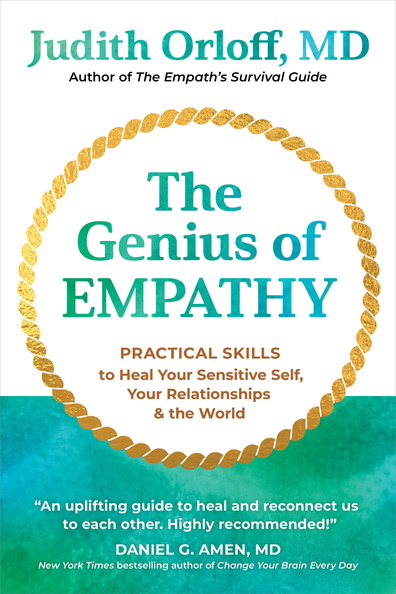
When we think about those special traits or abilities we consider to be “superpowers,” empathy isn’t usually the first thing that comes to mind. In fact, empathy is often seen as a weakness, not a strength. Through her bestselling books and her work training new psychiatrists, Dr. Judith Orloff is helping to change the narrative around empathy. In this podcast, Tami Simon speaks with Dr. Orloff about her new book, The Genius of Empathy, and how we can each begin to cultivate an empathic style that supports a thriving life. 

Tune in now for their conversation on how empathy opens the heart and fosters healing, the beauty of self-empathy and how it differs from self-compassion, empathy overwhelm, the four styles of empathy and how to identify your own, boundary-setting tools for empaths, the empathy spectrum, empathy deficiency disorders, trauma and empathy, letting go of resentment and helping it let go of you, empathic attunement, the practice of shielding, transmitting empathic love to people and places in need, observing without absorbing, and more.

Note: This episode originally aired on Sounds True One, where these special episodes of Insights at the Edge are available to watch live on video and with exclusive access to Q&As with our guests. Learn more at join.soundstrue.com.

Embracing Empathy as Your Superpower

What do I do when a loved one is suffering? How do I have empathy if I’m getting a divorce or losing my job? If my family treats me unfairly? Or if I’m emotionally overwhelmed or in chronic pain?

If you’ve ever asked yourself these questions, I’ve written The Genius of Empathy for you. It also includes a beautiful foreword by His Holiness the Dalai Lama.

In the book, I present empathy as a healing force that helps you overcome obstacles in your life with dignity, grace, and power. As a psychiatrist and empath, I draw from my insights and present techniques from my own life and from the healing journeys of my clients, students, and readers. As I say in the book, “Empathy softens the struggle, quiets the unkind voices, and lets you befriend yourself again.”

Empathy doesn’t mean being “on call” 24 hours a day for those in need. Empaths can often wear an invisible sign that says, “I can help you.” However, if you want to heal yourself, have better relationships, and contribute to healing our tumultuous world, you must learn how to set healthy boundaries and observe, not absorb, the energy of others.

To start taking a more proactive role in how much empathy you give others at any one time, I suggest that you keep in mind the following “rights.” They will help you maintain a healthy mindset and prevent or lessen any empathy overwhelm that might arise:

  • I have the right to say a loving, positive “no” or “no, thank-you.”
  • I have the right to set limits with how long I listen to people’s problems.
  • I have the right to rest and not be always available to everyone.
  • I have the right to quiet peacefulness in my home and in my heart.

Practice: Take a Sound Break to Repair Yourself

Plan periods of quiet to recover from our noisy, fast-paced world. This helps calm your nervous system and your mind, an act of self-empathy.

It’s rejuvenating to schedule at least five minutes of quiet or, even better, complete silence for an hour or more where no one can intrude. As I do, hang a Do Not Disturb sign on your office or bedroom door. During this reset period, you’ve officially escaped from the world. You’re free of demands and noxious sounds. You may also get noise canceling earbuds to block out noise.

If too much quiet is unsettling, go for a walk in a local park or a peaceful neighborhood to decompress from excessive sound stimulation. Simply focus on putting one foot in front of the other, which is called mindful walking. Nothing to do. Nothing to be. Move slowly and refrain from talking. If thoughts come, keep refocusing on your breath, each inhalation and exhalation. Just letting life settle will regenerate your body and empathic heart.

Embracing your empathy does require courage. It can feel scary. If you’re ready to discover its healing power, I would be honored to be your guide to helping you in overcoming your fears and obstacles, and enhancing this essential skill for long-term change.

Though many of us have never met, I feel connected to you. Connection is what fuels life. While empathy is what allows you to find peace. With both, we can make sense of this world together.

Book
Learn More
Amazon | Barnes & Noble | Bookshop | Sounds True

Digital Audio
Ignite empathy as a superpower for personal healing, deeper relationships, and more potent work in the world. New York Times bestselling author Dr. Judith Orloff draws on insights from neuroscience, psychology, and energy medicine to show us how to access our sensitivities, soothe our nervous systems, and embody our most fierce and authentic selves.

Learn More

5 Ways to Combat Energy Vampires This Holiday Season

For empaths and sensitive people, the holidays can be extra stressful because they are exposed to more socializing and holiday events. This means interacting with relatives, friends or acquaintances who may be energy vampires. Since empaths are emotional sponges, they tend to absorb other people’s negative energy unless they have a plan to approach the holiday season. Here are some tips from my book: Thriving as an Empath: 365 Days of Self-Care for Sensitive People.

Identify the energy vampires in your life

In your journal, write down the name of five energy vampires in your life that you may encounter over the holiday season. Then, write down what type of energy vampire they are so you know exactly how they drain your energy. For instance, The Criticizer: For instance they might say, “Oh dear, it looks like you’ve put on a few pounds!.” Or the Drama Queen, Controller, Narcissist or Passive Aggressive.

Journal about strategies to use

It’s important to pre-plan the strategies you use with these people. Write these in your journal. For instance, if you’re going to encounter a drama queen/king, tell yourself “I will not ask them how they are doing or look deeply into their eyes to encourage long stories. I will not feed into the drama queen/kings antics.” Map out your strategies so you are prepared.

Set clear boundaries

Boundaries are essential for all empaths and sensitive people to learn. Because we wear invisible signs around our necks saying “I can help you”, people flock from far and wide to tell us their life stories. Thus, it is important to set boundaries with energy vampires, and limit the time you interact with them. If necessary, escape into the bathroom for some quiet time.

No is a complete sentence

When dealing with energy vampires, such as rageaholics, it is important to learn how to say “no” to someone dumping anger on you. As an empath, anger feels toxic to me so I don’t allow it in my vicinity. If you’re going to encounter an angry person who tends to dump, be prepared to say “no” to them and politely excuse yourself to talk to someone else.

Notice your emotional triggers

We tend to be drained if our own unresolved issues are activated. So, it is healthy to examine your emotional triggers so you can’t be drained by people pushing your buttons. For instance, are you triggered by sadness, depression or anxiety? Or when someone tries to control you? Identify your triggers and begin to heal them in your private meditations or with a guide. This self-healing will help you be a more empowered empath!

Judith OrloffJudith Orloff, MD, is a leading voice in the fields of medicine, psychiatry, and intuitive development. An assistant clinical professor of psychiatry at UCLA, her bestselling books include Emotional Freedom, Positive Energy, Dr. Judith Orloff’s Guide to Intuitive Healing, and Second Sight. Find more inspiration at Dr. Orloff’s website drjudithorloff.com.


The community here at Sounds True wishes you a lovely holiday season! We are happy to collaborate with some of our Sounds True authors to offer you wisdom and practices as we move into this time together; please enjoy this blog series for your holiday season. 

To help encourage you and your loved ones to explore new possibilities this holiday season, we’re offering 40% off nearly all of our programs, books, and courses sitewide. May you find the wisdom to light your way.

EXPLORE NOW

You Might Also Enjoy

Rob Bell: “The Risk of Not Becoming More YouR...


What if not doing the thing is the riskier choice?

This week, Tami Simon speaks with Rob Bell—New York Times bestselling author of 14 books and plays, host of The RobCast, and a former pastor—about what he calls his civilian phase. Rob left the role years ago. What surprised him was how long the role stayed with him afterward: “We leave an external form, and then over the years, the form begins to leave us.”

This is an unusually candid conversation. Tami goes first, admitting she didn’t feel free to fully reveal herself until she had economic security—and Rob meets her there without a tidy answer.

Join Tami and Rob to explore:

  • Why he doesn’t believe in risk versus no risk—only in risk management, and which risk is actually smaller
  • The “answer man” conditioning of a job that expected crisp soundbites about the deepest human questions—and what it did to his nervous system
  • Hiding in plain sight: how public visibility can be its own kind of concealment
  • The abyss, the void, the fallow field—learning to stop fighting the empty seasons
  • “And then I kept going”: the phrase that came out of pandemic sessions, and why people can’t see their own resilience
  • What shifted when a plant medicine experience dropped his head into his heart
  • Toxic positivity, a lineage that didn’t know what to do with pain, and the son who taught him it’s okay to be sad
  • Why a birch tree scatters 250 million seeds and doesn’t seem worried about efficiency
  • His father’s dementia, temporariness, and the strange way mortality heightens aliveness

Rob will lead an immersive workshop, The Ongoing Creation of Your Life, at Omega Institute, August 30–September 4.

Listen now and hear what it costs to keep standing at a distance from your own life. →

This conversation offers genuine transmission, not just concepts about awakening, but the palpable presence of realized teachers exploring the growing edge of spiritual understanding together, and originally aired on Sounds True One.

Just One Question | James Hollis: Why Am I Here?

Tami came to Living with Borrowed Dust wanting to talk about the abyss — the chapter that held her attention most. James Hollis offers Heidegger’s framing of it: not the pit that swallows you, but the openness of being.

Then he does something guests rarely do here. He takes the question back. The abyss opens, he says, every time we ask a truly radical question — radical from radix, root — and there is none more radical than “Why am I here?”

He answers it from inside a hospital bed. Two serious spinal surgeries, real doubt about whether he’d come through, and what he describes feeling is not despair but something closer to adventure. He thanked his surgeon on the way into the operating room. Fear is normal, he says, and anxiety is real — but neither one has to be the thing that decides how you live.

In this episode:

  • Heidegger’s abyss as the openness of being, and how that reframe exposed Hollis’s own defenses
  • The patterns we build against the unknown: power over small things, staying out of harm’s way, narcissistic inflation
  • Why mortality is the one statistic with no uncertainty in it, and what that should free us to do
  • Keep walking — if you’re in the middle of the forest, you’re halfway through
  • Dignity over pride, and the one thing nobody can take from you unless you give it away

Taken from the full Insights at the Edge conversation with James Hollis. Find the complete interview in this feed or at soundstrue.com

Just One Question | Rev angel Kyodo williams: How Do W...

Reverend angel Kyodo williams has spent decades bridging Zen practice and social change, and she doesn’t offer the version of spirituality where relief is waiting somewhere down the road. She told Tami Simon that our joy lives at the center of our suffering, and Tami, to her credit, pushed back. Really? Right in the middle of my deep suffering and the world’s deep suffering?

Reverend angel’s answer is why this segment felt so powerful and transformative to us. She argues we’ve been handed a spiritual life that lives in a box: well-maintained, kept in good order, scheduled for Tuesday evenings from 6:30 to 8:30. Real practice, she says, pulls the lens all the way back to take in a whole life: the trauma, the history, the parts we’ve been trained to walk around. And when we refuse to touch our own suffering, we don’t contain it. We leave it behind us like roadkill, in how we treat each other and in what we let stand: patriarchy, racism, xenophobia.

In this episode:

  • Why “radical” means whole rather than extreme, and what a complete dharma asks of us
  • The cold-water method—entering your suffering ankle-deep, then further
  • What joy actually is, and why it isn’t an ice cream cone in the middle of the mess
  • The question Reverend angel keeps returning to in her own practice: where have I not yet looked?
  • Why fearlessness isn’t something you choose, but something that surfaces once the path is clear

Taken from the full Insights at the Edge conversation with Reverend angel Kyodo williams. Find the complete interview here: Reverend angel Kyodo williams: Warrior Spirit.