Black Tara Who Destroys All Negativities

    —
December 17, 2020

In the fall of 2010, our monthly Tara practice began at sundown at the end of Rosh Hashanah, the beginning of the Jewish new year, 5771. The days between Rosh Hashanah and Yom Kippur are known as the Days of Awe. During these ten days, observant practitioners reflect on the past year to repair harm they may have inflicted on friends, family, or members of the greater family of the planet. They apologize to others and seek to do t’shuvah to make amends if possible. People work consciously to repair and let go of past negativity and set intentions for the coming year to prevent further mischief.

Black Tara Who Destroys All Negativities was on the calendar for that night. We appreciated the synchronistic timing of the two events. I noted that Tara protects us from negativity, internal and external, and helps us release the effects of negative energies we’ve encountered or generated. This protection occurs in part from remembering our connection to the Whole—that we are nurtured and contained by a multilayered universe. When we help another, we are helped. If we harm another, we harm ourselves. Perhaps harder to grasp—if we harm ourselves, we harm the whole universe.

The teaching centered around the meaning of the mantra, which refers explicitly to ingrained behaviors operating outside of consciousness that wreak havoc in interpersonal relationships. Negative energies transferred from one individual to another are potent and destructive, and often have lasting effects.

Tara’s Appearance

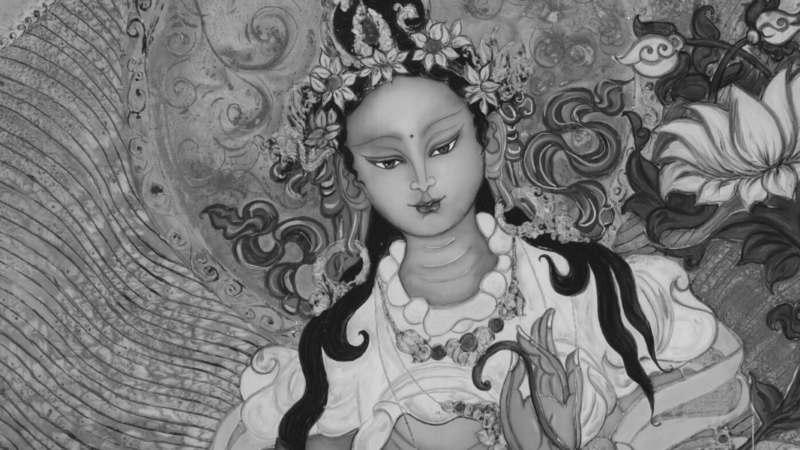
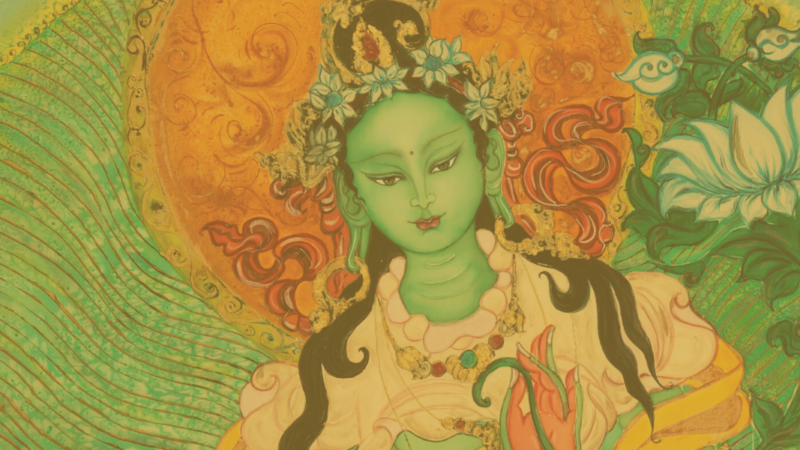
Black Tara appears with her mouth wide open in a fierce expression. Like all the wrathful emanations, she sits on a fiery sun disc, which rests in the center of her lotus throne. The sun disc replaces the usual soothing moon disc. She holds a black vase, which contains the power to overcome even the most destructive and negative powers. In this aspect, Tara is known as the Destroyer of All Negativities.

The Mantra

Om Tare Tuttare Ture Sarva Vidya Avarana Ye Bhye Phat Soha!

“Ohm Tahray Tootahray Tooray Sarwah Veedyah Ahvahrahnah Yay Bay Peyt Soha!”

This mantra sheds more light on the meaning of the practice, when you might need to use it, and how to align your own intentions with those of Tara. It insists that Tara remove mental obstacles that block insight into your complexes or the emotional forces that obscure your understanding. Avarana refers to the causes underlying negative tendencies in yourself or others. These instincts, imprints, or potencies are ingrained, influencing behavior outside of awareness. They are unconscious, unquestioned, and unprocessed. They have been denied, repressed, or avoided. You or others around you might struggle to bring them to consciousness or have no wish to do that whatsoever.

As with many words in Sanskrit, vidya has multiple meanings depending on the context. Vidya often means “wisdom”; in this instance, it means “intentions,” particularly negative intentions. Bhye phat urges Tara to destroy these obstacles or difficulties!

The mantra asks Tara to overcome the negative intentions of the enemy. Use it when you want her complete protection in order to fully grasp the difficulties in your situation. Watch for signs that you are being infected or possessed by internal negativity, which would be a natural response to the energy coming at you. Don’t be naive about actual outer dangers you might be facing; you have to remove yourself from harmful situations.

The Practice

Visualize the entire mandala of the twenty-one Taras arising out of vast space in front of you. Green Tara appears in the center in her radiant body of green light. Imagine your teachers surrounding her and all her other emanations in the background behind them. Finally, invite your friends and supporters and all beings you wish to receive the blessings of your practice. Recite the preliminary prayers. Then imagine that Black Tara Who Destroys All Negativities moves into the foreground, seated on her lotus throne with a sun disc in the center. She holds a black vase, which contains the power to destroy even the most virulent forces in the universe. See light streaming out of her heart and from her seed syllable Tam (“Tahm”) standing on a moon disc inside the vase. Just as a seed contains the entire essence of the plant it will become, the seed syllable Tam contains the entire essence of Tara’s infinite powers.

tam

If visualizing a Tibetan syllable proves difficult initially, simply visualize light streaming out instead. The light destroys all malice and negativity.

Invite Black Tara to protect you from the negative intentions and actions of others. Set your own intentions to release the shock of the impact of such energies on your body, psyche, and spirit. Ofer Tara all of your dark emotions; ask her to protect you inside and out as you engage with our imperfect world in which aggression and hatred are too easily encountered.

Recite the mantra, Om Tare Tuttare Ture Sarva Vidya Avarana Ye Bhye Phat Soha, at least 21 times or 108 times whenever possible. Then rest in the subtle vibration created by the mantra recitation. Notice the qualities of the energy around you. Remember and be grateful for the inherent goodness in the universe that is continuously giving birth to positive impulses inside of you and other beings in the world.

Black Tara brings you back to the radiant spaciousness at the core of your being. As she dissolves obstacles created by negativity, try to identify the signs of true knowing versus the cynical and damaging commentary of the complex. Learn to distinguish what’s coming from inside, what’s coming at you from outside, and how the two are related. Reach out to the cosmic Mother Protector in the form of Tara. Reach inward to her indwelling presence and open yourself to access wisdom and compassion, which offers the greatest protection no matter the circumstances.

As you bring the meditation to a close, visualize Black Tara receding into the background among all the other emanations. See the light streaming out of the entire mandala and then allow the mandala with all its beings to dissolve into space. The light flows into your body and heart, vivifying and stabilizing the essence of Tara within you, and then disperses into the universe. Dedicate the positive potential of the practice to the healing and awakening of all beings everywhere, with no exceptions.

This is an adapted excerpt from Tara: The Liberating Power of the Female Buddha by Dr. Rachael Wooten.

rachael wooten

Rachael Wooten, PhD, is a Zürich—trained Jungian analyst and psychologist who has been in private practice as a therapist for more than 40 years. An enthusiastic interfaith activist, she has studied and practiced in Buddhist, Jewish, Christian, and indigenous traditions throughout her adult life.

Rachael has been mentored by spiritual teachers such as her Tibetan root guru Lodrö Tulku Rinpoche and Rabbi Zalman Schachter-Shalomi. She has taught Tara practices under the authorization of Lodrö Rinpoche for more than 20 years. Rachael has offered Tara workshops through the Resource Center for Women and Ministry in the South, ALEPH: Alliance for Jewish Renewal, and C. G. Jung Society of the Triangle. She currently teaches a monthly Tara meditation group at Pullen Memorial Baptist Church in her hometown of Raleigh, North Carolina. To learn more, visit rachaelwootenauthor.com.


tara 3d cover

Learn More

Sounds True | Amazon | Barnes & Noble | Bookshop | Indiebound

Rachael Wooten

Rachael Wooten, PhD, is a Zürich—trained Jungian analyst and psychologist who has been in private practice as a therapist for more than 40 years. An enthusiastic interfaith activist, she has studied and practiced in Buddhist, Jewish, Christian, and indigenous traditions throughout her adult life.

Rachael has been mentored by spiritual teachers such as her Tibetan root guru Lodrö Tulku Rinpoche and Rabbi Zalman Schachter-Shalomi. She has taught Tara practices under the authorization of Lodrö Rinpoche for more than 20 years. Rachael has offered Tara workshops through the Resource Center for Women and Ministry in the South, ALEPH: Alliance for Jewish Renewal, and C. G. Jung Society of the Triangle. She currently teaches a monthly Tara meditation group at Pullen Memorial Baptist Church in her hometown of Raleigh, North Carolina. To learn more, visit rachaelwootenauthor.com.

Author photo © Teresa Porter

Listen to Tami Simon's in-depth audio podcast interviews with Dr. Rachael Wooten:
The Liberating Power of Tara >>

Also By Author

Golden Tara to Who Helps Manifest and Fulfill Purpose

Meditating on Golden Tara shifts your sense of identity away from the smaller self that experiences itself as a separate being. When you identify with Tara in meditation and throughout the day, you realize that you are always in relationship with a fantastic, complex universe. Your energy increases because you no longer feel alone. You have Tara’s help, the help of friends, and countless other beings as well.

On the one hand, you are an infinitesimally tiny part of the grand whole. On the other hand, you have a role to play in the continuing creation of this complex universe. As you deepen and stabilize your inner Tara consciousness, your actions are imbued with love and compassion, arising from your understanding that you are an integral part of whatever you seek to change.

Remembering Tara also helps preserve your energies when you encounter unexpected obstacles; her golden light reveals the treasures hidden in the unwelcome stumbling blocks of life. Difficult challenges hold keys to awakening. Tara helps you approach problems as an inherent part of the journey, supporting you as you move toward them to uncover wisdom they might offer. They often provide a wake-up call to send you in a new direction, offering greater clarity about your life purpose.

This inclusive attitude creates more health in your personal ecosystem as well as the universal ecosystem. Ask Golden Tara to transform your challenging emotions into love and to increase your energy for discovering meaning and purpose in your life.

Tara’s Appearance

Golden Tara appears as the life-giving female buddha in a body of radiant golden light. She embodies the light of life itself. The vase in Golden Tara’s hand contains the power to increase our life energy, power, and material and spiritual resources. These resources support us in times of ease and times of difficulty, enabling us to discover and fulfill the purposes of our life on a moment-to-moment basis and over the arc of our lives.

For centuries, artists have created statues and thangka paintings of Tara, always adorned with jewelry. These sacred paintings, usually done on fabric and surrounded by brocade, portray the qualities of their subjects and convey teachings as well. Thus we take special note of Tara’s adornments. A crown rests atop her head. Necklaces of varying lengths cascade from her neck to her waist. Bracelets encircle her wrists. All have been crafted from gold with deep red and blue jewels woven into the designs.

Gold has been the preferred precious metal of jewelry makers for thousands of years. Gold is malleable; gold doesn’t tarnish. Golden light is associated with increasing life-force, healing, and holiness. Holy people of many faiths are often painted in an aura of golden radiance.

Many years ago, I heard a teaching that Tara’s jewels represent her experiences over lifetimes on her way to enlightenment and buddhahood. Profound understanding of the Buddhist teachings and her experiences as a woman led Wisdom Moon to vow to attain enlightenment as a woman and to persevere toward her goal. Tara’s life events were surely difficult and awe-inspiring, ordinary and phenomenal. All of them were precious contributions to her journey, which has benefited countless beings over hundreds of years.

The Mantra

Om Tare Tuttare Ture Sarva Ayur Punye Pushtam Kuru Soha!

“Ohm Tahray Tootahray Tooray Sarwah Ahyoor Poonyay Pushtahm Kooroo Soha!”

When you recite the mantra of Golden Tara, you are urging (kuru) Tara to increase (pushtam) your life energies (ayur) and merit (punye), your contributions to adding positive energy to beings around the world, near and far. Mantra recitations need not be limited to formal practice. Use them throughout the day to slow down and focus on whatever task is at hand.

The Practice

First, visualize the entire mandala of Green Tara emerging into the space in front of you. You are surrounded by your friends, loved ones, and supporters, and she is surrounded by your teachers and all the twenty-one emanations. After the opening prayers, imagine Golden Tara coming into the foreground of the mandala. Recall her praise while visualizing golden rays of light streaming from her heart as well as the golden vase in her right hand, which rests on her right knee, palm open in the gesture of supreme giving.

As you recite her mantra, Om Tare Tuttare Ture Sarva Ayur Punye Pushtam Kuru Soha, imagine that you are absorbing this light and that other beings and other places are receiving the light of Tara as well.

Kuru, which appears in seven of the Tara mantras, carries a particularly bold tone. You’re not meekly asking Tara to help—you’re putting your whole heart and body into this request. “Tara, please do this for me. Remove blockages so more energy flows into my life and work! I’m counting on you!” The same tasks that feel overwhelming in one moment seem entirely possible in the next.

Tara can help you discern the wisdom inherent in the obstacles you encounter in your life and practice. Meditate on the continuity in your life—the joyful moments, the extremely painful moments, and everything in between. Your experiences are not meaningless fragments. Imagine a mosaic forming as you piece the fragments together into a beautiful coherent pattern. Invoke Tara’s wisdom to give you greater clarity about your life purpose and the means to fulfill it.

Recite the mantra at least 21 times or 108 times whenever possible. Then rest in the vibrational field created by your chanting. Allow frustration and doubt to dissolve, releasing energy for healing. You become richer in inner resources, which leads to enriched outer resources as well, both material and spiritual. Affirm your connection to all life forms in the universe. Know that the benefits of your heartfelt wishes and efforts will flow from you into the world.

As you bring the session to a close, visualize Golden Tara receding into her place among the twenty-one emanations. See the whole mandala dissolve into radiant light, which flows into you and merges with your inner light. Dedicate the merit or positive potential generated by the practice to the healing of all beings—with no exceptions.

This is an adapted excerpt from Tara: The Liberating Power of the Female Buddha by Dr. Rachael Wooten.


rachael wooten

Rachael Wooten, PhD, is a Zürich—trained Jungian analyst and psychologist who has been in private practice as a therapist for more than 40 years. An enthusiastic interfaith activist, she has studied and practiced in Buddhist, Jewish, Christian, and indigenous traditions throughout her adult life.

Rachael has been mentored by spiritual teachers such as her Tibetan root guru Lodrö Tulku Rinpoche and Rabbi Zalman Schachter-Shalomi. She has taught Tara practices under the authorization of Lodrö Rinpoche for more than 20 years. Rachael has offered Tara workshops through the Resource Center for Women and Ministry in the South, ALEPH: Alliance for Jewish Renewal, and C. G. Jung Society of the Triangle. She currently teaches a monthly Tara meditation group at Pullen Memorial Baptist Church in her hometown of Raleigh, North Carolina. To learn more, visit rachaelwootenauthor.com.


book cover

Learn More

Sounds True | Amazon | Barnes & Noble | Bookshop | Indiebound
Black Tara Who Destroys All Negativities

In the fall of 2010, our monthly Tara practice began at sundown at the end of Rosh Hashanah, the beginning of the Jewish new year, 5771. The days between Rosh Hashanah and Yom Kippur are known as the Days of Awe. During these ten days, observant practitioners reflect on the past year to repair harm they may have inflicted on friends, family, or members of the greater family of the planet. They apologize to others and seek to do t’shuvah to make amends if possible. People work consciously to repair and let go of past negativity and set intentions for the coming year to prevent further mischief.

Black Tara Who Destroys All Negativities was on the calendar for that night. We appreciated the synchronistic timing of the two events. I noted that Tara protects us from negativity, internal and external, and helps us release the effects of negative energies we’ve encountered or generated. This protection occurs in part from remembering our connection to the Whole—that we are nurtured and contained by a multilayered universe. When we help another, we are helped. If we harm another, we harm ourselves. Perhaps harder to grasp—if we harm ourselves, we harm the whole universe.

The teaching centered around the meaning of the mantra, which refers explicitly to ingrained behaviors operating outside of consciousness that wreak havoc in interpersonal relationships. Negative energies transferred from one individual to another are potent and destructive, and often have lasting effects.

Tara’s Appearance

Black Tara appears with her mouth wide open in a fierce expression. Like all the wrathful emanations, she sits on a fiery sun disc, which rests in the center of her lotus throne. The sun disc replaces the usual soothing moon disc. She holds a black vase, which contains the power to overcome even the most destructive and negative powers. In this aspect, Tara is known as the Destroyer of All Negativities.

The Mantra

Om Tare Tuttare Ture Sarva Vidya Avarana Ye Bhye Phat Soha!

“Ohm Tahray Tootahray Tooray Sarwah Veedyah Ahvahrahnah Yay Bay Peyt Soha!”

This mantra sheds more light on the meaning of the practice, when you might need to use it, and how to align your own intentions with those of Tara. It insists that Tara remove mental obstacles that block insight into your complexes or the emotional forces that obscure your understanding. Avarana refers to the causes underlying negative tendencies in yourself or others. These instincts, imprints, or potencies are ingrained, influencing behavior outside of awareness. They are unconscious, unquestioned, and unprocessed. They have been denied, repressed, or avoided. You or others around you might struggle to bring them to consciousness or have no wish to do that whatsoever.

As with many words in Sanskrit, vidya has multiple meanings depending on the context. Vidya often means “wisdom”; in this instance, it means “intentions,” particularly negative intentions. Bhye phat urges Tara to destroy these obstacles or difficulties!

The mantra asks Tara to overcome the negative intentions of the enemy. Use it when you want her complete protection in order to fully grasp the difficulties in your situation. Watch for signs that you are being infected or possessed by internal negativity, which would be a natural response to the energy coming at you. Don’t be naive about actual outer dangers you might be facing; you have to remove yourself from harmful situations.

The Practice

Visualize the entire mandala of the twenty-one Taras arising out of vast space in front of you. Green Tara appears in the center in her radiant body of green light. Imagine your teachers surrounding her and all her other emanations in the background behind them. Finally, invite your friends and supporters and all beings you wish to receive the blessings of your practice. Recite the preliminary prayers. Then imagine that Black Tara Who Destroys All Negativities moves into the foreground, seated on her lotus throne with a sun disc in the center. She holds a black vase, which contains the power to destroy even the most virulent forces in the universe. See light streaming out of her heart and from her seed syllable Tam (“Tahm”) standing on a moon disc inside the vase. Just as a seed contains the entire essence of the plant it will become, the seed syllable Tam contains the entire essence of Tara’s infinite powers.

tam

If visualizing a Tibetan syllable proves difficult initially, simply visualize light streaming out instead. The light destroys all malice and negativity.

Invite Black Tara to protect you from the negative intentions and actions of others. Set your own intentions to release the shock of the impact of such energies on your body, psyche, and spirit. Ofer Tara all of your dark emotions; ask her to protect you inside and out as you engage with our imperfect world in which aggression and hatred are too easily encountered.

Recite the mantra, Om Tare Tuttare Ture Sarva Vidya Avarana Ye Bhye Phat Soha, at least 21 times or 108 times whenever possible. Then rest in the subtle vibration created by the mantra recitation. Notice the qualities of the energy around you. Remember and be grateful for the inherent goodness in the universe that is continuously giving birth to positive impulses inside of you and other beings in the world.

Black Tara brings you back to the radiant spaciousness at the core of your being. As she dissolves obstacles created by negativity, try to identify the signs of true knowing versus the cynical and damaging commentary of the complex. Learn to distinguish what’s coming from inside, what’s coming at you from outside, and how the two are related. Reach out to the cosmic Mother Protector in the form of Tara. Reach inward to her indwelling presence and open yourself to access wisdom and compassion, which offers the greatest protection no matter the circumstances.

As you bring the meditation to a close, visualize Black Tara receding into the background among all the other emanations. See the light streaming out of the entire mandala and then allow the mandala with all its beings to dissolve into space. The light flows into your body and heart, vivifying and stabilizing the essence of Tara within you, and then disperses into the universe. Dedicate the positive potential of the practice to the healing and awakening of all beings everywhere, with no exceptions.

This is an adapted excerpt from Tara: The Liberating Power of the Female Buddha by Dr. Rachael Wooten.

rachael wooten

Rachael Wooten, PhD, is a Zürich—trained Jungian analyst and psychologist who has been in private practice as a therapist for more than 40 years. An enthusiastic interfaith activist, she has studied and practiced in Buddhist, Jewish, Christian, and indigenous traditions throughout her adult life.

Rachael has been mentored by spiritual teachers such as her Tibetan root guru Lodrö Tulku Rinpoche and Rabbi Zalman Schachter-Shalomi. She has taught Tara practices under the authorization of Lodrö Rinpoche for more than 20 years. Rachael has offered Tara workshops through the Resource Center for Women and Ministry in the South, ALEPH: Alliance for Jewish Renewal, and C. G. Jung Society of the Triangle. She currently teaches a monthly Tara meditation group at Pullen Memorial Baptist Church in her hometown of Raleigh, North Carolina. To learn more, visit rachaelwootenauthor.com.


tara 3d cover

Learn More

Sounds True | Amazon | Barnes & Noble | Bookshop | Indiebound
You Might Also Enjoy

Facing Mortality: How to Find Peace When Confronting D...

Death is one of the few experiences every person will face, yet many people avoid speaking openly about it. Thoughts about mortality can bring fear, sadness, and uncertainty, but they can also deepen gratitude, strengthen relationships, and encourage a more present way of living. When we begin acknowledging the reality of death, life itself often feels more honest and alive.

At Sounds True, we have spent more than 40 years sharing teachings from spiritual leaders, meditation teachers, psychologists, and wisdom keepers who help people navigate grief, impermanence, healing, and conscious living with compassion and clarity.

Here, we discuss facing mortality, death acceptance, mortality meditation, and spiritual approaches that may support greater peace and emotional understanding around death.

Key Takeaways:

  • When Fear Softens Into Freedom: Learning to acknowledge mortality can reduce fear and create more emotional openness in everyday life.
  • How Reflection Deepens Gratitude: Reflective practices like mortality meditation can deepen gratitude, compassion, and awareness of the present moment.
  • Peace Grows Through Connection: Honest conversations, spiritual reflection, and connection with others often support greater end of life peace.

Awaken Your Inner Healing Power and Learn to Confront Death

What It Really Means to Face Mortality 

Facing mortality often begins through loss, aging, illness, or the realization that life moves quickly. While these experiences can feel unsettling, many spiritual traditions teach that acknowledging mortality can deepen presence, compassion, and honesty.

Impermanence is part of every human experience, yet avoiding thoughts about death often strengthens fear beneath the surface. Reflecting on mortality can shift perspective, making relationships, conversations, and everyday moments feel more meaningful and precious.

There is also comfort in remembering that mortality is a shared human experience. Every person carries questions about loss and death, and recognizing this shared vulnerability can create deeper empathy and connection.

Why Death Acceptance Can Bring Greater Emotional Freedom

Death acceptance is not about pretending grief or fear disappears. Rather, it is about loosening the struggle against realities that cannot be controlled. Many people spend years avoiding thoughts of death, yet avoidance often creates emotional tension and unease. Acceptance allows people to meet life with greater honesty and less resistance. 

Learning to Release the Need for Control

Much of our fear comes from wanting certainty about the future, yet mortality reminds us that life cannot be fully controlled. While this can feel uncomfortable, it may also create emotional freedom and a deeper sense of presence.

Practices such as meditation, prayer, journaling, and honest conversations can help people remain grounded even when answers are unclear, and Pema Chödrön’s course, Embracing the Unknown, was created to guide people through exactly this kind of unsettled inner terrain by focusing on the concept of bardo, or the in-between space beyond death.

Allowing Grief and Love to Exist Together

Grief is often seen as something to overcome quickly, yet it reflects the depth of human love. Death acceptance encourages people to honor sorrow rather than resist it. Loss can still feel painful and disorienting, but allowing grief to exist openly often creates more space for healing than suppressing it. Tears, memories, and longing become expressions of love rather than weakness.

Mourning deeply and still feeling grateful for the relationships and experiences that shaped a life can happen at the same time. Grief and gratitude are not opposites. They are two expressions of the same deep love.

Commonalities In Spiritual Approaches to Accepting and Understanding Death

Death has been approached from a spiritual perspective for centuries, often centering on impermanence as a path toward greater awareness and compassion. While spiritual traditions differ in belief and language, many encourage people to contemplate impermanence as a path toward deeper presence rather than fear. 

Seeing Impermanence as a Sacred Part of Life

Impermanence is part of every human experience. Bodies age, emotions change, and life continues shifting moment by moment. 

Many spiritual traditions teach that recognizing this truth can deepen appreciation for everyday life. When people remember that experiences are temporary, they often become more present and attentive. Simple moments, honest conversations, and time with loved ones can feel more valuable and emotionally rich.

Awareness of mortality can also encourage forgiveness. Conflicts and resentment often lose their intensity when life is viewed as finite, creating more space for compassion, connection, and healing.

Practicing Presence Through Spiritual Reflection

Spiritual reflection creates space for stillness and inner awareness. Practices like meditation, prayer, breathwork, and mindful silence help people sit with difficult emotions instead of avoiding them, and The Power of Awareness offers a structured path into the kind of presence that makes this possible.

While these practices do not remove uncertainty about death, they can help people feel more grounded within it. Over time, many notice that fear softens through presence, reflection, and connection.

How Mortality Meditation Helps Us Stay Present

Mortality meditation is a contemplative practice that encourages honest reflection on the temporary nature of life. Rather than focusing on fear, this practice helps cultivate gratitude, awareness, and emotional clarity. 

Using Mortality Meditation to Deepen Awareness

A mortality meditation practice may involve reflecting quietly on the reality that every moment eventually passes. This awareness can sharpen attention and help people reconnect with the present moment instead of living distracted or emotionally numb.

Simple experiences often become more meaningful through this practice. The sound of laughter, the warmth of sunlight, or the comfort of sitting beside someone you love may feel more vivid when viewed through the understanding that life is temporary.

Mortality meditation can also reveal how often fear influences daily habits. Many people stay constantly busy because silence feels uncomfortable. Sitting with mortality may initially feel challenging, yet it often creates greater emotional honesty and clarity over time.

Building Compassion Through Contemplation

This practice also deepens compassion by reminding people that every human being shares vulnerability, loss, and uncertainty. Remembering this can soften judgment and increase empathy toward others.

Compassion grows naturally when people recognize that everyone carries invisible struggles. Relationships may become more heartfelt and less superficial. Listening becomes more patient. Deep human connection begins to feel more important than competition or outward appearances.

Step Inside Your Mind, And Learn How It Works

Finding End of Life Peace Through Compassion and Connection

End of life peace often grows through emotional openness, compassionate care, and sincere connection with the people we love.

  • Honest conversations with loved ones can reduce fear and create emotional closeness. Naming fears openly, even when words feel imperfect, often brings more relief than silence ever could.
  • Meditation, prayer, and mindful breathing may offer steadiness during uncertainty, and our course, Finding Calm in the Storm, provides gentle guidance for staying grounded when life feels most turbulent.
  • Forgiveness can help release emotional pain carried for many years. Choosing to forgive does not mean forgetting. Rather, it means freeing yourself from the weight of unresolved hurt so that peace has room to enter.
  • Spending time in nature often reminds people that life moves in cycles of change and renewal. Watching the seasons shift or sitting near moving water can offer quiet comfort and a sense of natural continuity.
  • Listening deeply to someone nearing death may be more healing than trying to offer perfect advice. Presence itself is a profound gift, and sometimes the most loving thing is simply to stay.
  • Shared rituals, storytelling, music, and quiet presence can bring comfort during grief. These small acts of remembrance honor lives lived fully and keep the warmth of connection alive.
  • Allowing emotions to be expressed openly creates more room for healing and connection. When people feel safe to grieve without judgment, healing tends to move more naturally and fully.

Common Fears That Arise When Facing Mortality

Many fears emerge when facing mortality. Some people fear physical suffering or losing independence. Others worry about leaving loved ones behind, carrying regret, or reaching the end of life without fulfillment. Fear of the unknown can feel especially difficult because it reaches beyond what the mind can fully grasp.

These fears are deeply human and deserve compassion rather than judgment. Avoiding them often increases emotional distress beneath the surface. Speaking openly about mortality can reduce shame and create relief through shared honesty and recognition.

Fear may also reveal what matters most. The fear of loss reflects love. The fear of regret points toward a longing to live authentically. Rather than viewing fear as weakness, we can approach it as an invitation to deeper self-awareness and honesty.

Practices That Support Death Acceptance and Inner Calm

Practices that support death acceptance often encourage emotional presence rather than avoidance. Mindfulness meditation helps people observe difficult thoughts and emotions without immediately becoming overwhelmed by them. Journaling allows space for honest reflection and emotional processing.

Community also plays an important role. Conversations with trusted friends, spiritual teachers, therapists, or support groups can reduce feelings of isolation. Creative practices such as music, poetry, storytelling, and art may help express emotions that feel difficult to describe directly.

Nature can also offer comfort. For example, watching the changing seasons, falling leaves, or ocean tides reminds people that impermanence exists everywhere in our world. This awareness often creates a gentler relationship with change and loss. These practices help people develop greater emotional steadiness and compassion while facing life’s uncertainties, and a program like Opening to Our Lives gently supports this kind of ongoing openness to whatever life holds.

Facing Mortality as a Path to Meaning, Gratitude, and Peace

Facing mortality can become an invitation to live more intentionally. Awareness of death often clarifies what truly matters and encourages people to spend their time with greater care and sincerity. Everyday moments begin carrying deeper meaning because they are recognized as temporary and precious.

Many people discover that mortality awareness inspires greater honesty, compassion, and gratitude. Relationships feel more valuable. Expressions of love become more important. Small moments of connection carry unexpected beauty.

Peace rarely arrives as a sudden transformation. More often, it appears quietly through acceptance, presence, and meaningful connection. Facing mortality does not erase grief or uncertainty, but it can soften resistance and open the heart to a deeper experience of life itself.

Center Yourself With Guided Audios, Wisdom Teachings, and More

Final Thoughts

Facing mortality can feel uncomfortable, yet it also has the power to awaken greater compassion, honesty, and presence. By allowing space for reflection, grief, and heartfelt connection, people often discover that peace does not come from avoiding death, but from meeting life more fully. Mortality reminds us that every moment carries value, and that even in uncertainty, there is room for gratitude, love, and inner calm. 

At Sounds True, we have spent more than 40 years gathering teachers, psychologists, meditation guides, and wisdom keepers whose work speaks to exactly these moments. Whether you are sitting with grief, searching for steadiness, or simply beginning to ask harder questions about life and death, our digital courses and programs are here to meet you where you are. 

Frequently Asked Questions About Facing Mortality

What does facing mortality mean emotionally?

Facing mortality emotionally means becoming aware that life is temporary and allowing yourself to process the feelings that arise from that awareness, including fear, grief, gratitude, and acceptance.

Why do people avoid conversations about death?

Many people avoid discussing death because it brings uncertainty and emotional discomfort. Cultural taboos and fear of loss can also make these conversations feel difficult or overwhelming.

Can facing mortality improve mental well-being?

Yes. For some people, acknowledging mortality can reduce hidden anxiety and encourage a more intentional and meaningful approach to life, relationships, and emotional health.

Is death acceptance the same as giving up on life?

No. Death acceptance is not about hopelessness. It is about recognizing the natural reality of impermanence while continuing to live with presence, purpose, and emotional honesty.

How can spirituality help someone cope with mortality?

Spiritual practices such as meditation, prayer, or contemplation may help people feel more grounded, connected, and emotionally supported while navigating thoughts about death and uncertainty.

What is the purpose of mortality meditation?

Mortality meditation encourages reflection on life’s temporary nature so people can become more aware, compassionate, and appreciative of the present moment.

How can families support loved ones facing the end of life?

Families can offer support through honest communication, active listening, emotional presence, and respecting the wishes and feelings of the person experiencing the end-of-life process.

Why does mortality awareness increase gratitude?

When people recognize that life is temporary, they often become more attentive to everyday experiences and relationships, which can deepen appreciation and emotional connection.

Can children understand conversations about mortality?

Children can understand mortality in age-appropriate ways. Honest and compassionate conversations often help children process loss and feel emotionally supported rather than confused or isolated.

How can someone begin practicing death acceptance?

People often begin through small reflective practices such as journaling, meditation, therapy, spiritual study, or open conversations about fear, grief, and impermanence.

Michelle Cassandra Johnson is an author, activist, spiritual teacher, racial equity consultant, and intuitive healer. She is the author of six books, including Skill in Action and Finding Refuge. Amy Burtaine is a leadership coach and racial equity trainer. With Robin DiAngelo, she is the coauthor of The Facilitator's Guide for White Affinity Groups. For more, visit https://www.michellecjohnson.com/wisdom-of-the-hive.

Tara Brach: Choosing to Love in Perilous Times


What if the bravest thing you can do right now is refusing to close your heart?

This week, Tami Simon speaks with Tara Brach—beloved meditation teacher, clinical psychologist, and bestselling author of Radical Acceptance and Trusting the Gold—about her new inner workbook with Sounds True, The Courageous Heart: Choosing to Love in Perilous Times. At a moment when so many people feel pulled between despair and action, Tara offers a grounded path through both.

Join Tami and Tara to explore:

  • How to stay spiritually engaged—without burning out or spiritually bypassing the reality of suffering
  • The bodhisattva path as a living practice: what it means to be an “awakening being” in ordinary, everyday life
  • Why grief is often covered over by anger—and how moving through grief unlocks the capacity for love and action
  • The RAIN practice (Recognize, Allow, Investigate, Nurture) for working with armoring, fear, and excruciating pain in the heart
  • The shift from head space to heart space—and a brief guided meditation to experience it directly
  • How aspiration becomes the fuel for the spiritual path—and why Tara “sandwiches” her day with it
  • The practice of seeing basic goodness in others—including stories of Father Gregory Boyle and John Lewis that illuminate how this changes everything
  • What to do when you feel alone, disconnected, and uncertain where to start

Whether you’re overwhelmed by current events or searching for a more engaged and openhearted way to meet this moment, Tara Brach offers both the courage and the practical tools to begin.

Listen now and choose to love. →

This conversation offers genuine transmission—not just concepts about awakening, but the palpable presence of realized teachers exploring the growing edge of spiritual understanding together. Originally aired on Sounds True One.

The Deep Heart: How to Access Your Portal to Presence

Many people spend years searching for a deeper sense of peace, clarity, and connection. Even with meditation or spiritual practice, the mind can remain busy and restless. Deep heart meditation offers a gentler approach through heart awareness and embodied presence. Rather than trying to force stillness, this practice invites us to slow down, listen inwardly, and reconnect with the quiet wisdom already within us. Through the multidimensional heart, moments of openness and presence can begin to emerge naturally in everyday life.

At Sounds True, we have spent four decades sharing transformational teachings from respected spiritual teachers, contemplatives, and wisdom leaders. Through audio courses, digital programs, and learning experiences, we walk alongside people seeking greater mindfulness, emotional healing, and authentic spiritual growth. The teachings of John Prendergast and his reflections on the multidimensional heart align closely with our commitment to grounded, heart-centered wisdom.

Together, we’ll look at how deep heart meditation, heart awareness, and the portal to presence can open a more connected and compassionate way of living.

Key Takeaways:

  • Your Heart Already Knows: Deep heart meditation fosters a more compassionate relationship with thoughts, emotions, and embodied presence.
  • A Heart Beyond Emotion: John Prendergast describes the multidimensional heart as a space of intuition, openness, stillness, and connection.
  • Presence Lives Within You: Simple moments of listening, breathing, and receptivity can open the portal to presence in everyday life.

Discover the Power of Daily Meditation and Inner Stillness

The Deep Heart: What John Prendergast’s Work Reveals About Your Heart Center 

Much of what we explore draws from John Prendergast’s body of work, and his book The Deep Heart offers one of the most compassionate maps of the heart’s inner landscape. At its center is a simple but profound idea: the heart is not merely a seat of emotion. He describes the deep heart as a subtle center of emotional and energetic sensitivity, relational intimacy, profound inner knowing, and unconditional love. This is the territory that deep heart meditation is designed to help us access.

What makes Prendergast’s teaching so grounded is how it holds both sides of the heart’s reality. The heart is where kindness, gratitude, and appreciation land most deeply in us. Most people guard this place far more carefully than they realize, even as the longing to open it remains just as strong. That tension between protection and opening is something many of us carry quietly for years, and the practices of heart awareness offer a compassionate way to work with it.

This heart-centered lineage runs through many of the teachings we carry at Sounds True. Tara Brach’s work on radical compassion asks us to meet fear, grief, and pain with an open heart rather than turning away from them. Pema Chödrön’s teachings on unconditional friendliness toward oneself echo the same essential invitation to stop guarding and start softening. 

Looking to dive deeper into your heart? Our Presence Online Course is one structured way to continue that return, offering guided teachings that help bring these principles into the fabric of daily living.

The Wisdom of the Multidimensional Heart

Prendergast’s teaching bridges contemplative insight with emotional authenticity. His approach to the multidimensional heart offers a grounded way of experiencing presence directly through the body, emotions, and awareness itself.

The multidimensional heart is more than emotion alone. John Prendergast describes it as a spacious awareness that holds both vulnerability and clarity. Deep heart meditation helps people reconnect with this quieter inner wisdom beyond the analytical mind. As attention settles into the heart, the body often softens, breathing deepens, and thoughts lose their grip. Through heart awareness, experience can unfold with greater openness and ease.

The mind often looks for certainty and control, while the heart responds through openness and direct experience. During stress or uncertainty, heart awareness encourages compassionate listening instead of immediate reaction. In deep heart meditation, presence grows through allowing. The multidimensional heart creates space for emotions like grief, joy, fear, and tenderness without needing to judge or explain them.

How Heart Awareness Opens the Portal to Presence

Heart awareness begins with a willingness to slow down and listen more deeply. Presence often becomes accessible in the moments when we stop trying to escape ourselves or reshape experience into something more comfortable.

Presence Grows Through Receptive Attention

The portal to presence often opens through receptive awareness rather than effort. John Prendergast describes this as a relaxed and open quality of attention that allows stillness to arise naturally. Deep heart meditation helps people recognize that presence already exists beneath mental noise and tension. Simple experiences like breathing quietly, sensing the body, or listening without judgment can deepen heart awareness and create more space for reflection.

The Body as a Living Expression of Heart Awareness

The body plays a central role in deep heart meditation. Emotional protection and mental tension are often carried physically through the chest, shoulders, throat, and abdomen. Heart awareness invites us to meet these sensations gently rather than pushing past them. As the body softens, people experience a greater sense of groundedness and intimacy with life. 

The multidimensional heart goes beyond abstract idea or distant mystical state, revealing itself directly through the breath, the posture, and the quiet signals the body sends moment to moment. Sitting quietly, sensing the chest area, or simply noticing tension without judgment can begin opening the portal to presence in real and lasting ways. Those drawn to the relationship between the body and healing may find our Body as Healer program a natural companion to this practice.

Deep Heart Meditation and the Practice of Heart Awareness

Deep heart meditation encourages a different relationship with spiritual practice. Rather than emphasizing performance or attainment, it honors sincerity, openness, and inner listening.

Releasing the Pressure to Perform Spiritually

Many people unknowingly bring habits of striving into meditation. There can be pressure to remain peaceful, emotionally balanced, or spiritually insightful at all times. John Prendergast reminds us that genuine presence does not emerge from trying to appear awakened. Presence grows through authenticity.

Heart awareness allows us to meet ourselves without constantly evaluating our progress. Difficult emotions, distraction, uncertainty, and vulnerability are welcomed into awareness rather than rejected. This creates a more compassionate foundation for meditation and personal growth.

Deep heart meditation also softens the tendency to divide experience into spiritual and nonspiritual moments. Presence becomes something available during ordinary life — during a walk in the park, a quiet cup of tea, or an honest conversation.

Allowing Silence to Deepen Naturally

Silence within heart awareness carries warmth, spaciousness, and connection. In meditation, silence can become a place where emotional holding begins to loosen and deeper insight quietly emerges.

Some moments of practice may feel peaceful, while others may reveal discomfort or unresolved emotion. The multidimensional heart allows space for all of it. Rather than forcing silence or suppressing thoughts, deep heart meditation encourages patient presence with whatever arises.

Many people notice that this relationship with silence extends into daily life. The portal to presence begins appearing in simple moments that once felt unnoticed or rushed. For those looking for a structured path into this kind of stillness, our Insight Meditation program offers an approachable and grounded foundation to begin.

Learn How Your Mind and Heart Work With Sounds True

Exploring the Multidimensional Heart Through Deep Heart Meditation

The multidimensional heart can be supported through simple practices woven into everyday life. These moments of awareness help strengthen our connection to presence in practical and meaningful ways.

  • Pause and take several slow breaths before responding during emotional conversations.
  • Place gentle attention on the heart area for a few moments each morning.
  • Notice physical tension in the chest, shoulders, or jaw without trying to change it immediately.
  • Spend quiet time in nature while sensing the body and breath together.
  • Listen to another person fully before preparing a response.
  • Allow difficult emotions to move through awareness without immediate judgment or analysis.
  • Reflect on moments of gratitude, tenderness, or connection before going to sleep.

While these practices may appear simple, they help cultivate a more direct relationship with heart awareness. Deep heart meditation becomes less confined to formal practice and more integrated into the rhythm of daily living. Those drawn to deepening their relationship with the energetic and spiritual dimensions of the body may find The Subtle Body Online Training Program a rich and grounded place to continue.

Access Your Portal to Presence With Sounds True

Final Thoughts

Deep heart meditation invites us into a quieter and more compassionate relationship with ourselves. Through heart awareness, the portal to presence becomes something we can return to in ordinary moments of daily life. John Prendergast’s teaching on the multidimensional heart reminds us that presence is not distant or reserved for special experiences. Presence is available through openness, embodied awareness, and the willingness to listen deeply to what is already here.

At Sounds True, this is the work we have been devoted to for four decades. Our online courses and in-depth programs bring together the teachings of respected spiritual voices, from Tara Brach to Pema Chödrön, to help you build a practice that is grounded, personal, and lasting. The portal to presence does not require a perfect meditation cushion or a quiet mountain retreat. 

Through our programs, we walk with you into the heart of ordinary life, where the deepest transformation tends to happen.

Frequently Asked Questions About Deep Heart Meditation

What is deep heart meditation?

Deep heart meditation is a contemplative practice that focuses on awareness through the heart rather than through mental concentration alone. It encourages openness, emotional honesty, and embodied presence.

How does deep heart meditation differ from traditional meditation?

Many traditional meditation approaches emphasize focus or observation of thoughts. Deep heart meditation places greater attention on heart awareness, emotional receptivity, and connection with the body.

Who is John Prendergast?

John Prendergast is a spiritual teacher, psychotherapist, and author known for his teachings on presence, nonduality, and the multidimensional heart.

What does the phrase “portal to presence” mean?

The portal to presence refers to moments when awareness becomes more open, grounded, and connected to immediate experience instead of being consumed by mental distraction.

Can beginners practice deep heart meditation?

Yes. Deep heart meditation is approachable for beginners because it focuses on simple awareness, listening, breathing, and emotional openness rather than strict techniques.

What is the multidimensional heart?

The multidimensional heart refers to the deeper dimensions of awareness connected to intuition, compassion, stillness, embodiment, and spiritual insight.

How can heart awareness improve relationships?

Heart awareness can support deeper listening, emotional presence, and more compassionate communication by reducing reactive patterns and encouraging openness.

Is deep heart meditation connected to any religion?

Deep heart meditation may draw inspiration from contemplative traditions, but it can be practiced by people of any spiritual background or personal belief system.

How long should someone practice heart awareness each day?

Even a few quiet minutes each day can help strengthen heart awareness. Consistency and sincerity are often more important than long meditation sessions.

Can deep heart meditation help with emotional stress?

Many people find that deep heart meditation helps create space around emotional stress by encouraging grounded awareness, self-compassion, and embodied presence.

Michelle Cassandra Johnson is an author, activist, spiritual teacher, racial equity consultant, and intuitive healer. She is the author of six books, including Skill in Action and Finding Refuge. Amy Burtaine is a leadership coach and racial equity trainer. With Robin DiAngelo, she is the coauthor of The Facilitator's Guide for White Affinity Groups. For more, visit https://www.michellecjohnson.com/wisdom-of-the-hive.

Leave a Reply

Your email address will not be published. Required fields are marked *