

Stephen Cope on How Yoga Changes Your Brain and Emotio...
Have you ever noticed how quickly your mind reacts to stress, emotion, or even a passing thought? Many of these responses feel automatic, as if they happen before we have a chance to choose. Yoga offers another way of meeting these moments. Through breath, movement, and attention, we begin to slow down and notice what is happening within us. With practice, this awareness creates space, allowing for more clarity, steadiness, and a deeper connection to our emotional life.
At Sounds True, we have spent decades sharing the living wisdom of transformational teachers in their own authentic voice. Our work is rooted in making these teachings accessible and meaningful for everyday life. Through conversations with teachers like Stephen Cope, we bring forward insights that bridge ancient practice with modern understanding of the mind.
Here, we look at how yoga brain science shapes emotional health through Stephen Cope’s teachings on awareness, neuroplasticity, and mental well-being.
Key Takeaways:
- Neuroplasticity in Action: Yoga brain science shows that repeated awareness and breathwork can reshape neural pathways over time.
- Emotional Awareness: Yoga’s psychological benefits include recognizing and responding to emotions with greater clarity and steadiness.
- Mind-Body Connection: Practices rooted in yoga and mental health strengthen the relationship between physical sensations and emotional experience.

Stephen Cope on Yoga Brain Science and Emotional Transformation
In conversation with Stephen Cope, yoga brain science is not a general idea, but something lived and felt in the body and mind. Cope draws from decades of practice to highlight a simple truth: the brain is shaped by where we place our attention. Through yoga, we begin to notice our patterns, how reactions form, and how awareness can gently shift them.
Many of us move through life on autopilot, reacting quickly to stress and emotion. Yoga invites a slower pace. It encourages us to pause, feel, and stay present. Over time, this creates space between impulse and action, allowing for new ways of responding.
This transformation is not about becoming someone else. It is about becoming more aware of our own experience. Yoga brain science helps us understand this process, but the real change happens through practice, moment by moment.
Yoga Neuroplasticity: How Practice Rewires the Brain
Yoga offers a direct experience of neuroplasticity, showing us that change is not only possible but natural. Through steady practice, the brain begins to reorganize in response to new patterns of attention and presence.
Repetition and Awareness in Yoga Neuroplasticity
In yoga, repetition is not about perfection. It is about returning. Each time we bring awareness back to the breath or body, we are strengthening pathways in the brain that support presence. These moments may seem small, yet they accumulate in meaningful ways. Over time, the familiar pull of distraction or reactivity begins to shift.
This is how yoga neuroplasticity unfolds. The brain learns from experience. When we repeatedly choose awareness, the brain adapts to that choice. Patterns of calm, clarity, and steadiness become more accessible. What once required effort begins to feel more natural.
From Conditioned Patterns to Conscious Choice
Many of our emotional habits are deeply conditioned. They arise quickly and often without conscious awareness. Yoga creates an opportunity to see these patterns more clearly. As awareness deepens, we begin to recognize the early signs of reaction. A tightening in the body, a shift in breath, a familiar thought pattern.
In that recognition, there is a pause. That pause is significant. It allows for choice. Instead of being carried forward by habit, we can respond with intention. Cope points to this as a turning point in practice. It reflects a movement toward greater freedom, supported by the brain’s inherent capacity to change.
Yoga Psychological Benefits for Emotional Awareness and Resilience
The psychological benefits of yoga are grounded in the development of awareness and the cultivation of a steady relationship with inner experience. Through practice, we begin to understand our emotions in a more direct and embodied way.
Developing Emotional Awareness Through Practice
Yoga invites us to listen closely to what is happening within. Emotions are not abstract ideas. They are felt experiences that move through the body. By paying attention to sensations, breath, and subtle shifts, we begin to recognize emotional states as they arise.
This awareness changes our relationship with emotion. Instead of being swept away, we learn to stay present. We can name what is happening without becoming overwhelmed by it. This creates a sense of clarity that supports emotional balance.
Building Resilience Through Presence
Resilience is often thought of as strength in the face of difficulty. In yoga, resilience is cultivated through presence. When discomfort arises in practice, we are invited to stay with it, to observe it without immediately trying to change it.
This builds capacity. Over time, we develop the ability to remain steady even when emotions are intense. This steadiness carries into daily life. Challenges are still present, yet our way of meeting them shifts. There is more space, more patience, and a deeper sense of grounding.
Stephen Cope on Yoga and Mental Health in Daily Life
For Stephen Cope, yoga and mental health are inseparable. Practice is not limited to a specific time or place. It is woven into the fabric of daily living.
Attention as a Tool for Mental Health
Attention shapes experience. When attention is scattered or pulled into repetitive thought patterns, the mind can feel unsettled. Yoga trains attention in a gentle and consistent way. By returning to the breath or body, we begin to anchor awareness in the present moment.
This shift has a meaningful impact on mental health. Patterns of rumination begin to soften. The mind becomes less caught in loops of worry or self-judgment. There is a growing sense of stability that comes from being present with what is here.
Integrating Practice Into Daily Living
Integration is at the heart of yoga. The insights gained in practice are meant to be lived. This can be as simple as pausing before responding in a conversation or noticing the breath during a moment of stress.
These small moments matter. They reinforce the same patterns of awareness cultivated during practice. Over time, yoga becomes less about doing and more about being. Mental health is supported not through isolated efforts, but through a continuous relationship with awareness.

How Yoga Brain Science Supports Mental Health and Well-Being
Yoga brain science offers a grounded understanding of how practice supports well-being on multiple levels. It reflects the connection between body, mind, and attention, showing how each influences the other.
- Yoga supports the regulation of the nervous system by encouraging slower, more conscious breathing
- It brings awareness to habitual thought patterns, allowing for a different relationship with them
- It creates space for emotional processing by inviting presence rather than avoidance
- It strengthens the capacity for focused attention, which supports clarity and stability
- It deepens the connection between body and mind, helping us recognize early signals of stress
These elements work together to support mental health in a way that feels both practical and accessible. As practice continues, many people notice a shift toward greater balance. There is a growing sense of ease in how emotions are experienced and expressed.
This is not about removing difficulty from life. It is about developing the capacity to meet life as it unfolds. Yoga brain science helps us understand how this capacity is built through consistent, mindful engagement with our inner world.
Exploring Yoga Neuroplasticity and Long-Term Habit Change
Habit change is often seen as effort-driven, but yoga offers another approach. Through yoga neuroplasticity, habits are shaped and reshaped by attention and repetition.
Each moment of awareness, whether noticing the breath or a reactive thought, supports new patterns. These small shifts build over time, creating lasting change.
As practice continues, old habits loosen, and the mind becomes more flexible, allowing for greater freedom in how we respond.
The Psychological Benefits of Yoga for Stress and Emotional Balance
Stress is part of life, but yoga can change how we relate to it. By grounding attention in the body and breath, we create an anchor that helps us stay steady during intense or uncertain moments.
Instead of reacting automatically, we learn to remain present. This builds a sense of balance where emotions can move without overwhelming us. Over time, this steadiness becomes more natural, rooted in a deeper connection to awareness.
Integrating Yoga and Mental Health Practices Through Stephen Cope’s Teachings
Through the teachings of Stephen Cope, yoga and mental health become a lived practice grounded in both tradition and modern insight. He encourages approaching experience with curiosity rather than judgment, creating space for meaningful change.
Through attention, breath, and presence, yoga offers tools to meet ourselves more fully and support greater clarity, connection, and emotional well-being.

Final Thoughts
Yoga brain science reminds us that meaningful change begins with awareness. Through the teachings of Stephen Cope, we see how steady practice can reshape the way we meet our thoughts, emotions, and daily experiences. At Sounds True, we hold this work as a living process, one that invites patience, presence, and a deeper relationship with ourselves over time.
Frequently Asked Questions About Yoga, Brain Science, and Emotional Health
What is yoga brain science in simple terms?
Yoga brain science refers to how yoga practices like breathing, movement, and meditation influence brain function. It explains how consistent practice can shape attention, emotional patterns, and overall mental well-being.
How long does it take for yoga to affect the brain?
Changes can begin with a single session, especially in stress reduction. However, lasting shifts in brain patterns and emotional responses typically develop through consistent practice over weeks or months.
Can yoga replace therapy for mental health concerns?
Yoga can support mental health, but it is not a replacement for therapy. It works well alongside professional care by helping individuals build awareness, regulate emotions, and stay grounded.
Is yoga effective for anxiety and overthinking?
Yes, many people find yoga helpful for anxiety. Practices that focus on breath and body awareness can calm the nervous system and reduce cycles of overthinking.
Do you need physical flexibility to gain mental benefits from yoga?
No. The mental and emotional benefits of yoga come from awareness and attention, not physical ability. Anyone can experience these benefits regardless of flexibility.
What type of yoga is best for brain and emotional health?
Slower, mindful practices such as Hatha, restorative, or gentle flow yoga tend to support emotional regulation and awareness. The key factor is consistency and presence, not intensity.
How does breathing in yoga affect the brain?
Breathing practices influence the nervous system by signaling safety to the body. Slow, steady breathing can reduce stress responses and support clearer thinking.
Can yoga help with emotional burnout?
Yoga can help individuals reconnect with their body and internal state, which is often disconnected during burnout. This reconnection supports recovery and emotional balance over time.
Is meditation necessary to experience yoga’s brain benefits?
Meditation can deepen the effects, but it is not required. Many of the benefits come from mindful movement and breath awareness practiced during yoga itself.
How often should someone practice yoga for mental health support?
Even a few minutes daily can be helpful. Regular, consistent practice tends to be more beneficial than occasional longer sessions.

Michelle Cassandra Johnson is an author, activist, spiritual teacher, racial equity consultant, and intuitive healer. She is the author of six books, including Skill in Action and Finding Refuge. Amy Burtaine is a leadership coach and racial equity trainer. With Robin DiAngelo, she is the coauthor of The Facilitator’s Guide for White Affinity Groups. For more, visit https://www.michellecjohnson.com/wisdom-of-the-hive.

Richard Schwartz on IFS: Why There Are No Bad Parts In...
Many people experience moments of inner conflict. One part may want to take action, while another feels cautious or protective. Internal Family Systems offers a way to understand these experiences by recognizing that the mind is made up of different parts, each shaped by life experiences and emotional needs.
At Sounds True, we are dedicated to sharing transformational teachings from leading spiritual teachers in their authentic voices. Through our books, audio programs, and podcasts, we help bring wisdom from teachers such as Richard Schwartz to people seeking deeper self-understanding and personal growth.
Here, we discuss Richard Schwartz’s perspective on Internal Family Systems and the idea that there are no bad parts within us.
Key Takeaways:
- The Core Idea of IFS: Internal Family Systems explains the mind as a system of inner parts that influence thoughts, emotions, and behaviors.
- The Meaning of No Bad Parts: Richard Schwartz teaches that every part develops for a reason and often serves a protective role within a person’s inner system.
- The Purpose of Parts Work Therapy: IFS therapy helps people build awareness and compassion toward their inner parts, supporting emotional healing and self-understanding.
What Is Internal Family Systems and How Does It Work
Internal Family Systems is a therapeutic model developed by Richard Schwartz that views the mind as made up of different inner parts, each with its own perspective, emotions, and intentions. Instead of seeing these parts as problems, IFS therapy understands them as meaningful aspects of our inner world that developed to help us navigate life. Many people recognize this experience in moments of inner conflict, when one part of them wants to move forward while another part feels afraid or hesitant. In parts work therapy, these inner dynamics are approached with curiosity and compassion. By learning to listen to and understand these parts, people can begin to relate to themselves with greater awareness and balance.
Richard Schwartz and the Origins of Internal Family Systems
Internal Family Systems grew out of the work of family therapist Richard Schwartz. While listening to clients describe their inner struggles, he noticed that many spoke about different parts of themselves with distinct voices and roles.
How Richard Schwartz Developed IFS Therapy
During his clinical work in the 1980s, Schwartz began inviting clients to speak directly with these inner parts. He observed that the parts often had clear intentions and were trying to help in some way. This insight became the foundation of IFS therapy.
The Insight Behind “No Bad Parts”
Over time, Schwartz realized that even the most difficult reactions were protective in nature. This understanding led to the core idea in Internal Family Systems that there are no bad parts, only parts that need understanding and care.
The Core Idea Behind IFS Therapy and Inner Parts
Internal Family Systems teaches that the mind contains different parts, each shaped by life experiences. IFS therapy views these parts as meaningful aspects of the inner system that try to help a person cope, protect themselves, or manage emotional pain.
How Inner Parts Form in IFS Therapy
In parts work therapy, inner parts often develop during difficult or overwhelming experiences. These parts adopt roles that help a person handle stress, avoid pain, or maintain stability.
The Role of the Self in Internal Family Systems
IFS also describes a core presence called the Self. When people connect with the Self, they can approach their parts with calmness and compassion, allowing the inner system to move toward greater balance.
Why Richard Schwartz Says There Are No Bad Parts
Richard Schwartz teaches that many reactions we judge harshly are actually parts trying to protect us. In Internal Family Systems, these behaviors are understood as strategies that formed in response to difficult experiences. The idea of “no bad parts” invites people to look at their inner world with curiosity rather than criticism.
Why Protective Parts Form
Protective parts develop to help manage emotional pain or prevent past wounds from being triggered again. They step in to keep the person safe, even if their methods later create tension.
Seeing Difficult Reactions Through the Lens of IFS Therapy
IFS therapy encourages people to understand the intention behind their reactions. When parts are approached with compassion, it becomes easier to build trust within the inner system and support healing.
Understanding the Roles of Parts in Parts Work Therapy
In Internal Family Systems, parts are often grouped into different roles based on how they try to protect a person’s emotional system. Richard Schwartz observed that these roles help explain why certain thoughts, reactions, and behaviors appear in stressful situations. In parts work therapy, recognizing these roles helps people understand how their inner system has been working to keep them safe.
Common Roles in Internal Family Systems
- Managers Managers try to keep life organized and under control. These parts often focus on planning, perfectionism, or staying responsible so that painful emotions do not surface.
- Firefighters Firefighters react quickly when emotional pain breaks through. They try to stop overwhelming feelings by distracting, numbing, or pushing their minds away from distress.
- Exiles Exiles carry deeper emotional wounds, often connected to past hurt, rejection, or shame. Because these feelings can be intense, other parts work hard to keep them hidden or protected.
In IFS therapy, these roles are not viewed as problems. Each part was developed to help the system survive difficult experiences. As people begin to understand these roles with curiosity and compassion, they can start building a healthier relationship with every part of their inner world.
Understanding the Roles of Parts in Parts Work Therapy
In Internal Family Systems, parts take on different roles to protect a person from emotional pain. Richard Schwartz identified three common roles in IFS therapy: managers, firefighters, and exiles.
Managers try to keep life organized and controlled, often pushing people to perform well or avoid situations that may trigger painful emotions. Firefighters respond when distress surfaces and attempt to quickly reduce emotional intensity through distraction or other coping behaviors. Exiles carry deeper emotional wounds, such as shame, fear, or sadness that formed during difficult experiences.
In parts work therapy, healing begins when people approach these parts with curiosity and compassion, allowing the inner system to gradually move toward balance.
How IFS Therapy Helps You Build a Relationship With Your Parts
IFS therapy teaches people to relate to their inner parts with curiosity rather than judgment. Instead of trying to control or silence difficult reactions, Internal Family Systems encourages listening to what each part is trying to communicate.
Through this process, people begin to recognize the concerns and intentions behind their parts. As trust develops within the inner system, protective parts can relax and allow deeper healing to take place. This relationship between the Self and the parts is a central element of growth in parts work therapy.
Healing Through Internal Family Systems and the “No Bad Parts” Principle
A key teaching in Internal Family Systems is the understanding that every part has a positive intention. Richard Schwartz describes this idea as the principle of “no bad parts.” In IFS therapy, even reactions that seem unhelpful are viewed as protective strategies that developed in response to pain or stress.
By approaching these parts with compassion instead of criticism, people can begin to understand their purpose. As trust grows within the inner system, these parts often relax their roles, creating space for healing and greater inner balance.
Why Parts Work Therapy Is Transforming Modern Psychology
Parts work therapy has gained widespread attention because it offers a compassionate way to understand inner conflict. Instead of viewing difficult emotions as problems to eliminate, Internal Family Systems helps people recognize the protective roles behind their reactions. Through the teachings of Richard Schwartz and the principle of “no bad parts,” many individuals are finding a more respectful and healing relationship with their inner world. This approach continues to influence therapists, researchers, and people seeking deeper self-understanding.
Final Thoughts
Internal Family Systems offers a compassionate way to understand our inner world. Through the work of Richard Schwartz and the practice of IFS therapy, many people are learning that the thoughts and reactions they struggle with are parts that formed to protect them. The principle of “no bad parts” invites a shift from self-judgment to curiosity and care. As people begin to listen to their inner system with respect, parts work therapy can open the door to deeper healing and a more balanced relationship with themselves.
Frequently Asked Questions About Internal Family Systems
What is the main goal of Internal Family Systems therapy?
The main goal of Internal Family Systems is to help individuals develop a healthier relationship with their inner parts. IFS therapy encourages people to approach their thoughts and emotions with curiosity so they can better understand the intentions behind them and create more balance within their internal system.
Who created Internal Family Systems?
Internal Family Systems was developed by Richard Schwartz, a family therapist who began noticing that clients often described their inner experiences as different parts interacting with one another. His observations led to the development of IFS therapy as a structured approach to understanding and healing these inner dynamics.
How is IFS therapy different from traditional talk therapy?
IFS therapy focuses on direct communication with inner parts rather than only discussing experiences at a surface level. This approach helps people understand the roles their parts play and encourages internal dialogue that can lead to deeper emotional insight and healing.
What does the phrase “no bad parts” mean in Internal Family Systems?
The phrase “no bad parts” reflects the belief that every part of the mind developed for a reason. Even parts that lead to difficult behaviors are often trying to protect a person from emotional pain or past experiences.
Can Internal Family Systems be practiced outside of therapy?
Many people apply principles of Internal Family Systems in their daily lives by paying attention to their thoughts and emotional reactions. While professional guidance can be helpful, practicing awareness and curiosity about inner parts can support personal reflection and growth.
Is Internal Family Systems useful for personal development?
Yes. Beyond clinical therapy, Internal Family Systems is widely used for personal growth. The model helps people understand their emotional patterns, strengthen self-awareness, and develop a more compassionate relationship with themselves.
Why do people experience internal conflict, according to IFS?
In IFS, internal conflict happens when different parts of the mind have competing goals or fears. One part may want safety and stability, while another may seek change or expression. Understanding these differences can help people respond to conflict with greater clarity.
Is Internal Family Systems supported by modern psychology?
Internal Family Systems has gained increasing recognition among therapists and mental health professionals. Many practitioners integrate parts work therapy into their practice because it provides a structured way to understand complex emotional patterns.
What role does self-awareness play in IFS therapy?
Self-awareness allows people to notice when different parts are active. By observing these inner reactions without immediate judgment, individuals can begin to understand the needs and motivations of their parts more clearly.
Who can benefit from Internal Family Systems therapy?
IFS therapy can benefit a wide range of people, including those interested in emotional healing, mindfulness, and personal insight. It is often helpful for individuals who want to better understand their inner experiences and build a more compassionate relationship with themselves.
Michelle Cassandra Johnson is an author, activist, spiritual teacher, racial equity consultant, and intuitive healer. She is the author of six books, including Skill in Action and Finding Refuge. Amy Burtaine is a leadership coach and racial equity trainer. With Robin DiAngelo, she is the coauthor of The Facilitator’s Guide for White Affinity Groups. For more, visit https://www.michellecjohnson.com/wisdom-of-the-hive.

Elizabeth Stanley on Trauma-Sensitive Mindfulness: Whe...
Meditation is often understood as a way to find calm by turning inward. Yet for many people, that inward focus can feel overwhelming instead of grounding. The body may tighten, emotions may rise quickly, or the mind may feel harder to settle. These responses are not a sign of failure. They reflect how the nervous system holds and processes past experiences. Trauma sensitive mindfulness offers a way to approach awareness with more care, allowing space for safety, pacing, and choice.
At Sounds True, we have spent decades sharing the living wisdom of teachers who speak to real human experience with honesty and depth. Through voices like Elizabeth Stanley, we bring forward teachings that integrate science, mindfulness, and compassion, offering practices that support meaningful and lasting inner growth.
Here, we look at trauma sensitive mindfulness through Elizabeth Stanley’s perspective, including why meditation is not always enough and how a more supportive approach can help.
Key Takeaways:
- Nervous System Awareness: Trauma sensitive mindfulness centers on regulating the body, not just observing thoughts
- Flexible Practice: Meditation can include movement, choice, and external focus to support safety
- Healing Approach: Awareness becomes effective when paired with pacing, care, and nervous system support
What Is Trauma Sensitive Mindfulness and How It Differs from Traditional Mindfulness
Trauma sensitive mindfulness begins with a simple truth. The present moment does not feel safe for everyone. Turning inward can bring up intense sensations or emotions, and traditional mindfulness does not always account for how trauma shapes this experience.
This approach offers a gentler entry point. It considers how the body responds before asking it to be still. Instead of pushing through discomfort, it allows for choice, movement, and grounding.
Mindfulness then becomes less about doing it right and more about building a relationship with our experience. We learn to notice what feels supportive, pause when needed, and meet ourselves with care.
Elizabeth Stanley’s Approach to Trauma Sensitive Mindfulness and Healing
Elizabeth Stanley’s work brings clarity to why trauma sensitive mindfulness matters and how it can be practiced in a way that truly supports healing. Her perspective is grounded in both research and lived experience, creating a bridge between science and personal transformation.
Her Background in Trauma and Resilience
Stanley’s background includes years of studying resilience under extreme stress, alongside her own journey through trauma recovery. She emphasizes that resilience is not simply about mental strength. It is about the capacity of the nervous system to return to balance after disruption.
Through trauma sensitive mindfulness, she highlights how this capacity can be strengthened over time. The practice becomes less about observing thoughts and more about learning how to stay connected to the body without becoming overwhelmed.
The Limits of Traditional Mindfulness Practices
In her teaching, Stanley also speaks to the limitations of traditional mindfulness approaches. Many practices assume that the body can tolerate sustained attention. For someone carrying unresolved trauma, that assumption may not hold true.
Trauma sensitive mindfulness acknowledges that awareness alone is not always enough. Without support, attention can amplify distress rather than ease it. By integrating regulation and pacing, this approach creates a more supportive path that allows mindfulness to unfold gradually.
Why Trauma Sensitive Mindfulness Changes the Way We Practice Meditation
When we begin to understand mindfulness through the lens of trauma sensitivity, the practice itself starts to shift. Meditation is no longer about holding attention in one place at all costs. It becomes a responsive and adaptive experience.
Meditation Through the Lens of Trauma Sensitivity
In trauma sensitive mindfulness, meditation can include a wide range of options. A person might keep their eyes open, shift their focus between internal and external awareness, or engage in gentle movement. These choices are not distractions from the practice. They are part of the practice.
This flexibility helps create a sense of stability. It allows the practitioner to remain engaged without pushing beyond their capacity.
Creating Safety Within the Practice
Safety is not treated as an outcome. It is the foundation. Trauma sensitive mindfulness invites us to notice when something feels supportive and when it does not. That noticing becomes a form of guidance.
Over time, this builds trust. The practitioner begins to feel that they can stay present without losing themselves in the experience. Meditation then becomes a space where healing can happen at a natural pace.
When Trauma Sensitive Mindfulness Is Needed Beyond Standard Meditation
There are times when traditional mindfulness practices may not provide the support someone needs. Trauma sensitive mindfulness helps us recognize those moments with clarity and care.
Recognizing Signs That Mindfulness Alone Is Not Enough
Some people notice that meditation brings up anxiety, numbness, or a sense of disconnection. Others may feel flooded by emotion or unable to stay grounded. These experiences are not signs of failure. They are signals from the nervous system.
Trauma sensitive mindfulness encourages us to respond to these signals rather than push through them.
Expanding Beyond Stillness Into Regulation
In these moments, the practice may shift. Instead of remaining still, a person might focus on their surroundings, engage in movement, or connect with a steady rhythm like walking or breathing with sound.
These forms of regulation help restore balance. They create a pathway back to presence that feels supportive rather than overwhelming.
The Role of the Nervous System in Trauma Sensitive Mindfulness Practice
Trauma sensitive mindfulness recognizes that the nervous system plays a central role in how we experience awareness. Before we can rest in presence, the body needs to sense that it is safe enough to do so.
- The nervous system constantly interprets signals of safety and threat, often outside of conscious awareness
- Trauma can leave the body in patterns of activation or shutdown that shape how mindfulness feels
- Trauma sensitive mindfulness introduces gentle ways to support regulation before deep attention is invited
- Small moments of ease help the nervous system learn that presence can be safe
- Choice allows the practitioner to stay connected without feeling trapped in the experience
As these patterns begin to shift, mindfulness becomes more accessible. The body no longer experiences awareness as something to defend against. Instead, it becomes a place where steadiness can grow.
How to Practice Trauma Sensitive Mindfulness Safely and Effectively
Practicing trauma sensitive mindfulness begins with a willingness to move at the pace of the body. There is no need to force stillness or sustain attention beyond what feels manageable. Instead, we begin by noticing what feels supportive in the moment.
This might include grounding attention in the senses, feeling the contact of the body with a chair, or simply noticing the environment. At times, it may mean stepping away from internal awareness and focusing outward. These choices are not interruptions. They are expressions of care.
Over time, this approach builds a sense of trust. The practitioner learns that they can engage with mindfulness without becoming overwhelmed. Safety becomes something that is felt, not something that is assumed. From this foundation, awareness can deepen in a way that feels steady and sustainable.
Bringing Trauma Sensitive Mindfulness into Daily Life and Relationships
Trauma sensitive mindfulness does not remain confined to formal practice. It naturally extends into daily life. It can be present in the way we pause before responding, in how we notice tension in the body, or in the decision to take a moment of rest.
In relationships, this awareness can create space. Instead of reacting automatically, we begin to sense what is happening within us. This allows for more thoughtful responses and a greater sense of connection.
These small moments matter. They reflect a shift from striving to be present toward allowing presence to emerge. In this way, mindfulness becomes integrated into the rhythm of everyday life.
Building Resilience Through Trauma Sensitive Mindfulness Over Time
Resilience develops gradually. It is shaped through repeated experiences of safety, awareness, and regulation. Trauma sensitive mindfulness supports this process by honoring the body’s natural pace.
Each moment of grounded awareness strengthens the nervous system’s capacity to remain present. Over time, this creates a sense of stability that can hold a wider range of experiences.
This path is not about reaching a fixed state. It is about developing a relationship with ourselves that is steady, responsive, and compassionate. Through trauma sensitive mindfulness, we begin to discover that presence is not something we force. It is something that becomes possible as the body learns it is safe to be here.
Final Thoughts
Trauma sensitive mindfulness invites a more compassionate way of being present. Rather than pushing through discomfort, it encourages us to listen to the body and move at a pace that feels supportive.
Elizabeth Stanley’s insights remind us that awareness and regulation go hand in hand. As we honor both, mindfulness becomes a steady, healing practice that meets us exactly where we are.
Frequently Asked Questions About Trauma Sensitive Mindfulness
What makes trauma sensitive mindfulness different from trauma informed care?
Trauma sensitive mindfulness is a specific approach within the broader framework of trauma informed care. While trauma informed care can apply to many fields, such as healthcare or education, trauma sensitive mindfulness focuses directly on how mindfulness practices are adapted to support nervous system safety and regulation.
Can trauma sensitive mindfulness be practiced without a teacher?
Yes, it can be practiced individually, especially with gentle awareness and self-guided pacing. However, some people benefit from working with a trained practitioner who understands trauma and can offer guidance when difficult experiences arise.
Is trauma sensitive mindfulness suitable for beginners?
Yes, it is often more accessible for beginners because it emphasizes choice and flexibility. Instead of requiring strict focus, it allows people to ease into awareness in a way that feels manageable.
How long does it take to see benefits from trauma sensitive mindfulness?
The experience varies from person to person. Some may notice small shifts in awareness and calm within a short time, while bigger changes in resilience and regulation tend to develop gradually through consistent practice.
Can trauma sensitive mindfulness replace therapy?
It is not a replacement for therapy, especially for those working through significant trauma. It can be a supportive complement to therapeutic work, helping individuals build awareness and regulation skills alongside professional support.
What types of practices are included in trauma sensitive mindfulness?
Practices may include grounding exercises, sensory awareness, gentle movement, and flexible attention techniques. The focus is on what supports stability rather than following a fixed method.
How does trauma sensitive mindfulness support physical well-being?
By helping regulate the nervous system, this approach can reduce chronic stress responses in the body. Over time, this may support improved sleep, reduced tension, and a greater sense of ease.
Is it normal to feel discomfort during trauma sensitive mindfulness?
Some discomfort can arise, especially when becoming more aware of internal experiences. The key difference is that this approach encourages responding to discomfort with care, rather than pushing through it.
Can trauma sensitive mindfulness be practiced in short moments?
Yes, it is well suited for brief, everyday moments. Even a few seconds of grounding or awareness can support regulation and help build consistency over time.
Who can benefit most from trauma sensitive mindfulness?
Anyone can benefit, but it is especially supportive for individuals who find traditional meditation challenging or overwhelming. It offers an alternative path that honors personal capacity.
Michelle Cassandra Johnson is an author, activist, spiritual teacher, racial equity consultant, and intuitive healer. She is the author of six books, including Skill in Action and Finding Refuge. Amy Burtaine is a leadership coach and racial equity trainer. With Robin DiAngelo, she is the coauthor of The Facilitator’s Guide for White Affinity Groups. For more, visit https://www.michellecjohnson.com/wisdom-of-the-hive.

Life After Awakening, with Adyashanti
Friends, I wanted to share with you a free chapter from Adyashanti‘s inspiring (and very provocative) book The End of Your World: Uncensored Straight Talk on the Nature of Enlightenment.
More and more people are waking up spiritually. And for many of them, the question becomes: Now what? “Information about life after awakening is usually not made public,” explains Adya. “It’s most often shared only between teachers and their students.” The End of Your World is his response to a growing need for direction on the spiritual path. Consider this Adya’s personal welcome to “a new world.”
Here is the excerpt, entitled “Exploring Life After Awakening.”
There’s a phenomenon happening in the world today. More and more people are waking up—having real, authentic glimpses of reality. By this I mean that people seem to be having moments where they awaken out of their familiar senses of self, and out of their familiar senses of what the world is, into a much greater reality—into some- thing far beyond anything they knew existed.
These experiences of awakening differ from person to person. For some, the awakening is sustained over time, while for others the glimpse is momentary—it may last just a split second. But in that instant, the whole sense of “self ” disap- pears. The way they perceive the world suddenly changes, and they find themselves without any sense of separation between themselves and the rest of the world. It can be likened to the experience of waking up from a dream—a dream you didn’t even know you were in until you were jolted out of it.
In the beginning of my teaching work, most of the people who came to me were seeking these deeper realizations of spirituality. They were seeking to wake up from the limiting and isolated senses of self they had imagined themselves to be. It’s this yearning that underpins all spiritual seeking: to discover for ourselves what we already intuit to be true— that there is more to life than we are currently perceiving.
But as time has passed, more and more people are coming to me who have already had glimpses of this greater reality. It is because of them that I am giving the teachings in this book.
The Dawning of Awakening
This discovery I’m talking about is traditionally referred to as spiritual awakening, because one awakens from the dream of separation created by the egoic mind. We realize—often quite suddenly—that our sense of self, which has been formed and constructed out of our ideas, beliefs, and images, is not really who we are. It doesn’t define us; it has no center. The ego may exist as a series of passing thoughts, beliefs, actions, and reactions, but in and of itself it has no identity. Ultimately all of the images we have about ourselves and the world turn out to be nothing but a resistance to things as they are. What we call ego is simply the mechanism our mind uses to resist life as it is. In that way, ego isn’t a thing as much as it is a verb. It is the resistance to what is. It is the pushing away or pulling toward. This momentum, this grasping and rejecting, is what forms a sense of a self that is distinct, or separate, from the world around us.
But with the dawn of awakening, this outside world begins to collapse. Once we lose our sense of self, it’s as if we have lost the whole world as we knew it. At that moment— whether that moment is just a glimpse or something more sustained—we suddenly realize with incredible clarity that what we truly are is in no way limited to the small sense of self that we thought we were.
Awakening to truth or reality is something that is very hard to talk about because it is transcendent of speech. It is helpful, nevertheless, to work with some sort of a guidepost. The simplest thing one can say about the experiential knowledge of awakening is that it is a shift in one’s perception. This is the heart of awakening. There is a shift in perception from seeing oneself as an isolated individual to seeing oneself, if we have a sense of self at all after this shift, as something much more universal—everything and everyone and every- where at the same time.
This shift is not revolutionary; it’s the same as looking in the mirror in the morning and having an intuitive sense that the face you are looking at is yours. It is not a mystical experience; it is a simple experience. When you look in the mirror, you experience the simple recognition, “Oh, that’s me.” When the shift of perception that’s called awakening happens, whatever our senses come into contact with is experienced as ourselves. It’s as if we think with everything we encounter, “Oh, that’s me.” We don’t experience ourselves in terms of our ego, in terms of a separate someone or separate entity. It’s more a feeling of the One recognizing itself, or Spirit recognizing itself.
Spiritual awakening is a remembering. It is not becoming something that we are not. It is not about transforming ourselves. It is not about changing ourselves. It is a remembering of what we are, as if we’d known it long ago and had simply forgotten. At the moment of this remembering, if the remembering is authentic, it’s not viewed as a personal thing. There is really no such thing as a “personal” awakening, because “personal” would imply separation. “Personal” would imply that it is the “me” or the ego that awakens or becomes enlightened.
But in a true awakening, it is realized very clearly that even the awakening itself is not personal. It is universal Spirit or universal consciousness that wakes up to itself. Rather than the “me” waking up, what we are wakes up from the “me.” What we are wakes up from the seeker. What we are wakes up from the seeking.
The problem with defining awakening is that upon hear- ing each of these descriptions, the mind creates another image, another idea of what this ultimate truth or ultimate reality is all about. As soon as these images are created, our perception is distorted once again. In this way, it’s really impossible to describe the nature of reality, except to say that it’s not what we think it is, and it’s not what we’ve been taught it is. In truth, we are not capable of imagining what it is that we are. Our nature is literally beyond all imagination. What we are is that which is watching—that consciousness which is watching us pretending to be a separate person. Our true nature is continually partaking of all experience, awake to every instant, to each and every moment.
In awakening, what’s revealed to us is that we are not a thing, nor a person, nor even an entity. What we are is that which manifests as all things, as all experiences, as all personalities. We are that which dreams the whole world into existence. Spiritual awakening reveals that that which is unspeakable and unexplainable is actually what we are.
Abiding and Nonabiding Awakening
As I’ve mentioned, this experience of awakening can be just a glimpse, or it can be sustained over time. Now, some would say that if an awakening is momentary, it is not a real awakening. There are those who believe that, with authentic awakening, your perception opens up to the true nature of things and never closes back down again. I can understand this perspective, since ultimately the whole spiritual journey does lead us to a full awakening. Full awakening simply means that we perceive from the perspective of Spirit—from the view of oneness—all the time.
From this awakened perspective, there isn’t any separation anywhere—not in the world, not in the universe, not in all the universes everywhere. The truth is anywhere and everywhere, at all times, in all dimensions, for all beings. It is a truth that is the source of everything that will ever be experienced—in life, after life, in this dimension or any other dimension.
From the perspective of the ultimate, literally every- thing—be it at a higher or lower dimension, here or there, yesterday, today, or tomorrow, everything—is but a manifestation of Spirit. It is Spirit itself that wakes up. So, ultimately, the trajectory every being is on, whether they know it or not, is a trajectory toward full awakening—toward a full knowing, toward a full experiential knowledge of what they are, toward unity, toward oneness.
But the moment of awakening may or may not result in a permanent seeing. As I said, some people will tell you that unless it’s permanent, the awakening is not real. What I’ve seen as a teacher is that the person who has a momentary glimpse beyond the veil of duality and the person who has a permanent, “abiding” realization are seeing and experiencing the same thing. One person experiences it momentarily; another experiences it continually. But what is experienced, if it is true awakening, is the same: all is one; we are not a particular thing or a particular someone that can be located in a particular space; what we are is both nothing and every- thing, simultaneously.
So, as I see it, it doesn’t really matter whether an awakening is instantaneous or continuous. It matters in the sense that there is a trajectory—nobody’s heart will be totally fulfilled until that perceiving from the point of view of truth is continuous—but what is seen is an awakening, whether it is sustained or not.
This glimpse of awakening, which I call nonabiding awakening, is becoming more and more common. It happens for a moment, an afternoon, a day, a week—maybe as long as a month or two. Awareness opens up, the sense of the separate self falls away—and then, like the aperture on a camera lens, awareness closes back down. All of a sudden that person who had previously perceived true nonduality, true oneness, is quite surprisingly now perceiving back in the dualistic “dream state.” In the dream state, we’re back in our conditioned sense of self—in a limited, isolated sense of being.
The good news is that once a moment of this clear seeing has actually taken place, the aperture of our awareness can never completely close down again. It may seem like it has closed down completely, but it never quite does. In the deep- est part of yourself, you don’t ever forget. Even if you’ve only glimpsed reality for a moment, something within you is changed forever.
Reality is nuclear; it’s incredibly powerful. It’s unimaginably potent. People can experience a f lash of reality in the time it takes to snap your fingers, and the energy and the force that enters into them as a result is life altering.
Just one moment of awakening begins the dissolution of one’s false sense of self and, subsequently, the dissolution of one’s whole perception of the world.
Awakening Is Not What You Imagine It to Be
In a very real sense, it is much more accurate to talk about what we lose upon awakening rather than what we gain. We not only lose ourselves—who we thought we were—but we also lose our entire perception of the world. Separation is only a perception; in fact, when it comes to our world, there is nothing but perception. “Your world ” is not your world; it is only your perception. So while it may seem negative at first, I think it’s much more useful to talk about spiritual awakening in terms of what we lose—what we awaken from. This means we’re talking about the dissolution of the image we have of ourselves, and it’s this dismantling of who we thought we were that is so startling when one wakes up.
And it is indeed startling: it’s not what we think it’s going to be like at all. I’ve never had a single student come back and say, “You k now, Adya, I peered through the veil of separation, and it’s pretty much what I thought it would be. It measures up pretty closely to what I’ve been told.” Usually they come back and say, “This is nothing like what I imagined.”
This is especially interesting since many of the people I teach have been studying spirituality for many years, and they often have very intricate ideas about what awakening is going to be like. But when it happens, it is always different from their expectations. In many ways, it is grander, but also in many ways, it is simpler. In truth, if it is to be true and real, awakening must be different from what we imagine it to be. This is because all of our imaginings about awakening are happening within the paradigm of the dream state. It is not possible to imagine something outside of the dream state when our consciousness is still within it.
How Does Your Life Change after Awakening ?
With awakening there also comes a total reorganization of the way we perceive life—or at least the beginning of a reorganization. This is because awakening itself, while beautiful and amazing, often brings with it a sense of disorientation. Even though you as the One have awakened, there is still your whole human structure—your body, your mind, and your personality. Awakening can often be experienced as very disorienting to this human structure.
So it is the process that happens after awakening that I want to explore. As I’ve said, for a very few people, the moment of awakening will be complete. It will be final in a certain sense, and there will be no need for a continuing process. We might say that such people had an extraordinarily light karmic load; even though they may have experienced extreme suffering before awakening, one can see that their karmic inheritance, the conditioning that they were dealing with, wasn’t too deep. This is very rare. Only a few people in a given generation may wake up in such a way that there’s no further process to undergo.
What I always tell people is this: don’t count on that person being you. Better to count on being like everyone else, which means that you will undergo a process after an initial awakening. It won’t be the end of your journey. What I will attempt to do here is to point you in a direction that may be useful and orienting as you embark on that journey. As my teacher used to say, it’s like getting your foot in the front door. Just because you’ve gotten your foot in the front door doesn’t mean you have turned the lights on; it doesn’t mean you have learned to navigate in that different world that you’ve awakened to.
I’m very happy that this book, which is based on a series of talks I’ve given, offers me the opportunity to address this subject—the question of what happens after awaken- ing. The information that exists on life after awakening is not usually made public. It’s most often shared only between spiritual teachers and their students. The problem with that approach is that, as I’ve said, a lot of people are now having these moments of awakening, and there is very little coher- ent teaching available for them. In that sense, this book is meant to be a welcoming to that new world, that new state of oneness.
Golden Tara to Who Helps Manifest and Fulfill Purpose
Meditating on Golden Tara shifts your sense of identity away from the smaller self that experiences itself as a separate being. When you identify with Tara in meditation and throughout the day, you realize that you are always in relationship with a fantastic, complex universe. Your energy increases because you no longer feel alone. You have Tara’s help, the help of friends, and countless other beings as well.
On the one hand, you are an infinitesimally tiny part of the grand whole. On the other hand, you have a role to play in the continuing creation of this complex universe. As you deepen and stabilize your inner Tara consciousness, your actions are imbued with love and compassion, arising from your understanding that you are an integral part of whatever you seek to change.
Remembering Tara also helps preserve your energies when you encounter unexpected obstacles; her golden light reveals the treasures hidden in the unwelcome stumbling blocks of life. Difficult challenges hold keys to awakening. Tara helps you approach problems as an inherent part of the journey, supporting you as you move toward them to uncover wisdom they might offer. They often provide a wake-up call to send you in a new direction, offering greater clarity about your life purpose.
This inclusive attitude creates more health in your personal ecosystem as well as the universal ecosystem. Ask Golden Tara to transform your challenging emotions into love and to increase your energy for discovering meaning and purpose in your life.
Tara’s Appearance
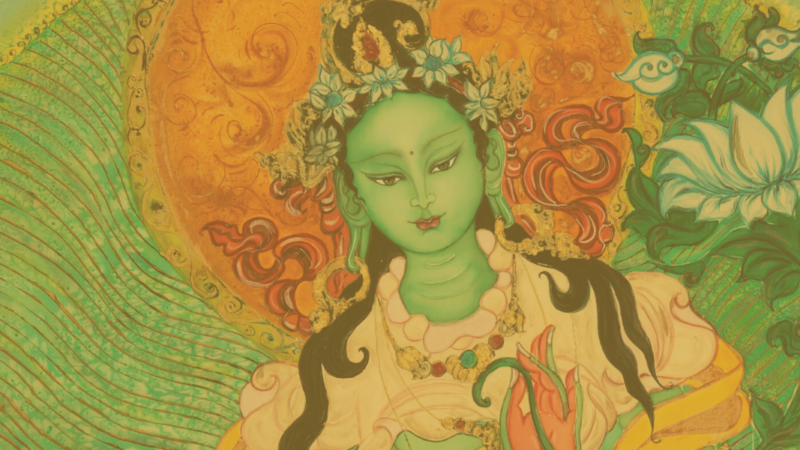
Golden Tara appears as the life-giving female buddha in a body of radiant golden light. She embodies the light of life itself. The vase in Golden Tara’s hand contains the power to increase our life energy, power, and material and spiritual resources. These resources support us in times of ease and times of difficulty, enabling us to discover and fulfill the purposes of our life on a moment-to-moment basis and over the arc of our lives.
For centuries, artists have created statues and thangka paintings of Tara, always adorned with jewelry. These sacred paintings, usually done on fabric and surrounded by brocade, portray the qualities of their subjects and convey teachings as well. Thus we take special note of Tara’s adornments. A crown rests atop her head. Necklaces of varying lengths cascade from her neck to her waist. Bracelets encircle her wrists. All have been crafted from gold with deep red and blue jewels woven into the designs.
Gold has been the preferred precious metal of jewelry makers for thousands of years. Gold is malleable; gold doesn’t tarnish. Golden light is associated with increasing life-force, healing, and holiness. Holy people of many faiths are often painted in an aura of golden radiance.
Many years ago, I heard a teaching that Tara’s jewels represent her experiences over lifetimes on her way to enlightenment and buddhahood. Profound understanding of the Buddhist teachings and her experiences as a woman led Wisdom Moon to vow to attain enlightenment as a woman and to persevere toward her goal. Tara’s life events were surely difficult and awe-inspiring, ordinary and phenomenal. All of them were precious contributions to her journey, which has benefited countless beings over hundreds of years.
The Mantra
Om Tare Tuttare Ture Sarva Ayur Punye Pushtam Kuru Soha!
“Ohm Tahray Tootahray Tooray Sarwah Ahyoor Poonyay Pushtahm Kooroo Soha!”
When you recite the mantra of Golden Tara, you are urging (kuru) Tara to increase (pushtam) your life energies (ayur) and merit (punye), your contributions to adding positive energy to beings around the world, near and far. Mantra recitations need not be limited to formal practice. Use them throughout the day to slow down and focus on whatever task is at hand.
The Practice
First, visualize the entire mandala of Green Tara emerging into the space in front of you. You are surrounded by your friends, loved ones, and supporters, and she is surrounded by your teachers and all the twenty-one emanations. After the opening prayers, imagine Golden Tara coming into the foreground of the mandala. Recall her praise while visualizing golden rays of light streaming from her heart as well as the golden vase in her right hand, which rests on her right knee, palm open in the gesture of supreme giving.
As you recite her mantra, Om Tare Tuttare Ture Sarva Ayur Punye Pushtam Kuru Soha, imagine that you are absorbing this light and that other beings and other places are receiving the light of Tara as well.
Kuru, which appears in seven of the Tara mantras, carries a particularly bold tone. You’re not meekly asking Tara to help—you’re putting your whole heart and body into this request. “Tara, please do this for me. Remove blockages so more energy flows into my life and work! I’m counting on you!” The same tasks that feel overwhelming in one moment seem entirely possible in the next.
Tara can help you discern the wisdom inherent in the obstacles you encounter in your life and practice. Meditate on the continuity in your life—the joyful moments, the extremely painful moments, and everything in between. Your experiences are not meaningless fragments. Imagine a mosaic forming as you piece the fragments together into a beautiful coherent pattern. Invoke Tara’s wisdom to give you greater clarity about your life purpose and the means to fulfill it.
Recite the mantra at least 21 times or 108 times whenever possible. Then rest in the vibrational field created by your chanting. Allow frustration and doubt to dissolve, releasing energy for healing. You become richer in inner resources, which leads to enriched outer resources as well, both material and spiritual. Affirm your connection to all life forms in the universe. Know that the benefits of your heartfelt wishes and efforts will flow from you into the world.
As you bring the session to a close, visualize Golden Tara receding into her place among the twenty-one emanations. See the whole mandala dissolve into radiant light, which flows into you and merges with your inner light. Dedicate the merit or positive potential generated by the practice to the healing of all beings—with no exceptions.
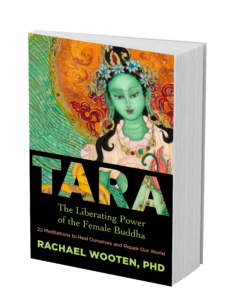
This is an adapted excerpt from Tara: The Liberating Power of the Female Buddha by Dr. Rachael Wooten.

Rachael Wooten, PhD, is a Zürich—trained Jungian analyst and psychologist who has been in private practice as a therapist for more than 40 years. An enthusiastic interfaith activist, she has studied and practiced in Buddhist, Jewish, Christian, and indigenous traditions throughout her adult life.
Rachael has been mentored by spiritual teachers such as her Tibetan root guru Lodrö Tulku Rinpoche and Rabbi Zalman Schachter-Shalomi. She has taught Tara practices under the authorization of Lodrö Rinpoche for more than 20 years. Rachael has offered Tara workshops through the Resource Center for Women and Ministry in the South, ALEPH: Alliance for Jewish Renewal, and C. G. Jung Society of the Triangle. She currently teaches a monthly Tara meditation group at Pullen Memorial Baptist Church in her hometown of Raleigh, North Carolina. To learn more, visit rachaelwootenauthor.com.
Learn More
Sounds True | Amazon | Barnes & Noble | Bookshop | Indiebound
Black Tara Who Destroys All Negativities
In the fall of 2010, our monthly Tara practice began at sundown at the end of Rosh Hashanah, the beginning of the Jewish new year, 5771. The days between Rosh Hashanah and Yom Kippur are known as the Days of Awe. During these ten days, observant practitioners reflect on the past year to repair harm they may have inflicted on friends, family, or members of the greater family of the planet. They apologize to others and seek to do t’shuvah to make amends if possible. People work consciously to repair and let go of past negativity and set intentions for the coming year to prevent further mischief.
Black Tara Who Destroys All Negativities was on the calendar for that night. We appreciated the synchronistic timing of the two events. I noted that Tara protects us from negativity, internal and external, and helps us release the effects of negative energies we’ve encountered or generated. This protection occurs in part from remembering our connection to the Whole—that we are nurtured and contained by a multilayered universe. When we help another, we are helped. If we harm another, we harm ourselves. Perhaps harder to grasp—if we harm ourselves, we harm the whole universe.
The teaching centered around the meaning of the mantra, which refers explicitly to ingrained behaviors operating outside of consciousness that wreak havoc in interpersonal relationships. Negative energies transferred from one individual to another are potent and destructive, and often have lasting effects.
Tara’s Appearance
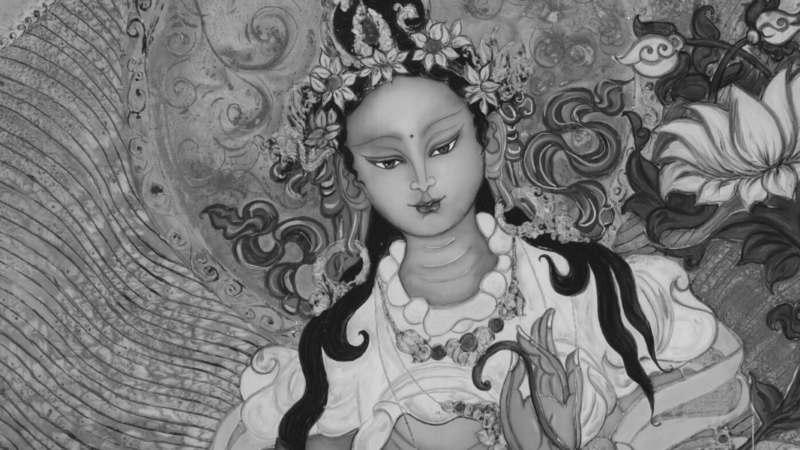
Black Tara appears with her mouth wide open in a fierce expression. Like all the wrathful emanations, she sits on a fiery sun disc, which rests in the center of her lotus throne. The sun disc replaces the usual soothing moon disc. She holds a black vase, which contains the power to overcome even the most destructive and negative powers. In this aspect, Tara is known as the Destroyer of All Negativities.
The Mantra
Om Tare Tuttare Ture Sarva Vidya Avarana Ye Bhye Phat Soha!
“Ohm Tahray Tootahray Tooray Sarwah Veedyah Ahvahrahnah Yay Bay Peyt Soha!”
This mantra sheds more light on the meaning of the practice, when you might need to use it, and how to align your own intentions with those of Tara. It insists that Tara remove mental obstacles that block insight into your complexes or the emotional forces that obscure your understanding. Avarana refers to the causes underlying negative tendencies in yourself or others. These instincts, imprints, or potencies are ingrained, influencing behavior outside of awareness. They are unconscious, unquestioned, and unprocessed. They have been denied, repressed, or avoided. You or others around you might struggle to bring them to consciousness or have no wish to do that whatsoever.
As with many words in Sanskrit, vidya has multiple meanings depending on the context. Vidya often means “wisdom”; in this instance, it means “intentions,” particularly negative intentions. Bhye phat urges Tara to destroy these obstacles or difficulties!
The mantra asks Tara to overcome the negative intentions of the enemy. Use it when you want her complete protection in order to fully grasp the difficulties in your situation. Watch for signs that you are being infected or possessed by internal negativity, which would be a natural response to the energy coming at you. Don’t be naive about actual outer dangers you might be facing; you have to remove yourself from harmful situations.
The Practice
Visualize the entire mandala of the twenty-one Taras arising out of vast space in front of you. Green Tara appears in the center in her radiant body of green light. Imagine your teachers surrounding her and all her other emanations in the background behind them. Finally, invite your friends and supporters and all beings you wish to receive the blessings of your practice. Recite the preliminary prayers. Then imagine that Black Tara Who Destroys All Negativities moves into the foreground, seated on her lotus throne with a sun disc in the center. She holds a black vase, which contains the power to destroy even the most virulent forces in the universe. See light streaming out of her heart and from her seed syllable Tam (“Tahm”) standing on a moon disc inside the vase. Just as a seed contains the entire essence of the plant it will become, the seed syllable Tam contains the entire essence of Tara’s infinite powers.

If visualizing a Tibetan syllable proves difficult initially, simply visualize light streaming out instead. The light destroys all malice and negativity.
Invite Black Tara to protect you from the negative intentions and actions of others. Set your own intentions to release the shock of the impact of such energies on your body, psyche, and spirit. Ofer Tara all of your dark emotions; ask her to protect you inside and out as you engage with our imperfect world in which aggression and hatred are too easily encountered.
Recite the mantra, Om Tare Tuttare Ture Sarva Vidya Avarana Ye Bhye Phat Soha, at least 21 times or 108 times whenever possible. Then rest in the subtle vibration created by the mantra recitation. Notice the qualities of the energy around you. Remember and be grateful for the inherent goodness in the universe that is continuously giving birth to positive impulses inside of you and other beings in the world.
Black Tara brings you back to the radiant spaciousness at the core of your being. As she dissolves obstacles created by negativity, try to identify the signs of true knowing versus the cynical and damaging commentary of the complex. Learn to distinguish what’s coming from inside, what’s coming at you from outside, and how the two are related. Reach out to the cosmic Mother Protector in the form of Tara. Reach inward to her indwelling presence and open yourself to access wisdom and compassion, which offers the greatest protection no matter the circumstances.
As you bring the meditation to a close, visualize Black Tara receding into the background among all the other emanations. See the light streaming out of the entire mandala and then allow the mandala with all its beings to dissolve into space. The light flows into your body and heart, vivifying and stabilizing the essence of Tara within you, and then disperses into the universe. Dedicate the positive potential of the practice to the healing and awakening of all beings everywhere, with no exceptions.
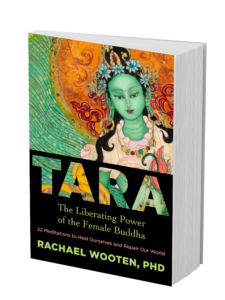
This is an adapted excerpt from Tara: The Liberating Power of the Female Buddha by Dr. Rachael Wooten.
Rachael Wooten, PhD, is a Zürich—trained Jungian analyst and psychologist who has been in private practice as a therapist for more than 40 years. An enthusiastic interfaith activist, she has studied and practiced in Buddhist, Jewish, Christian, and indigenous traditions throughout her adult life.
Rachael has been mentored by spiritual teachers such as her Tibetan root guru Lodrö Tulku Rinpoche and Rabbi Zalman Schachter-Shalomi. She has taught Tara practices under the authorization of Lodrö Rinpoche for more than 20 years. Rachael has offered Tara workshops through the Resource Center for Women and Ministry in the South, ALEPH: Alliance for Jewish Renewal, and C. G. Jung Society of the Triangle. She currently teaches a monthly Tara meditation group at Pullen Memorial Baptist Church in her hometown of Raleigh, North Carolina. To learn more, visit rachaelwootenauthor.com.
Learn More
Sounds True | Amazon | Barnes & Noble | Bookshop | Indiebound
5 Neurosculpting Practices for Lasting Brain Change
Incorporating these five best neuroplasticity practices can open the doors to a more graceful, resilient, and lasting experience of change.

The Way of the Feminine to Save the World
You feel special. Sometimes this feels like a curse. Like no one will understand you. Ever. Like you will always be an alien walking among regular humans, pretending to blend in. You have learned to live with this gulf, but what you really crave is community. You long to belong to the human family. To Mother Earth.
Participating in the human condition can be bewildering. It is just not always cozy and easy—rather, it’s humbling at best, downright humiliating when it is not flowing. It can seem so much simpler to ride solo, slaying your own dragons and singing the ballads you wrote about yourself. Collaboration can be tedious, and the prevailing masculine value system may have conditioned you to feel like you are giving away your power when you share it with others.
So what? Give it away. The time of the singular sage bestowing his unique wisdom is over. That was a method devised by the men in charge who sought to regulate wisdom. They taught us to suffer alone in the desert for forty years, collecting our insights in a secret box called “Esoteric Knowledge.” Then, we were supposed to dispense those insights stingily to those who proved themselves worthy by also suffering alone for the requisite forty years in the desert.
It turns out that the world is filled with special beings, grappling our way through the anxiety of solitary conundrums and tasting the occasional reprieve of connection. When you realize this, your body lets out its breath and relaxes. The curse lifts. You come in from the cold. You hold out your cup, and some other special being fills it with sweet, milky tea spiced with fragrant herbs. You drink.
Our way, the way of the feminine, is to find out what everyone is good at and praise them for it and get them to teach it to one another. Maybe you know something about the hidden meaning of the Hebrew letters, or how to build a sustainable home from recycled tires and rammed soil, or loving-kindness meditation. You, the one who knows the Islamic call to prayer, climb this minaret and call us all to prayer. You, the one who knows how to sit quietly at the bedside of the dying, show us the way to bear witness. You, the one who knows how to get us to wake up to the shadow of privilege, please wake us the #*#@ up. It will be chaotic, all this community building, but your cooperation will save the world.
Besides, it will be fun.
I Did a 40-Day Rest Cleanse and Here’s What Happened
For 40 days, I had the most soulful rest. And I did it in the comfort of my own home, with a full-time job, a family, and a social life.
Every day I awoke around 5:30 am and tiptoed to my Rest Cave (set up in a corner of our spare room). I laid on my back on an exercise mat (under my favorite blanket with a sleep mask) and plugged earbuds into my phone. Then I hit play on Karen Brody’s Daring to Rest yoga nidra meditation and let her soothing guidance lull me into a state of deep rest—or as Karen puts it, a return to myself. If you’re not familiar with yoga nidra, it’s a meditative practice for entering one of the deepest states of relaxation imaginable. And you do it lying down.
I’m not a morning person, but getting up to lie down (ironic, right?) was lovely. The stillness of the early morning quickly became my friend.
For the first 15 days, I listened to the Rest Meditation (20 minutes) to shed physical exhaustion, followed by 15 days of the Release Meditation (30 minutes) to let go of limiting beliefs. The last 10 days consist of the Rise Meditation (40 minutes), allowing life purpose exhaustion to lift, so that you can hone in on your true-hearted desires. Every five days I read a chapter in the book itself, Daring to Rest, for insight into what I was experiencing and supportive practices.
Gradually these aspects of my life began to shift—providing a depth of experience new to me, and oh so, beautiful.
- An underlying sense of sweetness in my day. I discovered a natural flow to my day, felt light and at ease in my skin, and second-guessed myself less.
- Deep intuition. Karen guided me to breathe in through my heart, then follow my breath, see where it landed, and listen for what she calls a “soul whisper”—a word or image that offers a clue to how you’re really feeling. Some days all I could think about was my to-do list or obsess over a worry. But when my soul whispers did arrive, they were often crystal clear and I journaled about them.
- Patience and connection. Mornings were less frantic. When my seven-year old son had stressful moments getting ready for school, I felt calmer and more present for him. When we walked to the bus stop, my awareness of the outdoor world was more acute—the blue sky, cloud formations, the crescent of a morning moon.
- Craving control. On days when I felt overwhelmed or anxious, my inclination to relieve those feelings with a glass of wine or binging on television lessened. Sometimes I would simply sit, gaze outdoors, and do nothing more. In those moments, I loved not feeling the need to do anything—not clean, not sort the mail, not check Facebook. I began to understand rest outside of my Rest Cave.
- A connection to beyond. This was a big one. Karen calls it your “council of women” and teaches you to summon it for love and support. It can be women in your circle, women who have passed, even women you don’t know personally. I saw my grandmother (who died before I was born) looking at me lovingly and felt my sister-in-law, who I’ve known since I was a baby, standing beside me. At times the feeling of these and other women was so strong that tears ran down my cheeks.
While my life became deeper and rosier, it was not until I went cold turkey for a few weeks that I realized just how powerful this rest cleanse was. I’ve always been someone who can go the distance, then neglect the sustaining part, like training for a half-marathon but not running for months after the race. And it’s so easy to fall back into old habits.
So now I’m learning how to translate this cleanse into an ongoing practice, for which Daring to Rest offers sound insights. My Rest Cave is an essential element. It’s not only a dedicated space for yoga nidra, but one for self-care in general—to journal, to listen to music, to just be.
Karen ends every yoga nidra meditation with the words, “Be good to yourself.” And in that spirit, I invite you to download her free Rest Cave Guide to create your own. And once you do, I dare you to rest and see what happens!
Christine Day has been a member of Sounds True’s sales and marketing team for more than five years and loves diving into our books on a personal level to learn both theory and practice. She also works on Sounds True’s children’s books and enjoys doing storytimes at her son’s elementary school.

