Bigger Isn’t Always Better (and Other Cultural Myths)

    —
July 23, 2019

Bigger Isn't Always BetterSome of our beliefs aren’t even ours. Like old wives’ tales passed down through generations or reflected back to us through society, we inherited certain cultural and familial narratives, adopted them, and left them unquestioned as “Truth.” Sometimes these inherited narratives and beliefs manifest as unquestioned traditions. For example, when making the Thanksgiving turkey, my friend’s mother always cut the breast of the bird off and roasted it separately. This process was embedded in my friend’s view of “how to cook a turkey.” When she moved to New York and began hosting her own Thanksgivings, she also sliced the top off the turkey and cooked it separately. Naturally. 

One year a guest asked her why she didn’t cook the turkey whole, which got her to thinking. She didn’t actually know why. It’s just the way it had always been done. So she called her mother to ask about the tradition: Why do we cut the tops off our turkeys? Her mother replied that she had always taken the top off because her mother had always taken the top off; it’s just the way she had learned how to cook a turkey. Naturally curious as to where this learned behavior all began, her mother called her mother, my acquaintance’s grandmother, and asked: Why do we cut the tops off our turkeys?

The grandmother, stumped, thought for a long, hard minute. “Oh,” she remembered, “the oven in my very first apartment was too small to fit an entire turkey, so I had to cook it with the top cut off.” Sixty years later, in a city across the country, my acquaintance was still cooking turkeys as a result of an oven that was too small. This is how inherited narrative works.

Here are some of the narratives that I inherited over the years, in order from most helpful to least: You can be anything that you want to be. Money isn’t very important. It is what it is, and it can’t be changed. Men prefer pretty over smart. Asking for help means you’re weak and needy. These are the ones that I’ve managed to tease out; I’m sure there are plenty more operating in the background that I can’t see.

Part of developing a wholesome or Beneficial View is identifying the stories that we live by, where they came from, and, perhaps most importantly, whether or not they are helpful on the path of waking up to our worthiness. Shariputra, one of the Buddha’s chief disciples, described Beneficial View as the practice of identifying which of our views spring from beneficial beliefs and which spring from harmful beliefs, and then choosing which to nourish and cultivate. Sometimes this also means looking at the views of the culture that we live in.

A few times every year, I host group coaching programs for a rather large online training institute with a global reach, drawing students from a dozen countries, primarily women of varying ages. These groups offer an encouraging environment in which we can speak openly about our fears and hesitations. Over the past decade, working as a coach has revealed to me just how many of us feel a chronic sense of falling behind and a nagging suspicion that we’re not quite _________ enough. You can fill in the blank here with your own particular flavor of not-enough-ness. Not educated enough, smart enough, good-looking enough, likable enough, thin enough . . . You get the picture. A consistent element of these groups has been a gobsmacking number of women sharing that they view their capabilities as insufficient or lacking. Sometimes this feeling extends to the way that they view themselves as people. It’s said that if one fish washes up on the shore, the scientist will call it what it is: a dead fish. Nothing of note, really. However, if hundreds of fish wash up on the shore, the biologist won’t look to the fish for answers. They’ll test the water that the fish are swimming in. So what’s up with the water that we all seem to be swimming in?

In the Western hemisphere, there is a deeply embedded narrative of scarcity that is nearly invisible. I don’t know about you, but I clearly remember playing the childhood game of musical chairs. It begins as a cheerful romp around the circle, with kids squealing and running to nab a chair once the music stops. As the game progresses, however, the stakes get higher. The chairs begin to disappear. The slowest, smallest, and most accommodating kids get disqualified. And the fastest, most aggressive kids advance amidst the dwindling resource of chairs. Good, clean childhood fun. Also, a wonderful way to implicitly teach kids this prevailing myth of scarcity: There is simply not enough to go around. And you better get yours before someone else takes it.

Author, activist, and fund-raiser Lynne Twist illustrates this phenomenon exquisitely in her book The Soul of Money. She likens the scarcity narrative to a “helmet” of insufficiency that we wear throughout our day that flavors every interaction we have. For example, our first thought when getting up in the morning tends to be I didn’t get enough sleep. As we get ready for the day, we think, I don’t have enough to wear, I don’t have enough time, I don’t have enough room on the subway, I don’t have enough help to get this job done well, There aren’t enough good men or women on Tinder, I don’t have enough energy to meet up with my friends, and then our final thought before falling asleep is I didn’t get enough done. This view of not having enough is truly pervasive. It’s no wonder that the women I’ve worked with consistently communicate that they don’t feel like they can live up to their own, or society’s, expectations.

Even if we try to address the messages we might tell ourselves about what we have and don’t have, we can’t avoid them altogether. I was riding the subway to Brooklyn one day when a father and his daughter, who was all of five or six years old, entered the train and stood toward the center of the car. She was chatting to her dad about her day at school until one of the many subway ads caught her eye. In it, there were two juxtaposed photos of a blonde woman. In one photo, the woman was frowning while holding a lemon in each hand, which were hovering at chest height. In the other, she was holding two grapefruits, also at chest height, but she was grinning. “Dad, why is she happy in that one and sad in that one?” the girl asked, pointing to the ad for breast augmentation. I swear the entire subway car went silent in anticipation of how her father would respond. He awkwardly and skillfully lobbed the question back to his daughter. “Well . . . what do you think?” The girl waited a beat and then answered, “She’s happy there because she has big ones and sad there because she has small ones.”

Clearly she had understood the message this poster was communicating to us all: a message of scarcity, insufficiency, and how one might always be “better.” And in that instant I understood how conditioning works. Hello, demon of self-doubt. Just like the fish in the ocean, we’re bound to swallow the water that we swim in. When considering what it means to develop Beneficial View, and the view of our own worthiness, it can be helpful to identify why we might not feel worthy to begin with. If our cultural perspective is rooted in the myth of “not enough,” it would logically follow that we would inherit this not-so-beneficial view of ourselves. Through looking at our own mind in meditation practice, we begin to take stock of the stories and beliefs that are not serving us, unraveling this myth of “not enough,” and revealing the Beneficial View of our innate wholeness and worth.

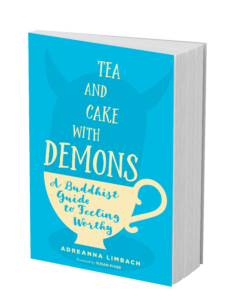
This is an excerpt from Tea and Cake with Demons: A Buddhist Guide to Feeling Worthy by Adreanna Limbach.Tea and Cake with Demons

Adreanna LimbachAdreanna Limbach is a personal coach and a lead meditation instructor at MNDFL, NYC’s premier drop-in meditation studio. Her teachings have been featured in the New York Times, Women’s Health, and Refinery29. She lives in New York City. For more, visit adreannalimbach.com.

Buy your copy of Tea and Cake with Demons at your favorite bookseller!

Sounds True | Amazon | Barnes & Noble | Indiebound


Bigger Isn't Always Better Pinterest

Adreanna Limbach

Adreanna Limbach is the head teacher at MNDFL meditation studios and a personal development coach who helps women access their inherent clarity and confidence so that they can expand their freedom in business and life. She’s practiced meditation for the last twenty years and has taught Buddhist studies, meditation, and the cultivation of self-worth since 2012 at locations across the globe.
 
She has spent a decade mentoring do-gooders at the Institute for Integrative Nutrition as a coach, and she has catalyzed cohorts of tomorrow’s leaders around social change as an executive coach and faculty member at the Institute for Compassion Leadership. Her work has been featured by the New York Times, Refinery29, Women’s Health, and xoJane. She lives with her husband and too many small animals in an apartment in NYC. You can find out more at AdreannaLimbach.com.

Author photo © Veronika Kindred

Also By Author

Bigger Isn’t Always Better (and Other Cultural Myths...

Some of our beliefs aren’t even ours. Like old wives’ tales passed down through generations or reflected back to us through society, we inherited certain cultural and familial narratives, adopted them, and left them unquestioned as “Truth.” Sometimes these inherited narratives and beliefs manifest as unquestioned traditions. For example, when making the Thanksgiving turkey, my friend’s mother always cut the breast of the bird off and roasted it separately. This process was embedded in my friend’s view of “how to cook a turkey.” When she moved to New York and began hosting her own Thanksgivings, she also sliced the top off the turkey and cooked it separately. Naturally. 

One year a guest asked her why she didn’t cook the turkey whole, which got her to thinking. She didn’t actually know why. It’s just the way it had always been done. So she called her mother to ask about the tradition: Why do we cut the tops off our turkeys? Her mother replied that she had always taken the top off because her mother had always taken the top off; it’s just the way she had learned how to cook a turkey. Naturally curious as to where this learned behavior all began, her mother called her mother, my acquaintance’s grandmother, and asked: Why do we cut the tops off our turkeys?

The grandmother, stumped, thought for a long, hard minute. “Oh,” she remembered, “the oven in my very first apartment was too small to fit an entire turkey, so I had to cook it with the top cut off.” Sixty years later, in a city across the country, my acquaintance was still cooking turkeys as a result of an oven that was too small. This is how inherited narrative works.

Here are some of the narratives that I inherited over the years, in order from most helpful to least: You can be anything that you want to be. Money isn’t very important. It is what it is, and it can’t be changed. Men prefer pretty over smart. Asking for help means you’re weak and needy. These are the ones that I’ve managed to tease out; I’m sure there are plenty more operating in the background that I can’t see.

Part of developing a wholesome or Beneficial View is identifying the stories that we live by, where they came from, and, perhaps most importantly, whether or not they are helpful on the path of waking up to our worthiness. Shariputra, one of the Buddha’s chief disciples, described Beneficial View as the practice of identifying which of our views spring from beneficial beliefs and which spring from harmful beliefs, and then choosing which to nourish and cultivate. Sometimes this also means looking at the views of the culture that we live in.

A few times every year, I host group coaching programs for a rather large online training institute with a global reach, drawing students from a dozen countries, primarily women of varying ages. These groups offer an encouraging environment in which we can speak openly about our fears and hesitations. Over the past decade, working as a coach has revealed to me just how many of us feel a chronic sense of falling behind and a nagging suspicion that we’re not quite _________ enough. You can fill in the blank here with your own particular flavor of not-enough-ness. Not educated enough, smart enough, good-looking enough, likable enough, thin enough . . . You get the picture. A consistent element of these groups has been a gobsmacking number of women sharing that they view their capabilities as insufficient or lacking. Sometimes this feeling extends to the way that they view themselves as people. It’s said that if one fish washes up on the shore, the scientist will call it what it is: a dead fish. Nothing of note, really. However, if hundreds of fish wash up on the shore, the biologist won’t look to the fish for answers. They’ll test the water that the fish are swimming in. So what’s up with the water that we all seem to be swimming in?

In the Western hemisphere, there is a deeply embedded narrative of scarcity that is nearly invisible. I don’t know about you, but I clearly remember playing the childhood game of musical chairs. It begins as a cheerful romp around the circle, with kids squealing and running to nab a chair once the music stops. As the game progresses, however, the stakes get higher. The chairs begin to disappear. The slowest, smallest, and most accommodating kids get disqualified. And the fastest, most aggressive kids advance amidst the dwindling resource of chairs. Good, clean childhood fun. Also, a wonderful way to implicitly teach kids this prevailing myth of scarcity: There is simply not enough to go around. And you better get yours before someone else takes it.

Author, activist, and fund-raiser Lynne Twist illustrates this phenomenon exquisitely in her book The Soul of Money. She likens the scarcity narrative to a “helmet” of insufficiency that we wear throughout our day that flavors every interaction we have. For example, our first thought when getting up in the morning tends to be I didn’t get enough sleep. As we get ready for the day, we think, I don’t have enough to wear, I don’t have enough time, I don’t have enough room on the subway, I don’t have enough help to get this job done well, There aren’t enough good men or women on Tinder, I don’t have enough energy to meet up with my friends, and then our final thought before falling asleep is I didn’t get enough done. This view of not having enough is truly pervasive. It’s no wonder that the women I’ve worked with consistently communicate that they don’t feel like they can live up to their own, or society’s, expectations.

Even if we try to address the messages we might tell ourselves about what we have and don’t have, we can’t avoid them altogether. I was riding the subway to Brooklyn one day when a father and his daughter, who was all of five or six years old, entered the train and stood toward the center of the car. She was chatting to her dad about her day at school until one of the many subway ads caught her eye. In it, there were two juxtaposed photos of a blonde woman. In one photo, the woman was frowning while holding a lemon in each hand, which were hovering at chest height. In the other, she was holding two grapefruits, also at chest height, but she was grinning. “Dad, why is she happy in that one and sad in that one?” the girl asked, pointing to the ad for breast augmentation. I swear the entire subway car went silent in anticipation of how her father would respond. He awkwardly and skillfully lobbed the question back to his daughter. “Well . . . what do you think?” The girl waited a beat and then answered, “She’s happy there because she has big ones and sad there because she has small ones.”

Clearly she had understood the message this poster was communicating to us all: a message of scarcity, insufficiency, and how one might always be “better.” And in that instant I understood how conditioning works. Hello, demon of self-doubt. Just like the fish in the ocean, we’re bound to swallow the water that we swim in. When considering what it means to develop Beneficial View, and the view of our own worthiness, it can be helpful to identify why we might not feel worthy to begin with. If our cultural perspective is rooted in the myth of “not enough,” it would logically follow that we would inherit this not-so-beneficial view of ourselves. Through looking at our own mind in meditation practice, we begin to take stock of the stories and beliefs that are not serving us, unraveling this myth of “not enough,” and revealing the Beneficial View of our innate wholeness and worth.

This is an excerpt from Tea and Cake with Demons: A Buddhist Guide to Feeling Worthy by Adreanna Limbach.


adreanna limbachAdreanna Limbach is a personal coach and a lead meditation instructor at MNDFL, NYC’s premier drop-in meditation studio. Her teachings have been featured in the New York Times, Women’s Health, and Refinery29. She lives in New York City. For more, visit adreannalimbach.com.


tea and cake with demons

Buy your copy of Tea and Cake with Demons at your favorite bookseller!

Sounds True | Amazon | Barnes & Noble | Indiebound | Bookshop

Adreanna Limbach: Tea and Cake with Demons

Adreanna Limbach is a personal coach and the lead meditation teacher at Mindful Meditation Studios in New York City. With Sounds True, she has published Tea and Cake with Demons: A Buddhist Guide to Feeling Worthy. In this episode of Insights at the Edge, Tami Simon speaks with Adreanna about contemplative practices that can open anyone to sitting down and becoming more familiar with their own difficult, painful feelings. Adreanna explains how these same practices helped her come to terms with panic attacks and become more resilient to extreme bursts of emotion. Tami and Adreanna discuss what it means to be “worthy” and why challenges are actually invitations to practice. Finally, they talk about the Four Noble Truths and how they might be interpreted in the modern era. (67 minutes)

Bigger Isn’t Always Better (and Other Cultural Myths...

Bigger Isn't Always BetterSome of our beliefs aren’t even ours. Like old wives’ tales passed down through generations or reflected back to us through society, we inherited certain cultural and familial narratives, adopted them, and left them unquestioned as “Truth.” Sometimes these inherited narratives and beliefs manifest as unquestioned traditions. For example, when making the Thanksgiving turkey, my friend’s mother always cut the breast of the bird off and roasted it separately. This process was embedded in my friend’s view of “how to cook a turkey.” When she moved to New York and began hosting her own Thanksgivings, she also sliced the top off the turkey and cooked it separately. Naturally. 

One year a guest asked her why she didn’t cook the turkey whole, which got her to thinking. She didn’t actually know why. It’s just the way it had always been done. So she called her mother to ask about the tradition: Why do we cut the tops off our turkeys? Her mother replied that she had always taken the top off because her mother had always taken the top off; it’s just the way she had learned how to cook a turkey. Naturally curious as to where this learned behavior all began, her mother called her mother, my acquaintance’s grandmother, and asked: Why do we cut the tops off our turkeys?

The grandmother, stumped, thought for a long, hard minute. “Oh,” she remembered, “the oven in my very first apartment was too small to fit an entire turkey, so I had to cook it with the top cut off.” Sixty years later, in a city across the country, my acquaintance was still cooking turkeys as a result of an oven that was too small. This is how inherited narrative works.

Here are some of the narratives that I inherited over the years, in order from most helpful to least: You can be anything that you want to be. Money isn’t very important. It is what it is, and it can’t be changed. Men prefer pretty over smart. Asking for help means you’re weak and needy. These are the ones that I’ve managed to tease out; I’m sure there are plenty more operating in the background that I can’t see.

Part of developing a wholesome or Beneficial View is identifying the stories that we live by, where they came from, and, perhaps most importantly, whether or not they are helpful on the path of waking up to our worthiness. Shariputra, one of the Buddha’s chief disciples, described Beneficial View as the practice of identifying which of our views spring from beneficial beliefs and which spring from harmful beliefs, and then choosing which to nourish and cultivate. Sometimes this also means looking at the views of the culture that we live in.

A few times every year, I host group coaching programs for a rather large online training institute with a global reach, drawing students from a dozen countries, primarily women of varying ages. These groups offer an encouraging environment in which we can speak openly about our fears and hesitations. Over the past decade, working as a coach has revealed to me just how many of us feel a chronic sense of falling behind and a nagging suspicion that we’re not quite _________ enough. You can fill in the blank here with your own particular flavor of not-enough-ness. Not educated enough, smart enough, good-looking enough, likable enough, thin enough . . . You get the picture. A consistent element of these groups has been a gobsmacking number of women sharing that they view their capabilities as insufficient or lacking. Sometimes this feeling extends to the way that they view themselves as people. It’s said that if one fish washes up on the shore, the scientist will call it what it is: a dead fish. Nothing of note, really. However, if hundreds of fish wash up on the shore, the biologist won’t look to the fish for answers. They’ll test the water that the fish are swimming in. So what’s up with the water that we all seem to be swimming in?

In the Western hemisphere, there is a deeply embedded narrative of scarcity that is nearly invisible. I don’t know about you, but I clearly remember playing the childhood game of musical chairs. It begins as a cheerful romp around the circle, with kids squealing and running to nab a chair once the music stops. As the game progresses, however, the stakes get higher. The chairs begin to disappear. The slowest, smallest, and most accommodating kids get disqualified. And the fastest, most aggressive kids advance amidst the dwindling resource of chairs. Good, clean childhood fun. Also, a wonderful way to implicitly teach kids this prevailing myth of scarcity: There is simply not enough to go around. And you better get yours before someone else takes it.

Author, activist, and fund-raiser Lynne Twist illustrates this phenomenon exquisitely in her book The Soul of Money. She likens the scarcity narrative to a “helmet” of insufficiency that we wear throughout our day that flavors every interaction we have. For example, our first thought when getting up in the morning tends to be I didn’t get enough sleep. As we get ready for the day, we think, I don’t have enough to wear, I don’t have enough time, I don’t have enough room on the subway, I don’t have enough help to get this job done well, There aren’t enough good men or women on Tinder, I don’t have enough energy to meet up with my friends, and then our final thought before falling asleep is I didn’t get enough done. This view of not having enough is truly pervasive. It’s no wonder that the women I’ve worked with consistently communicate that they don’t feel like they can live up to their own, or society’s, expectations.

Even if we try to address the messages we might tell ourselves about what we have and don’t have, we can’t avoid them altogether. I was riding the subway to Brooklyn one day when a father and his daughter, who was all of five or six years old, entered the train and stood toward the center of the car. She was chatting to her dad about her day at school until one of the many subway ads caught her eye. In it, there were two juxtaposed photos of a blonde woman. In one photo, the woman was frowning while holding a lemon in each hand, which were hovering at chest height. In the other, she was holding two grapefruits, also at chest height, but she was grinning. “Dad, why is she happy in that one and sad in that one?” the girl asked, pointing to the ad for breast augmentation. I swear the entire subway car went silent in anticipation of how her father would respond. He awkwardly and skillfully lobbed the question back to his daughter. “Well . . . what do you think?” The girl waited a beat and then answered, “She’s happy there because she has big ones and sad there because she has small ones.”

Clearly she had understood the message this poster was communicating to us all: a message of scarcity, insufficiency, and how one might always be “better.” And in that instant I understood how conditioning works. Hello, demon of self-doubt. Just like the fish in the ocean, we’re bound to swallow the water that we swim in. When considering what it means to develop Beneficial View, and the view of our own worthiness, it can be helpful to identify why we might not feel worthy to begin with. If our cultural perspective is rooted in the myth of “not enough,” it would logically follow that we would inherit this not-so-beneficial view of ourselves. Through looking at our own mind in meditation practice, we begin to take stock of the stories and beliefs that are not serving us, unraveling this myth of “not enough,” and revealing the Beneficial View of our innate wholeness and worth.

This is an excerpt from Tea and Cake with Demons: A Buddhist Guide to Feeling Worthy by Adreanna Limbach.Tea and Cake with Demons

Adreanna LimbachAdreanna Limbach is a personal coach and a lead meditation instructor at MNDFL, NYC’s premier drop-in meditation studio. Her teachings have been featured in the New York Times, Women’s Health, and Refinery29. She lives in New York City. For more, visit adreannalimbach.com.

Buy your copy of Tea and Cake with Demons at your favorite bookseller!

Sounds True | Amazon | Barnes & Noble | Indiebound


Bigger Isn't Always Better Pinterest

You Might Also Enjoy

Thomas Moore: “Curing Our Cultural Lostness̶...

Thoreau said he wasn’t paddling the Assabet River—he was on the Ganges. Was he being poetic, or was he seeing something we’ve lost the capacity to see?

This week, Tami Simon speaks with Thomas Moore—bestselling author of Care of the Soul, Dark Nights of the Soul, and Ageless Soul—about his new book, The Cure at Walden Pond: A Guide to Recovering Our Humanity. At 85, Moore offers a reading of Thoreau that upends the one most of us were taught: not a naturalist cataloguing the woods, but a mystic looking for what he called the divine “lurking” there.

Join Tami and Thomas to explore:

  • Living daimonically: the guiding presence the Greeks called a daimon and the Romans called a genius—and how to tell it from your own ego agenda
  • Why Moore left the monastery after 13 years on the strength of a single morning’s clarity
  • “We are half human, half angel”—and what changes when you look at the people in your life through that lens
  • Musical time, Bach, and why playing the piano every day has made Moore think differently about dying
  • Why “the ultimate secret is to show the world who you are”—and why humiliation may be closer to the soul than confidence
  • Thoreau’s dark night: holding his brother as he died, and what it teaches about grief you never get over
  • The chapter called “Be Cold and Hungry,” and why the storms belong

Tami presses Moore on the parts she finds hard to swallow—and his answers are the heart of this episode.

Listen now, and find the cure. →

This conversation offers genuine transmission, not just concepts about awakening, but the palpable presence of realized teachers exploring the growing edge of spiritual understanding together, and it originally aired on Sounds True One.

Robert Thurman on Tibetan Buddhism and the Revolutiona...

Robert Thurman spent more than five decades translating the language and logic of Tibetan Buddhism for a Western audience, and he passed away this year, leaving behind one of the most substantial bodies of work in that field. He was the first American ordained as a Tibetan Buddhist monk and later became the first person to hold an endowed chair in Buddhist studies anywhere in the West.

At Sounds True, we return to his teachings because few scholars managed to make a concept as difficult as emptiness feel both rigorous and useful. In this piece, we look at his life, his central ideas, and the legacy he leaves for students still working through his contributions to the tradition.

In this piece, we will look at his life, his central ideas, and the legacy he leaves for students still working through his books and translations.

Key Takeaways:

  • A Life Built for Teaching: Thurman became the first American Tibetan Buddhist monk and the first Western scholar to hold an endowed Buddhist studies chair, dedicating his career to making ancient teachings accessible to modern readers.
  • Emptiness as Full Belonging: Sunyata does not mean nothingness. Thurman taught that emptiness points to radical interdependence, the recognition that everything, including the self, arises in relationship.
  • The Revolution That Starts Within: The inner revolution Thurman described is not a retreat from the world. That recognition becomes the realization that inner freedom carries real social weight and opens the door to genuine compassion.

Build Relationships That Nourish And Sustain

Who Was Robert Thurman?

Thurman was ordained by the Dalai Lama in 1965, becoming the first Western Tibetan Buddhist monk, before later disrobing, marrying, and raising a family while continuing his scholarship. He earned a PhD in Sanskrit and Indo-Tibetan studies from Harvard in 1972 and went on to hold the Jey Tsong Khapa Professorship at Columbia, the first endowed Buddhist studies chair in the West. He also co-founded Tibet House US to help preserve Tibetan culture and teaching.

Over the course of his career, Thurman authored and translated nearly twenty works, including original texts on Tibetan philosophy that introduced Buddhist psychology to readers with no prior background in the tradition. His writing built a bridge that made these teachings widely accessible to Western minds.

His voice is among the many remarkable teachers we are honored to carry. Alongside Thurman, you can learn from a wide range of wisdom teachers through our All Teachers & Authors, where lineage and lived teaching come together in one place.

What Sunyata Really Means 

Thurman’s doctoral dissertation focused on Sunyata, the Sanskrit term usually translated as emptiness, and he spent much of his career correcting a common misreading. In his teachings, emptiness does not mean nothingness or absence. Instead, the concept points to the truth that nothing exists independently, that everything, including the self, arises through relationship and interdependence. 

Where Emptiness Meets Suchness

In Tibetan Buddhism, sunyata and suchness, called tathata in the tradition, are two ways of pointing at the same truth. 

Emptiness names the absence of fixed, independent existence. Suchness names what that freedom reveals: the world as it actually is, vivid, present, and unobstructed by our projections onto it. Thurman illustrated this with everyday examples rather than abstract philosophy, arguing that once people grasp interdependence, rigid ideas about identity and separation soften on their own.

This is also where emptiness opens into possibility. Nothing is fixed, and nothing is closed off from change. The same conditions that make our habits feel permanent are the very conditions that make genuine growth accessible.

Meet Your Sorrow with Kindness. Learn Practices for Self-Compassion with Sounds True.

How Inner Revolution Leads to Compassion 

In his most widely read work, Thurman argued for what he called the inner revolution, the idea that cultivating inner freedom is a direct challenge to materialism and oppression, not a private retreat from them. He positioned enlightenment as an active force in the world, not a personal achievement disconnected from politics or society.

The thread back to sunyata and emptiness is direct. When the illusion of a fixed, separate self begins to loosen, compassion arises in its place. On compassion, the Dalai Lama and Thurman were in full agreement: recognizing our shared interdependence is not a comfort. That recognition becomes a responsibility, one that asks us to re-enter the world with clearer eyes and a more open heart.

Living These Teachings Every Day

The practices Thurman introduced to Western readers have always been meant as lived tools, not only as philosophical frameworks. Tibetan Buddhism has long emphasized direct application: how we meet conflict, face uncertainty, and remain present even when things feel fixed and unresolvable. 

A daily sitting practice, even a brief one, can become the space for noticing when the grip of a fixed identity tightens and gently releasing it. Contemplative inquiry, the simple act of resting with a question without immediately grasping for an answer, mirrors what Thurman described as the fruit, or the meat, of emptiness work.

Those ready to bring this kind of practice into daily life will find our Meditation & Mindfulness collection brings together programs from teachers who have spent years making these ideas deeply livable.

Honoring His Academic and Cultural Legacy

Beyond his own writing, Thurman’s influence shows up in the institutions and honors that followed him. 

Time named him one of the twenty-five most influential Americans in 1997, and in 2020, he received India’s Padma Shri Award, one of the country’s highest civilian honors, for his contributions to education and literature. Also, The New York Times described him as the leading interpreter of Tibetan Buddhism in the West, a reputation built through his classroom teaching at Columbia. He also served as editor of the Treasury of the Buddhist Sciences series, overseeing scholarly translations meant to outlast any single career.

Likewise, his teachings on the bardo, the Tibetan concept for the states of consciousness encountered between one experience and the next, are among his most powerful contributions. His recording on liberation upon hearing in the between draws from this tradition, reminding practitioners that presence is possible even in the most disorienting transitions of everyday life. Anyone deepening a mindfulness practice will find these teachings open a doorway worth stepping through.

Conversations on lineage, lived practice, and the teachers who carry wisdom forward are part of what we explore on our Insights at the Edge Podcast. Those drawn to the broader tradition Thurman spent his life explaining will find our Spirituality & Awakening collection holds courses and programs rooted in similar questions about consciousness, interdependence, and meaning.

Awaken Something Greater Within You. Find Teachings that Speak to You With Sounds True.

Final Thoughts

Robert Thurman’s work asked readers to take an unfamiliar idea seriously enough to let it change how they saw themselves and their relationships to everyone around them. Emptiness, in his hands, became less an abstract puzzle and more an invitation toward compassion grounded in interdependence.

At Sounds True, our mission has always been to wake up the world. The teachers we carry, Thurman among them, offer a portal to presence through teachings that are both ancient and immediately relevant. We are grateful to have shared in carrying his work forward, and we hope revisiting it here offers something worth sitting with.

Frequently Asked Questions About Robert Thurman

What does sunyata or emptiness mean in Tibetan Buddhism?

It refers to interdependence, the idea that nothing exists independently, rather than nothingness or absence.

What is Robert Thurman’s Inner Revolution about?

The work argues that personal spiritual transformation is a form of resistance to materialism and social oppression. Thurman believed that the inner work of loosening a fixed sense of self is what makes compassion and social engagement possible. 

What was Robert Thurman’s connection to the Dalai Lama?

They shared a close friendship spanning over fifty years, rooted in shared teaching and cultural advocacy work.

What is Robert Thurman best known for academically?

Holding Columbia’s first endowed Buddhist studies chair and translating major Tibetan texts into English.

Did Robert Thurman receive any major honors?

Yes, including Time’s list of influential Americans and India’s Padma Shri Award for education and literature.

Where can I learn more about Robert Thurman’s teachings?

Sounds True features books, podcasts, and programs from Robert Thurman and other respected Buddhist teachers.

Michelle Cassandra Johnson is an author, activist, spiritual teacher, racial equity consultant, and intuitive healer. She is the author of six books, including Skill in Action and Finding Refuge. Amy Burtaine is a leadership coach and racial equity trainer. With Robin DiAngelo, she is the coauthor of The Facilitator's Guide for White Affinity Groups. For more, visit https://www.michellecjohnson.com/wisdom-of-the-hive.

Being with Dying: Roshi Joan Halifax on Compassionate ...

What if the most powerful thing you could do for someone who is dying is simply to stay?

Instead of fixing or solving, offer a steady, open presence that says: I am here, and you are not alone. For most of us, that kind of stillness is harder than it sounds. We reach for words, for solutions, for anything that keeps us from feeling the full weight of what is happening. In the practice of end-of-life care, though, the willingness to remain present without an agenda may be the most generous gift we can give.

For more than 40 years, we at Sounds True have been committed to sharing teachings that meet people at life’s most profound thresholds. In this piece, we look at Roshi Joan Halifax’s approach to compassionate end-of-life care, what contemplative care looks like in practice, and how a different relationship with death and dying can change the way we live.

Key Takeaways:

  • Presence Transforms the Dying Process: Being fully present with someone who is dying doesn’t require having all the answers. Halifax shows us that steady, open attention is the most generous thing we can offer to someone nearing the end of life.
  • Contemplative Care Begins Within: Mindfulness and self-awareness sit at the heart of Halifax’s approach, equipping caregivers, family members, and healthcare professionals to meet grief and fear with greater clarity and less reactivity.
  • Death as a Door to Awakening: Halifax invites us to release the story that dying equals failure and see it, instead, as a profound passage that can open the heart and deepen our connection to life.

Center Yourself With Meditative Teachings by Sounds True

Roshi Joan Halifax and the Work of Being with Dying 

Joan Halifax, Ph.D., is an anthropologist, Buddhist teacher, and writer who has worked with dying people since 1970. She has served on the faculties of Columbia University, the University of Miami School of Medicine, the New School for Social Research, the Naropa Institute, and the California Institute for Integral Studies. In 1994, she founded the Project on Being with Dying to train healthcare professionals in contemplative care, a program that shapes how practitioners, families, and spiritual seekers relate to death and dying.

Her work has shaped how practitioners, families, and spiritual seekers relate to death. Her voice is one of many you can hear through the Insights at the Edge Podcast, where Sounds True founder Tami Simon brings these kinds of conversations to life.

Learn Different Ways to Meet Death and Dying

Much of our culture frames death as something to be managed or delayed as long as possible. Halifax takes a different path. Rather than viewing dying as failure, she invites us to see it as a natural passage in the human experience, one that, when met with awareness and openness, can deepen our appreciation for life and sharpen our capacity to respond to the suffering of those we love.

The Practice of Compassionate Presence in Death

One of Halifax’s most essential teachings is compassionate presence at death, or the art of being fully with someone as they near the end of life. 

More than having the right words or eliminating pain, this approach is about offering steady attention and genuine care without needing to redirect what is happening. A hospice nurse who sits in silence with a patient, a son who holds his mother’s hand through the night without trying to reassure her. These are acts of compassionate presence that ask nothing of the dying person except to be witnessed.

When we bring that quality of attention to the dying process, we create space for people to feel seen and held, even in the most uncertain moments. Compassionate presence honors the emotional, spiritual, and relational dimensions of dying, which matter just as deeply as physical comfort. Caregivers looking to deepen their practice can find a range of teachings that address the whole person through our Health & Healing collection.

Build Relationships That Nourish And Sustain

Being with Dying: The Audio Learning Course

Halifax’s decades of work have been distilled into the Being with Dying audio learning course, a direct response to the question caregivers, family members, and spiritual seekers carry: How do I do this well?

The course draws on Eastern and Western psychology, philosophy, and contemplative practices from across spiritual traditions. The approach is kind, open, and dignified, designed to guide medical professionals, social workers, clergy, community activists, and spiritual seekers toward a path that takes the fear out of dying and replaces it with presence, clarity, and love. 

End of Life Care as a Path of Compassionate Service

Halifax has long taught that end-of-life care is not only a professional skill. Caring for someone through death is a practice of the heart, one that asks for patience, humility, and a genuine willingness to remain open to what is hard. A chaplain who sits with a grieving family long after visiting hours have ended, a social worker who stays present in the room when words have run out, these are the moments where caregiving becomes something closer to a calling.

What many caregivers find, alongside the grief, are unexpected gifts: moments of beauty, gratitude, and profound human connection that they did not anticipate. Death, when met with presence, does not only diminish. Death also reveals.

Contemplative Care: Integrating Mindfulness into Caregiving

Contemplative care dying weaves mindfulness, reflection, and compassionate awareness into caregiving at every level. Rather than managing the dying process from clinical distance, this approach asks both caregivers and the people they accompany to meet what arises, fear, grief, resistance, wonder, with honest, grounded presence.

For healthcare professionals, contemplative care means developing the inner resources to stay present in high-stress environments without shutting down emotionally. For family members, the practice offers a way to move through grief with tenderness rather than being swept away. Our Spirituality & Awakening collection brings together teachings that can help build that foundation at any stage of your path.

Seeing Death Not as Failure, But as Possibility

We have absorbed a quiet cultural story that says life equals success and death equals failure. Halifax challenges that story with great compassion and persistence. What if dying were not a defeat, but a doorway? What if the dying process could hold the conditions for awakening, for the kind of presence, love, and release that transforms everyone in its path?

Roshi Joan Halifax has spent more than 50 years demonstrating that this reorientation is both possible and necessary. When we stop relating to death as the enemy, we free ourselves to accompany others through it with courage and care. 

Our All Teachers & Authors page brings together many more voices who hold that same commitment, teachers and guides for every threshold life presents.

Awaken Something Greater Within You. Find Teachings that Speak to You With Sounds True.

Final Thoughts

Roshi Joan Halifax’s teachings on death and dying remind us that compassionate end-of-life care begins with presence, and that presence begins with the willingness to stay. When we approach the dying process with awareness and an open heart, we bring something no clinical protocol alone can match: the assurance that another person does not face their final passage alone.

Her work continues to shape how caregivers, loved ones, and practitioners meet life’s most profound transitions. We are grateful to carry her voice as part of the Sounds True community, and we hope her teachings open something tender and true in you.

Frequently Asked Questions About Being with Dying

What is Being with Dying?

Being with Dying is a training approach developed by Roshi Joan Halifax that focuses on mindful, compassionate support for people facing serious illness, aging, and the end of life.

Who is Roshi Joan Halifax?

Roshi Joan Halifax is a Zen Buddhist teacher, author, anthropologist, and hospice caregiver known for her work in contemplative practice, compassion training, and end-of-life care.

How does contemplative care differ from traditional caregiving?

Contemplative care incorporates mindfulness, self-awareness, and spiritual reflection into caregiving, helping both caregivers and patients navigate difficult experiences with greater clarity.

Can the principles of Being with Dying be applied outside hospice settings?

Yes. The principles can support anyone caring for a loved one, working in healthcare, or seeking to develop greater compassion in everyday life.

What challenges do caregivers commonly experience during end-of-life care?

Caregivers may face emotional exhaustion, grief, stress, and feelings of helplessness. Developing self-awareness and supportive practices can help address these challenges.

What role does spirituality play in end-of-life care?

Spirituality can offer comfort, meaning, and perspective during difficult times. It may help individuals connect with their values, beliefs, and sense of purpose.

Michelle Cassandra Johnson is an author, activist, spiritual teacher, racial equity consultant, and intuitive healer. She is the author of six books, including Skill in Action and Finding Refuge. Amy Burtaine is a leadership coach and racial equity trainer. With Robin DiAngelo, she is the coauthor of The Facilitator's Guide for White Affinity Groups. For more, visit https://www.michellecjohnson.com/wisdom-of-the-hive.

2 comments on Bigger Isn’t Always Better (and Other Cultural Myths)

  1. Maria says:

    Thank you, great article

  2. Dusanka Woods says:

    All well and done from the rational and psychological point of view except that low self asteem is also a symptom of depresson, I mean clinically depressed people who are not capable to see their way out just by understanding and believing that they may talk themselves out of negative thinking and by practicing positive affirmations. I have seen depression first hand … in my family…hours and hours of therapy and still the self doubt and low self asteem is there. It’s almost like its etched in our cellular memory and stuck there. the early childhood trauma are very difficult to overcome, it’s like the tape is playing all the time somwhere in the background and does not allow one to move on despite all the gifts and talents one is told to have.
    Thank you though for your good work and the book.

Leave a Reply

Your email address will not be published. Required fields are marked *