Sometime last year, I was having a conversation with a close relative of mine. I had sent them a recent news story I was quoted in and had been met with… silence. Eventually, I nudged a little bit and they responded, saying “I’m sorry, I just can’t be proud of someone who talks about sex and sex toys for a living. It’s embarrassing.” As we unpacked this statement, it became clear that they were unable to see the good—any good—in my work. As a therapist, as a writer, as an educator… my work was shameful in their eyes. In that moment, I understood my clients in a way I never had before.
With Sprinkles on Top was already finished by the time this occurred, but if it hadn’t? This conversation would have inspired me to write it. It can be incredibly painful to have someone you love tell you that “What you do is wrong. Who you are is not OK.” Many kinky people are afraid that if they share their innermost selves with the ones they love most, they too will be rejected, written off as broken or creepy or wrong. I wrote Sprinkles because I believe deeply that every single human being deserves to feel loved and worthy and whole, to know that their innermost desires are not just valid but beautiful, and to find others who can celebrate this beauty and their relationships together with them.
Sprinkles is also written for the partners of these kinky people, many of whom tell me that, if their spouse had just been willing to share their desires, they would have happily explored with them. For the spouses who don’t understand the fantasies or intimate practices they’re learning about and who need a guide to help them navigate these new relationship waters. For the men and women who call my office afraid—afraid that there’s something wrong with their partner or something inadequate in themselves.
They want me to “fix” them. I want to celebrate them.
With Sprinkles on Top is not a “how to” book. It’s a “what now?” book. My goal is to celebrate the things that make each person and each relationship unique and delightful—and to help them discover new unique qualities in themselves and new ways to delight one another. I want to celebrate vanilla relationship values while also normalizing and affirming kinky identities. I want to help my readers find new and exciting ways to enhance their own core sexual and relational “flavor” through interactive activities they do by themselves and with their partner.
Differences in desire represent an exciting opportunity to strengthen and reinforce the bonds of intimacy and trust we have created within our relationships, while also expanding the erotic playground we enjoy together. We don’t have to change who we are. We don’t have to be ashamed of what we want or embarrassed to talk about it. Sexuality, desire, and intimacy are, to me, sacred gifts. I’m honored to be able to help my readers, my clients, and others to build happier, healthier relationships with their bodies, their partners, and themselves. I hope you enjoy the process of finding your sprinkles and using them to communicate, explore, and connect with the one(s) you love.
Kol Tuv,
Stefani Goerlich
Stefani Goerlich, PhD, LMSW-Clinical, LISW, LCSW, CST, is a certified sex therapist and master social worker who specializes in working with gender, sexuality, and relationships. She is a sought-after clinical supervisor, media consultant, and conference presenter who has appeared in media ranging from CNN and the Washington Post to Cosmopolitan and Teen Vogue. She is the award-winning author of the professional books The Leather Couch and Kink-Affirming Practice.
Stefani Goerlich, PhD, LMSW-Clinical, LISW, LCSW, CST, is a certified sex therapist and master social worker who specializes in working with gender, sexuality, and relationships. She is a sought-after clinical supervisor, media consultant, and conference presenter who has appeared in media ranging from CNN and the Washington Post to Cosmopolitan and Teen Vogue. She is the award-winning author of the professional books The Leather Couch and Kink-Affirming Practice.
You’re kinky but your partner is vanilla. Or maybe it’s the other way around. Perhaps you’ve always known; perhaps you just found out. So how do you talk about it? And what happens next?
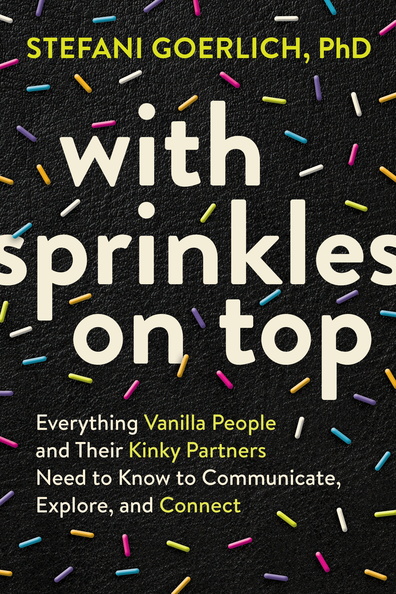
In this podcast, Tami Simon speaks with “edge expert,” certified sex therapist, and master social worker Dr. Stefani Goerlich about her new book, With Sprinkles on Top: Everything Vanilla People and Their Kinky Partners Need to Know to Communicate, Explore, and Connect. Give a listen to this much-needed discussion about destigmatizing kink and expanding our definition of a healthy relationship, as Tami and Stefani discuss: reassessing our sexual attitudes; how kinky became taboo; bringing kink into the “cultural redemption arc”; the misconceptions about trauma and kink; the concept of authority exchange; surrender and relaxation; kink as a relational, not a sexual, behavior; moving from secrecy to shared knowledge; decorating and enhancing one’s “core vanilla-ness”; discovering your fantasies; the nature of fetishes; understanding your erotic map; and more.
Note: This episode originally aired on Sounds True One, where these special episodes of Insights at the Edge are available to watch live on video and with exclusive access to Q&As with our guests. Learn more at join.soundstrue.com.
Sometime last year, I was having a conversation with a close relative of mine. I had sent them a recent news story I was quoted in and had been met with… silence. Eventually, I nudged a little bit and they responded, saying “I’m sorry, I just can’t be proud of someone who talks about sex and sex toys for a living. It’s embarrassing.” As we unpacked this statement, it became clear that they were unable to see the good—any good—in my work. As a therapist, as a writer, as an educator… my work was shameful in their eyes. In that moment, I understood my clients in a way I never had before.
With Sprinkles on Top was already finished by the time this occurred, but if it hadn’t? This conversation would have inspired me to write it. It can be incredibly painful to have someone you love tell you that “What you do is wrong. Who you are is not OK.” Many kinky people are afraid that if they share their innermost selves with the ones they love most, they too will be rejected, written off as broken or creepy or wrong. I wrote Sprinkles because I believe deeply that every single human being deserves to feel loved and worthy and whole, to know that their innermost desires are not just valid but beautiful, and to find others who can celebrate this beauty and their relationships together with them.
Sprinkles is also written for the partners of these kinky people, many of whom tell me that, if their spouse had just been willing to share their desires, they would have happily explored with them. For the spouses who don’t understand the fantasies or intimate practices they’re learning about and who need a guide to help them navigate these new relationship waters. For the men and women who call my office afraid—afraid that there’s something wrong with their partner or something inadequate in themselves.
They want me to “fix” them. I want to celebrate them.
With Sprinkles on Top is not a “how to” book. It’s a “what now?” book. My goal is to celebrate the things that make each person and each relationship unique and delightful—and to help them discover new unique qualities in themselves and new ways to delight one another. I want to celebrate vanilla relationship values while also normalizing and affirming kinky identities. I want to help my readers find new and exciting ways to enhance their own core sexual and relational “flavor” through interactive activities they do by themselves and with their partner.
Differences in desire represent an exciting opportunity to strengthen and reinforce the bonds of intimacy and trust we have created within our relationships, while also expanding the erotic playground we enjoy together. We don’t have to change who we are. We don’t have to be ashamed of what we want or embarrassed to talk about it. Sexuality, desire, and intimacy are, to me, sacred gifts. I’m honored to be able to help my readers, my clients, and others to build happier, healthier relationships with their bodies, their partners, and themselves. I hope you enjoy the process of finding your sprinkles and using them to communicate, explore, and connect with the one(s) you love.
Kol Tuv,
Stefani Goerlich
Stefani Goerlich, PhD, LMSW-Clinical, LISW, LCSW, CST, is a certified sex therapist and master social worker who specializes in working with gender, sexuality, and relationships. She is a sought-after clinical supervisor, media consultant, and conference presenter who has appeared in media ranging from CNN and the Washington Post to Cosmopolitan and Teen Vogue. She is the award-winning author of the professional books The Leather Couch and Kink-Affirming Practice.
Most of us were raised to chase happiness as the finish line, yet Jungian analyst James Hollis has spent his career arguing that happiness was never a reliable measure to begin with.
Sounds True has carried this conversation between depth psychology and everyday struggle for decades, and Hollis remains one of our clearest voices on the subject.
In this piece, we look at why Jungian psychology treats happiness as an unreliable goal, how the soul signals when we’ve drifted off course, and what resilience looks like without the comfort of certainty.
Key Takeaways:
A Different Measure: Learn why James Hollis treats happiness as an unreliable goal to build a life around.
The Soul Sends Signals: Understand how restlessness and dread can point toward a wrong turn.
Resilience Without Certainty: See how meaning sustains people through periods without clear answers.
A Different Measure for a Well-Lived Life
Hollis tells Tami Simon that happiness is only ever transiently possible, while meaning, once found, tends to abide. This is not a small semantic distinction; it reorganizes how a person might evaluate an entire life, past and future.
Jungian Psychology’s Case Against Chasing Happiness
Drawing on Jungian psychology, Hollis explains why treating happiness as life’s organizing goal sets people up for repeated disappointment. Moods shift, circumstances change, and pleasure fades on its own schedule regardless of effort. Meaning operates differently in his framework, built less on favorable conditions and more on alignment between a person’s actions and their deeper psychological truth. This idea traces back through decades of depth psychology, which has long treated symptom and suffering as data rather than simply obstacles to remove. Hollis extends that lineage into plain, accessible language for readers outside clinical settings.
Happiness Is Transient: It depends on circumstances that are largely outside our control.
Meaning Is Durable: It persists even through hardship, loss, and difficult seasons.
Alignment Over Pleasure: True satisfaction comes from congruence, not from comfort alone.
How the Soul Signals a Wrong Turn
Hollis describes a kind of inner feedback system, subtle but consistent, that lets a person know when they’ve drifted from their own path: a persistent restlessness, a low-grade dread, symptoms that resist easy explanation. Rather than pathologizing these signals, Hollis treats them as intelligent messages worth decoding instead of medicating them away entirely. This reframing runs through much of his later work, including Living Between Worlds, where he writes at length about resilience during periods of upheaval.
He is careful to add that decoding these signals takes patience. The soul rarely communicates in plain language, and learning to translate restlessness into useful insight is itself a skill built slowly, often with the help of therapy, journaling, or sustained reflection over time.
Resilience Without Certainty
Much of this conversation addresses a question many listeners were quietly asking during a period of global instability: how does a person stay steady without pretending to have answers they don’t have? Hollis’s version of resilience does not rely on optimism. It relies on tolerance for ambiguity and a willingness to keep showing up for the questions life keeps asking, even when no clear resolution is in sight and the ground itself keeps shifting underfoot.
Repetition Builds Strength: Resilience grows through repeated encounters with difficulty, not avoidance of it.
Certainty Can Deceive: It often functions as a defense against anxiety rather than as an accurate perception.
Living Between Worlds: The title itself names the space between old certainties and whatever comes next.
Why Meaning Requires Ongoing Attention
Unlike a goal that can be checked off, meaning in Hollis’s framework demands continual renewal. It is less a destination reached once than a practice sustained through the accumulation of honest choices over time, which is part of why his work resists any tidy self-help formula or five-step solution. A person can find meaning in one season of life and still need to relocate it in the next, since circumstances, relationships, and inner priorities continue to shift.
The Difference Age Makes
Hollis suggests that this pursuit shifts noticeably across a lifetime. What felt meaningful in early adulthood, often tied to achievement or external validation, tends to lose its hold as people age, replaced by quieter, more internally sourced sources of significance. This isn’t decline, in Hollis’s reading, but maturation, a gradual trading of performance for depth. He describes the second half of life as an invitation to finally ask what was being pursued all along and whether it still fits.
A Fifteen-Book Case for Meaning
By the time of this conversation, Hollis had already authored fifteen books exploring meaning, purpose, and depth psychology, including Finding Meaning in the Second Half of Life and What Matters Most. Hollis describes the search for meaning as the defining topic of his life’s work, one he approaches not as an academic exercise but as something he watches play out daily in his clinical practice with real people navigating real crises, decade after decade, with remarkably consistent patterns.
The Weight of a Global Moment
This particular episode was recorded during a period of widespread uncertainty, and Hollis addresses that context directly rather than avoiding it. He suggests that collective instability tends to surface exactly the kind of questions his work has always centered: what actually matters when the usual supports fall away, and what remains standing once distraction is stripped back. Crisis, in his view, has a way of accelerating psychological work that might otherwise take decades to surface on its own.
What Meaning Asks Us to Give Up
Choosing meaning over happiness, Hollis suggests, often means giving up the comfort of a simpler narrative. It is easier to chase pleasure and call it a life well lived than to sit with the harder, slower project of aligning daily choices with something deeper than mood. Hollis doesn’t romanticize this trade-off; he describes it plainly as more demanding, and ultimately more honest, than the alternative most of us default toward without noticing, especially in a culture that constantly rewards comfort over depth.
The Sounds True Foundation and Wider Access
This particular episode also introduces listeners to the Sounds True Foundation, a nonprofit dedicated to making tools like mindfulness and self-compassion available regardless of financial or social circumstance. It’s a fitting companion to Hollis’s message, since meaning, unlike many luxuries, is something every listener deserves genuine access to explore, regardless of where they happen to start from.
Final Thoughts
James Hollis offers no promise that meaning arrives easily or stays without tending, only that it holds weight happiness alone cannot carry.
Sounds True continues sharing this conversation because it captures something central to our mission of waking up the world: that a considered life asks more of us than comfort, and gives back more in return.
Choosing meaning is rarely a single decision; it is a posture practiced again each time comfort tempts us toward the smaller path. Hollis’s broader catalog remains available for anyone ready to keep asking these questions.
Frequently Asked Questions About James Hollis
How many books has James Hollis written?
Hollis is the author of sixteen books, including Finding Meaning in the Second Half of Life.
What is Living Between Worlds about?
It explores personal resilience during periods of significant change, uncertainty, and cultural upheaval.
Was Hollis a university professor?
Yes, he taught Jungian studies at Saybrook University across its San Francisco and Houston programs.
Does Sounds True offer audio versions of Hollis’s teaching?
Yes, Sounds True has produced the audio learning series Through the Dark Wood with Hollis.
What is the Sounds True Foundation?
A nonprofit making transformational tools accessible to at-risk youth, veterans, and underserved communities worldwide.
Is meaning the same as religious belief, according to Hollis?
No, Hollis frames meaning as a psychological and personal experience, independent of any specific faith.
Where did James Hollis train as an analyst?
He trained at the C.G. Jung Institute in Zurich before practicing as a licensed analyst.
Can this teaching help during periods of grief?
Yes, many listeners find Hollis’s framework useful for locating meaning within difficult, uncertain seasons.
Michelle Cassandra Johnson is an author, activist, spiritual teacher, racial equity consultant, and intuitive healer. She is the author of six books, including Skill in Action and Finding Refuge. Amy Burtaine is a leadership coach and racial equity trainer. With Robin DiAngelo, she is the coauthor of The Facilitator’s Guide for White Affinity Groups. For more, visit https://www.michellecjohnson.com/wisdom-of-the-hive.
Andrea Gibson did not write about mortality from a safe distance. Colorado’s 2023–25 Poet Laureate spoke with Sounds True founder Tami Simon while living with cancer, and Sounds True later shared the conversation again as an encore after Gibson’s passing.
Great poets tend to expand our view of ourselves, of each other, and of the wider universe we share, and Sounds True has spent four decades making room for voices willing to speak this honestly.
In this piece, we look at what Gibson taught about softening rather than pushing, what poetry offered as a container for grief, and what it looked like to keep showing up for a cause while loosening one’s grip on the outcome.
Key Takeaways:
Softness Over Force: Learn why Andrea Gibson chose trying softer instead of harder while living with cancer.
Poetry Holds Grief: Understand how Gibson used verse to witness sorrow rather than resolve it.
Activism Without Grip: See how Gibson stayed committed to causes while loosening control over outcomes.
A Conversation Recorded From Inside the Fire
What emerged was not wisdom delivered from a place of having already arrived, but a real-time account of learning to love a life that was actively slipping away, told with a rare mix of humor, ache, and clarity.
A phrase that anchors much of this conversation, trying softer instead of harder, captures something Gibson circled back to again and again. Illness stripped away the option of pushing through discomfort the way Gibson once might have. What replaced it was a different relationship to effort itself, one built on relaxation rather than force, and one that felt genuinely earned rather than borrowed from a wellness slogan.
Relaxation as Skill: Gibson treated softening as a practice, not a passive default.
Effort Redefined: Trying softer did not mean giving up, only releasing unnecessary tension.
Presence Over Push: Staying with what is real mattered more than forcing outcomes.
Poetry and Grief as the Same Practice
For Gibson, poetry and grief were never separate disciplines. Writing became the place where sorrow could be witnessed rather than managed, and the poem “Acceptance Speech After Setting the World Record in Goosebumps,” read aloud during the episode, shows this directly. Rather than resolving grief into something tidy, Gibson’s poems tend to sit within it, finding unexpected tenderness there instead of rushing toward comfort or closure, a quality that has resonated with readers facing their own losses.
This approach offers something rare: permission to let a poem remain unresolved, because life itself often remains unresolved. Gibson never treated grief as a problem waiting for a solution, but as a companion worth genuinely listening to.
Being Adored by the Universe
The episode’s title borrows Gibson’s own language for a shift in perception that arrived alongside the diagnosis: a felt sense of being cherished by existence itself, not despite the illness but somehow through it. This was not framed as denial or spiritual bypassing. Gibson spoke openly about fear and about the ordinary difficulty of staying present with an uncertain future, refusing to perform a peace that wasn’t fully felt.
Gibson described this shift as something closer to surrender than achievement, a letting go of the need to control how the story ended in exchange for a fuller experience of what was happening right now.
Activism Without a Death Grip on Outcomes
Gibson’s decades of work in queer, disability, and social justice movements gave the conversation another dimension: how does a lifelong activist hold hope when illness limits what the body can do? Gibson didn’t retreat from these questions, instead treating illness as another lens for examining how change actually happens. Several threads run through this part of the discussion:
Loosened Attachment: Committing to a cause without needing a specific outcome to feel it mattered.
Rest as Contribution: Recognizing presence and rest as valid forms of participation, not failures of dedication.
Joy Beside Grief: Letting both feelings coexist rather than treating one as a distraction.
Self-Love as a Radical Practice
Much of this conversation returns to self-love, not as an indulgent afterthought but as something Gibson treated as foundational work. Loving the self fully, Gibson suggested, is inseparable from loving the whole world, since the way we treat our own fear and fragility often mirrors how we treat everyone else’s. This wasn’t offered as a tidy affirmation but as ongoing practice, revisited daily and never fully finished, especially on days when self-compassion felt hardest to access.
Finding Joy in Every Instant
Gibson resisted the idea that joy has to wait for circumstances to improve. Even amid a serious diagnosis, Gibson described locating genuine joy inside small, present moments rather than deferring it to some future recovery. This wasn’t forced positivity; Gibson was candid about fear and grief throughout the conversation. The joy Gibson described lived alongside difficulty, not instead of it, which is part of what makes this teaching feel honest rather than aspirational, and part of why it has stayed with so many listeners since.
Small Moments Count: A conversation, a breath, or a piece of music could hold real joy.
No Waiting Required: Joy did not depend on the illness resolving or improving first.
Coexistence, Not Contradiction: Fear and joy showed up together without canceling each other out.
Authenticity as the Foundation of Gibson’s Writing
Throughout the conversation, Gibson returns to authenticity as the single most important quality in creative work. Writing that performs certainty or polish, in Gibson’s view, tends to ring hollow, while writing that admits confusion and fear invites readers closer rather than pushing them away. This belief shaped Gibson’s entire body of work, long before illness entered the picture, and it became even more pronounced once every page carried real stakes.
Why This Conversation Stays With Sounds True
Sounds True has always believed spiritual teaching lands hardest when it comes from an unscripted, honest voice rather than a polished script. Gibson’s conversation with Tami embodies that belief completely, offering listeners a chance to sit with mortality alongside someone who was living it in real time rather than theorizing from a comfortable distance. That kind of transmission is rare, and it’s part of why this episode has continued to reach new listeners well beyond its original air date.
Final Thoughts
Andrea Gibson left behind a body of work that refuses to separate beauty from difficulty, and this conversation captures that refusal in its most direct form. At Sounds True, our mission has always been to wake up the world, and Gibson’s willingness to stay tender in the face of mortality is exactly the kind of courage that mission was built to honor. Their words remain in our library for anyone who needs company in facing what feels unfaceable, today or on a harder day ahead, and their voice continues to offer that company long after the recording ended.
Frequently Asked Questions About Andrea Gibson
Who was Andrea Gibson?
Andrea Gibson was Colorado’s 2023–25 Poet Laureate, celebrated for poetry on love, identity, and social justice.
When was this conversation originally recorded?
The conversation with Tami Simon originally aired in 2023 and was later shared again as an encore.
What poem does Gibson read during the episode?
Gibson reads “Acceptance Speech After Setting the World Record in Goosebumps” during the conversation.
Does Sounds True offer more of Gibson’s work?
Sounds True continues sharing Gibson’s recorded conversations and reflections through our podcast archives.
What podcast series includes this episode?
This conversation appears on Insights at the Edge, hosted by Sounds True founder Tami Simon.
Is this conversation appropriate for someone newly diagnosed?
Many listeners facing illness find comfort in Gibson’s honesty about fear, softness, and staying present.
Where can I explore similar teachings on self-compassion?
Visit our Self-Compassion collection for related titles and programs from other Sounds True authors.
Does Sounds True cover grief and loss elsewhere?
Yes, related conversations and resources appear throughout our Relationships and Spirituality & Awakening collections.
Michelle Cassandra Johnson is an author, activist, spiritual teacher, racial equity consultant, and intuitive healer. She is the author of six books, including Skill in Action and Finding Refuge. Amy Burtaine is a leadership coach and racial equity trainer. With Robin DiAngelo, she is the coauthor of The Facilitator’s Guide for White Affinity Groups. For more, visit https://www.michellecjohnson.com/wisdom-of-the-hive.
What if spiritual awakening was not something that happened above the noise of daily life, but something that could be lived, felt, and carried into the most ordinary moments of being? Judith Blackstone’s teachings invite us to consider exactly that. Her work shows how awareness, at its most fundamental level, can be experienced throughout the whole body and integrated into the texture of everyday living.
At Sounds True, our mission has always been to wake up the world by bringing transformative wisdom directly to those who seek it. Over more than four decades, we have shared trusted teachings from leading voices in spirituality, psychology, mindfulness, and personal growth through books, courses, in-depth programs, and live events.
We are honored to share Judith Blackstone’s perspective on embodied realization, nondual embodiment, and the practice of bringing awakening into the body and into every layer of daily living.
Key Takeaways:
Awakening Lives in the Body: Judith Blackstone teaches that spiritual awakening becomes richer and more sustainable when awareness is experienced through the body, not just the mind, making presence something we carry into every moment of life.
Nondual Embodiment and Daily Presence: Nondual embodiment supports a deeper sense of connection, clarity, and emotional openness that extends into ordinary moments, relationships, and the way we traverse the world.
Steps Toward Embodied Realization: Blackstone offers guided exercises and practical wisdom for transforming how you experience yourself, your relationships, and the world around you.
Who Is Judith Blackstone and Her Foundations of Embodied Realization?
Judith Blackstone is an innovative teacher and licensed clinical psychotherapist based in New York, working at the intersection of nondual realization and spiritual, relational, and somatic psychotherapy. She developed the Realization Process, a direct path for realizing fundamental consciousness, as well as its application to psychological, relational, and physical healing.
Central to her work is a belief that has shaped everything she teaches: awakening is not a destination reached by moving beyond the body, but a living reality that can be experienced within it. Judith holds that awareness pervades every cell, every sensation, and every relationship. When we settle into that ground, we do not leave life behind but meet it more fully.
Her approach weaves together the wisdom of nondual philosophy with the practical tools of somatic and relational psychology, cultivated through decades of clinical experience and contemplative practice. The result is a body of work that makes some of the most profound spiritual teachings accessible and livable for anyone on the path.
How Embodied Realization Brings Awakening Into the Body
Judith Blackstone’s approach to embodied realization is rooted in a belief that awakening can take root and flourish within the body. She has explored these themes across five books, including Trauma and the Unbound Body, Belonging Here, The Intimate Life, The Enlightenment Process, and The Empathic Ground. These titles reflect the full scope of her teaching, from the ways held tension can constrain presence to the relational and spiritual dimensions of an embodied life.
At Sounds True, we encourage exploring her audio courses and programs to bring this work into living practice. Judith’s work can open the door to healing, a more direct experience of awakening, and a richer quality of empathy.
Healing Through Presence
When awareness reaches into the body at its most fundamental level, areas of long-held tension and contraction can begin to soften. Judith teaches that many of the patterns shaping how we feel and how we relate to others have roots in earlier experiences, and that meeting these patterns with open, grounded awareness creates real conditions for change. In this context, healing is less about fixing and more about returning to the aliveness that was always there.
A Direct Experience of Awakening
Embodied realization offers more than a fleeting glimpse of expanded awareness. Judith’s work invites practitioners to stabilize that awareness so it becomes a living ground rather than a peak state that fades. The kind of awakening she points toward is sustainable, integrated, and present in the midst of everyday life.
Empathy Through Embodied Presence
When we inhabit our bodies more fully, our capacity for connection with others naturally deepens. Judith’s work in this area, especially in The Empathic Ground, explores how the same awareness that opens inward also opens outward, making us more attuned and present in our relationships. She teaches that presence goes beyond the personal, and when grounded in the body, it becomes the foundation from which real connection grows.
How Nondual Embodiment Supports Everyday Awareness
Nondual embodiment refers to the lived experience of wholeness, in which awareness, the body, and the surrounding world are no longer felt as separate. That familiar sense of being an isolated self, cut off from experience, gives way to something more continuous and alive.
Embodied realization and nondual embodiment are closely related but distinct in emphasis. Embodied realization describes the process of bringing awakening into full-body experience, allowing fundamental consciousness to be inhabited rather than only glimpsed. Nondual embodiment is what that realization feels like when it is lived: a quality of presence that extends through the body and outward into relationship and environment.
Judith explores how physical tension and long-held patterns can limit this openness. Years of guarding against difficult experiences can create a kind of inner contraction that narrows both perception and connection. Meeting these patterns with gentle awareness, rather than force or analysis, allows them to soften naturally.
As the body settles into greater ease, emotional resilience tends to follow. Reactions that once felt overwhelming begin to lose their grip, and awareness becomes a steadier ground from which to meet whatever arises. Relational presence deepens in much the same way. Nondual embodiment opens the capacity to arrive with another person without strategy or performance, the kind of contact that transforms relationships in ways no technique alone can replicate.
Judith Blackstone on Living Through Embodied Realization
Those ready to take these teachings into practice will find a rich and structured path in The Realization Process, Judith Blackstone’s audio course available through Sounds True. Spanning six hours of insights and guided exercises, this program brings the full depth of her approach into a format designed for ongoing practice and return:
Releasing What Limits Presence: Judith guides practitioners through recognizing and releasing “holding patterns,” the subtle ways the body braces against experience that, accumulated across years, become second nature. Working through these contractions creates more space for the awareness that was always present beneath them.
The Subtle Core as Entryway: At the heart of the course is the subtle core, an interior channel Judith describes as the most direct entryway into fundamental consciousness. This is not a visualization or abstract concept. The subtle core is a felt, living experience of presence that opens from the inside.
Stabilizing and Expanding Awakening: Judith offers practical guidance on the maturation of the ego and how to follow the body’s energetic circuitry as a path into greater embodiment. The goal is presence as a living ground, not a passing state.
When the body becomes a home for awareness rather than a source of distraction, every ordinary moment carries the potential for presence, connection, and genuine aliveness.
Final Thoughts
Judith Blackstone’s work offers something rare in the landscape of spiritual teaching. Her path honors both the depth of awakening and the full richness of human life. These teachings on embodied realization and nondual embodiment remind us that presence is not a retreat from the world, but a way of meeting it with greater openness, warmth, and clarity. At Sounds True, this is the kind of wisdom we have always sought to share: grounded, lived, and deeply human.
Frequently Asked Questions About Embodied Realization
What is Judith Blackstone best known for?
Judith Blackstone is best known for developing the Realization Process, an approach that integrates spiritual awakening with the lived experience of the body, supporting both personal growth and contemplative practice.
What is the Realization Process developed by Judith Blackstone?
The Realization Process is a series of practices designed to help individuals experience a deeper sense of presence, embodiment, and connection. It combines principles from meditation, psychology, and body awareness.
How is embodied realization different from mindfulness?
While mindfulness often emphasizes observing thoughts and experiences, embodied realization places greater attention on inhabiting the body as a way of experiencing nondual awareness.
What does nondual embodiment mean in simple terms?
Nondual embodiment refers to experiencing a sense of wholeness where awareness, the body, and the surrounding environment are no longer perceived as separate.
Does Judith Blackstone’s work belong to a specific spiritual tradition?
Her teachings draw inspiration from multiple contemplative traditions while remaining accessible to people from diverse spiritual and secular backgrounds.
Why is the body important in spiritual practice?
The body provides a direct way to experience awareness in daily life, helping spiritual insights become more integrated and sustainable over time.
What topics are discussed in this podcast with Judith Blackstone?
The podcast covers embodiment, spiritual development, the Realization Process, the relationship between awareness and the body, and practical applications of these teachings.
Michelle Cassandra Johnson is an author, activist, spiritual teacher, racial equity consultant, and intuitive healer. She is the author of six books, including Skill in Action and Finding Refuge. Amy Burtaine is a leadership coach and racial equity trainer. With Robin DiAngelo, she is the coauthor of The Facilitator’s Guide for White Affinity Groups. For more, visit https://www.michellecjohnson.com/wisdom-of-the-hive.