Poetic Mindset Tip: Your Awe Can Be Connective

January 21, 2021

POETIC MINDSET TIP: YOUR AWE CAN BE CONNECTIVE

Try applying a mentality of awe when you’re interacting with someone who lives a life very different from yours. Let your awe be the inspiration for a connection. How did they come to believe something that makes you so uncomfortable? What is the root of their behavior? Maybe this person has a dissimilar political view. Maybe they live in a rural town, and you live in a city. Maybe they grew up practicing a particular religion, and you didn’t. These are the big facts that surround the difference between you, but maybe this contrast can be intriguing instead of off-putting? When I find myself on a disparate page from someone else, I try not to close up. I try to lean in to discovery. It’s frequently these occasions that surprise me the most and give me new insight.

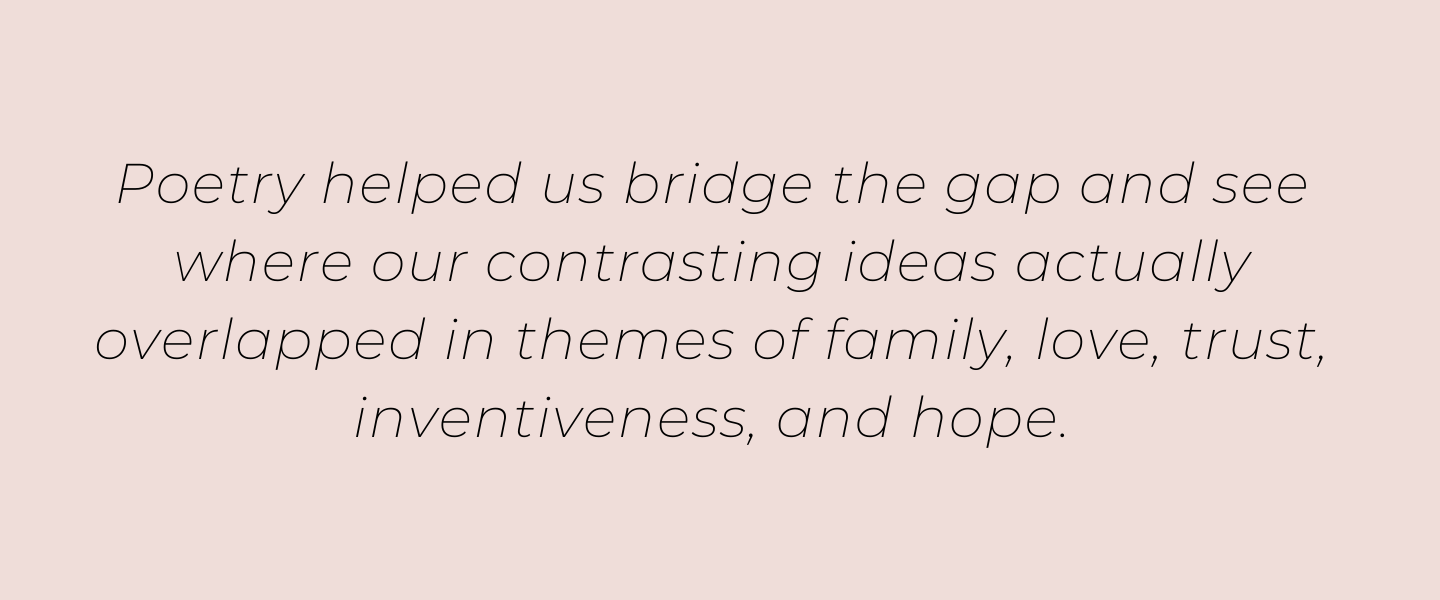
When I let myself stay curious about another person’s point of view instead of shutting down, I’m challenged to see with a new lensand that feels creative. What would I have overlooked if I hadn’t led with a sense of reverential respect? For example, through Poem Store, I developed very unlikely friendships that are still a huge part of my life.

From a familial bond with a timber baron to a deep camaraderie with a wealthy businessman, I found myself open to all kinds of folks I might normally shut out if I weren’t in the mode of poetic openness.
quote

These relationships continue to teach me how to develop compassionate language and an availability for dialogue that focuses on similarities, respect, and humanity, as opposed to difference, disdain, and judgment.

Letting your interest in a person’s inner world outweigh your differences could have unifying results. Awe is often the key to the similarities we all share. It’s our curiosity that links us, and these connections can cause the largest transformations.
poem

Housemates

Pierre Talón lives

in the kitchen,

close to the kettle

with an invisible web.

His brothers and sisters

share the same name.

Long glass-like legs

and dark teardrop bodies.

Penelope is on the front porch,

blending with the potted plant,

her green abdomen longer each day, 

her hind legs like mechanical armor. 

Pierre Talón catches the flies

and Penelope reminds me

to pause, peering between blossoms. 

The spider never leaves, just changes 

corners and sizes, and dodges the steam 

when I make tea. The grasshopper 

greets me for months, until one day

she sheds her skin and leaves me

with a perfect paper version of herself.

This is an excerpt from Every Day Is A Poem: Find Clarity, Feel Relief, and See Beauty in Every Moment by Jacqueline Suskin.



jacqueline suskinJacqueline Suskin has composed over forty thousand poems with her ongoing improvisational writing project, Poem Store. She is the author of six books, including Help in the Dark Season. Her work has been featured in the New York Times, the Atlantic, and Yes! magazine. She lives in Northern California. For more, see jacquelinesuskin.com.


book cover

Sounds True | Amazon | Barnes & Noble | Indiebound | Bookshop


Jacqueline Suskin

Jacqueline Suskin has composed over forty thousand poems with her ongoing improvisational writing project, Poem Store. She is the author of six books, including Help in the Dark Season. Her work has been featured in the New York Times, the Atlantic, and Yes! magazine. She lives in Northern California. For more, see jacquelinesuskin.com.

Author photo © James Adam Taylor

Also By Author

Winter’s Reminder to Slow Down and Sink into Deep Re...

My constant reminder to myself all winter is to not push too hard. The essence of the season reminds me that I don’t have to document every aha moment that happens in these cold, quiet months. I don’t have to share every discovery or turn every insight into a poem. In the winter, I’m much more inclined to commune with the Divine and let those conversations remain private. This is the influence of winter, the way it teaches me to shift from an overly productive participant’s pace into a person with a battery that needs to plug in and recharge gradually in order to rise up refreshed for the act of creation.

Rest isn’t easy for us, and we have to be intentional about it. How will you ensure that rest is a central part of your winter schedule? A lot can be accomplished in these sleepy months of contemplation, but if you position rest as the central focus of your routine, you’ll emerge from this season with more endurance for the working days ahead of you.

What does an ideal period of rest look like for you?

Unwinding looks different for everyone, and you’ll need to spend some time making a list of ways you can actualize rest in your daily winter life.

Maybe once a week you wake up and immediately take a hot bath. Maybe you watch a movie in the middle of the day. Maybe you get under your electric blanket and read a book for an hour after lunch. Resting usually requires doing (or not doing) something that will break your routine of constant output. How can you convince yourself to pause and be leisurely?

You’ll have to choose activities that will force you to slow down. You’ll have to remind yourself that resting will expand your creative practice in the long run, even if it seems like the opposite is happening in the moment. Experiment with what works best for you.

Prompts from the Planet

What do plants and other animals do in the winter?

They go dormant. Seeds wait, inactive in the dark soil or stored away, safe and dry.

They harden, keep warm, and get slow. Some stop growing. Others sleep and dream.

Below ground, everything works anew, protective and focused on survival.

The plant world pauses its creation and changes its approach, waiting for the sun to return.

Remember, we are part of the same cycle.

Remember to ask yourself: What is the natural world up to right now? How does it include me?

This is an adapted excerpt from A Year in Practice: Seasonal Rituals and Prompts to Awaken Cycles of Creative Expression by Jacqueline Suskin.


Jacqueline Suskin has composed over forty thousand poems with her ongoing improvisational writing project, Poem Store. She is the author of six books, including Help in the Dark Season. Her work has been featured in the New York Times, the Atlantic, and Yes! magazine. She lives in Northern California. For more, see jacquelinesuskin.com.

Author photo © James Adam Taylor

A Year in Practice

Learn More

Amazon | Barnes & Noble | Bookshop | Sounds True

Jacqueline Suskin: Being an Artist for the Earth

In our modern world, many of us live predominantly out of sync with the rhythms and cycles of nature and the Earth. In her new book, A Year in Practice, Jacqueline Suskin offers readers a wealth of teachings, tools, and rituals to realign with the four seasons and the transitions between them for creative insight and inspiration. 

Take a listen as Tami Simon speaks with the celebrated poet and author about the rewards we reap through a return to harmony with our immediate natural surroundings and our larger planetary home, in this conversation on: following your own creative impulse; letting the experiment be the guide; the shift from creative practice to profession; guesswork and trust; the Earth and the seasons as ever-present muse; the many faces of devotion and meaning-making; remembering our connection to nature on a daily basis; the importance of carefully tending to transitional times; the benefits of cultivating a greater sense of embodiment; balancing hope and hopelessness; the sacred function of the poet; the healing power of intentional rest, and the “medicine of winter” so many of us need; introspection, silence, and solitude; making the “radical return” to nature’s cycles; the poem “Desert Bear” and the metaphor of hibernation; shedding what’s no longer needed; and more.

Note: This episode originally aired on Sounds True One, where these special episodes of Insights at the Edge are available to watch live on video and with exclusive access to Q&As with our guests. Learn more at join.soundstrue.com.

Poetic Mindset Tip: Your Awe Can Be Connective

POETIC MINDSET TIP: YOUR AWE CAN BE CONNECTIVE

Try applying a mentality of awe when you’re interacting with someone who lives a life very different from yours. Let your awe be the inspiration for a connection. How did they come to believe something that makes you so uncomfortable? What is the root of their behavior? Maybe this person has a dissimilar political view. Maybe they live in a rural town, and you live in a city. Maybe they grew up practicing a particular religion, and you didn’t. These are the big facts that surround the difference between you, but maybe this contrast can be intriguing instead of off-putting? When I find myself on a disparate page from someone else, I try not to close up. I try to lean in to discovery. It’s frequently these occasions that surprise me the most and give me new insight.

When I let myself stay curious about another person’s point of view instead of shutting down, I’m challenged to see with a new lensand that feels creative. What would I have overlooked if I hadn’t led with a sense of reverential respect? For example, through Poem Store, I developed very unlikely friendships that are still a huge part of my life.

From a familial bond with a timber baron to a deep camaraderie with a wealthy businessman, I found myself open to all kinds of folks I might normally shut out if I weren’t in the mode of poetic openness.

quote

These relationships continue to teach me how to develop compassionate language and an availability for dialogue that focuses on similarities, respect, and humanity, as opposed to difference, disdain, and judgment.

Letting your interest in a person’s inner world outweigh your differences could have unifying results. Awe is often the key to the similarities we all share. It’s our curiosity that links us, and these connections can cause the largest transformations.

poem

Housemates

Pierre Talón lives

in the kitchen,

close to the kettle

with an invisible web.

His brothers and sisters

share the same name.

Long glass-like legs

and dark teardrop bodies.

Penelope is on the front porch,

blending with the potted plant,

her green abdomen longer each day, 

her hind legs like mechanical armor. 

Pierre Talón catches the flies

and Penelope reminds me

to pause, peering between blossoms. 

The spider never leaves, just changes 

corners and sizes, and dodges the steam 

when I make tea. The grasshopper 

greets me for months, until one day

she sheds her skin and leaves me

with a perfect paper version of herself.

This is an excerpt from Every Day Is A Poem: Find Clarity, Feel Relief, and See Beauty in Every Moment by Jacqueline Suskin.


jacqueline suskinJacqueline Suskin has composed over forty thousand poems with her ongoing improvisational writing project, Poem Store. She is the author of six books, including Help in the Dark Season. Her work has been featured in the New York Times, the Atlantic, and Yes! magazine. She lives in Northern California. For more, see jacquelinesuskin.com.


book cover

Sounds True | Amazon | Barnes & Noble | Indiebound | Bookshop

 

You Might Also Enjoy

Jasper Young Bear: “Prophecies for This Time: Wh...

Something is shifting in the world—and the Indigenous peoples of Turtle Island have seen it coming for generations.

This week, Tami Simon speaks with Jasper Young Bear—wisdom keeper, storyteller, founder of the Medicine Lodge Confederacy, and member of the Mandan, Hidatsa, and Arikara Nation—about the sacred oral teachings he was entrusted to carry, and why he has chosen this urgent moment to share them with the world. Jasper is the featured teacher in a new medicine film and four-part audio series, The Creation Story, available to watch and listen to for free at thecreationstory.co.

Join Tami and Jasper to explore:

  • The Seventh Generation prophecy—and why we are living inside its fulfillment right now
  • The Prophecy of the Eagle and the Condor, and what the reunification of North and South means for the human family
  • Why the greatest preparation for coming change is spiritual and emotional—not physical
  • The sacred laws woven into Indigenous creation stories, and what whole-to-part perception makes possible
  • The importance of forgiving the unforgivable—and how it opens the frequency of true freedom
  • Ceremony as living technology: sweat lodges, sacred instruments, and star knowledge as tools of consciousness
  • Why Jasper believes love—not systems, not ideology—is ultimately what will heal the human family

This interview is unlike most. Tami listens more than she asks. And what Jasper Young Bear offers is truly a transmission: a vision of where we are, where we’re headed, and what each of us can do to become a worthy ancestor for the generations yet to come.

Watch and listen to The Creation Story for free at thecreationstory.co.

This conversation offers genuine transmission—not just concepts about awakening, but the palpable presence of realized teachers exploring the growing edge of spiritual understanding together. Originally aired on Sounds True One.

Andrew Holecek: Stop, Drop, and Be Held in the Dark

What if the most transformative place you could go isn’t a retreat center or a therapist’s office—but complete and total darkness?

This week, Tami Simon speaks with Andrew Holecek—interdisciplinary scholar, longtime practitioner of Tibetan Buddhism, and author of the new Sounds True book Total Eclipse of the Mind: Unleashing the Power of Darkness for Creativity, Healing, and Transformation—about the practice of dark retreat: full immersion in sealed, lightless environments used by yogis for centuries to accelerate inner transformation.

Holecek calls it the single most transformative practice of his fifty years of meditation, psychedelic exploration, and three-year Tibetan retreat—and in this interview, he explains why.

Join Tami and Andrew to explore:

  • What actually happens to the mind in extended darkness—and the neurological science behind why it’s so transformative
  • The descent of the mind through conscious, subconscious, and collective unconscious layers—and what waits at the bottom
  • Dark retreat as a “sober psychedelic”: how the brain generates its own endogenous DMT in extended darkness
  • The practice of enantiodromia—when extreme contraction suddenly flips into extraordinary openness
  • How to work with panic, trauma, and unwanted experience using the “reverse meditation” principle: feel it, but don’t feed it
  • Why appearances don’t matter in the dark—and why so many people emerge in tears, feeling safe and held for the first time
  • The four-step process for integrating darkness into daily life, from sleep masks to dedicated dark rooms

This interview was recorded with both Tami and Andrew wearing blackout masks—making it one of the most immersive listening experiences in Insights at the Edge history.

Listen now and discover what’s been waiting in the dark. →

This conversation offers genuine transmission—not just concepts about awakening, but the palpable presence of realized teachers exploring the growing edge of spiritual understanding together. Originally aired on Sounds True One.

This episode is sponsored by Omega Institute, a global gathering hub for lifelong learning and spiritual exploration. Located in upstate New York’s beautiful Hudson Valley, Omega offers weekend workshops, special events, rest and rejuvenation retreats, professional trainings, online learning, and more. Discover what calls to you at eomega.org/true.

Stephen Cope on How Yoga Changes Your Brain and Emotio...

Have you ever noticed how quickly your mind reacts to stress, emotion, or even a passing thought? Many of these responses feel automatic, as if they happen before we have a chance to choose. Yoga offers another way of meeting these moments. Through breath, movement, and attention, we begin to slow down and notice what is happening within us. With practice, this awareness creates space, allowing for more clarity, steadiness, and a deeper connection to our emotional life.

At Sounds True, we have spent decades sharing the living wisdom of transformational teachers in their own authentic voice. Our work is rooted in making these teachings accessible and meaningful for everyday life. Through conversations with teachers like Stephen Cope, we bring forward insights that bridge ancient practice with modern understanding of the mind.

Here, we look at how yoga brain science shapes emotional health through Stephen Cope’s teachings on awareness, neuroplasticity, and mental well-being.

Key Takeaways:

  • Neuroplasticity in Action: Yoga brain science shows that repeated awareness and breathwork can reshape neural pathways over time.
  • Emotional Awareness: Yoga’s psychological benefits include recognizing and responding to emotions with greater clarity and steadiness.
  • Mind-Body Connection: Practices rooted in yoga and mental health strengthen the relationship between physical sensations and emotional experience.

Awaken Your Inner Healing Power with Guided Practices by Sounds True

Stephen Cope on Yoga Brain Science and Emotional Transformation

In conversation with Stephen Cope, yoga brain science is not a general idea, but something lived and felt in the body and mind. Cope draws from decades of practice to highlight a simple truth: the brain is shaped by where we place our attention. Through yoga, we begin to notice our patterns, how reactions form, and how awareness can gently shift them.

Many of us move through life on autopilot, reacting quickly to stress and emotion. Yoga invites a slower pace. It encourages us to pause, feel, and stay present. Over time, this creates space between impulse and action, allowing for new ways of responding.

This transformation is not about becoming someone else. It is about becoming more aware of our own experience. Yoga brain science helps us understand this process, but the real change happens through practice, moment by moment.

Yoga Neuroplasticity: How Practice Rewires the Brain

Yoga offers a direct experience of neuroplasticity, showing us that change is not only possible but natural. Through steady practice, the brain begins to reorganize in response to new patterns of attention and presence.

Repetition and Awareness in Yoga Neuroplasticity

In yoga, repetition is not about perfection. It is about returning. Each time we bring awareness back to the breath or body, we are strengthening pathways in the brain that support presence. These moments may seem small, yet they accumulate in meaningful ways. Over time, the familiar pull of distraction or reactivity begins to shift.

This is how yoga neuroplasticity unfolds. The brain learns from experience. When we repeatedly choose awareness, the brain adapts to that choice. Patterns of calm, clarity, and steadiness become more accessible. What once required effort begins to feel more natural.

From Conditioned Patterns to Conscious Choice

Many of our emotional habits are deeply conditioned. They arise quickly and often without conscious awareness. Yoga creates an opportunity to see these patterns more clearly. As awareness deepens, we begin to recognize the early signs of reaction. A tightening in the body, a shift in breath, a familiar thought pattern.

In that recognition, there is a pause. That pause is significant. It allows for choice. Instead of being carried forward by habit, we can respond with intention. Cope points to this as a turning point in practice. It reflects a movement toward greater freedom, supported by the brain’s inherent capacity to change.

Yoga Psychological Benefits for Emotional Awareness and Resilience

The psychological benefits of yoga are grounded in the development of awareness and the cultivation of a steady relationship with inner experience. Through practice, we begin to understand our emotions in a more direct and embodied way.

Developing Emotional Awareness Through Practice

Yoga invites us to listen closely to what is happening within. Emotions are not abstract ideas. They are felt experiences that move through the body. By paying attention to sensations, breath, and subtle shifts, we begin to recognize emotional states as they arise.

This awareness changes our relationship with emotion. Instead of being swept away, we learn to stay present. We can name what is happening without becoming overwhelmed by it. This creates a sense of clarity that supports emotional balance.

Building Resilience Through Presence

Resilience is often thought of as strength in the face of difficulty. In yoga, resilience is cultivated through presence. When discomfort arises in practice, we are invited to stay with it, to observe it without immediately trying to change it.

This builds capacity. Over time, we develop the ability to remain steady even when emotions are intense. This steadiness carries into daily life. Challenges are still present, yet our way of meeting them shifts. There is more space, more patience, and a deeper sense of grounding.

Stephen Cope on Yoga and Mental Health in Daily Life

For Stephen Cope, yoga and mental health are inseparable. Practice is not limited to a specific time or place. It is woven into the fabric of daily living.

Attention as a Tool for Mental Health

Attention shapes experience. When attention is scattered or pulled into repetitive thought patterns, the mind can feel unsettled. Yoga trains attention in a gentle and consistent way. By returning to the breath or body, we begin to anchor awareness in the present moment.

This shift has a meaningful impact on mental health. Patterns of rumination begin to soften. The mind becomes less caught in loops of worry or self-judgment. There is a growing sense of stability that comes from being present with what is here.

Integrating Practice Into Daily Living

Integration is at the heart of yoga. The insights gained in practice are meant to be lived. This can be as simple as pausing before responding in a conversation or noticing the breath during a moment of stress.

These small moments matter. They reinforce the same patterns of awareness cultivated during practice. Over time, yoga becomes less about doing and more about being. Mental health is supported not through isolated efforts, but through a continuous relationship with awareness.

Discover the Hidden Power of Daily Meditation

How Yoga Brain Science Supports Mental Health and Well-Being

Yoga brain science offers a grounded understanding of how practice supports well-being on multiple levels. It reflects the connection between body, mind, and attention, showing how each influences the other.

  • Yoga supports the regulation of the nervous system by encouraging slower, more conscious breathing
  • It brings awareness to habitual thought patterns, allowing for a different relationship with them
  • It creates space for emotional processing by inviting presence rather than avoidance
  • It strengthens the capacity for focused attention, which supports clarity and stability
  • It deepens the connection between body and mind, helping us recognize early signals of stress

These elements work together to support mental health in a way that feels both practical and accessible. As practice continues, many people notice a shift toward greater balance. There is a growing sense of ease in how emotions are experienced and expressed.

This is not about removing difficulty from life. It is about developing the capacity to meet life as it unfolds. Yoga brain science helps us understand how this capacity is built through consistent, mindful engagement with our inner world.

Exploring Yoga Neuroplasticity and Long-Term Habit Change

Habit change is often seen as effort-driven, but yoga offers another approach. Through yoga neuroplasticity, habits are shaped and reshaped by attention and repetition.

Each moment of awareness, whether noticing the breath or a reactive thought, supports new patterns. These small shifts build over time, creating lasting change.

As practice continues, old habits loosen, and the mind becomes more flexible, allowing for greater freedom in how we respond.

The Psychological Benefits of Yoga for Stress and Emotional Balance

Stress is part of life, but yoga can change how we relate to it. By grounding attention in the body and breath, we create an anchor that helps us stay steady during intense or uncertain moments.

Instead of reacting automatically, we learn to remain present. This builds a sense of balance where emotions can move without overwhelming us. Over time, this steadiness becomes more natural, rooted in a deeper connection to awareness.

Integrating Yoga and Mental Health Practices Through Stephen Cope’s Teachings

Through the teachings of Stephen Cope, yoga and mental health become a lived practice grounded in both tradition and modern insight. He encourages approaching experience with curiosity rather than judgment, creating space for meaningful change.

Through attention, breath, and presence, yoga offers tools to meet ourselves more fully and support greater clarity, connection, and emotional well-being.

Learn How your Mind Really Works with Sounds True

Final Thoughts

Yoga brain science reminds us that meaningful change begins with awareness. Through the teachings of Stephen Cope, we see how steady practice can reshape the way we meet our thoughts, emotions, and daily experiences. At Sounds True, we hold this work as a living process, one that invites patience, presence, and a deeper relationship with ourselves over time.

Frequently Asked Questions About Yoga, Brain Science, and Emotional Health

What is yoga brain science in simple terms?

Yoga brain science refers to how yoga practices like breathing, movement, and meditation influence brain function. It explains how consistent practice can shape attention, emotional patterns, and overall mental well-being.

How long does it take for yoga to affect the brain?

Changes can begin with a single session, especially in stress reduction. However, lasting shifts in brain patterns and emotional responses typically develop through consistent practice over weeks or months.

Can yoga replace therapy for mental health concerns?

Yoga can support mental health, but it is not a replacement for therapy. It works well alongside professional care by helping individuals build awareness, regulate emotions, and stay grounded.

Is yoga effective for anxiety and overthinking?

Yes, many people find yoga helpful for anxiety. Practices that focus on breath and body awareness can calm the nervous system and reduce cycles of overthinking.

Do you need physical flexibility to gain mental benefits from yoga?

No. The mental and emotional benefits of yoga come from awareness and attention, not physical ability. Anyone can experience these benefits regardless of flexibility.

What type of yoga is best for brain and emotional health?

Slower, mindful practices such as Hatha, restorative, or gentle flow yoga tend to support emotional regulation and awareness. The key factor is consistency and presence, not intensity.

How does breathing in yoga affect the brain?

Breathing practices influence the nervous system by signaling safety to the body. Slow, steady breathing can reduce stress responses and support clearer thinking.

Can yoga help with emotional burnout?

Yoga can help individuals reconnect with their body and internal state, which is often disconnected during burnout. This reconnection supports recovery and emotional balance over time.

Is meditation necessary to experience yoga’s brain benefits?

Meditation can deepen the effects, but it is not required. Many of the benefits come from mindful movement and breath awareness practiced during yoga itself.

How often should someone practice yoga for mental health support?

Even a few minutes daily can be helpful. Regular, consistent practice tends to be more beneficial than occasional longer sessions.

Michelle Cassandra Johnson is an author, activist, spiritual teacher, racial equity consultant, and intuitive healer. She is the author of six books, including Skill in Action and Finding Refuge. Amy Burtaine is a leadership coach and racial equity trainer. With Robin DiAngelo, she is the coauthor of The Facilitator's Guide for White Affinity Groups. For more, visit https://www.michellecjohnson.com/wisdom-of-the-hive.

Leave a Reply

Your email address will not be published. Required fields are marked *