Customer Favorites

3 Ways to be in Financial Integrity this Holiday Seaso...

In the whirlwind of holiday parties, gift-giving, and cooking, you can lose your grip on financial integrity faster than slipping on ice. But, your integrity is essential to your happiness and your self-worth. Here are a few easy ways to regain your center and empower your choices to give from your heart instead of your wallet.

Treasure Connectivity

When your presence is truly a gift to others, you won’t find yourself needing to overspend. Practice loving presence with the little interactions you have through the day. Slow down. Listen more. Smile more. Appreciate the uniqueness of the person in front of you. When you treasure connectivity, you won’t find yourself spending money on things that aren’t in alignment with your values.

Affirm Your Unique Values & Convictions

Speaking of aligning to your values … what are YOUR values? What do you value about the holidays? About gifting? About receiving? About money? Take a minute and write down your values and your convictions about the holidays. Read your convictions before bed, and upon arising. You’ll be more likely to live up to your convictions with money. And when you don’t, you’ll be very clear exactly what value you violated. When that happens, stop. Notice. Course correct.

Gift from Your Values

Whether you’re baking cookies or filling stockings, make each an act in alignment with your convictions. At first you may be aware of how your extended family or friends have different trends, values, or convictions. That’s ok. Notice. And be YOU. Be in your integrity. Make your people paleo gingersnaps or whatever you find nourishing and delightful. Tell your people why you gift how you gift. They love you for being you. And you being you will help them find their own financial integrity.

Cate Stillman has been teaching audiences how to create health and wellness through yoga and Ayurveda since 2001. She is the author of Body Thrive, and hosts the Yogahealer Real Thrive Show, a weekly podcast featuring dozens of experts in the field. She splits her time between the Idaho border country and Mexico.

Meet Hello, Moon! Children’s book author Sarah J Hin...

The Author
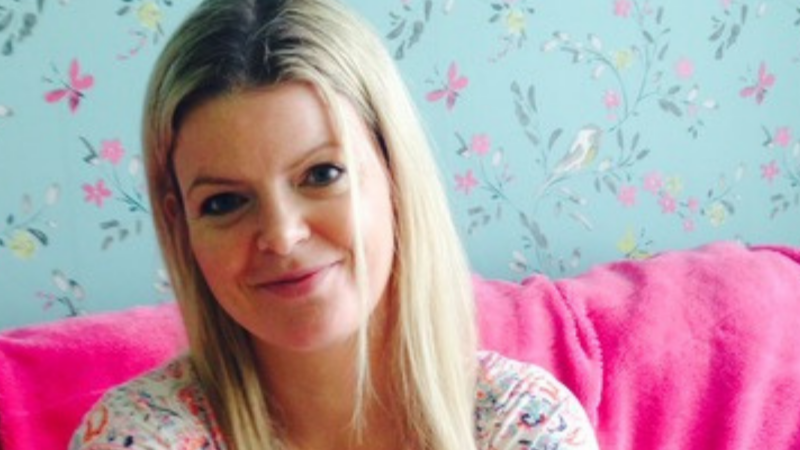
Sarah Jane Hinder is a yoga and mindfulness teacher and the illustrator of several bestselling children’s picture books, including Good Night Yoga and Good Morning Yoga. She is also the author and illustrator of Hello, Sun! and the bestselling yoga board book series that includes Yoga Bug, Yoga Bear, Yoga Whale, and Yoga Bunny for children. Sarah lives in Manchester, England. For more information, visit sarahjanehinder.com.

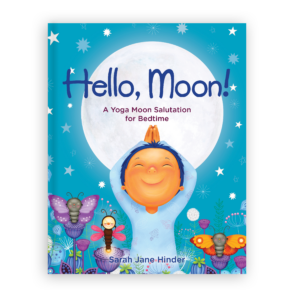
hello moon book coverThe Book
Whimsical and playful, Hello, Moon! is both a celebration of the night sky and an introduction to the joys of yoga, teaching children ages 4–8 to breathe, stretch, and relax through yoga poses to wind down at the end of the day.


What was your favorite book as a child? 

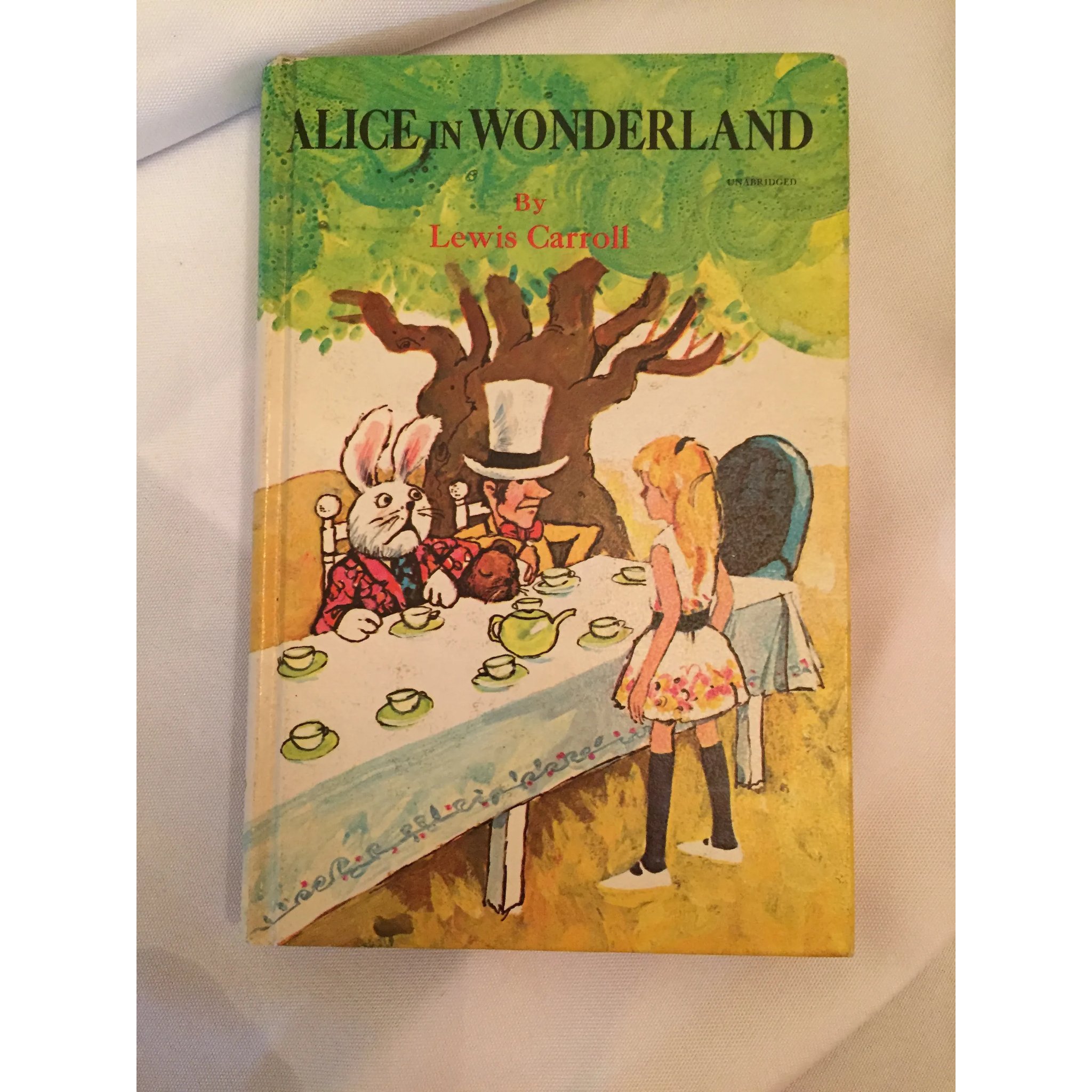
Alice in Wonderland, written by Lewis Carroll and illustrated by John Tenniel, has to be my favorite book as a child. I loved how the White Rabbit was always late, the hilarious Mad Hatter’s tea party, and how Alice would grow and shrink by eating the Caterpillar’s toadstool.

I loved that Alice was brave and strong, overcoming her fears and solving problems by herself. She meets so many wonderful creatures throughout her imaginative and fantastical journey. I used to dream about meeting the Caterpillar and the Cheshire Cat and always wanted to save the Dormouse from the teapot. I love a story where the character grows (literally) and learns from her experiences.

Alice in Wonderland

Send us a photo of you and your pet, and let us know if your pet had any role in helping you write your book!

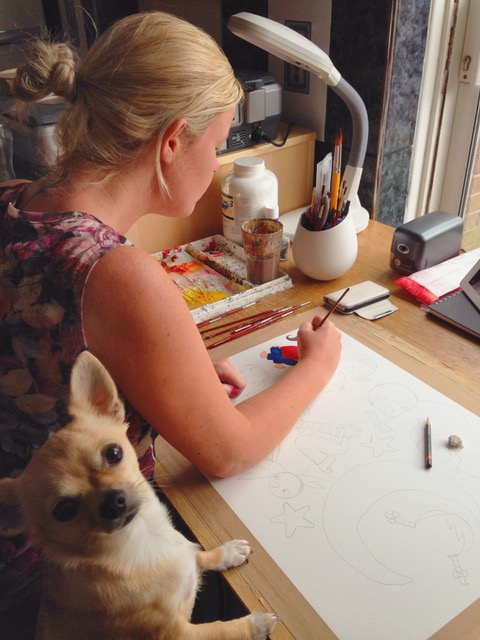
I have two Chihuahuas, who are my artist’s assistants, Paul and Alice. They are always by my side, in front of my face, or standing on my artwork or laptop.

paulie and alice

Paul has actually been a co-illustrator on one of my book covers, Good Night Yoga.

paulie

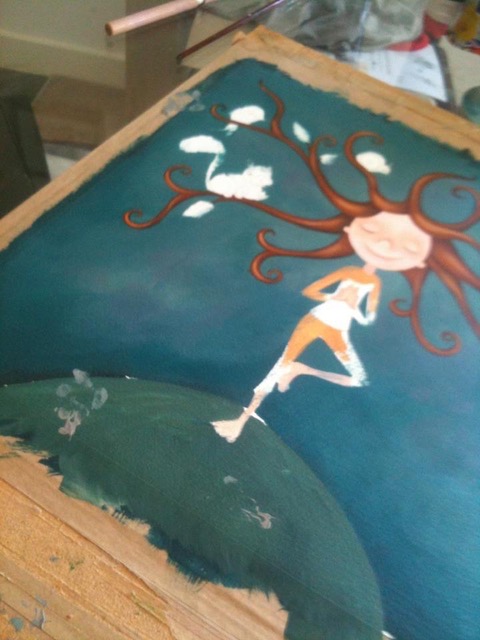
When my art was propped against the wall, Paul decided to put his paw in my paint palette. He then trotted over to my illustration and pawed paint over it. He likes to get involved, much to my dismay! They also both love to join me during Savasana by standing on my chest and giving me lots of kisses.

good nigh yoga painting

Has your book taken on a new meaning in the world’s current circumstances? Is there anything you would have included in your book if you were writing it now?

There has been more awareness of the importance of mental health in children since the pandemic. Social connection is very important, especially in early childhood, yet children are being isolated from one another. Avoiding each other through fear greatly increases stress in a child.

Yoga and mindfulness can help children develop connections within themselves, using their mind, body, and breath to reduce levels of stress and anxiety.

Hello, Moon! delivers a gentle sequence of yoga poses, moon salutations, to calm and soothe the body before bedtime, a time when fears can appear.

When writing Hello, Moon!, I included a Moon Meditation; however, there wasn’t enough room within the 32 pages of a picture book to include it. I will be adding this as a free resource on my website as a bedtime companion to the picture book.


hello moon book cover

Learn More

Sounds True | Amazon | Barnes & Noble | IndieBound | Bookshop

Cortland Dahl, PhD: The Energizing Force of Compassion

Imagine how our world would change if all of our actions were rooted in love and compassion. Is that even possible? In this podcast, Tami Simon sits down with Dr. Cortland Dahl, the renowned Buddhist scholar, translator, scientist, researcher, and author of several books including his newest, A Meditator’s Guide to Buddhism, to discuss how compassion can become the energizing force that motivates you and inspires you each and every day.

Listen now for their insights on attuning to the intelligence of your heart; a neuroscientific approach to healing anxiety; the exciting research and new modalities emerging from the study of contemplative practice; how quickly we can begin to enjoy the profound benefits of meditation; the four pillars of a healthy mind: awareness, connection, insight, and purpose; appreciation and noticing the positive; living life in a meditative way; bringing your innate compassion up to the surface of conscious experience; doing the dishes as an act of love—how every action can become a gift; generosity, the inner richness that can never be exhausted; how empathy and compassion activate the brain’s “care network”; compassion in relationships; the universal longing for meaning and purpose; transformative pain, and why physical discomfort does not equal suffering; dealing with uncertainty; unlocking the insights of our emotions and finding the beauty in difficult experiences; a pith instruction: look at your mind; and more.

Note: This episode originally aired on Sounds True One, where these special episodes of Insights at the Edge are available to watch live on video and with exclusive access to Q&As with our guests. Learn more at join.soundstrue.com.

E66: You Are Not Your Thoughts: From Mental Noise to I...

Most human suffering stems from being addicted to the mind and its narratives. The mind uses past experiences to shape expectations and to resist reality. You must shift from identifying with thoughts and ego to realizing yourself as pure consciousness—the observer behind all experiences. True spiritual freedom comes from embracing reality without resistance and allowing inspiration to flow through you. The mind, while a powerful tool, should serve the deeper self rather than dictating your life. Joy, wisdom, and clarity arise naturally when you stop trying to control life and instead accept and let go.

For more information, go to michaelsingerpodcast.com.

© Sounds True Inc. Episodes: © 2025 Michael A. Singer. All Rights Reserved.

Release Your Traumas with This Forgiveness Practice

Forgiveness Practice - Inner Alchemy Sounds True Blog

The “horizontal axis” of the soul is where we have stored many lessons and a great deal of energy that remains trapped and stagnant. It is this trapped energy that feeds our internal “demons” and the behaviors that plague us so much. But it doesn’t have to be this way.

With a framework of self-care, qi gong, and mental awareness practice, we can delve into the “darkness” of the shadow and start the alchemical process in full force. Finding the “lead,” which we will turn into “gold,” is easy—we simply need to discover the things that bother us the most in any given day and start with them. It may be a reaction to our spouse’s dilly-dallying or maybe the behavior of a certain coworker. Whatever it is that upsets us, chances are it isn’t anything new to us.

We start to create the spin in the bolstered energy fields of our attachments, and in doing so, our fields take on other similar issues. They fall into families of issues by topic and class.

We start with what Alfred Korzybski called “the original event,” and then we keep branching out and expanding from there, moving further and further into levels of “abstraction.” We get further away from the essential truth of the original event, and we start to create storylines for ourselves to make it okay. The more this goes on, the more energy we pump into this artificial field. The more energy we put in, the more it seems utterly impossible for us to penetrate this mutated, powerful field and face the truth. We create monsters out of undesirable events and we feed them until they own us.

So, here’s the way out. First and foremost, we have to stop the bleeding. This requires awareness of these patterns and forgiveness in the moment. We should be constantly scanning to see what mess we’re about to get involved in and stop it right there. Once we get the hang of it, we invariably find that we’re about to go down a very familiar road with a given subject. This is where the attention of the shen (the energy center housed in the heart) comes in. We have detected a given behavior or karmic action from an old theme, and we have recognized that we are about to go into some old trance behavior. What can we do?

We must first acknowledge this behavior and then, focusing on our heart, we must immediately go into forgiving whomever, whatever, and however anyone was involved. Far from the polarity consciousness of our reactive mind, the heart holds our personal connection with the primordial Tao. It is our true state of being, prior to the separation of yin and yang. Once we tap into this with the energy of forgiveness, we can hold it in our heart and consciously reclaim our power from this event or memory. We do this by understanding the fundamental split that took place in our mind and then pulling back the energy we deposited into the opposite pole.

For instance, say your father was abusive to you as a child and you are still harboring ill will toward him, even though he’s now a broken-down old man. The typical behavior you automatically default to when he calls is to get very short and cool with him. You could be out at the pool with the family having the perfect day, and then he calls. Your breath shortens, your pulse speeds up, and you are suddenly in a very different space. What’s the first thing to do? Recognize what it is that you’re doing right then. You are the one getting revved up, you are the one raising your blood pressure, and you are the one lowering your voice and going from smile to frown over this. So, what then? Stop it. Recognize the unconscious behavior and then stop it in that instant.

Now, yes, I understand that’s easier said than done, but that’s because there is such a massive charge around your relationship with your father. The energy is stored up like a balloon about to burst. But this is where you must change your typical behavior or else you’ll feed even more negative energy into your chapter of “father.” This is where you drop into your heart; forgive him for whatever he has done right there and then, and with the energy neutralized (in the moment), begin to see the pattern for what it is. Every time he comes up in your thought field, a whole slew of emotions race in and get you all fired up. But now, instead of channeling daggers into the aversion of your father, channel forgiveness to the man himself. Forgive him, forgive his behavior, forgive yourself, and forgive the situation. Thank him for the lessons he has given you and for the opportunity to be more loving. Understand that his behavior (whatever it was he did or still does) is a product of an imbalance. He was (is) acting out on his demons, and they, in turn, have infected you. Do not accept them! The only way you can get infected is if you buy into and then co-create that imbalanced energy yourself. A powerful thing to say in this instance is, “This is not my energy, these are not my demons, and I do not accept this into my field.”

Having withdrawn our energy from our typical patterns, we may now focus on the original split that created the charge around this field and apply our knowledge to actively target and mend that schism. Remember, all movement and life began with the split into yin and yang. Therefore, our polarization of the energy related to any given event is what gave it an initial charge and brought it to life. Our recognition of this allows us to withdraw our attention from this polarity and reunite the energy as a whole. We focus on the item in our mind’s eye and simply feel where we’ve been misdirecting all our energy. And remember, it’s our power, so it should be easy to find. Once we reclaim it, we can pull it back into our lower dantien (an energy center right below the navel) and then seal it in there mentally. From that point, we can watch the energy field of the original issue collapse, and then we can continue to forgive it until it is completely gone.

In the example of dealing with your dad, go back to the first time you recall him treating you that way and forgive that moment. Use the mental practice to trace around the timeline and clean and clear with forgiveness. You should be able to heal any particular issue within one to three times of following this practice. The more you pay attention and the more focused you remain, the quicker it’ll be done. If you catch yourself leaking more energy into the shadow when you think about a subject, simply trace your way back to the root of it again. Like the pull of gravity, follow the cord of energy flow back to the original event and confront it there. This is the quickest way to heal these attachments. They don’t want to live in the shadow; all discordant energy wants to return to the Source. Think of it like a homecoming—pull all your fragmented pieces back into yourself.

Excerpted from Inner Alchemy: The Urban Monk’s Guide to Happiness, Health, and Vitality by Pedram Shojai.

—————————————————————————————————————-

Pedram Shojai - Inner Alchemy Sounds True Blog

Pedram Shojai is a New York Times bestselling author, accomplished physician, Qi Gong master, and former Taoist monk. Perhaps best known as the Urban Monk, Shojai is a dynamic teacher who’s helped thousands of people create more time, energy, and passion with modern hacks for well-being. He is the author of the bestselling book The Urban Monk and is the creator of the Urban Monk Academy, podcast, and Mastermind program. His DVD series, The Alchemy of Qi Gong, received acclaim at the COVR awards. Shojai is currently involved in a number of philanthropic causes that revolve around public health, fair trade, and education. For more, visit theurbanmonk.com.


Inner Alchemy - Sounds True Blog


Buy your copy of Inner Alchemy at your favorite bookseller!

Sounds True | Amazon | Barnes & Noble | Indiebound


Pinterest Forgiveness Practice Inner Alchemy Sounds True Blog

Tools for Opening Ourselves to Our Deeper Nature

A few months ago, I found when getting up from the table that I could no longer walk. A meniscus had ruptured and wedged itself against my knee joint. It was very painful, but luckily, thanks to my friends, I was able to get an MRI that same day and be operated on the following day. For the operation, whether I liked it or not, I had to submit to a general anesthesia, and I remained unconscious a little less than two hours.

Unexpectedly, when I woke up, I had a very enriching experience. I had the impression of not being completely there. I was in a light and luminous state of mind. My first thoughts went toward my spiri- tual teachers. For a good hour, their presence illuminated my mental landscape. I experienced a state of bliss, of devotion, and unalloyed trust. I was alone in my room, and I began softly to chant verses that reminded me of my teacher. My thoughts also went to other people who are dear to me.

I said to myself that if things go this well at the time of death, it won’t be too bad! Could anesthesia be a kind of dress rehearsal for dying? Could such a moment show us what is present in the profoundest depths of our mind when the thought processes that clutter the field of consciousness have been silenced? All in all, I was very glad to have gone through this anesthesia experience.

Later, I wondered if such experiences could be revealing about our basic nature. This feeling of lightness and bliss could perhaps result from not immediately reifying the world around us when waking up from the anesthesia. At that moment the mind is not yet distorted by myriad conceptual constructs. This is the antithesis of dwelling on thoughts; it is perfect simplicity. I felt like a young child discovering the beauty of life with a fresh and transparent mind.

— Matthieu Ricard

Toolbox for Opening Ourselves to Our Deeper Nature

MATTHIEU RICARD:

Keep your mind open. Experience the key moments in life with an open mind, welcoming the range of constructive possibilities for oneself and others.

Discriminate. Let what really counts come to the surface from the profoundest depths of consciousness.

Be confident. No matter what happens, you will find a way to utilize adverse circumstances as catalysts for making progress on the spiritual path and for manifesting greater compassion toward those around you. 

Inhabit the space of interdependence. Resituate the events that affect you in the much larger context of the interdependence of all beings and all things, who like you, experience countless joys and sorrows.

ALEXANDRE JOLLIEN:

Contemplate the little persona that you play all day long. Look at the labels, the functions you use to define yourself. Examine the outfit that you dress up in from morning till night so that you can go naked to meet your deeper nature.

Be aware of the heavy weight of education, of the mass of prejudices, of the heap of illusions that have ended up as an overlay on reality. Just identify this factitious layer so that you can take in daily life as it is without the intervention of ego, of concepts, and of the thousand expectations that shape your world.

Discover the deep personal aspirations that inhabit you. What do you expect out of life? What is it that you are running after so avidly?

Accept losing your grip. Ego defends its territory tooth and nail. It sets up boundaries, busies itself delimiting its world. In its folly, it isolates us, confines us to solitude, to distance. Opening your heart, going beyond the bounds of narrow individuality, means facing the experience of leaping into the void, of swimming in the open sea of freedom.

CHRISTOPHE ANDRÉ:

Discover your inner resources. The deeper nature we have been talking about is not just a theoretical matter, but a very practical one. We should do our best never to forget all the strengths and resources we have within us. They are not an illusion. Our mindset is such that we quite often underestimate our personal capacity to deal with adversity. And then there are the strengths and resources all around us, the help and inspiration that others can supply us. We are better equipped than we think. To access these resources within us and outside us, the best thing is not to shrink back into ourselves and dwell on our fears and bitterness or on our certainties, positive or negative.

What if nothing happens? What if no tangible sign of the existence or emergence of our deeper nature comes along? Well, it’s not that serious! In any case, it’s there. Let’s just not forget to live, act, love, work, and enjoy ourselves; to help others the best we can; and to continue to be open to this profound and universal aspect of ourselves that we all have within us.

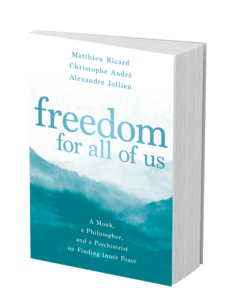
This is excerpted from the newest book from Matthieu Ricard, Christophe André, and Alexandre Jollien, Freedom For All Of Us: A Monk, A Philosopher, and a Psychiatrist on Finding Inner Freedom.

MatthieuRicard-AlexandreJollien-ChristopheAndré

Matthieu Ricard is a Buddhist monk, a photographer, and a molecular geneticist who has served as an interpreter for the Dalai Lama. 

Christophe André is a psychiatrist and one of the primary French specialists in the psychology of emotions and feelings.

Alexandre Jollien is a philosopher and a writer whose work has been attracting an ever-growing readership. Together, they are the authors of In Search of Wisdom and Freedom For All of Us.

Learn More

Sounds True | Amazon | Barnes & Noble | Bookshop | IndieBound