Customer Favorites

The Body Awake

Tami Simon speaks with Ann Marie Chiasson, a teacher, author, and a practitioner of energy medicine. She holds a master’s degree in public health, a doctorate in family medicine, and has worked as a primary care physician. Ann Marie currently lives in Arizona, where she has a private integrative medicine practice, and also teaches at the Arizona Center for Integrative Medicine at the University of Arizona. Ann Marie coauthored a Sounds True program with Dr. Andrew Weil called Self-Healing with Energy Medicine and will be releasing the home study course Energy Healing, as well as a video program called Energy Healing for Beginners. She is also teaching a six-session online course on energy healing at SoundsTrue.com. (55 minutes)

Sandra Ingerman: Shamanism and Spiritual Light

Tami Simon speaks with Sandra Ingerman a shamanic practitioner, psychotherapist, and educational director for the Foundation for Shamanic Studies who has taught workshops on shamanism around the world. Sandra is the author, along with Hank Wesselman, of the Sounds True book Awakening to the Spirit World and the three-part online event 21st-Century Shamanism, which begins August 5, 2010, at SoundsTrue.com. Sandra discusses our connected web of consciousness, understanding our individual spiritual aspects, and how developing our shamanistic qualities can benefit others. (60 minutes)

Let it R.A.I.N – a home for all of you – w...

Dear friends, some years ago a simple, yet powerful approach to working with difficult emotions emerged out of the intersection of the fields of mindfulness and psychotherapy. Come to be known as the “RAIN” technique (an acronym for the four steps of the process), many therapists, meditators, healers, and practitioners have found it to be incredibly helpful for on-the-spot relief and support during challenging times.

Here, friend and Sounds True author, Dr. Rick Hanson, describes the RAIN practice and the benefits is offers. This article was originally published by our friends at The Huffington Post. We hope you find it helpful and beneficial in your own life – and in the work you may be doing with others.

Let it R.A.I.N. – by Rick Hanson, PhD

When you’re young, the territory of the psyche is like a vast estate, with rolling hills, forests and plains, swamps and meadows. So many things can be experienced, expressed, wanted, and loved.

But as life goes along, most people pull back from major parts of their psyche. Perhaps a swamp of sadness was painful, or fumes of toxic wishes were alarming, or jumping exuberantly in a meadow of joy irritated a parent into a scolding. Or maybe you saw someone else get in trouble for feeling, saying, or doing something and you resolved, consciously or unconsciously, to Stay Away From That Place Forever.

In whatever way it happens, most of us end up by mid-adulthood living in the gate house, venturing out a bit, but lacking much sense of the whole estate, the great endowment of the whole psyche. Emotions are shut down, energetic and erotic wellsprings of vitality are capped, deep longings are set aside, sub-personalities are shackled and silenced, old pain and troubles are buried, the roots of reactions — hurt, anger, feelings of inadequacy — are veiled so we can’t get at them, and we live at odds with both Nature and our own nature.

Sure, the processes of the psyche need some regulation. Not all thoughts should be spoken, and not all desires should be acted upon! But if you suppress, disown, push away, recoil from, or deny major parts of yourself, then you feel cut off, alienated from yourself, lacking vital information about what is really going on inside, no longer at home in your own skin or your own mind — which feels bad, lowers effectiveness at home and work, fuels interpersonal issues, and contributes to health problems.

So what can we do? How can we reclaim, use, enjoy, and be at peace with our whole estate — without being overwhelmed by its occasional swamps and fumes?

This is where R.A.I.N. comes in.

How?

R.A.I.N. is an acronym developed by Michelle McDonald, a senior mindfulness teacher, to summarize a powerful way to expand self-awareness. (I’ve adapted it a bit below, and any flaws in the adaptation are my own, not Michelle’s.)

R = Recognize: Notice that you are experiencing something, such as irritation at the tone of voice used by your partner, child, or co-worker. Step back into observation rather than reaction. Without getting into story, simply name what is present, such as “annoyance,” “thoughts of being mistreated,” “body firing up,” “hurt,” “wanting to cry.”

A = Accept (Allow): Acknowledge that your experience is what it is, even if it’s unpleasant. Be with it without attempting to change it. Try to have self-compassion instead of self-criticism. Don’t add to the difficulty by being hard on yourself.

I = Investigate (Inquire): Try to find an attitude of interest, curiosity, and openness. Not detached intellectual analysis but a gently engaged exploration, often with a sense of tenderness or friendliness toward what it finds. Open to other aspects of the experience, such as softer feelings of hurt under the brittle armor of anger. It’s OK for your inquiry to be guided by a bit of insight into your own history and personality, but try to stay close to the raw experience and out of psychoanalyzing yourself.

N = Not-identify (Not-self): Have a feeling/thought/etc., instead of being it. Disentangle yourself from the various parts of the experience, knowing that they are small, fleeting aspects of the totality you are. See the streaming nature of sights, sounds, thoughts, and other contents of mind, arising and passing away due mainly to causes that have nothing to do with you, that are impersonal. Feel the contraction, stress, and pain that comes from claiming any part of this stream as “I,” or “me,” or “mine” — and sense the spaciousness and peace that comes when experiences simply flow.

R.A.I.N. and related practices of spacious awareness are fundamental to mental health, and always worth doing in their own right. Additionally, sometimes they alone enable painful or challenging contents of mind to dissipate and pass away.

But often it is not enough to simply be with the mind, even in as profound a way as R.A.I.N. Then we need to work with the mind, by reducing what’s negative and increasing what’s positive. (It’s also necessary to work with the mind to build up the inner resources needed to be with it; being with and working with the mind are not at odds with each other as some say, but in fact support each other.)

And whatever ways we work with the garden of the mind — pulling weeds and planting flowers — will be more successful after it R.A.I.N.s.

Rick Hanson, Ph.D., is a neuropsychologist and author of Hardwiring Happiness: The New Brain Science of Contentment, Calm, and Confidence (from Random House in October, 2013; in 4 languages), Buddha’s Brain: The Practical Neuroscience of Happiness, Love, and Wisdom (New Harbinger; in 24 languages), Just One Thing: Developing a Buddha Brain One Simple Practice at a Time (New Harbinger; in 12 languages), and Mother Nurture: A Mother’s Guide to Health in Body, Mind, and Intimate Relationships(Penguin). Founder of the Wellspring Institute for Neuroscience and Contemplative Wisdom and an Affiliate of the Greater Good Science Center at UC Berkeley, he’s been an invited speaker at Oxford, Stanford, and Harvard, and taught in meditation centers worldwide. A summa cum laude graduate of UCLA, his work has been featured on the BBC, NPR, CBC, FoxBusiness, Consumer Reports Health, U.S. News and World Report,and O Magazine and he has several audio programs with Sounds True. His weekly e-newsletter – Just One Thing – has over 91,000 subscribers, and also appears on Huffington Post, Psychology Today, and other major websites.


raindrops4

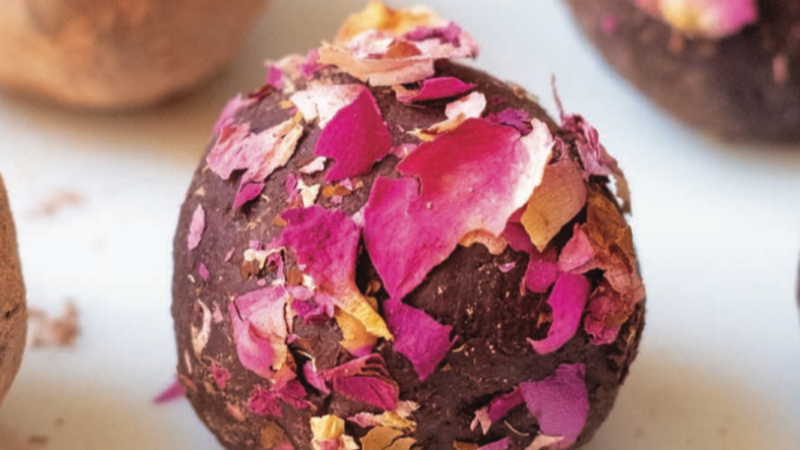
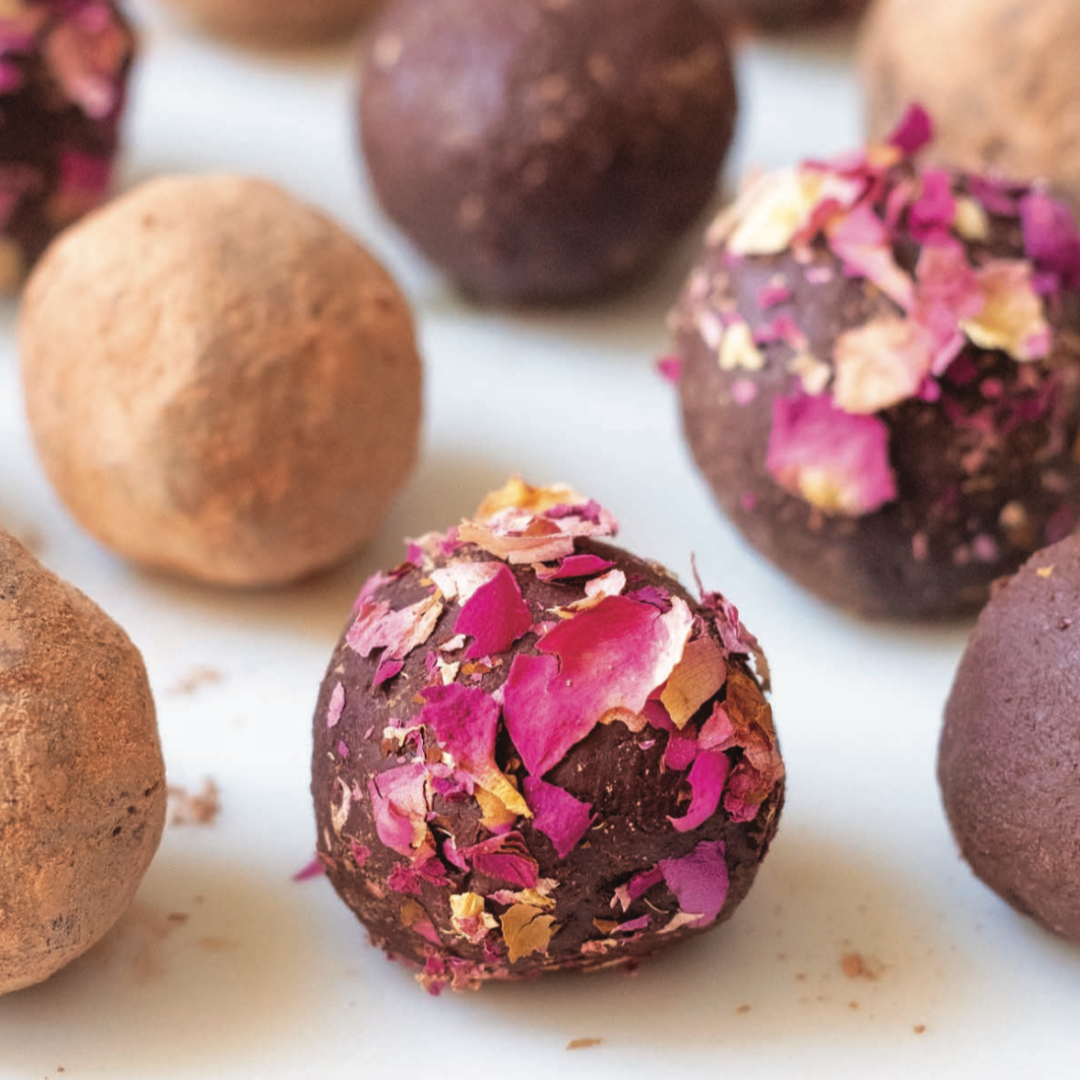
Lavender Rose Chocolate Truffles

Lavender Rose Chocolate Truffles

From the book, Whole Girl by Sadie Radinsky

INGREDIENTS:

  • 1/2 cup coconut cream, from the top of a chilled 13 1/2-ounce can of full-fat coconut milk
  • 1 1/2 cups dark chocolate chips or chopped dark chocolate
  • 2 drops food-grade pure lavender oil
  • 1/4 cup cacao powder
  • 2 Tbsp dried rose petals, crushed

INSTRUCTIONS:

  1. Scoop the coconut cream into a double boiler. Heat the coconut cream until it’s hot to the touch, then pour in the chocolate. Turn the heat down to medium-low. Stir the chocolate and coconut cream together until the chocolate is fully melted and the mixture forms a shiny ganache.
  2. Remove the ganache from heat and stir in the lavender oil. Place the bowl of ganache in the refrigerator to chill for 2 hours, or until completely solid.
  3. Line a plate with parchment paper. Scoop the chocolate mixture into 16 pieces using a tablespoon, and place on the plate. Don’t worry about forming the pieces into spheres yet. Place the plate back in the refrigerator for 10 minutes to firm up.
  4. Pour the cacao powder and crushed rose petals into 2 small separate bowls. Roll the refrigerated chocolate blobs into balls, then roll them in either cacao powder, rose petals, or leave them plain. Serve.
  5. Store leftover Lavender Rose Chocolate Truffles in an airtight container in the refrigerator for about 1 week, or freeze for up to 1 month. Defrost before serving.

chocolate truffles

This recipe is featured in the young adult book, Whole Girl: Live Vibrantly, Love Your Entire Self, and Make Friends with Food by Sadie Radinsky.


sadie radinskySadie Radinsky is a 19-year-old blogger and recipe creator. For over six years, she has touched the lives of girls and women worldwide with her award-winning website, wholegirl.com, where she shares paleo treat recipes and advice for living an empowered life. She has published articles and recipes in national magazines and other platforms, including Paleo, Shape, Justine, mindbodygreen, and The Primal Kitchen Cookbook. She lives in the mountains of Los Angeles. For more, visit wholegirl.com.


whole girl bookSounds True | Amazon | Barnes & Noble | Bookshop | Indiebound


Justin Michael Williams, Shelly Tygielski, and Mario V...

The end of racism—really? When your eyes stop rolling, tune in to this podcast to hear why it’s actually possible—in our lifetimes—to free our society from systemic racial oppression and  injustice. In part one of this episode of Insights at the Edge, Tami Simon speaks with Justin Michael Williams and Shelly Tygielski about their new book, How We Ended Racism. In part two, filmmaker and activist Mario Van Peebles joins the conversation to share his own hope-giving perspective. 

This stirring and uplifting podcast explores the five assumptions that perpetuate racism; the eight pillars of possibility; the pledge to help end racism; how our inner work relates to the outer change that we’re working toward; assertion versus assessment, and learning to recognize our own biases; shadow work and confronting the concept of supremacy; taking action where we’re standing right now; “loving with bigger arms”; crossing the divide within families; the metaphor of the inherited house; the practice of calling forward; intraconnection; the link between exposure and empathy; the SUSS process: State, Uncover, Synergize, and Select; and more.

Note: This episode originally aired on Sounds True One, where these special episodes of Insights at the Edge are available to watch live on video and with exclusive access to Q&As with our guests. Learn more at join.soundstrue.com.

Zulma Reyo: The Radiant Sun of the Heart

Each of us has a sense of ourselves as a separate and distinct individual, or what’s commonly called the personality or the ego. Yet beneath the surface of who we take ourselves to be shines a radiant and holy true Self, or who we are at the soul level. In this podcast, Sounds True’s founder, Tami Simon, speaks with celebrated spiritual teacher and author Zulma Reyo about the continual work of releasing the limitations of the egoic self to uncover and express the light and love of our deepest nature. 

Drawing on insights from the books Inner Alchemy and Emergence of Consciousness, Zulma and Tami explore: the gift of etheric sight; the relationship between the personality and the soul; ego death; objective self-observation; the lifelong process of clearing out stuck emotional energies; the three energy bodies of the personality; turning your attention from the personality to your deeper, inner self; finding community support; seeing the purity within others; working on yourself as an act of service to the world; humility and self-honesty; the practice of letter writing; giving yourself the love and acceptance you didn’t receive as a child; a guided experience of Zulma’s alchemical alignment practice; connecting to the radiant sun within yourself; forgiving the unforgivable; the emergence of a new group consciousness; examining your attachments; and more.

Note: This episode originally aired on Sounds True One, where these special episodes of Insights at the Edge are available to watch live on video and with exclusive access to Q&As with our guests. Learn more at join.soundstrue.com.