Customer Favorites

Chanting as a Heart-path to God

Tami Simon speaks with Jai Uttal, a Grammy-nominated musician who is best known as a world-renowned kirtan artist, kirtan being ecstatic chant in a call-and-response format. His music is an eclectic mix of contemporary and ancient musical elements from various cultures throughout the Eastern and Western worlds. Jai has created five albums with Sounds True, including Kirtan!, and his latest release, Bhakti Bazaar. Jai discusses chanting as a devotional practice, the story of Jai’s first trip to India, his experience meeting his guru, and his understanding of the many Hindu god and goddess figures. (67 minutes)

November New Releases and Giveaway

NOVEMBER NEW RELEASES


The Integrity Advantage by Kelly Kosow

Are you ready to open up to new levels of self-trust and self-love, to get where you want to go?

You vowed to speak up at work, and then sat silent in the meeting yet again.

You told yourself “this time the diet is going to stick,” only to watch the scale inching up.

You felt that something just wasn’t right about someone that—until you learned the hard way that your instincts were right.

“Every time you bite your tongue,” teaches Kelley Kosow, “you swallow your integrity.”

Before Kelley Kosow was a renowned life coach and CEO, she constantly second-guessed herself, let her “to-do” lists and others steer her dreams and passions, and played it “small and safe.”

Inspired by the groundbreaking principles of her renowned mentor Debbie Ford, who hand-picked Kelley to be her successor, The Integrity Advantage is Kelley’s step-by-step guide for facing the fear, shame, and false beliefs that cause us to lose our way.

Through life-changing insights, true stories, and proven strategies, this book will show you how to live on your own terms—according to you—from the inside out.


Daring to Rest by Karen Brody

As modern women, we’re taught that we can do it all, have it all, and be it all. While this freedom is beautiful, it’s also exhausting. Being a “worn-out woman” is now so common that we think feeling tired all the time is normal. According to Karen Brody, feeling this exhausted is not normal—and it’s holding us back. In Daring to Rest, Brody comes to the rescue with a 40-day program to help you reclaim rest and access your most powerful, authentic self through yoga nidra, a meditative practice that guides you into one of the deepest states of relaxation imaginable.

It’s time to lie down and begin the journey to waking up


Breathe and Be by Anna Emilia Laitinen and Kate Coombs

Teaching mindfulness helps kids learn to stay calm, regulate their emotions, and appreciate the world around them. With Breathe and Be, author Kate Coombs and illustrator Anna Emilia Laitinen team up to present a book of poetry and art for young readers to make mindfulness easy, natural, and beautiful. Here is a book sure to delight parents and kids alike, blending lovingly illustrated nature imagery with elegant verse about living with awareness and inner peace.


Leopard Warrior by John Lockley

A Teaching Memoir That Crosses the Barriers Between Worlds

A shaman is one who has learned to move between two worlds: our physical reality and the realm of spirits. For John Lockley, shamanic training also meant learning to cross the immense divide of race and culture in South Africa.

As a medic drafted into the South African military in 1990, John Lockley had a powerful dream. “Even though I am a white man of Irish and English descent, I knew in my bones that I had received my calling to become a sangoma, a traditional South African shaman,” John writes. “I felt blessed by the ancient spirit of Africa, and I knew that I had started on a journey filled with magic and danger.” His path took him from the hills of South Korea, where he trained as a student under Zen Master Su Bong, to the rural African landscape of the Eastern Cape and the world of the sangoma mystic healers, where he found his teacher in the medicine woman called MaMngwev


Things That Join the Sea and the Sky by Mark Nepo

A Reader for Navigating the Depths of Our Lives

The Universe holds us and tosses us about, only to hold us again. With Things That Join the Sea and the Sky, Mark Nepo brings us a compelling treasury of short prose reflections to turn to when struggling to keep our heads above water, and to breathe into all of our sorrows and joys.

Inspired by his own journal writing across 15 years, this book shares with us some of Mark’s most personal work. Many passages arise from accounts of his own life events—moments of “sinking and being lifted”—and the insights they yielded. Through these passages, we’re encouraged to navigate our own currents of sea and sky, and to discover something fundamental yet elusive: How, simply, to be here.

To be enjoyed in many ways—individually, by topic, or as an unfolding sequence—Things That Join the Sea and the Sky presents 145 contemplations gathered into 17 themes, each intended to illuminate specific situations.


                NOVEMBER GIVEAWAY


WIN OUR NEW RELEASE BUNDLE:The Integrity Advantage, Daring to Rest, Breathe and Be, Leopard Warrior, and Things That Join the Sea and the Sky

TO ENTER: Simply reply in the comments with why you’d like to win!

How to Cultivate Generosity in Our Children


Nearly every spiritual tradition has a practice of generosity and giving. We call it Dana in some traditions, Caritas in Christianity, Tzedekah in Judaism, alms or communal sharing in others, or in the United States, “The Holiday Season” stretching onward from Black Friday through the New Year. These spiritual (and commercial) practices existed long before the term “positive psychology,” but the principles overlap significantly. We know now that making a practice of kindness and generosity leads to physical and mental health and social and spiritual benefits.

In families, children are often in the “getting” role, while adults are in the “giving role,” but how can we encourage that spirit of generosity in the next generation?

We are wired to be generous, and both neuroscience and well-worn clichés tells us we feel more joy in giving than in receiving. However, our consumer culture tells us the opposite, that getting will make us feel better. These messages run counter to the spiritual and scientific wisdom showing health and happiness come more through giving than getting. Just imagine if our society received just as many messages urging us to give than get, if people camped outside stores for days just to donate to the latest charity.

Among the many benefits, generosity also builds trust between people. Studies show that the giver’s brain regions associated with trust and connection light up, fostering optimism, reducing depression, and creating healthy attachments, showing us why cultures develop practices related to gift-giving. The benefits even extend to just witnessing an act of generosity.


So how can we encourage generosity our families? Here are a few ideas to consider.

  • Involve your kids in the decision for charitable giving, taking into account what your family’s values are: Social justice, the environment, health issues that have impacted your family, presents for children or families in need, and so on.
  • Follow the lead of my friend’s grandmother who gave the grandkids $100 each year, with $50 to spend on themselves and $50 she would donate to a charity of their choice.
  • Remember that giving can also include your time or your support. Volunteer as a family, a practice shown to boost happiness, empathy, and build closeness.
  • Give experiences; the happiness will last longer than the lifespan of a toy. Perhaps travel, theater tickets, or museum passes.
  • Donate toys to make space for the new. Notice together which toys are getting lonely and would be happier in a new home, saying thank you and goodbye to old toys, and imagining the happiness they will bring after they’ve been donated.


Looking for more great reads?


Excerpted from Raising Resilience by Christopher Willard, Pysd.

Christopher Willard, Psyd, is a clinical psychologist and consultant specializing in bringing mindfulness into education and psychotherapy. He lives in Cambridge, Massachusetts, teaches at Harvard Medical Schools, and leads workshops worldwide. For more, visit drchristopherwillard.com.

Breaking away from the idea that there is one “right...

We live in a wild world with a wealth of information at our fingertips. This means we can read reviews, check forums, and see what other parents are saying about everything we purchase or do for our children. 

But that is not always a good thing. There is such a thing as too much research. 

I distinctly remember working with a client who had very high expectations around her child’s food. She was concerned with what ingredients were in the food, how it was prepared, how it was served—and anything less than “healthy” felt wrong to her. She was a self-proclaimed perfectionist who wanted the best for her child—she wasn’t going to “lower her standards” at the request of her partner or anyone else. 

As a result of her food concerns, she spent hours upon hours extensively researching topics related to food such as GMOs, toxins, ingredients, and safety. Through her research, she also read that stress could decrease her milk supply—so she shut down any conversations when her family tried to approach her about this or how it had taken over her life. 

This level of research was no longer about the food—postpartum anxiety was in the driver’s seat, pushing her to search for control. 

It’s also important to break away from the idea that there is one “right” way to mother. Just because we have access to information doesn’t mean there isn’t room for nuance. Take “healthy food” as an example. What constitutes a “healthy” diet has been a debated topic for decades and is often a wellness space filled with fads and extremes with each approach contradicting the next. There have been more rules prescribed to our food then I can count that cause people not to trust themselves and leave them seeing food as being good or bad. Food is not black or white. Our approach doesn’t have to be all or nothing.

In my client’s case, research had gone beyond just information-seeking. Sometimes, research is just research. But other times, research is:

  • Trying to find the “right” or “best” way to do something
  • Seeking reassurance
  • Grasping for certainty
  • Feeding your anxiety
  • An attempt to soothe your anxiety

I have seen this pattern play out many times with many of my clients. I believe that in many ways intensive mothering prevents us from seeing signs of anxiety. When we interpret perfectionism and the need to avoid mistakes at all costs as being a good mother, we have a lot of pressure to carry. It’s no wonder that so many of us find ourselves in the research rabbit hole.

Does that mean all research is bad? Of course not. But we need to learn the difference between when it’s helping and when it’s not. Researching should be used to provide you with enough information to make an informed decision. It should have boundaries—not be all-consuming. 

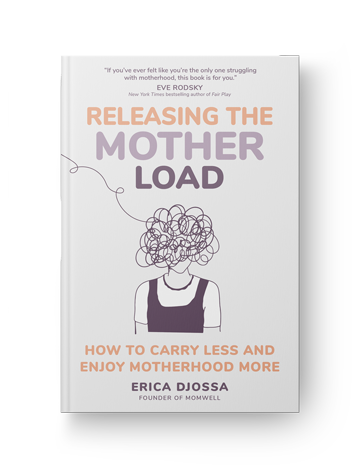
Excerpt from Releasing the Mother Load: How to Carry Less and Enjoy Motherhood More by Erica Djossa.

Erica Djossa

Erica Djossa is a registered psychotherapist, sought-after maternal mental health specialist, and the founder of wellness company Momwell. Her popular Momwell podcast has over a million downloads. Erica’s a regular contributor to publications like the Toronto Star, Scary Mommy, and Medium, and her insights have been shared by celebrities like Ashley Graham, Nia Long, Christy Turlington, and Adrienne Bosh. She lives in Toronto. For more, visit momwell.com

Learn More
Amazon | Barnes & Noble | Bookshop | Sounds True

Frederic Laloux: The Adventure of Remaking Our World

The modern workplace is a source of so much pain in so many peoples’ lives. And with the extreme challenges facing humanity, it’s easy to understand the gloom-and-doom perspective that has become prevalent today. Frederic Laloux sees things differently. “I look at it from a place of adventure,” he tells us. “If we don’t have a lens of ‘these are times that are confusing and difficult’ we can see them instead as extraordinary times for us to learn and to grow as individuals.”

In this podcast, Tami Simon speaks with the renowned author of Reinventing Organizations about his life’s mission to transform our approach to business. Give a listen as Tami and Frederic discuss: becoming change makers at the systemic level; applying Ken Wilber’s Integral Model to the way we organize businesses; the “inner angle,” or the mindset and beliefs that we bring to any problem; societal leaps and the people who drive them; a polycrisis or a great adventure: how do you see it?; three cornerstones for the future of business: self-management, wholeness, and evolutionary purpose; creating fluid hierarchies at work; leadership that inspires and connects; the fundamental shift from predict and control to sense and respond (especially in these uncertain times); to budget or not to budget…; finding support and community during a “dark night of the soul”; bringing joy, pride, and courage to our social change activism; climate change and the concept of pluralistic ignorance; and more.

Note: This episode originally aired on Sounds True One, where these special episodes of Insights at the Edge are available to watch live on video and with exclusive access to Q&As with our guests. Learn more at join.soundstrue.com.

E52: The Mind Is Not the Problem: Identifying with It ...

Spirituality is about recognizing that you are a conscious being, separate from your thoughts, emotions, and external experiences. You suffer because you identify with the past experiences that have molded your preferences and desires. True spiritual awakening occurs when your consciousness ceases to be distracted by the ego, permitting thoughts and emotions to pass through without clinging to them. This allows the shift inward to the infinite consciousness that lies beyond personal identity.

For more information, go to michaelsingerpodcast.com.

© Sounds True Inc. Episodes: © 2025 Michael A. Singer. All Rights Reserved.