We live in a wild world with a wealth of information at our fingertips. This means we can read reviews, check forums, and see what other parents are saying about everything we purchase or do for our children.
But that is not always a good thing. There is such a thing as too much research.
I distinctly remember working with a client who had very high expectations around her child’s food. She was concerned with what ingredients were in the food, how it was prepared, how it was served—and anything less than “healthy” felt wrong to her. She was a self-proclaimed perfectionist who wanted the best for her child—she wasn’t going to “lower her standards” at the request of her partner or anyone else.
As a result of her food concerns, she spent hours upon hours extensively researching topics related to food such as GMOs, toxins, ingredients, and safety. Through her research, she also read that stress could decrease her milk supply—so she shut down any conversations when her family tried to approach her about this or how it had taken over her life.
This level of research was no longer about the food—postpartum anxiety was in the driver’s seat, pushing her to search for control.
It’s also important to break away from the idea that there is one “right” way to mother. Just because we have access to information doesn’t mean there isn’t room for nuance. Take “healthy food” as an example. What constitutes a “healthy” diet has been a debated topic for decades and is often a wellness space filled with fads and extremes with each approach contradicting the next. There have been more rules prescribed to our food then I can count that cause people not to trust themselves and leave them seeing food as being good or bad. Food is not black or white. Our approach doesn’t have to be all or nothing.
In my client’s case, research had gone beyond just information-seeking. Sometimes, research is just research. But other times, research is:
Trying to find the “right” or “best” way to do something
Seeking reassurance
Grasping for certainty
Feeding your anxiety
An attempt to soothe your anxiety
I have seen this pattern play out many times with many of my clients. I believe that in many ways intensive mothering prevents us from seeing signs of anxiety. When we interpret perfectionism and the need to avoid mistakes at all costs as being a good mother, we have a lot of pressure to carry. It’s no wonder that so many of us find ourselves in the research rabbit hole.
Does that mean all research is bad? Of course not. But we need to learn the difference between when it’s helping and when it’s not. Researching should be used to provide you with enough information to make an informed decision. It should have boundaries—not be all-consuming.
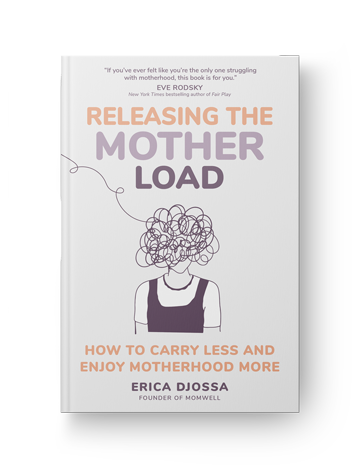
Excerpt from Releasing the Mother Load: How to Carry Less and Enjoy Motherhood More by Erica Djossa.
Erica Djossa
Erica Djossa is a registered psychotherapist, sought-after maternal mental health specialist, and the founder of wellness company Momwell. Her popular Momwell podcast has over a million downloads. Erica’s a regular contributor to publications like the Toronto Star, Scary Mommy, and Medium, and her insights have been shared by celebrities like Ashley Graham, Nia Long, Christy Turlington, and Adrienne Bosh. She lives in Toronto. For more, visit momwell.com
Erica Djossa is a registered psychotherapist, sought-after maternal mental health specialist, and the founder of wellness company Momwell. Her popular Momwell podcast has over a million downloads. Erica’s a regular contributor to publications like the Toronto Star, Scary Mommy, and Medium, and her insights have been shared by celebrities like Ashley Graham, Nia Long, Christy Turlington, and Adrienne Bosh. She lives in Toronto. For more, visit momwell.com.
What have we done to our mothers? Sociologists call our times “the era of intensive mothering,” a period in which moms must be it all and do it all for their children and families. Psychotherapist and maternal mental health specialist Erica Djossa has made it her mission to teach today’s mothers how to take care of their well-being in a sustainable way. In this podcast, Tami Simon speaks with Erica about her much-needed new book, Releasing the Mother Load, and the steps we can take to challenge the norms and change the culture around mothering.
Enjoy this empowering discussion of: values-centered mothering; mothers as martyrs; the pressures facing a generation of “overinformed, overeducated, and overwhelmed” moms; equally sharing our household duties; the cost of cognitive or invisible labor; boundaries; using the “load map” to redistribute the work; “mom rage,” its roots, and the unique nature of anger in motherhood; identifying the “red light and green light” times for difficult conversations with partners (and sticking to them); overcoming perfectionism; self-compassion; re-parenting yourself while you’re parenting your children; the disempowering belief that I’m failing as a mom; effective self-care for moms (it’s not just bubble baths!); advice for making changes—start small; and more.
Note: This episode originally aired on Sounds True One, where these special episodes of Insights at the Edge are available to watch live on video and with exclusive access to Q&As with our guests. Learn more at join.soundstrue.com.
We live in a wild world with a wealth of information at our fingertips. This means we can read reviews, check forums, and see what other parents are saying about everything we purchase or do for our children.
But that is not always a good thing. There is such a thing as too much research.
I distinctly remember working with a client who had very high expectations around her child’s food. She was concerned with what ingredients were in the food, how it was prepared, how it was served—and anything less than “healthy” felt wrong to her. She was a self-proclaimed perfectionist who wanted the best for her child—she wasn’t going to “lower her standards” at the request of her partner or anyone else.
As a result of her food concerns, she spent hours upon hours extensively researching topics related to food such as GMOs, toxins, ingredients, and safety. Through her research, she also read that stress could decrease her milk supply—so she shut down any conversations when her family tried to approach her about this or how it had taken over her life.
This level of research was no longer about the food—postpartum anxiety was in the driver’s seat, pushing her to search for control.
It’s also important to break away from the idea that there is one “right” way to mother. Just because we have access to information doesn’t mean there isn’t room for nuance. Take “healthy food” as an example. What constitutes a “healthy” diet has been a debated topic for decades and is often a wellness space filled with fads and extremes with each approach contradicting the next. There have been more rules prescribed to our food then I can count that cause people not to trust themselves and leave them seeing food as being good or bad. Food is not black or white. Our approach doesn’t have to be all or nothing.
In my client’s case, research had gone beyond just information-seeking. Sometimes, research is just research. But other times, research is:
Trying to find the “right” or “best” way to do something
Seeking reassurance
Grasping for certainty
Feeding your anxiety
An attempt to soothe your anxiety
I have seen this pattern play out many times with many of my clients. I believe that in many ways intensive mothering prevents us from seeing signs of anxiety. When we interpret perfectionism and the need to avoid mistakes at all costs as being a good mother, we have a lot of pressure to carry. It’s no wonder that so many of us find ourselves in the research rabbit hole.
Does that mean all research is bad? Of course not. But we need to learn the difference between when it’s helping and when it’s not. Researching should be used to provide you with enough information to make an informed decision. It should have boundaries—not be all-consuming.
Excerpt from Releasing the Mother Load: How to Carry Less and Enjoy Motherhood More by Erica Djossa.
Erica Djossa
Erica Djossa is a registered psychotherapist, sought-after maternal mental health specialist, and the founder of wellness company Momwell. Her popular Momwell podcast has over a million downloads. Erica’s a regular contributor to publications like the Toronto Star, Scary Mommy, and Medium, and her insights have been shared by celebrities like Ashley Graham, Nia Long, Christy Turlington, and Adrienne Bosh. She lives in Toronto. For more, visit momwell.com
Is a spiritual awakening only real if it completely rearranges your life? That’s the question Tami Simon puts to Adyashanti in this episode, and his answer digs into something a lot of seekers wrestle with: the gap between a powerful glimpse of clarity and the ongoing work of actually living from it.
Adya, the American-born teacher behind books like The End of Your World and Falling into Grace, walks through why those temporary tastes of awakening are real, even when they fade, and offers a surprisingly practical way to hold onto what they revealed without grasping at them. Then he does something rare: he tells the story of his own first major awakening, a moment he describes as feeling like a nuclear explosion going off inside him.
Here’s what we cover:
Why a fleeting shift still counts as a real awakening, even if it doesn’t stick
The two (seemingly contradictory) pieces of advice Adya gives people chasing a past peak experience
How the first awakening can feel like a “freebie,” while everything after asks you to participate consciously
Adya’s own account of the night everything fell away and the still, small voice that told him, “This isn’t all of it. Keep going.”
What if aging isn’t the slow closing of your erotic life, but the doorway into its most alive season?
This week, Tami Simon speaks with Kimberly Ann Johnson—sexological body worker, somatic experiencing practitioner, birth doula, and author of the new Sounds True book Erotic Seasons: Tuning In to the Rhythms of Women’s Sexuality and Spirituality—about what she calls erotic sovereignty, and the sentence that closes her book: the female body is its own spiritual path.
Join Tami and Kimberly to explore:
Erotic sovereignty—your relationship to your own life force, and why it stays with you across every season
Why the goal isn’t a more regulated nervous system, but a more responsive one, and what it means to run more charge
The four erotic seasons—maiden, mother, virgin, crone—and the surprising reason virgin comes after mother
Why hormonal transitions are “wet clay”: golden opportunities for repatterning that our culture teaches us to rush past
Menopause as a death rehearsal, and the life review that arrives decades before we expect it
Hot sex and warm sex—widening the range beyond adrenaline, and learning the language of the pause
“Hormones are gods”: the collective endocrine system, and why living intergenerationally may be the original hormone therapy
Becoming a sexual alchemist—arousal as healing energy, and why care is the whole ethic
Whether you are 25 or 75, Kimberly offers a map for meeting your body’s changes as thresholds rather than losses.
Please note: this episode includes candid discussion of sexual abuse and sexual wounding, including Kimberly Ann Johnson’s own experience.
Listen now, and meet your body as the path. →
This conversation offers genuine transmission, not just concepts about awakening, but the palpable presence of realized teachers exploring the growing edge of spiritual understanding together, and it originally aired on Sounds True One.
What if the very thing that wounded you is the source of the medicine you’re here to give?
In this month’s Point of Insight, Tami Simon shares a personal story: minutes before going live with an archetypal astrologer, she was told—correctly, and within seconds—that she carried “the mother of all mother wounds.” That single moment became the culmination of a much longer, gradual unfolding: a lifetime’s worth of “drops,” from a mentor she called the Queen of the Reframe, to an interview with yoga teacher and activist Seane Corn titled “Your Pain Is Your Purpose,” to an email from a business coach whose four simple words reframed everything—your karma is your dharma.
Join Tami as she reflects on:
How a lifelong feeling of not belonging became the soil for a life’s work helping others feel connected
The difference between sudden insight and the slow, gradual “boiling water” of a tipping point
Why real breakthrough requires going all the way through pain, not around it
Joanna Macy’s question—”What breaks your heart?”—and how grief and care become fuel for service
Why “never turn away” may be one of the most important spiritual instructions there is
This is a shorter, solo reflection from Tami—released once a month on the Insights at the Edge feed—on where our deepest wounds and our clearest purpose meet.