Customer Favorites

Damien Echols: Building the Light Body

Damien Echols was wrongfully convicted of murder in the infamous “West Memphis Three” case and spent more than 18 years on death row before his exoneration and release. Now he teaches Western ceremonial magick—the same practice he credits with saving his life in prison. With Sounds True, Damien has published the book High Magick and a practice-oriented audio companion, A Course in High Magick. In this episode of Insights at the Edge, Tami Simon speaks with Damien about magick and how it is meant to “constantly ingest more of divinity.” Damien describes two of the central practices of magick—the Middle Pillar and the Lesser Banishing Ritual of the Pentagram—and details why they are so foundational to the modality. Damien explains how he first discovered magick while in solitary confinement and details the concept of “will” in relationship to the Buddhist concept of dharma. Finally, Damien and Tami talk about what it means to manifest a “light body” and the overall goal of spiritual liberation through magick. (83 minutes)

Tami’s Takeaway:
Damien Echols is a “current-bearer”—someone who is able to pass to others an experience of boundless light. When I met with Damien in November of 2018 at a launch event for his new book, High Magick, I could tell that something had recently happened to him that had dramatically increased the intensity of this current. In this conversation, he describes how the practices of magick, which he calls “a Western path of enlightenment,” brought him to an experience of ego dissolution, which he describes as “experiencing myself as a small handful of sand that someone threw into a tornado.” The takeaway: an invitation to let go of any feeling of separateness, enter the abyss, and discover the interconnected light that awaits us.

E119: Escaping the Pull of Ego: A Call to Liberation

The root of all human suffering is ego—defined as our personal preferences, desires, and resistance to reality. Consciousness—our true self—is inherently divine, ever-present, and unchanging. It gets pulled down into lower vibrations by mental and emotional attachments to past experiences. The path to liberation involves recognizing the futility of resisting what has already happened and the importance of releasing our stored blockages. Over time, this allows us to enter a state of joy, peace, and harmony with the universe.

© Sounds True Inc. Episodes: © 2025 Michael A. Singer. All Rights Reserved.

Emma Isaacs: The Art of Winging It

Emma Isaacs is the founder of Business Chicks, a highly sought-after keynote speaker, and a media commentator on topics around female leadership and entrepreneurship. A bestselling author who has worked with the world’s greatest thought leaders and businesspeople, Emma inspires thousands with her boundless energy and ability to see possibility wherever she goes. She is also a mom to six kids under age 11. In this podcast, Emma joins Tami Simon to discuss her new book, Winging It. Emma and Tami also discuss the fallacy of “having it all,” the “four-burner theory” and focusing on our highest priorities, the concept of work-life balance (Emma doesn’t buy it!), and much more.

E1: Living From a Deeper Part of Your Being

What do you truly want? Wealth? Recognition? A perfect relationship? At our core, reflects Michael Singer, what we really want is to be happy: to dwell in a place of joy, love, and freedom from fear. In this episode, he shows how our thoughts and emotions lead us astray with solutions and goals… and how to experience the deeper, complete part of our being that transcends both external events and the misguided perceptions and tendencies of the mind.

For more information, go to michaelsingerpodcast.com. 
© Sounds True Inc. Episodes: © 2024 Michael A. Singer. All Rights Reserved.

The Hidden Meaning of The Belly in Yoga

The Hidden Meaning of the Belly in Yoga Blog Header ImageMost of us have lost our connection to the mysterious forces at play in the abdominal region, as well as to the appearance, function, and location of the organs and glands within it. We know that this area is responsible for digestion and assimilation, but in most Western cultures, a belly is considered healthy only according to its outer appearance: flat, “cut,” and firm. Good posture is supposed to be chest up, shoulders back, gut in. Emotionally, for many, the belly receives the brunt of our dysfunctional attempts to deal with negative feelings such as anger, fear, or low self-esteem.

In general, popular Western culture has placed more prominence on the head (objective intellect) and heart (individual soul) centers for discernment and transformation, while overlooking what many Eastern or so-called primitive cultures consider an essential step—the prerequisite descent into the depths of our being (lower centers), which is necessary before the ascent toward higher levels of awareness (upper centers). Our attention has moved away from the profound intelligence of the lower physical and emotional center of the body—our “guts.”

However, remnants of understanding are still found in common expressions in our languages, intimating a time when we recognized the power of the lower centers. In English, to have “a gut feeling” suggests a deep understanding that often is hard to explain logically, and in the past, feelings that come from deep in our center were considered more reliable than those that came from “above”: the heart or the head. Then there is someone with “guts,” which implies courage and unwavering integrity.

In Japan, the word hara can be simply translated as “belly,” but the roots of its meaning extend far beyond the physical abdomen. In Japanese culture, hara takes on a meaning that involves almost every aspect of life. It implies all that is considered essential to a person’s character and spiritual evolvement. Hara is the center of the human body, but not just of the physical body. In many idiomatic Japanese expressions where the root word is found, the meanings suggest a deeper context for the term. In his book Hara: The Vital Center of Man, Karlfried Graf Dürckheim describes one such expression: Hara no aru hito. It suggests not only one who possesses “center” physically, as in posture and balance, but also one who maintains balance in every way, including emotionally and mentally. This person is capable of tranquility in the face of strain, moves in and about the world with serenity, and possesses an inner elasticity that allows quick and decisive responses to any situation that arises. The hara is also seen as the place where the body’s vital life energies collect and are expressed, whether through physical movement or energetic presence.

Hara means an understanding of the significance of the middle of the body as the foundation of an overall feeling for life.

—Karlfried Graf Dürckheim

It is this very quality of hara that we look for in our yoga practice. What is referred to in Patanjali’s Yoga Sutras as sthira sukham is a state of unconditional calm that is not dependent on any outward circumstances. When in it, we command heightened sensitivity and an increased readiness to meet the unexpected. Here we realize that our capacity for appropriate response in the practice of asana can only come from the genuine absence of tension, coupled with the correct attitude of mind and lightness of heart. Throughout the practice of yoga poses, cultivating softness in the belly helps release a subtle downward flow and sense of fluidity that can be felt there and moving down into the pelvic floor, providing an intuitive invitation to move more deeply in all poses, especially those that turn or lengthen through the waist.

How the belly “thinks” intuitively could be a function of what science is now calling our second brain, or the enteric nervous system, which is an extensive network of neurons embedded in the lining of our gastrointestinal tract, from esophagus to anus. In addition to its handling of nearly all the digestive functions of our intestines, it is important to understand how this system of neurons intimately connects with our autonomic nervous system and, through the vagus nerve, becomes a critical component of parasympathetic control of the heart, lungs, and intestines.

The vagal channel of communication between the abdominal organs and the brain includes branches of cardiac and pulmonary ganglion, which suggests a shared relationship among these organs as well and offers a scenario in which the interrelationships are established both anatomically and energetically. The enteric system includes many of the same neurotransmitters found in the brain, including dopamine (in the intestines, it reduces peristaltic movement and maintains the inner linings of the intestinal tract; in the brain, it stimulates desire and motivation for reward response, or pleasure), serotonin (in the intestines, it stimulates peristaltic movement; in the brain, it regulates mood, appetite, and sleep), and acetylcholine (in the intestines, it stimulates peristaltic movement; in the brain, it regulates arousal, attention, memory, and motivation).

Numerous scientific studies have shown that the voluntary control of slow breathing has a substantial positive effect on our parasympathetic response. There is multidirectional communication via vagal signals to and from the brain to quiet frontal cortical activity, as well as an inhibitory influence upon the heart and sympathetic nervous system activity to and from the gastrointestinal tract that improves peristaltic function while strengthening immune system response in the gut.

Breathing is not merely an in-drawing and outstreaming of air, but a fundamental movement of a living whole, affecting the world of the body as well as the regions of the soul and mind.

—Karlfried Graf Dürckheim

This is an excerpt from Gravity & Grace: How to Awaken Your Subtle Body and the Healing Power of Yoga by Peter Sterios.


Peter Sterios is a popular yoga teacher and trainer with over four decades of experience. He’s the founder of LEVITYoGA™ and MANDUKA™, as well as KarmaNICA™, a charitable organization for underprivileged children in rural Nicaragua. Sterios taught yoga at the White House for Michelle Obama’s anti-obesity initiatives for three years, and in 2018 he was invited to the Pentagon to share yoga’s therapeutic effects with the US Marine Corps. He resides in San Luis Obispo, CA. For more, visit LEVITYoGA.com.

Read Gravity & Grace today!

Sounds True | Amazon | Barnes&Noble | Indiebound


The Hidden Meaning of the Belly In Yoga Pinterest

The Power of Mapping Your Emotions

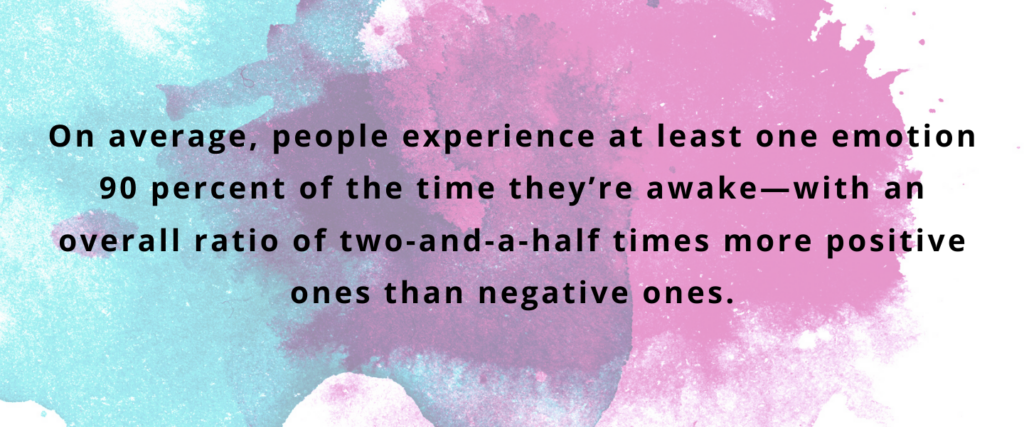
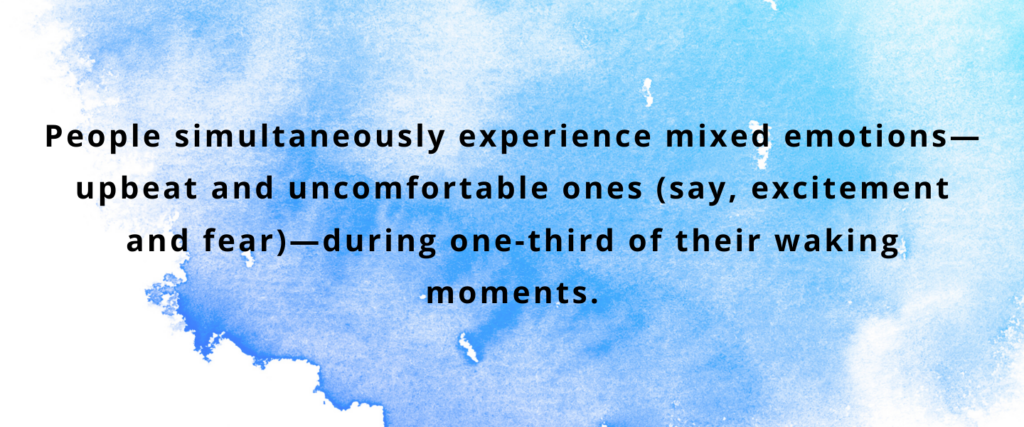
It’s in everyone’s best interest to learn to remove the emotional blinders and identify emotions accurately, both the uncomfortable and the upbeat ones. After all, unpleasant emotions are normal and natural, a fundamental part of being human. Emotions fluctuate on a daily basis, often several times in a given day. If you didn’t experience negative feelings now and then, the positive ones wouldn’t be as noteworthy or joyful; your emotional life would likely be unnaturally narrow. You would also be deprived of the opportunity to glean important insights into yourself. Feelings, both the good and the bad, are silent messages, alerting you to pay attention to something in your personal or professional life, in your behavior, or in the world around you.

Instead of separating emotions into categories such as good or bad, positive or negative, happy or sad, it’s better to view all your emotions as useful information, as “evolutionarily evolved responses that are uniquely appropriate to specific situations,” says Karla McLaren, MEd, author of The Language of Emotions. “When you stop valencing, you’ll learn to empathically respond to what’s actually going on—and you’ll learn how to observe emotions without demonizing them or glorifying them.”

Being able to recognize and express what you’re feeling helps you better understand yourself (leading to greater self-knowledge); validate your emotions and tend to your own emotional needs; and take steps to address those feelings directly by communicating and responding to them effectively. Having emotional self-awareness can motivate you to make healthy changes in your life, take action to improve the world around you, and become more psychologically resilient—that is, better able to cope with crises and rebound from setbacks.

Learning to Unpack Your Emotions

For some people, engaging in free association can clear the cobwebs from their minds, almost like opening the cellar door to a musty basement and letting in light and fresh air. To do this, you might take a break and consider how you’re feeling about what you’re doing, reading, seeing, or thinking every few hours throughout the day. If a general word comes to mind—such as stressed, anxious, or angry—dig deeper and ask yourself what other emotions you might be feeling (maybe fear or annoyance) along with it. If you do this out loud in unedited, private moments, you might find yourself blurting out what you’re really thinking or feeling, revealing the emotions that are taking a lot of energy to keep inside. This is really about unpacking your suitcase of feelings, or untangling the knot of emotions that is taking up space inside you.

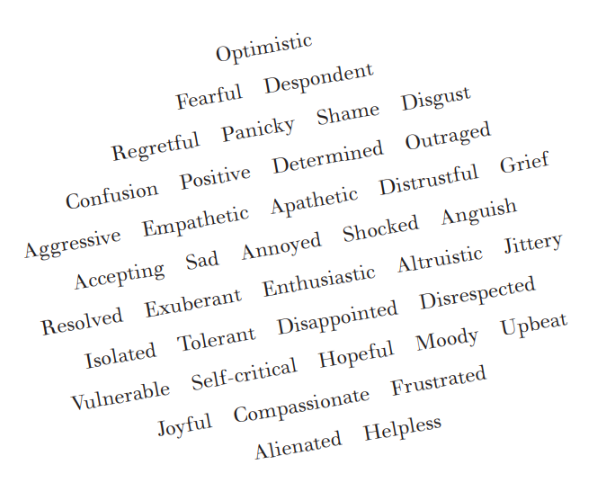
When you think about this in the abstract, it can be hard to pinpoint how you’re feeling. You may just see a swirling mass of a feeling quality such as “dread” or “foreboding” rather than recognizing the specific emotions you feel. To get to the root of your feelings, spend five minutes looking at the word cloud below—no more than five so that you don’t have time to filter your responses—and choose the emotions that resonate with your mood-state lately.

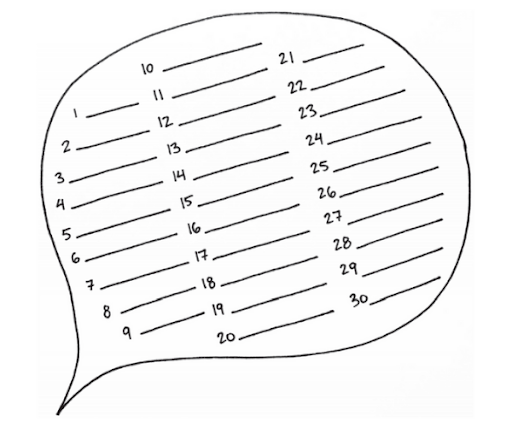
If reviewing these words evokes other feelings for you or if words or phrases that apply to you were not on this word cloud, jot these down in the blank word cloud that follows. Give yourself another five minutes to think about your recent state of mind and jot down phrases, images, or words that occur to you. This is your opportunity to personalize it without any limits or restrictions. If you feel stymied or draw a blank initially, think about your recent responses to current events or situations in your personal life or on the world stage. Try to be as honest as you can by focusing on how you’re really feeling when no one is watching—free-associate without judging, censoring, or revising what you write down.

Once you’ve finished your list, look at the order of the words you wrote down: Did they progress from all negative to increasingly hopeful? Do they portray an internal tension or friction in going back and forth between various feelings? If all the words are positive, consider the possibility that you may be in some degree of denial, focusing only on the window dressing rather than the emotions that lie beneath the surface. Also, consider this: Is there a pattern of shallow, visceral reactions that came out initially, followed by more complex thoughts and feelings? If so, think about whether you’re giving yourself enough time in your life to reflect. If you came out with highly intellectualized words or phrases first, it might suggest that you put on a bit of a facade when engaging with the world, and you might benefit from striving for a deeper engagement or familiarity with your emotions.

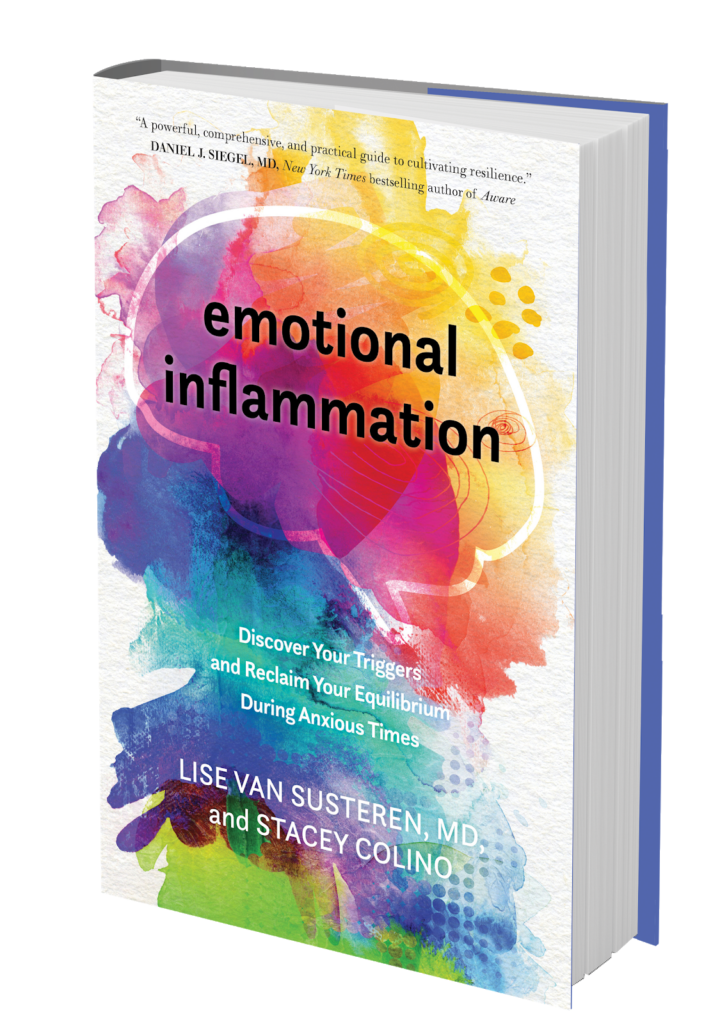
This is an excerpt from Emotional Inflammation: Discover Your Triggers and Reclaim Your Equilibrium During Anxious Times by Lise Van Susteren, MD, and Stacey Colino.

Buy your copy of Emotional Inflammation at your favorite bookseller!
Sounds True | Amazon | Barnes & Noble | Bookshop