Customer Favorites

The Trauma-Trigger Cycle

When you are stuck with old unprocessed experiences living inside you, they can create what I call a trauma-trigger cycle because they are still very much alive in our systems.

Here’s my analogy to help you understand how this works and why it causes so much trouble. Imagine that you have a very difficult experience, for example, having to say goodbye to a sick pet. All of the details in the form of individual feelings, smells, images, sounds, and more get bundled up and deposited into a metaphorical glass trauma capsule—which gets stored in the body. It sits there with all of the old feelings we experienced at the time the event happened. While you might not be aware of it constantly, you are likely feeling those emotions at a low level all the time. When any current situation reminds you of any of those details hanging out in the capsule—either consciously or subconsciously—the old trauma gets “poked,” or reactivated. This is how we get triggered. Being triggered can bring up flashes of those memories, including images, feelings, and any sensory stimuli.

For the most part, except in certain cases of post-traumatic stress disorder (PTSD) from major life events, where sometimes the trigger is known, this trauma-trigger reaction actually happens at a subconscious level, outside of your awareness. Even in obvious situations, you may think you know what the trigger is, and try to avoid it, but it may be something totally different that got stuck in the metaphorical glass trauma capsule. Often, people come to me and say, “Nothing set this off,” “I’m depressed for no reason,” or “I suddenly started feeling terrible but nothing happened.” While this may seem true, I can bet on the fact that while the bad feelings might seem random, they are being triggered in some way that you simply haven’t yet identified. Triggers can be foods, colors, smells,sounds, weather, or anything, really! Finding and resolving triggers can become almost an entertaining game if you let it.

As you can imagine, this entire trauma-trigger dynamic is very unsettling and unpredictable—which can feel like danger to your system and keep you stuck in that freakout response. Not only that, but in this state, you can actually be excessively tuned in to your trauma, seeing reminders of it everywhere, which further traumatizes you.

I had an experience after going through a loved one’s difficult health crisis where every single place I looked, I saw reminders of the experience. And for someone who wonders if everything is some greater “sign from the Universe” (fact: not every single thing is) or my intuition is trying to get my attention because another loved one might be in danger (second fact: trauma and fear clouds intuition), it felt like torture to me. I kept meeting people who had the same illness that my loved one had had, saw posters and billboards advertising medications for the condition, and more. As a distraction while on vacation, I had deliberately picked out several seemingly lighthearted books to take—and it turned out a character in every single book had that same medical condition! I was constantly on edge and further traumatized by all of these things. This is a perfect example of what happens to us in a traumatized state: we become highly attuned to the world around us, perhaps subconsciously scanning for danger, but in the process, we see and get triggered by everyday things we’ve probably passed by a million times before. I realized that had I been tuned in to any other single thing out in the world, like peaches, I likely would have seen that everywhere. This recognition actually led to a funny mantra I used during that time to keep things light while I did the deeper healing work: Look for the peaches! But in all seriousness, what happened as I worked to release the trauma, just like you’ll be doing in this chapter, was that I stopped seeing reminders of it. I have to be honest in that this took months of using energy therapy in different ways to overcome the trauma I had experienced, like you’ll be learning soon—but it worked. Did all the people with this condition go away? Did all the billboards get taken down? No. The less traumatized I became, the less heightened my sensitivity to it was. This is a perfect example of why it’s essential to work with unprocessed experiences.

Emotional memory is stored throughout the entire body. Thanks to the work of Candace Pert, we know that “unexpressed emotions from experiences can get stuck in the body at the level of cellular memory.” This is such a simple explanation for why we feel bad when we haven’t resolved our past experiences. We are still quite literally feeling them. And even if it’s at a subtle level, it may only take a “trigger” from that metaphorical glass capsule to awaken it.

While your own unprocessed experiences may not disrupt your life in the way that clinically diagnosed PTSD does, you may relate to what it feels like to have PTSD, when one or a few memories from life takes over all of it. This is, again, why we must deal effectively and consistently with our emotions instead of suppressing them. Otherwise, we are at risk of our emotions becoming part of future unresolved experiences.

Even knowing all of this, there’s no need to panic. Again, not all experiences traumatize you. And, not all traumas will need to be dealt with in order to get you feeling better. But the ones that do need careful attention. I want you to understand that by working with trauma, we are not trying to force a positive perspective on it or make you be okay with something bad that happened to you. Not at all. What we want to do is release the stress it’s causing you, even if that stress is undetected consciously. We don’t want these traumas taking up space and energy in your body anymore or triggering you without your knowledge.

Working with unprocessed experiences will help empty the metaphorical glass trauma capsule so we stop becoming triggered by the world around us. In other words, you’ll be seeing peaches more easily instead of trauma triggers.

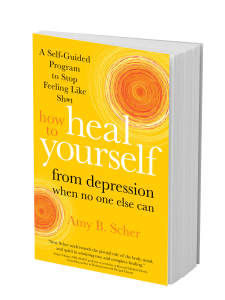
This is an excerpt from How to Heal Yourself From Depression When No One Else Can: A Self-Guided Program to Stop Feeling Like Sh*t by Amy B. Scher.

 

amy b scherAmy B. Scher is an energy therapist, expert in mind-body healing, and the bestselling author of How to Heal Yourself When No One Else Can and How to Heal Yourself from Anxiety When No One Else Can. She has been featured in the Times of India, CNN, HuffPost, CBS, the Washington Post, Cosmopolitan, the Los Angeles Review of Books, Curve magazine, and San Francisco Book Review. Scher was also named one of the Advocate’s “40 Under 40.” She lives in New York City. For more, visit amybscher.com.


how to heal

Learn More

Sounds True | Amazon | Barnes & Noble | Indiebound | Bookshop

Mark Wolynn: Becoming Aware of Inherited Family Trauma

Mark Wolynn is the director of The Family Constellation Institute, The Inherited Trauma Institute, and The Hellinger Institute of Northern California. His book It Didn’t Start With You: How Inherited Family Trauma Shapes Who We Are and How to End the Cycle was a Silver Nautilus award-winner in 2016. In this episode of Insights at the Edge, Tami Simon speaks with Mark about inherited trauma and how it can be the source of unexplained illnesses. Mark explains how the effects of deep trauma ripple across generations, citing the evidence of epigenetic changes following traumatic events. Mark and Tami discuss the work of Roger Woolger and the possibility of trauma descending from past lives. Finally, they talk about what it means to honor our ancestors’ pain while also healing and moving forward with our own lives. (70 minutes)

Heidi Smith: Bringing People to the Flowers


Heidi Smith is a psychosomatic therapist, flower essence practitioner, and registered herbalist. She is the author of The Bloom Book: A Flower Essence Guide to Cosmic Balance, a comprehensive guide for working with flower essences in order to bring about healing, transformation, and awakening, at both a personal and collective level. Heidi is Tami Simon’s guest in “Bringing People to the Flowers,” a podcast exploring humanity’s call to enter into a deeper relationship with flowers. Heidi and Tami also discuss flower essences as a “verbal and vibrational” medicine, the power of intention, how to begin working with flower essences yourself, and much more.

Relieve Anxiety and Depression – a free audio do...

Millions around the world suffer from anxiety and depression, and seek relief from the many challenges associated with these difficult conditions. Over the last few decades, both scientific research and clinical reports have pointed to the power of meditation to lessen the challenging symptoms of anxiety and depression, and to aid living a more healthy, productive, and stress-free life.

With this collection of seven guided meditations, Sounds True brings together seven respected psychiatrists, psychologists, and bestselling authors who offer exercises designed to help bring immediate—and potentially lasting—relief from the troubling symptoms of anxiety and depression. Each of these guided exercises can be undertaken in the comfort of your own home, and require no prerequisite knowledge or training.

Receive free access to Relieve Anxiety and Depression: Seven Guided Meditations; simply select the format (“Audio Download”) and click “Add to Cart”. From there, click on your shopping cart in the top right corner, enter your details (no credit card information needed), and this product will be delivered to your Digital Library!

Tracks include:

1. “Soft Belly Meditation” with James Gordon, MD

The author of Freedom from Depression speaks about the role of meditation in the treatment of depression and leads a guided practice for balancing the emotions, body, and spirit.

2. “Body Scan” with Erin Olivo, PhD, MPH

Dr. Erin Olivo, psychotherapist and author of Free Yourself from Anxiety presents a guided body-scan exercise to reduce anxiety and open us to the wisdom of the body.

3. “Guided Relaxation Visualization” with Mark Hyman, MD

The bestselling author and co-medical director at Canyon Ranch in the Berkshires Health Resort in Lenox, Massachusetts, shares a guided relaxation visualization designed to reduce anxiety, lower stress, and cultivate deep relaxation in both body and mind. Excerpted from the audio learning program UltraCalm.

4. “Guided Mindfulness Meditation” with Daniel J. Siegel, MD

Psychiatrist Dr. Daniel J. Siegel, author of The Mindful Brain, offers a guided mindfulness meditation to help bring us into the present moment, thereby allowing us to access a natural and creative healing response to whatever distressing symptoms arise in our lives.

5. “Coming Home to Happiness” with Rick Hanson, PhD

The next guided meditation is from Dr. Rick Hanson, neuropsychologist, bestselling author, and creator of the audio program Meditations for Happiness. Here, Dr. Hanson teaches a guided meditation to help us access our “true home,” finding rest and acceptance in whatever comes our way.

6. “A Pause for Presence” with Tara Brach, PhD

Clinical psychologist and bestselling author of the audio learning series Radical Self-Acceptance Tara Brach teaches us a way to pause in our daily lives, ground ourselves, and start fresh in the midst of any difficult situation.

7. “Healing Lake Meditation” with Jon Kabat-Zinn, PhD

The founder and director of the Stress Reduction Clinic at the University of Massachusetts Medical Center and bestselling author of Mindfulness for Beginners guides us through what he calls the “healing lake meditation” to relieve anxiety and stress, helping us contact a place of deep relaxation within that is available at any time.

The Self-Acceptance Project… a free online video...

Access the Self-Acceptance Project free of charge

Self-aggression, self-acceptance, self-love, and issues of self-worth can be challenging for contemporary spiritual practitioners, even for those who have meditated or engaged in psychotherapy for years. There are many ways we can be unkind to ourselves, often subtle and unconscious, which can affect the way we perceive and engage in our lives, especially in interpersonal and intimate relationship.

In this free, 12-week video event series, I invited 23 psychologists, psychotherapists, neuroscientists, and spiritual teachers to speak with my friend and longtime colleague, Tami Simon, to explore these areas and how we might move toward the creation of a certain kind of holding environment in which we can grow, heal, and transform together.

All episodes of the Self-Acceptance Project are now posted and can be accessed as video or audio downloads, or can be streamed at no cost from the comfort of your own home. We invite you to join us for this pioneering series and look forward to sharing our discoveries with you – and hearing what you have learned. It is our intention that you benefit deeply from this work and that it guide you along your own journey of love and awakening.

Episodes include

  • Developing Shame Resilience with Dr. Brené Brown
  • Waking Up from the Trance of Unworthiness with Dr. Tara Brach
  • Turning Towards Our Pain with Dr. Robert Augustus Masters
  • Begin Exactly Where You Are with Jeff Foster
  • Taking in the Good with Dr. Rick Hanson
  • The Human Capacity to Take Perspectives with Dr. Steven Hayes
  • What if There is Nothing Wrong with Raphael Cushnir
  • No Strangers in the Heart with Mark Nepo
  • Transforming Self-Criticism into Self-Compassion with Dr. Kelly McGonigal
  • Faith in Our Fundamental Worthiness with Sharon Salzberg
  • Developing a Wise Mind with Dr. Erin Olivo
  • Embodied Vulnerability and Non-Division with Bruce Tift
  • Perfect in Our Imperfection with Colin Tipping
  • Staying Loyal to One’s Self with Dr. Judith Blackstone
  • Compassion for the Self-Critic with Dr. Kristin Neff
  • Curiosity is the Key with Dr. Harville Hendrix
  • Kindness is the Means and End with Geneen Roth
  • Healing at the Level of the Subconscious Mind with Dr. Friedemann Schaub
  • Embracing all of Our Parts with Dr. Jay Earley
  • Understanding Empathy and Shame with Karla McLaren
  • Integrating the Shadow with Dr. Parker PalmerLetting Life Be in Charge with Cheri Huber


Stan Tatkin: In Each Other’s Care

Dr. Stan Tatkin is uniquely talented at helping couples shift from being in each other’s faces to being in each other’s care. In this podcast, Tami Simon speaks to the innovative therapist and author about his new book, In Each Other’s Care: A Guide to the Most Common Relationship Conflicts and How to Work Through Them, discussing some of the research-based, practical strategies he has developed in his celebrated PACT (Psychobiological Approach to Couples Therapy) model.

Give a listen to this gritty, honest, informative, and empowering conversation exploring: cultivating secure functioning relationships; why couples must create their own culture of shared power, respect, and collaboration; finding the balance between independence and interdependence; the one-directional nature of codependency; becoming your partner’s whisperer; why “earned love” is what endures; the fantasy of the same page; attachment versus love; mutual purpose and care as ingredients for an awesome relationship; the physical toll of an insecure functioning relationship; the Sherlocking technique; the power of eye contact; practicing quick repair; touch: an unequivocal signal of friendliness; the basic need in relationship: you and I are OK; the Big Five: sex, money, kids, time, and mess; jealousy and envy; longevity and happiness through co-creating the architecture of your relationship and understanding how you interact under stress; and more.

Note: This episode originally aired on Sounds True One, where these special episodes of Insights at the Edge are available to watch live on video and with exclusive access to Q&As with our guests. Learn more at join.soundstrue.com.