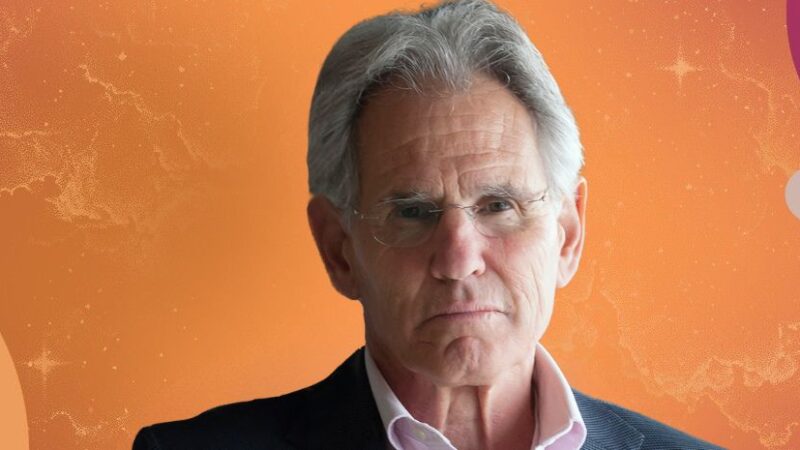
Jon Kabat-Zinn

Jon Kabat-Zinn, PhD, is professor of medicine emeritus at the University of Massachusetts Medical School and the founder and director of its renowned Mindfulness-Based Stress Reduction Clinic. His clinic was featured in 1993 in the public television series Healing and the Mind with Bill Moyers. Jon Kabat-Zinn is the author of 15 books, in print in over 45 languages. These include Full Catastrophe Living; Wherever You Go, There You Are; Coming to Our Senses; and Mindfulness for Beginners.

Author photo © Jaume Cosialls

Also By Author

[ENCORE EPISODE] Jon Kabat-Zinn: Befriending Pain

**SPECIAL ENCORE PRESENTATION**

Current statistics tell us that 20% of the US population has some form of chronic pain, defined as severe discomfort that has continued for six months or more. That’s more than 50 million people. Jon Kabat-Zinn has received international acclaim for his leading work in bringing the life-changing practices of meditation and mindfulness into the mainstream of medicine and society. In this inspiring podcast, Tami Simon speaks with Jon about his empowering new book, Mindfulness Meditation for Pain Relief, and how we can greatly improve our lives (and our entire world) by reframing the way we relate to our thoughts, our minds, and the sensations of our bodies.

Listen in as they discuss the epidemic of chronic pain and the power of mindfulness to ease suffering of all kinds, the myth of the “good meditator,” the body as the starting point for practice, exploring your “emotionally freighted thoughts,” our longing to be who we really are, working with the mind and learning to inhabit a space of embodied awareness, the refuge that is meditation practice, letting go of our stories, befriending the sensory field of what we call pain, the miracle of life on Earth, the Buddha’s teaching on mindfulness as the direct path to liberation, surfing the waves of your own experience, unity within diversity and the arising of compassion, focusing on what’s right instead of what’s wrong, how we are all on a growth curve on life’s journey, and more.

Note: This episode originally aired on Sounds True One, where these special episodes of Insights at the Edge are available to watch live on video and with exclusive access to Q&As with our guests. Learn more at join.soundstrue.com.

This episode is sponsored by BetterHelp. Listeners of Insights At The Edge get 10% off their first month at

www.betterhelp.com/soundstrue

Jon Kabat-Zinn: Befriending Pain

Current statistics tell us that 20% of the US population has some form of chronic pain, defined as severe discomfort that has continued for six months or more. That’s more than 50 million people. Jon Kabat-Zinn has received international acclaim for his leading work in bringing the life-changing practices of meditation and mindfulness into the mainstream of medicine and society. In this inspiring podcast, Tami Simon speaks with Jon about his empowering new book, Mindfulness Meditation for Pain Relief, and how we can greatly improve our lives (and our entire world) by reframing the way we relate to our thoughts, our minds, and the sensations of our bodies. 

Listen in as they discuss the epidemic of chronic pain and the power of mindfulness to ease suffering of all kinds, the myth of the “good meditator,” the body as the starting point for practice, exploring your “emotionally freighted thoughts,” our longing to be who we really are, working with the mind and learning to inhabit a space of embodied awareness, the refuge that is meditation practice, letting go of our stories, befriending the sensory field of what we call pain, the miracle of life on Earth, the Buddha’s teaching on mindfulness as the direct path to liberation, surfing the waves of your own experience, unity within diversity and the arising of compassion, focusing on what’s right instead of what’s wrong, how we are all on a growth curve on life’s journey, and more.

Note: This episode originally aired on Sounds True One, where these special episodes of Insights at the Edge are available to watch live on video and with exclusive access to Q&As with our guests. Learn more at join.soundstrue.com.

On The Mindfulness Revolution and Our Fear of Authenti...

The Mindfulness Revolution Header Image

Deepen your personal healing practice with guided meditations, audio presentations, and learning intensives by Jon Kabat-Zinn on Sounds True »

Have you ever wondered who coined the term ‘mindfulness’? That was Dr. Jon Kabat-Zinn. He describes it as “paying attention on purpose with a non-judgmental attitude.”

“I take an enormous amount of pleasure in actually not trying to get anywhere” —Jon Kabat-Zinn

Partly because of his work and research, this concept of ‘mindfulness’ has become mainstream. We see it at colleges, small businesses and large corporations, and—perhaps most notably—in medicine (Kabat-Zinn also founded the Stress Reduction Clinic at the University of Massachusetts Medical School).

In Tami’s interview with Kabat-Zinn on Insights at the Edge, the two begin asking: Why is mindfulness gaining popularity in the first place? In the process, they explore what’s simple, profound, and relatable about it.

AGE OF MINDFULNESS

mindfulness revolution woman

“Once you realize that we are completely embedded in an interconnected world … the only real response is a sense of profound appreciation or affection for the fact that we are not separate” 

Mindfulness has always been a part of humanity. It has been called different names and interpreted by different lenses, but the concept of some greater unity of which we are all a part—that doesn’t seem to be going anywhere.

So, even if it’s a trend, couldn’t there be more to it? In a way, mindfulness seems to take on the breath of intuition, not necessarily logic or reason. It is truly the air of possibility.

YOU ARE NOT YOUR THOUGHTS

mindfulness revolution thoughts

You cannot get rid of your thoughts. But when you create distance between yourself and your thoughts, you can let them wash through you. You do not have to fight to maintain them or believe them. And, you do not have to fight to let them go.

“Suppose the sky is awareness. If a bird flew through, then the sky would know it. … [The sky] has its own sort of ground condition of just being the sky, just being awareness”

He describes this awareness not as a state of being, but as a shift in seeing. There was always space there. We just needed to rotate a lens.

Have you ever retreated your vision while meditating, so that you were gazing out from between your two closed eyes? Like that. That field of awareness stretches infinitely—as conscious beings, it weaves us together.

This feeling is both humbling and terrifying in its awesomeness. When the sky is so big, we don’t know what we are. But we can accept this uncertainty. Our minds, our egos, our bodies—can expand with it.

WE ARE ALL GENIUSES

mindfulness revolution connected

Homo sapien sapien literally translates from Latin to “the species that knows and knows that it knows.”

In the episode, Jon and Tami talk beautifully about mindfulness’s fundamental humanness. There is an utter connection between our feet grounded on this Earth, and the spaces we don’t understand.

“There is something about mindfulness that is absolutely core to our humanity … the final common pathway of what makes us human”

Sometimes, meditation helps us feel the truth of this. Once we know this awareness is there, we can integrate it into the ways we think and make decisions.

FEAR OF AUTHENTICITY

mindfulness revolution authenticityWe reach for purpose; we wish to understand our place in the universe. (It isn’t weird for us to do this. If I were an alien, and I heard humans were doing this, I would be like, well, yeah.)

Yet, we are afraid to be ourselves. We don’t want ourselves to disappear. So we keep inside our deepest sorrows, anxieties, and emotions.

The parts of us we try and protect so carefully end up banging on the walls inside of us, stuck.

“It’s not like we can never suppress that shadow side … but if we can come to understand it in a deeper way, then I think there is a potential … [to] elevate what is most beautiful and good about all human beings”

What if we gave all of it—ourselves, and our connection to the world—the space to breathe?

(And the possibilities begin to shimmer.)


ABOUT JON KABAT-ZINN

Jon Kabat-Zinn Author Photo

Jon Kabat-Zinn, PhD, is professor of medicine emeritus at the University of Massachusetts Medical School, where he founded the Center for Mindfulness in Medicine, Health Care, and Society in 1995, and its world-renowned Mindfulness-Based Stress Reduction (MBSR) Clinic in 1979. His trailblazing research has helped bring mindfulness meditation into mainstream medicine. He is the author of 10 books, including the bestsellers Full Catastrophe Living; Wherever You Go, There You Are; and Mindfulness for Beginners.

Take a look at Jon Kabat-Zinn’s book and accompanying CD of guided practices, Mindfulness for Beginners, published by Sounds True!

★★★★★ Easy to read and informative as well as inspiring. —gus c
★★★★★ In my opinion, a must-read for all humans. —Yves N

ABOUT THE AUTHORDani Ferrara Blogger Author Photo

When she isn’t writing, playing music or teaching, Dani Ferrara blogs at Sounds True and researches the alchemy of healing. Explore her art at daniferrarapoet.com.

 

You Might Also Enjoy

Cecily Mak: “My Life Is Better Clear”

What if sobriety isn’t the point? Tami Simon talks with Cecily Mak, founder of the ClearLife Movement, about the spontaneous thirty-day break from drinking that began at Burning Man and never really ended. They explore why “alcohol-free” became a more honest word for her than “sober,” and what it looks like to face what we’re really avoiding when we reach for a drink, a distraction, or anything that dims our life.

Cecily Mak is the founder and visionary of the ClearLife Movement, a former attorney and Silicon Valley executive turned writer, podcast host, and co-founder of Wisdom Ventures. She is the author of Undimmed: The Eight Awarenesses for Freedom from Unwanted Habits.

In this conversation, Tami and Cecily explore:

  • The spontaneous thirty-day alcohol-free experiment that began at Burning Man, and the divorce decision behind it
  • Why Cecily chose the language “alcohol-free” over “sober,” and a therapist’s model of use, abuse, and addiction
  • The concept of dimmers: the habits, substances, and behaviors we use to soften difficult feelings
  • How to tell whether a habit is helping us grow, or helping us avoid something we already know
  • Forgiveness and letting go as an inside job, including her path toward her ex-husband and her late mother
  • Why self-compassion, not self-judgment, is often the real work underneath changing any habit
  • The sixth awareness: learning not to judge or impose our own path onto someone else’s

This conversation is for anyone questioning their relationship with alcohol or another habit, anyone doing forgiveness work with a parent or former partner, and anyone curious what it actually takes to live with more clarity and presence.

Listen now and discover what it means to live undimmed. →

This interview originally aired on Sounds True One, where you can enjoy early, ad-free access to episodes of Insights at the Edge: https://join.soundstrue.com/

Dr. Sue Morter: “The Energetic Architecture of A...

Twenty-six years ago, a chiropractor sitting in her first meditation class was transported into a field of light ten times brighter than the desert sun. Dr. Sue Morter, bestselling author of The Energy Codes, joins Tami Simon to map the energetic architecture behind that kind of awakening, and how the rest of us can build the inner circuitry to access it on purpose instead of by accident.

Dr. Sue earned her doctorate in chiropractic more than 40 years ago and has spent decades developing a body of work in bioenergetics—the study of how energy flows through, builds, and heals the body. She’s the founder of the Body Awake School of Yoga and the Morter Institute, an internationally recognized speaker, and the author of the new book The Anatomy of Awakening: The 5 Hidden Codes to Activate Self-Healing, Unlock Your Higher Consciousness, and Live Your Divine Destiny, which maps five additional energy centers beyond the familiar seven chakras.

In this conversation, Tami and Dr. Sue explore:

  • The spiritual experience that reoriented Dr. Sue’s entire career and, over time, helped resolve her lifelong scoliosis and migraines
  • Why “seeking enlightenment” misses the point, and why embodiment, not transcendence, is the real work
  • The five additional chakras beyond the traditional seven (eight through twelve), and what each one governs in our energetic architecture
  • How to build “energetic circuitry” at the site of a trigger instead of getting lost in its story
  • Spherical breathing and Mula Bandha as practical tools for grounding and stabilizing the nervous system
  • What it actually means to regulate your nervous system, and why trying too hard to do it can backfire

This episode is for anyone navigating a season of nervous system dysregulation, energy practitioners and bodyworkers, and listeners drawn to the chakra system who want a more embodied, practical approach to awakening.

Listen in for a guided practice you can use the next time you feel triggered, overwhelmed, or ungrounded.

Dr. Sue uses a number of visual aids throughout this conversation, so if you’d rather watch than just listen, you can find the video version on YouTube @SoundsTrueManyVoices or on our premium membership platform at soundstrueone.com

Just One Question | Lama Rod Owens: How Can I Receive ...


Giving love comes easy, but can you actually receive it? Lama Rod Owens says most of us flinch at being cared for, even by something as simple as the chair we’re sitting in. In this practice from his book The New Saints, he walks us through what it takes to actually let love in.

Lama Rod Owens, a Black Buddhist Southern Queen, authorized lama in the Kagyu lineage of Tibetan Buddhism, and author of The New Saints: From Broken Hearts to Spiritual Warriors, guides Tami Simon (and all of us listening) through a short meditation on receiving care, drawn straight from the pages of his new book.

In this conversation, Tami and Lama Rod explore:

  • Feeling supported by the seat or ground beneath you
  • Recalling a time someone, or something, really loved you
  • Letting that love move through the body, including the grief it can stir up along the way
  • Imagining the whole universe wanting you safe, happy, and free
  • Gently returning to the body and closing the practice

This one’s for anyone who finds it easier to give love than to receive it, which, let’s be honest, is most of us.

Taken from the full Insights at the Edge conversation with Lama Rod Owens. Find the complete interview in this feed or at https://bit.ly/new-saint