Customer Favorites

Black Tara Who Destroys All Negativities

In the fall of 2010, our monthly Tara practice began at sundown at the end of Rosh Hashanah, the beginning of the Jewish new year, 5771. The days between Rosh Hashanah and Yom Kippur are known as the Days of Awe. During these ten days, observant practitioners reflect on the past year to repair harm they may have inflicted on friends, family, or members of the greater family of the planet. They apologize to others and seek to do t’shuvah to make amends if possible. People work consciously to repair and let go of past negativity and set intentions for the coming year to prevent further mischief.

Black Tara Who Destroys All Negativities was on the calendar for that night. We appreciated the synchronistic timing of the two events. I noted that Tara protects us from negativity, internal and external, and helps us release the effects of negative energies we’ve encountered or generated. This protection occurs in part from remembering our connection to the Whole—that we are nurtured and contained by a multilayered universe. When we help another, we are helped. If we harm another, we harm ourselves. Perhaps harder to grasp—if we harm ourselves, we harm the whole universe.

The teaching centered around the meaning of the mantra, which refers explicitly to ingrained behaviors operating outside of consciousness that wreak havoc in interpersonal relationships. Negative energies transferred from one individual to another are potent and destructive, and often have lasting effects.

Tara’s Appearance

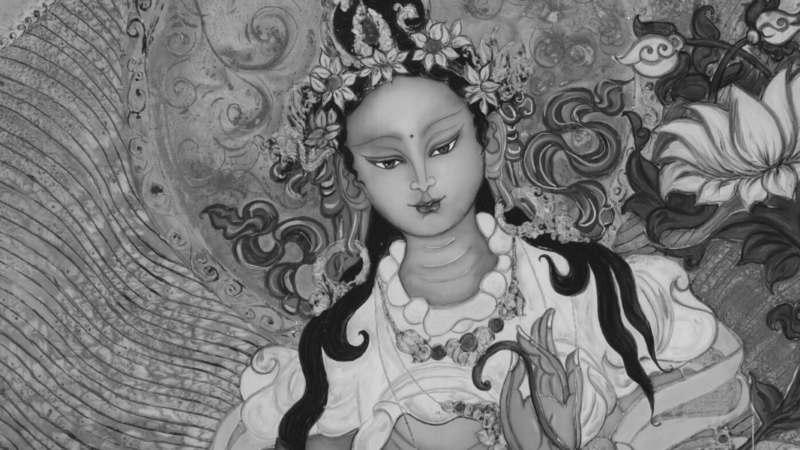
Black Tara appears with her mouth wide open in a fierce expression. Like all the wrathful emanations, she sits on a fiery sun disc, which rests in the center of her lotus throne. The sun disc replaces the usual soothing moon disc. She holds a black vase, which contains the power to overcome even the most destructive and negative powers. In this aspect, Tara is known as the Destroyer of All Negativities.

The Mantra

Om Tare Tuttare Ture Sarva Vidya Avarana Ye Bhye Phat Soha!

“Ohm Tahray Tootahray Tooray Sarwah Veedyah Ahvahrahnah Yay Bay Peyt Soha!”

This mantra sheds more light on the meaning of the practice, when you might need to use it, and how to align your own intentions with those of Tara. It insists that Tara remove mental obstacles that block insight into your complexes or the emotional forces that obscure your understanding. Avarana refers to the causes underlying negative tendencies in yourself or others. These instincts, imprints, or potencies are ingrained, influencing behavior outside of awareness. They are unconscious, unquestioned, and unprocessed. They have been denied, repressed, or avoided. You or others around you might struggle to bring them to consciousness or have no wish to do that whatsoever.

As with many words in Sanskrit, vidya has multiple meanings depending on the context. Vidya often means “wisdom”; in this instance, it means “intentions,” particularly negative intentions. Bhye phat urges Tara to destroy these obstacles or difficulties!

The mantra asks Tara to overcome the negative intentions of the enemy. Use it when you want her complete protection in order to fully grasp the difficulties in your situation. Watch for signs that you are being infected or possessed by internal negativity, which would be a natural response to the energy coming at you. Don’t be naive about actual outer dangers you might be facing; you have to remove yourself from harmful situations.

The Practice

Visualize the entire mandala of the twenty-one Taras arising out of vast space in front of you. Green Tara appears in the center in her radiant body of green light. Imagine your teachers surrounding her and all her other emanations in the background behind them. Finally, invite your friends and supporters and all beings you wish to receive the blessings of your practice. Recite the preliminary prayers. Then imagine that Black Tara Who Destroys All Negativities moves into the foreground, seated on her lotus throne with a sun disc in the center. She holds a black vase, which contains the power to destroy even the most virulent forces in the universe. See light streaming out of her heart and from her seed syllable Tam (“Tahm”) standing on a moon disc inside the vase. Just as a seed contains the entire essence of the plant it will become, the seed syllable Tam contains the entire essence of Tara’s infinite powers.

tam

If visualizing a Tibetan syllable proves difficult initially, simply visualize light streaming out instead. The light destroys all malice and negativity.

Invite Black Tara to protect you from the negative intentions and actions of others. Set your own intentions to release the shock of the impact of such energies on your body, psyche, and spirit. Ofer Tara all of your dark emotions; ask her to protect you inside and out as you engage with our imperfect world in which aggression and hatred are too easily encountered.

Recite the mantra, Om Tare Tuttare Ture Sarva Vidya Avarana Ye Bhye Phat Soha, at least 21 times or 108 times whenever possible. Then rest in the subtle vibration created by the mantra recitation. Notice the qualities of the energy around you. Remember and be grateful for the inherent goodness in the universe that is continuously giving birth to positive impulses inside of you and other beings in the world.

Black Tara brings you back to the radiant spaciousness at the core of your being. As she dissolves obstacles created by negativity, try to identify the signs of true knowing versus the cynical and damaging commentary of the complex. Learn to distinguish what’s coming from inside, what’s coming at you from outside, and how the two are related. Reach out to the cosmic Mother Protector in the form of Tara. Reach inward to her indwelling presence and open yourself to access wisdom and compassion, which offers the greatest protection no matter the circumstances.

As you bring the meditation to a close, visualize Black Tara receding into the background among all the other emanations. See the light streaming out of the entire mandala and then allow the mandala with all its beings to dissolve into space. The light flows into your body and heart, vivifying and stabilizing the essence of Tara within you, and then disperses into the universe. Dedicate the positive potential of the practice to the healing and awakening of all beings everywhere, with no exceptions.

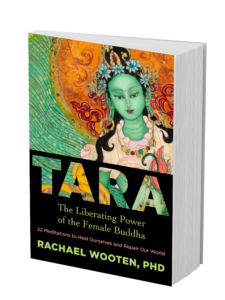
This is an adapted excerpt from Tara: The Liberating Power of the Female Buddha by Dr. Rachael Wooten.

rachael wooten

Rachael Wooten, PhD, is a Zürich—trained Jungian analyst and psychologist who has been in private practice as a therapist for more than 40 years. An enthusiastic interfaith activist, she has studied and practiced in Buddhist, Jewish, Christian, and indigenous traditions throughout her adult life.

Rachael has been mentored by spiritual teachers such as her Tibetan root guru Lodrö Tulku Rinpoche and Rabbi Zalman Schachter-Shalomi. She has taught Tara practices under the authorization of Lodrö Rinpoche for more than 20 years. Rachael has offered Tara workshops through the Resource Center for Women and Ministry in the South, ALEPH: Alliance for Jewish Renewal, and C. G. Jung Society of the Triangle. She currently teaches a monthly Tara meditation group at Pullen Memorial Baptist Church in her hometown of Raleigh, North Carolina. To learn more, visit rachaelwootenauthor.com.


tara 3d cover

Learn More

Sounds True | Amazon | Barnes & Noble | Bookshop | Indiebound

No Bad Parts

Richard “Dick” Schwartz earned his PhD in marriage and family therapy from Purdue University. He coauthored the most widely used family therapy text in the United States, Family Therapy: Concepts and Methods, and is the creator of the Internal Family Systems Model, which he developed in response to clients’ descriptions of various “parts” within themselves. With Sounds True, Dick has written a new book titled No Bad Parts: Healing Trauma and Restoring Wholeness with the Internal Family Systems Model. In this episode of Insights at the Edge, Tami Simon talks to Dick about the transformation that occurs when we welcome every part of who we are. He explains that even our most destructive parts have protective intentions, put in place to shield us from unprocessed pain, and details his method for accessing and mending these inner wounds. They also discuss the myth of the “mono mind,” and why the mind is naturally multiple; how “exiled” trauma can manifest as bodily pain; connecting with our core Self and letting it lead us in our healing; and how the language of “parts” can be useful in our relationship dynamics.

E1: Living From a Deeper Part of Your Being

What do you truly want? Wealth? Recognition? A perfect relationship? At our core, reflects Michael Singer, what we really want is to be happy: to dwell in a place of joy, love, and freedom from fear. In this episode, he shows how our thoughts and emotions lead us astray with solutions and goals… and how to experience the deeper, complete part of our being that transcends both external events and the misguided perceptions and tendencies of the mind.

For more information, go to michaelsingerpodcast.com. 
© Sounds True Inc. Episodes: © 2024 Michael A. Singer. All Rights Reserved.

Trauma Recovery and Post-Traumatic Growth

Dr. Arielle Schwartz is a clinical psychologist, author, teacher, and widely sought-out voice in the healing of trauma and complex trauma. She offers workshops for therapists on EMDR and somatic therapy, and maintains a private practice in Boulder, Colorado. She has written a book called The Post-Traumatic Growth Guidebook, and with Sounds True, has created a new audio teaching series called Trauma Recovery, A Mind-Body Approach to Becoming Whole. In this episode of Insights at the Edge, Tami Simon speaks with Arielle about reframing the narrative of trauma recovery to one of growth and meaning-making, rather than an effort to regain something we’ve lost. Arielle offers a look into different types of trauma, and explores how the body shapes itself around these wounds. She shares strategies for adapting to adversity and attending to trauma in ways that help victims return to a felt sense of safety within themselves. Finally, Tami and Arielle discuss how we can embrace the hero or heroine’s journey in our own lives as we grow from trauma.

Helping Someone with a Disorganized Attachment Style

You may not identify with the disorganized adaptation yourself, but perhaps people close to you live with this attachment style.

Clearly, this is not intended to serve as an end-all guide to helping these people (or anyone else, for that matter), but if you want to promote safety and secure relating in others, I highly recommend trying out the following habits. And if you’re a person of the disorganized style, I hope you’ll feel empowered to request the following practices from people you love:

Communicate simply and clearly.

As I illustrated at the beginning of this chapter, people with disorganized attachment often grew up in households with confusing mixed messages. For this reason, it’s important to be as clear and direct as possible in your speech, especially when it comes to instructions or directions, or when your partner or child seems stuck in indecision or confusion. This occurs most profoundly in the freeze state, when people can have trouble finding the right words, responding at all, or even forming basic thoughts. When this occurs, giving the disorganized person as few options as possible is the best idea. Even in a less-charged state, they might have trouble choosing where to go to dinner among a number of favorite restaurants, and under stress, it’s best to reduce any options down to two or three, max. Remember also to describe and explain things to children using age-appropriate concepts and language.

Be mindful of your tone of voice.

How we use our voice—especially the prosody, or tone of voice—communicates safety or danger to others. A melodic voice that employs fluid modulation and intonation fosters a sense of safety, whereas a monotone or robotic voice comes across as cold, uncaring, and in some cases, threatening. We often use a more musical tone of voice with babies and animals, our voice going up and down with affection in an exaggerated, singsong way. I’m not suggesting going around using the same type of voice with adults, but modulating your tone will certainly help when you’re speaking with others.

Think about how people’s voices change when they’re angry or feel endangered; that’s an evolutionary cue to the community that something’s wrong. When danger occurs, we are biologically and evolutionarily designed to shift our tone to alert the tribe. Women’s voices tend to become high-pitched and shrill, while men lower their tone and get louder, producing a booming voice. It immediately signals to other people that there is danger, that they should stop what they are doing and prepare to defend themselves. But when our voice does this under stress during a discussion or conflict with our partner—a relatively safe person (hopefully) whom we love—it can easily trigger their threat response, shifting them toward fighting or wanting to escape. So if you’re interested in reconciliation and a positive result for your relationship, it will benefit you to be mindful of how you use your voice. Practicing a calming, soothing, and well-modulated voice will reduce a sense of threat in your partner when you are trying to work out intimacy issues or relationship concerns. Shrill or booming, threat-stimulating voices will trigger our amygdala, or reptilian brain, that’s engaged in promoting survival responses, making our partner appear as an enemy rather than as our beloved.

Practice safe touch.

Using touch in a way that’s loving and conscious of another person’s boundaries also creates a feeling of safety. Physical touch amplifies anything we might be expressing verbally. In Snap: Making the Most of First Impressions, Body Language, and Charisma, Patti Wood says that we communicate regulation through regulated touch. That is, when we are regulated in our own body, we can convey physiological regulation even with a handshake. The key is to be centered and grounded in your own nervous system—within your own range of resiliency—before you employ touch in this way. Wood asserts that a simple, regulated handshake can offer more regulation than three hours of affirming, empowered conversation. Safe touch may help you and your partner regulate each other. Be mindful, however, that if your dysregulation is severe, it might be too much to touch another without dysregulating them. The chemistry or energy of your skin on theirs is communicated in a tangible way, so keep in mind the importance of taking time to establish your own regulation first if you can manage it. Think about how regulating hugs are when the other person is calm, loving, and safe. I’m not talking about those quick, pat-you-on-the-back kind of hugs, but the ones that involve bellies touching one another in a full-contact embrace. Try it with someone you feel close to. You can feel each other’s bodies regulating from this type of contact.

One technique I often use with clients is to begin by simply sitting next to the person. I feel what that’s like for a bit—getting a sense of their energy, so to speak—and allow them to get used to me. I ask if it is okay to place one of my palms near their back, between their shoulder blades, starting in their energy feld about three or four inches away from their skin, checking in with them to see how they’re doing. If that goes well, and they agree, I gently put my hand on their body and find the right amount of pressure—too much or too little can make a big difference. I also ask them to let me know where the best spot on their back is, and I shift my hand in response. By doing so, I am adjusting my contact in attunement with their request, so they have the experience of having their needs met as I convey safety, presence, and care. For ongoing support, we can teach our partners or family members to do this, too.

Look at others (and use facial expressions) with kindness.

How we use our face when we express ourself can also communicate a sense of safety to our partner. The eyes are of particular importance. Take the idea of what I call “the beam gleam.” It’s a soft, safe gaze you see between couples that display secure attachment. It involves a lot of eye contact, of course, but also a look that expresses appreciation, love, and a sense that the other person is special. As I mentioned, it’s important to invite this type of connection only when the person is available for it and not when they are dealing with shame, signaled by gaze aversion. Often their shame needs to be processed a bit before you can establish a nourishing connection with an attachment gaze. These nonverbal messages of connection and kindness really do trigger other people’s safety responses. Think about the difference in your partner’s face when they’re angry (scowling, tense) and when they’re happy to be with you (smiling, eyes wide and bright). People read your gaze and facial expressions all the time, even if they’re not conscious of it.

This is an excerpt from The Power of Attachment: How to Create Deep and Lasting Intimate Relationships by Diane Poole Heller, PhD.

Diane Poole Heller, Ph.D., is an established expert in the field of Child and Adult Attachment Theory and Models, trauma resolution, and integrative healing techniques. Diane developed her own signature series on Adult Attachment called DARe (Dynamic Attachment Re-patterning experience) also known as SATe (Somatic Attachment Training experience). Dr. Heller began her work with Dr. Peter Levine, founder of SETI (Somatic Experiencing® Trauma Institute) in 1989. As Senior Faculty for SETI, she taught Somatic Experiencing® trauma work internationally for over 25 years. As a dynamic speaker and teacher, Diane has been featured at prestigious international events and conferences. She is the author of numerous articles in the field.

Buy your copy of The Power of Attachment at your favorite bookseller!

Sounds True | Amazon | Barnes & Noble | Indiebound


Helping Someone with a Disorganized Attachment Style Pinterest

Frederic Laloux: The Adventure of Remaking Our World

The modern workplace is a source of so much pain in so many peoples’ lives. And with the extreme challenges facing humanity, it’s easy to understand the gloom-and-doom perspective that has become prevalent today. Frederic Laloux sees things differently. “I look at it from a place of adventure,” he tells us. “If we don’t have a lens of ‘these are times that are confusing and difficult’ we can see them instead as extraordinary times for us to learn and to grow as individuals.”

In this podcast, Tami Simon speaks with the renowned author of Reinventing Organizations about his life’s mission to transform our approach to business. Give a listen as Tami and Frederic discuss: becoming change makers at the systemic level; applying Ken Wilber’s Integral Model to the way we organize businesses; the “inner angle,” or the mindset and beliefs that we bring to any problem; societal leaps and the people who drive them; a polycrisis or a great adventure: how do you see it?; three cornerstones for the future of business: self-management, wholeness, and evolutionary purpose; creating fluid hierarchies at work; leadership that inspires and connects; the fundamental shift from predict and control to sense and respond (especially in these uncertain times); to budget or not to budget…; finding support and community during a “dark night of the soul”; bringing joy, pride, and courage to our social change activism; climate change and the concept of pluralistic ignorance; and more.

Note: This episode originally aired on Sounds True One, where these special episodes of Insights at the Edge are available to watch live on video and with exclusive access to Q&As with our guests. Learn more at join.soundstrue.com.