Busyness, distraction, and stress have all led to the shrinking of the modern mind.
I realize that’s a strange thing to say. Most of us don’t think of our mind as something with space in it, as a thing that can either be big or small, expensive or claustrophobic.
But just think about the last time you felt overwhelmed, stressed, or out of control. Chances are, you might not even have to think that hard. You might be experiencing that state right now as you read these words.
What happens in these moments?
First, our mind wanders. It spins through all sorts of random thoughts about the past and the future. As a result, we lose touch with the direct experience of present time.
Second, we lose perspective. We can’t see the big picture anymore. Instead, it’s like we’re viewing life through a long and narrow tunnel. We become blind to possibility, fixated on problems.
Put these two together and you’ve got the perfect recipe for eradicating space in the mind. The landscape of the mind begins to feel like a calendar jammed with so many meetings, events, and obligations that these neon colored boxes cover-up even the smallest slivers of white space.
So it could be nice for our partner, for our kids, and, mostly, for our ourselves to consider: how can we create more space in the mind?
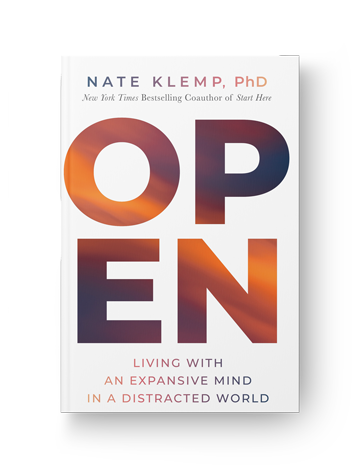
Here are five tools for creating mental space. If you want to go deeper, check out my new book with Sounds True on the topic called OPEN: Living With an Expansive Mind in a Distracted World.
1. Meditation.
You’ve no doubt heard about all of the scientifically validated benefits of this practice. It reduces stress. It boosts productivity. It enhances focus.
That is all true. But here is the real benefit of meditation: it creates more space in the mind. To get started, try it out for just a few minutes a day. Use an app or guided practice to help you.
2. Movement.
So, maybe you’re not the meditating type. That’s fine. You can still create space in the mind by setting aside time for undistracted movement.
The key word here is “undistracted.” For many of us, exercise and movement have become yet another time where our headspace gets covered over by texts, podcasts, or our favorite Netflix series.
There’s nothing wrong with this. But it can be powerful to leave the earbuds behind every once in a while and allow the mind to rest while you walk, stretch, run, bike, swim, or practice yoga.
3. Relax.
When it comes to creating headspace, we moderns, with our smartphone-flooded, overly-stimulated, minds seem to inevitably encounter a problem: we’re often too stressed, amped, and agitated to open.
Relaxation – calming the nervous system – is perhaps the best way to counter this effect and create more fertile ground for opening. When we relax – the real kind, not the Netflix or TikTok kind – the grip of difficult emotions loosens, the speed of our whirling thoughts slows, and, most important, the sense of space in our mind begins to expand.
How can you relax? Try yoga. Try extended exhale breathing, where you inhale four counts, exhale eight counts. Try yoga nidra. Or, just treat yourself to a nap.
4. See bigger.
When life gets crazy, the mind isn’t the only thing that shrinks. The size of our visual field also gets smaller. Our eyes strain. Our peripheral vision falls out of awareness.
What’s the antidote to this tunnel vision view? See bigger.
Try it right now. With a soft gaze, allow the edges of your visual field to slowly expand. Imagine you’re seeing whatever happens to be in front of you from the top of a vast mountain peak. Now bring this more expansive, panoramic, way of seeing with you for the rest of the day.
5. Do nothing.
Now for the most advanced practice. It’s advanced because it cuts against everything our culture believes in. In a world where everyone is trying desperately to get more done, one of the most radical acts is to not do — to do nothing.
Even just a few minutes of this paradoxical practice can help you experience an expansion of space in the mind.
Lie on the floor or outside on the grass. Close your eyes. Put on your favorite music if you want. Set an alarm for a few minutes so you don’t freak out too much.
Then, stop. Drop the technique. Drop the effort. Just allow yourself to savor this rare experience of doing absolutely nothing.
Nate Klemp, PhD, is a philosopher, writer, and mindfulness entrepreneur. He is the coauthor of the New York Times bestseller Start Here and the New York Times critics’ pick The 80/80 Marriage. His work has been featured in the LA Times, Psychology Today, the Times of London, and more, and his appearances include Good Morning America and Talks at Google. He’s a cofounder of LifeXT and founding partner at Mindful. For more, visit nateklemp.com or @Nate_Klemp on Instagram.
Nate Klemp, PhD, is a philosopher, writer, and mindfulness entrepreneur. He is the coauthor of the New York Times bestseller Start Here and the New York Times critics’ pick The 80/80 Marriage. His work has been featured in the LA Times, Psychology Today, the Times of London, and more, and his appearances include Good Morning America and Talks at Google. He’s a cofounder of LifeXT and founding partner at Mindful. For more, visit nateklemp.com or @Nate_Klemp on Instagram.
It’s not just you. Millions upon millions of people today are feeling more stressed, anxious, and overwhelmed than ever before. As a result, explains philosopher and writer Dr. Nate Klemp, a lot of us are contracting ourselves—closing our minds in an effort to shield ourselves from the constant noise of the 21st century. With his new book, Open, Nate explores possible solutions to help us shift into a life of expansiveness, creativity, and wonder.
Press the play button and join Tami Simon in conversation with this innovative and inspiring thinker, discussing: breaking free from screen addiction; the drivers of closure; the concept of “feast practice”; our need for novelty; an experiment that may shock you; the practice of staying; shifting from a wandering mind to “meta awareness”; how an open mind is synonymous with an open heart; overcoming separateness; noticing your “closure cues”; skillful closing; the intent to win versus the intent to understand; the portal of bliss and the portal of suffering; getting unstuck; letting go; and more.
Note: This episode originally aired on Sounds True One, where these special episodes of Insights at the Edge are available to watch live on video and with exclusive access to Q&As with our guests. Learn more at join.soundstrue.com.
Busyness, distraction, and stress have all led to the shrinking of the modern mind.
I realize that’s a strange thing to say. Most of us don’t think of our mind as something with space in it, as a thing that can either be big or small, expensive or claustrophobic.
But just think about the last time you felt overwhelmed, stressed, or out of control. Chances are, you might not even have to think that hard. You might be experiencing that state right now as you read these words.
What happens in these moments?
First, our mind wanders. It spins through all sorts of random thoughts about the past and the future. As a result, we lose touch with the direct experience of present time.
Second, we lose perspective. We can’t see the big picture anymore. Instead, it’s like we’re viewing life through a long and narrow tunnel. We become blind to possibility, fixated on problems.
Put these two together and you’ve got the perfect recipe for eradicating space in the mind. The landscape of the mind begins to feel like a calendar jammed with so many meetings, events, and obligations that these neon colored boxes cover-up even the smallest slivers of white space.
So it could be nice for our partner, for our kids, and, mostly, for our ourselves to consider: how can we create more space in the mind?
Here are five tools for creating mental space. If you want to go deeper, check out my new book with Sounds True on the topic called OPEN: Living With an Expansive Mind in a Distracted World.
1. Meditation.
You’ve no doubt heard about all of the scientifically validated benefits of this practice. It reduces stress. It boosts productivity. It enhances focus.
That is all true. But here is the real benefit of meditation: it creates more space in the mind. To get started, try it out for just a few minutes a day. Use an app or guided practice to help you.
2. Movement.
So, maybe you’re not the meditating type. That’s fine. You can still create space in the mind by setting aside time for undistracted movement.
The key word here is “undistracted.” For many of us, exercise and movement have become yet another time where our headspace gets covered over by texts, podcasts, or our favorite Netflix series.
There’s nothing wrong with this. But it can be powerful to leave the earbuds behind every once in a while and allow the mind to rest while you walk, stretch, run, bike, swim, or practice yoga.
3. Relax.
When it comes to creating headspace, we moderns, with our smartphone-flooded, overly-stimulated, minds seem to inevitably encounter a problem: we’re often too stressed, amped, and agitated to open.
Relaxation – calming the nervous system – is perhaps the best way to counter this effect and create more fertile ground for opening. When we relax – the real kind, not the Netflix or TikTok kind – the grip of difficult emotions loosens, the speed of our whirling thoughts slows, and, most important, the sense of space in our mind begins to expand.
How can you relax? Try yoga. Try extended exhale breathing, where you inhale four counts, exhale eight counts. Try yoga nidra. Or, just treat yourself to a nap.
4. See bigger.
When life gets crazy, the mind isn’t the only thing that shrinks. The size of our visual field also gets smaller. Our eyes strain. Our peripheral vision falls out of awareness.
What’s the antidote to this tunnel vision view? See bigger.
Try it right now. With a soft gaze, allow the edges of your visual field to slowly expand. Imagine you’re seeing whatever happens to be in front of you from the top of a vast mountain peak. Now bring this more expansive, panoramic, way of seeing with you for the rest of the day.
5. Do nothing.
Now for the most advanced practice. It’s advanced because it cuts against everything our culture believes in. In a world where everyone is trying desperately to get more done, one of the most radical acts is to not do — to do nothing.
Even just a few minutes of this paradoxical practice can help you experience an expansion of space in the mind.
Lie on the floor or outside on the grass. Close your eyes. Put on your favorite music if you want. Set an alarm for a few minutes so you don’t freak out too much.
Then, stop. Drop the technique. Drop the effort. Just allow yourself to savor this rare experience of doing absolutely nothing.
Nate Klemp, PhD, is a philosopher, writer, and mindfulness entrepreneur. He is the coauthor of the New York Times bestseller Start Here and the New York Times critics’ pick The 80/80 Marriage. His work has been featured in the LA Times, Psychology Today, the Times of London, and more, and his appearances include Good Morning America and Talks at Google. He’s a cofounder of LifeXT and founding partner at Mindful. For more, visit nateklemp.com or @Nate_Klemp on Instagram.
Is a spiritual awakening only real if it completely rearranges your life? That’s the question Tami Simon puts to Adyashanti in this episode, and his answer digs into something a lot of seekers wrestle with: the gap between a powerful glimpse of clarity and the ongoing work of actually living from it.
Adya, the American-born teacher behind books like The End of Your World and Falling into Grace, walks through why those temporary tastes of awakening are real, even when they fade, and offers a surprisingly practical way to hold onto what they revealed without grasping at them. Then he does something rare: he tells the story of his own first major awakening, a moment he describes as feeling like a nuclear explosion going off inside him.
Here’s what we cover:
Why a fleeting shift still counts as a real awakening, even if it doesn’t stick
The two (seemingly contradictory) pieces of advice Adya gives people chasing a past peak experience
How the first awakening can feel like a “freebie,” while everything after asks you to participate consciously
Adya’s own account of the night everything fell away and the still, small voice that told him, “This isn’t all of it. Keep going.”
What if aging isn’t the slow closing of your erotic life, but the doorway into its most alive season?
This week, Tami Simon speaks with Kimberly Ann Johnson—sexological body worker, somatic experiencing practitioner, birth doula, and author of the new Sounds True book Erotic Seasons: Tuning In to the Rhythms of Women’s Sexuality and Spirituality—about what she calls erotic sovereignty, and the sentence that closes her book: the female body is its own spiritual path.
Join Tami and Kimberly to explore:
Erotic sovereignty—your relationship to your own life force, and why it stays with you across every season
Why the goal isn’t a more regulated nervous system, but a more responsive one, and what it means to run more charge
The four erotic seasons—maiden, mother, virgin, crone—and the surprising reason virgin comes after mother
Why hormonal transitions are “wet clay”: golden opportunities for repatterning that our culture teaches us to rush past
Menopause as a death rehearsal, and the life review that arrives decades before we expect it
Hot sex and warm sex—widening the range beyond adrenaline, and learning the language of the pause
“Hormones are gods”: the collective endocrine system, and why living intergenerationally may be the original hormone therapy
Becoming a sexual alchemist—arousal as healing energy, and why care is the whole ethic
Whether you are 25 or 75, Kimberly offers a map for meeting your body’s changes as thresholds rather than losses.
Please note: this episode includes candid discussion of sexual abuse and sexual wounding, including Kimberly Ann Johnson’s own experience.
Listen now, and meet your body as the path. →
This conversation offers genuine transmission, not just concepts about awakening, but the palpable presence of realized teachers exploring the growing edge of spiritual understanding together, and it originally aired on Sounds True One.
What if the very thing that wounded you is the source of the medicine you’re here to give?
In this month’s Point of Insight, Tami Simon shares a personal story: minutes before going live with an archetypal astrologer, she was told—correctly, and within seconds—that she carried “the mother of all mother wounds.” That single moment became the culmination of a much longer, gradual unfolding: a lifetime’s worth of “drops,” from a mentor she called the Queen of the Reframe, to an interview with yoga teacher and activist Seane Corn titled “Your Pain Is Your Purpose,” to an email from a business coach whose four simple words reframed everything—your karma is your dharma.
Join Tami as she reflects on:
How a lifelong feeling of not belonging became the soil for a life’s work helping others feel connected
The difference between sudden insight and the slow, gradual “boiling water” of a tipping point
Why real breakthrough requires going all the way through pain, not around it
Joanna Macy’s question—”What breaks your heart?”—and how grief and care become fuel for service
Why “never turn away” may be one of the most important spiritual instructions there is
This is a shorter, solo reflection from Tami—released once a month on the Insights at the Edge feed—on where our deepest wounds and our clearest purpose meet.