Making the darkness conscious

    —
January 12, 2015

Much is being said these days about spiritual awakening, and the causeless joy, clarity, and peace that are inevitable milestones of the inner journey. Not all that much is mentioned, however, about the disappointment of awakening, or of the ways it can break our hearts, cracking us open to the reality of the crucifixion, the resurrection, *and* the transfiguration we are likely to encounter along the way. In the full embrace of life—right inside the yucky, messy, shadowy nether regions of the heart—we are invited to meet the wholeness of what we are, which includes the dark *and* the light, the movement of separation *and* union, and the entirety of what it means to be an embodied human being.

As Carl Jung so poignantly reminds us, we do not become enlightened by “imagining figures of light, but by making the darkness conscious.” He went on to say that the integral journey of the dark *and* the light is one that is often “disagreeable” and thus would never be popular. I believe Jung is offering very important guidance for us and the voyage of the heart in contemporary times.

The ancient path of love may never conform to our hopes, fears, dreams, and fantasies, for it is emerging in the here and now as an emissary of the unknown itself. Let us rest in the aching truth that one of the primary roles of the beloved is to seed deflation in the field of separation. Yes, awakening may always be a disappointment, from the perspective of egoic organization. In this sense, the journey is eternally hopeless, but it is in the creation of a home for our hopelessness—and allowing it to be illuminated within us—that we are finally able to step into a world beyond our wildest imagination.

As we journey together as fellow travelers, let us find a way to embrace both the joy *and* the heartbreak of spiritual awakening, and bear witness to the wisdom shining out of our immediate experience, whether it appears as sadness, bliss, despair, or great joy. It is true that grace will appear in both sweet *and* fierce forms, but regardless of its particular manifestation, it is still grace, sent from beyond to open us to the radiant fullness of being.

– Matt Licata, from the Preface to the forthcoming, It’s Okay to Be Broken: Embracing the Joy and Heartbreak of Spiritual Awakening.

sunset_itsokay

Matt Licata

Matt Licata, PhD, is a practicing psychotherapist and hosts in-person retreats. His work incorporates developmental, psychoanalytic, and depth psychologies, as well as contemplative, meditative, and mindfulness-based approaches for transformation and healing. He co-facilitates a monthly online membership community called Befriending Yourself, is author of The Path Is Everywhere, and is the creator of the blog A Healing Space. He lives in Boulder, Colorado. For more, visit mattlicataphd.com.

Author photo © Krista Marleena

Listen to Tami Simon's in-depth audio podcast interview with Matt Licata:

The Alchemy Of Befriending Ourselves In Difficult Times  »

Also By Author

The Simple Magic of a Book

One of the gifts of isolation, solitude, and social distancing is the opportunity to reconnect with pieces of soul and strands of vision that have become lost in the busyness of our ordinary lives.

Reading for many has become a lost art. We can become so used to turning on the news, scrolling through Facebook, becoming lost in hours of YouTube or Netflix, or fused with one electronic device or another. Nothing wrong with any of these, but at times an alternative portal will open.

To take a book and find a place within your home or under a tree or out in the park and go on a pilgrimage with it. Ask the stars to help you to find a place to just be for a while and open to revelation.

It need not be a “spiritual” book, though of course those are fine, too. A book of poetry, a novel, a book of art history, or of mythology.

Allow its images to come alive, its metaphors, its characters… step into the poetic landscape with the figures and enter a state of receptivity and play. Sense what they are sensing, feel what they are feeling as these correspond with the internal others dancing within you.

healing space blog graphic

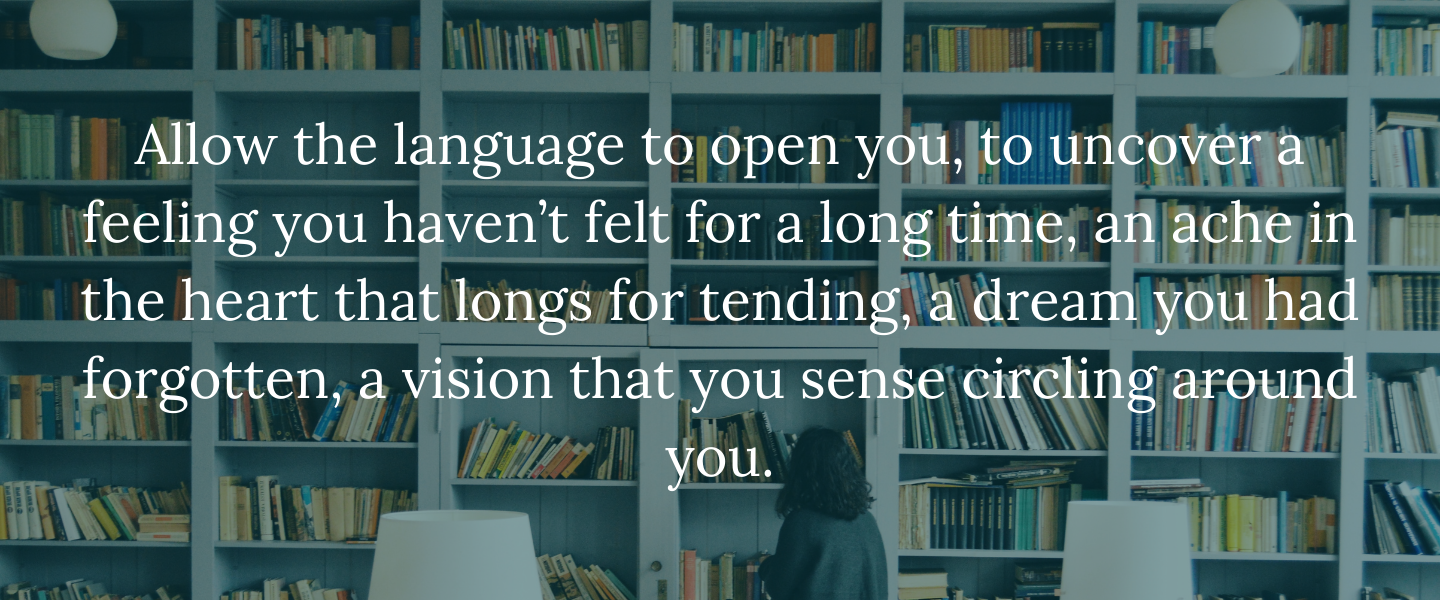
Not necessarily reading for “information,” but for communion. Allow the language to open you, to uncover a feeling you haven’t felt for a long time, an ache in the heart that longs for tending, a dream you had forgotten, a vision that you sense circling around you.

Read a paragraph or two and close the book. Enter the interactional field – with the natural world, with the visions, figures, moods, feelings, and images that seek your attention, your curiosity, your care, and just a moment of your being-ness.

We can so easily forget the magic of this place, of the imaginal realms, of those liminal places in between the physical world of matter and the transcendental realm of pure spirit. In the liminal we can dance and play and see and perceive and sense and intuit something holy.

A good book can help us do this, can serve as a companion as we step into uncharted territory.

Reading has been such an important part of my life. My books are my friends, lovers, allies, guides, and they also challenge me, break me open, tenderize and marinate me in the Unknown. They reveal how little I know about this world, this soul, this heart, this place, and the unique opportunity to be here. I find this so lifegiving.

I fantasize that perhaps in other worlds there are no books. That is sad to think about. For me, at least.

This blog post originally appeared on Matt Licata’s blog, A Healing Space. Redistributed with permission.

matt licataMatt Licata, PhD, is a practicing psychotherapist and hosts in-person retreats. His work incorporates developmental, psychoanalytic, and depth psychologies, as well as contemplative, meditative, and mindfulness-based approaches for transformation and healing. He co-facilitates a monthly online membership community called Befriending Yourself, is author of The Path Is Everywhere, and is the creator of the blog A Healing Space. He lives in Boulder, Colorado. For more, visit mattlicataphd.com.


Healing Space

Learn More

Sounds True | Amazon | Barnes & Noble | Bookshop | Indiebound

Why We Need To Live the Full Spectrum of Human Experie...

Metabolizing Experience

In order to know and befriend ourselves at the deepest levels, one of the core foundations for true healing, we must cultivate a new way of relating with ourselves that allows even our most difficult and challenging experience to disclose its meaning, intelligence, and purpose in our lives. To do this, we have to slow down and shift our relationship from one of thinking about our experience to fully embodying it. We have to allow ourselves to truly touch it and be touched by it rather than merely orbiting around it, where we are sure to continue to feel some degree of disconnection. Just as we must properly digest the food we eat to absorb its nutrients, we must also assimilate our experience to receive the wisdom and sacred data within it. All through the day and night, we are receiving impressions—through our mental, emotional, somatic (i.e., body-based), imaginal, and spiritual bodies. Life is a constant stream of experience—conversations with friends, caring for our kids, cooking a meal, wandering in nature, practicing yoga or meditation, engaging our work and creative projects, reading a book, shopping for groceries, running errands. But to what degree are we experiencing all of this? How present are we to our moment-to-moment experience, embodied and engaged, allowing it to penetrate us, where it can become true experience and not just some passing event? To what degree are we on autopilot as we make our way through the day, only partially connecting with our friends and family and engaging the sensory reality of what we see, hear, smell, taste, and touch?

I’m pointing toward a way of “metabolizing” our experience that allows us to touch and engage it at the most subtle levels, where it is able to disclose its qualities, intelligence, and purpose. By evoking “metabolization,” I am making use of a biological process in a metaphorical way to refer to working through and integrating our experience, especially those thoughts, feelings, sensations, and parts of ourselves that historically we have pushed away. Other words from the biological sciences, for example “digestion,” “absorption,” or “assimilation” can be used to point to the same idea, indicating that it requires concentration, attention, and a certain fire or warmth to “make use” of our experience and mine the “nutrients” contained within it.

Just because we “have” an experience does not mean we properly digest and absorb it. If our emotional and sensory experience remain partly processed, they become leaky (a psychic version, if you will, of “leaky gut syndrome”) and unable to provide the fuel required to live a life of intimacy, connection, and spontaneity. This inner psychic situation is analogous to not properly chewing and breaking down the food we eat and thus not being able to mine the energy and nutrients our bodies need to function optimally.

Although the desire for change and transformation is natural, noble, and worthy of our honor and attention, if we are not careful, it can serve as a powerful reminder and expression of the painful realities of materialism and self-abandonment. One of the shadow sides of spiritual seeking and the (seemingly) endless project of self-improvement is that we never slow down enough to digest what we have already been given, often much more than we consciously realize. In some sense, most of us have been given everything in terms of the basic alchemical prima materia required to live a life of integrity and inner richness, but not the “everything” the mind thinks it needs to be happy and fulfilled, found by way of a journey of internal and external consumerism. And not the “everything” that conforms to our hopes, fears, and dreams of power and control and that keeps us consistently safe and protected from the implications of what it means to have a tender (and breakable) human heart, but the “everything” already here as part of our true nature, the raw materials for a life of inner contentment and abundance, revealed by way of slowness and humility, not unconscious acquisition.

It is important to remember that for most of us, healing happens gradually, slowly, over time when we begin to perceive ourselves and our lives in a new way. Each micro-moment of new insight, understanding, and perspective must be integrated and digested on its own, honored and tended to with curiosity, care, and attention. Before we “move forward” to the next moment, we must fully apprehend and open our hearts to this one; this slow tending (metabolization) is one of the true essences of a lasting, transformative, and deep healing. If we are not able to metabolize even our most intense and disturbing experience, we will remain in opposition to it, at subtle war with it, and not able to be in relationship with it as a healing ally.

In Tibetan tradition, there is an image of the hungry ghost, a figure of the imaginal realms with a large, distended belly and tiny mouth. No matter how much food (experience) is consumed, there is a deep ache and longing for more. Regardless of how much is taken in, the ghost retains an insatiable hunger. Because this one is not able to digest, make use of, or enjoy what is given, a primordial hole is left behind that can never seem to be filled. One invitation, as this image appears in our own lives, is to slow way down and send awareness and compas- sion directly into the hole, infusing it with presence and warmth, and finally tend to what is already here, not what is missing and might come one day in the future by way of further procurement.

Just as with food—choosing wisely, chewing mindfully, allowing ourselves to taste the bounty of what is being offered, and stopping before we are full—we can honor the validity, workability, and intelligence of our inner experience, even if it is difficult or disturbing. The willingness to fully digest our own vulnerability, tenderness, confusion, and suffering is an act of love and fierce, revolutionary kindness. There are soul nutrients buried in the food of our embodied experience that yearn to be integrated, metabolized, and assimilated in the flame of the heart. But this digestion requires the enzymes of presence, embodi- ment, compassion, and curiosity about what is here now.

Let us slow down and become mindful of the ways we seek to fill the empty hole in the center, whether it be with food when we’re not hungry or experience when we are already full. And in this way, we can walk lightly together in this world, on this precious planet, not as hungry ghosts desperate to be fed but as kindred travelers of interior wealth, richness, and meaning.

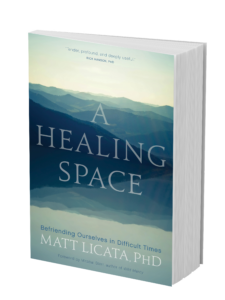
This is an excerpt from A Healing Space: Befriending Ourselves in Difficult Times by Matt Licata, PhD.
Matt LicataMatt Licata, PhD, is a practicing psychotherapist and hosts in-person retreats. His work incorporates developmental, psychoanalytic, and depth psychologies, as well as contemplative, meditative, and mindfulness-based approaches for transformation and healing. He co-facilitates a monthly online membership community called Befriending Yourself, is author of The Path Is Everywhere, and is the creator of the blog A Healing Space. He lives in Boulder, Colorado. For more, visit mattlicataphd.com.


Healing Space

Learn More

Sounds True | Amazon | Barnes & Noble | Bookshop | Indiebound

Matt Licata, PhD: The Alchemy of Befriending Ourselves...

Matt Licata is a practicing psychotherapist, a co-facilitator of a monthly online membership community called Befriending Yourself, and the author of The Path Is Everywhere. With Sounds True, he has written a new book titled, A Healing Space: Befriending Ourselves in Difficult Times. In this episode of Insights at the Edge, Tami Simon speaks with Matt about what it is to be a healing space, that is to hold space for ourselves and others, as well as how we can feel held by something greater than ourselves during challenging experiences. They also explore our inner wounds and self-abandonment, spiritual bypassing and the ways in which many practices allow us to gloss over the real healing needed, and how coming into an embodied state can open us to greater inner depths. Finally, Tami and Matt discuss becoming an alchemist of your own life, discovering the inner gold that each of us has within, and befriending all of ourselves.

You Might Also Enjoy

Just One Question | Osho Zenju Earthlyn Manuel: How Ca...

When we heard Osho Zenju Earthlyn Manuel share her story of a terrifying night she couldn’t breathe, it was eerily similar to a personal experience—and helpful too. We knew we had to share this moment from her conversation with Tami Simon on Insights at the Edge, in which she tells the story of the night she nearly died from a severe anaphylactic reaction and how she got through it not by searching for light at the end of the tunnel, but by staying present with the darkness itself. 

Zenju, a poet and ordained Zen Buddhist priest, challenges the instinct most of us have to fear darkness, rush out of it, or wait for a gift on the other side. Instead, she describes an experience of profound non-struggle — a moment of near-death where she wasn’t afraid, didn’t fight, and somehow found a way to keep breathing by trusting her body completely.

Key themes from this episode:

  • Why darkness — and even light — may be far more unknown and unknowable than we assume
  • How struggling against a frightening experience can make it worse, while staying present with it can be transformative
  • A firsthand account of surviving a full-blown anaphylactic shock without fear
  • Rethinking our cultural instinct to rush ourselves and others out of difficult emotional or physical states
  • Why “the absence of light” might be less about despair and more about a different kind of awakening

Taken from the full Insights at the Edge conversation with Zenju Earthlyn Manuel “Opening to Darkness,” which is also the title of her book. Find the complete interview in this feed or at soundstrue.com.

This episode is sponsored by Omega Institute, a global gathering hub for lifelong learning and spiritual exploration. Omega offers weekend workshops, special events, rest and rejuvenation retreats, professional training, online learning, and more. Discover what calls to you at eomega.org/true.

Michael A. Singer: The Pain That Ends All Pain


What if the pain you’ve been avoiding is actually the thing that could set you free?

This week, Tami Simon speaks with Michael A. Singer, beloved wisdom teacher, founder of the Temple of the Universe, and author of The Untethered Soul, The Surrender Experiment, Living Untethered, and his newest book, Wisdom Untethered: The Time for Questions. Drawn from 1,200 reader questions distilled into 200 essential ones, the conversation keeps returning to a single teaching Michael once received from a saint: “It’s the pain that ends all pain.”

Join Tami and Michael to explore:

  • Why “letting go” is an inner practice, not spiritual bypassing or passivity
  • What samskaras are, and why blocked energy, not memory, is the real source of inner darkness
  • Why the willingness to feel disturbance, rather than suppress it, is the actual path of purification
  • The practice of “falling behind” resistance, and other techniques for letting stuck energy move and release
  • The difference between preferences and fears, and why the Buddha named preference as the root of suffering
  • How to face real-world injustice with clarity instead of ego-driven reactivity
  • Why the true motive of spiritual practice is simply to let go of what’s in the way

Whether you’ve read The Untethered Soul a dozen times or are new to Michael’s teachings, this conversation offers both the practical tools and the felt experience of what it means to stop blocking the shakti that’s already flowing within you.

Listen now, and discover why the pain you’ve been running from might be exactly what ends it. →

This conversation offers genuine transmission, not just concepts about awakening, but the palpable presence of realized teachers exploring the growing edge of spiritual understanding together, and originally aired on Sounds True One.

Insights at the Edge is supported by Magic Hour, whose ceremonial teas carry more presence, beauty, and ritual into ordinary days. Magic Hour draws its leaves and botanicals from regenerative small farms around the world, in blends made to nourish the body and open the mind.

Explore their teas, matchas, and herbal rituals at clubmagichour.com. Get 20% off your first order with the code TRUE.

Just One Question | Connie Zweig: What Does It Mean to...

You know the object of your addiction is bad for you. So why can’t you stop? Dr. Connie Zweig has spent decades working with people who feel stuck in exactly that gap between knowing and changing.

Zweig is a retired Jungian therapist and the author of the newly republished Meeting the Shadow and Romancing the Shadow — the books that helped launch the shadow-work movement, and the reason a new generation is now discovering it on TikTok.

In this clip, she walks Tami through her method step by step, using the story of a client who couldn’t stop eating ice cream every night while waiting for an unavailable boyfriend to call. Awareness alone, Zweig explains, is never enough. You have to name the shadow character, trace it back to where it was first modeled, and uncover the valid need hiding underneath it.

What you’ll take away from this clip:

  • Why awareness of a compulsive pattern rarely changes it on its own
  • How to identify a “shadow character” through its recurring thoughts, feelings, and body sensations
  • Why every addictive or compulsive behavior is protecting a valid, hidden need
  • Zweig’s own story of discovering her “judge” shadow character — inherited from her father

This clip is taken from the full Insights at the Edge conversation with Connie Zweig: “Meeting One of the World’s Leading Experts on the Shadow.” 

This episode is sponsored by Omega Institute, a global gathering hub for lifelong learning and spiritual exploration. Omega offers weekend workshops, special events, rest and rejuvenation retreats, professional training, online learning, and more. Discover what calls to you at eomega.org/true.

Leave a Reply

Your email address will not be published. Required fields are marked *