Why We Need To Live the Full Spectrum of Human Experience

    —
November 24, 2020

Metabolizing Experience

In order to know and befriend ourselves at the deepest levels, one of the core foundations for true healing, we must cultivate a new way of relating with ourselves that allows even our most difficult and challenging experience to disclose its meaning, intelligence, and purpose in our lives. To do this, we have to slow down and shift our relationship from one of thinking about our experience to fully embodying it. We have to allow ourselves to truly touch it and be touched by it rather than merely orbiting around it, where we are sure to continue to feel some degree of disconnection. Just as we must properly digest the food we eat to absorb its nutrients, we must also assimilate our experience to receive the wisdom and sacred data within it. All through the day and night, we are receiving impressions—through our mental, emotional, somatic (i.e., body-based), imaginal, and spiritual bodies. Life is a constant stream of experience—conversations with friends, caring for our kids, cooking a meal, wandering in nature, practicing yoga or meditation, engaging our work and creative projects, reading a book, shopping for groceries, running errands. But to what degree are we experiencing all of this? How present are we to our moment-to-moment experience, embodied and engaged, allowing it to penetrate us, where it can become true experience and not just some passing event? To what degree are we on autopilot as we make our way through the day, only partially connecting with our friends and family and engaging the sensory reality of what we see, hear, smell, taste, and touch?

I’m pointing toward a way of “metabolizing” our experience that allows us to touch and engage it at the most subtle levels, where it is able to disclose its qualities, intelligence, and purpose. By evoking “metabolization,” I am making use of a biological process in a metaphorical way to refer to working through and integrating our experience, especially those thoughts, feelings, sensations, and parts of ourselves that historically we have pushed away. Other words from the biological sciences, for example “digestion,” “absorption,” or “assimilation” can be used to point to the same idea, indicating that it requires concentration, attention, and a certain fire or warmth to “make use” of our experience and mine the “nutrients” contained within it.

Just because we “have” an experience does not mean we properly digest and absorb it. If our emotional and sensory experience remain partly processed, they become leaky (a psychic version, if you will, of “leaky gut syndrome”) and unable to provide the fuel required to live a life of intimacy, connection, and spontaneity. This inner psychic situation is analogous to not properly chewing and breaking down the food we eat and thus not being able to mine the energy and nutrients our bodies need to function optimally.

Although the desire for change and transformation is natural, noble, and worthy of our honor and attention, if we are not careful, it can serve as a powerful reminder and expression of the painful realities of materialism and self-abandonment. One of the shadow sides of spiritual seeking and the (seemingly) endless project of self-improvement is that we never slow down enough to digest what we have already been given, often much more than we consciously realize. In some sense, most of us have been given everything in terms of the basic alchemical prima materia required to live a life of integrity and inner richness, but not the “everything” the mind thinks it needs to be happy and fulfilled, found by way of a journey of internal and external consumerism. And not the “everything” that conforms to our hopes, fears, and dreams of power and control and that keeps us consistently safe and protected from the implications of what it means to have a tender (and breakable) human heart, but the “everything” already here as part of our true nature, the raw materials for a life of inner contentment and abundance, revealed by way of slowness and humility, not unconscious acquisition.

It is important to remember that for most of us, healing happens gradually, slowly, over time when we begin to perceive ourselves and our lives in a new way. Each micro-moment of new insight, understanding, and perspective must be integrated and digested on its own, honored and tended to with curiosity, care, and attention. Before we “move forward” to the next moment, we must fully apprehend and open our hearts to this one; this slow tending (metabolization) is one of the true essences of a lasting, transformative, and deep healing. If we are not able to metabolize even our most intense and disturbing experience, we will remain in opposition to it, at subtle war with it, and not able to be in relationship with it as a healing ally.

In Tibetan tradition, there is an image of the hungry ghost, a figure of the imaginal realms with a large, distended belly and tiny mouth. No matter how much food (experience) is consumed, there is a deep ache and longing for more. Regardless of how much is taken in, the ghost retains an insatiable hunger. Because this one is not able to digest, make use of, or enjoy what is given, a primordial hole is left behind that can never seem to be filled. One invitation, as this image appears in our own lives, is to slow way down and send awareness and compas- sion directly into the hole, infusing it with presence and warmth, and finally tend to what is already here, not what is missing and might come one day in the future by way of further procurement.

Just as with food—choosing wisely, chewing mindfully, allowing ourselves to taste the bounty of what is being offered, and stopping before we are full—we can honor the validity, workability, and intelligence of our inner experience, even if it is difficult or disturbing. The willingness to fully digest our own vulnerability, tenderness, confusion, and suffering is an act of love and fierce, revolutionary kindness. There are soul nutrients buried in the food of our embodied experience that yearn to be integrated, metabolized, and assimilated in the flame of the heart. But this digestion requires the enzymes of presence, embodi- ment, compassion, and curiosity about what is here now.

Let us slow down and become mindful of the ways we seek to fill the empty hole in the center, whether it be with food when we’re not hungry or experience when we are already full. And in this way, we can walk lightly together in this world, on this precious planet, not as hungry ghosts desperate to be fed but as kindred travelers of interior wealth, richness, and meaning.

This is an excerpt from A Healing Space: Befriending Ourselves in Difficult Times by Matt Licata, PhD.
Matt LicataMatt Licata, PhD, is a practicing psychotherapist and hosts in-person retreats. His work incorporates developmental, psychoanalytic, and depth psychologies, as well as contemplative, meditative, and mindfulness-based approaches for transformation and healing. He co-facilitates a monthly online membership community called Befriending Yourself, is author of The Path Is Everywhere, and is the creator of the blog A Healing Space. He lives in Boulder, Colorado. For more, visit mattlicataphd.com.
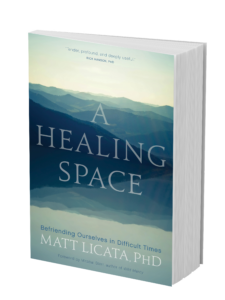


Healing Space

Learn More

Sounds True | Amazon | Barnes & Noble | Bookshop | Indiebound

Matt Licata

Matt Licata, PhD, is a practicing psychotherapist and hosts in-person retreats. His work incorporates developmental, psychoanalytic, and depth psychologies, as well as contemplative, meditative, and mindfulness-based approaches for transformation and healing. He co-facilitates a monthly online membership community called Befriending Yourself, is author of The Path Is Everywhere, and is the creator of the blog A Healing Space. He lives in Boulder, Colorado. For more, visit mattlicataphd.com.

Author photo © Krista Marleena

Listen to Tami Simon's in-depth audio podcast interview with Matt Licata:

The Alchemy Of Befriending Ourselves In Difficult Times  »

Also By Author

The Simple Magic of a Book

One of the gifts of isolation, solitude, and social distancing is the opportunity to reconnect with pieces of soul and strands of vision that have become lost in the busyness of our ordinary lives.

Reading for many has become a lost art. We can become so used to turning on the news, scrolling through Facebook, becoming lost in hours of YouTube or Netflix, or fused with one electronic device or another. Nothing wrong with any of these, but at times an alternative portal will open.

To take a book and find a place within your home or under a tree or out in the park and go on a pilgrimage with it. Ask the stars to help you to find a place to just be for a while and open to revelation.

It need not be a “spiritual” book, though of course those are fine, too. A book of poetry, a novel, a book of art history, or of mythology.

Allow its images to come alive, its metaphors, its characters… step into the poetic landscape with the figures and enter a state of receptivity and play. Sense what they are sensing, feel what they are feeling as these correspond with the internal others dancing within you.

healing space blog graphic

Not necessarily reading for “information,” but for communion. Allow the language to open you, to uncover a feeling you haven’t felt for a long time, an ache in the heart that longs for tending, a dream you had forgotten, a vision that you sense circling around you.

Read a paragraph or two and close the book. Enter the interactional field – with the natural world, with the visions, figures, moods, feelings, and images that seek your attention, your curiosity, your care, and just a moment of your being-ness.

We can so easily forget the magic of this place, of the imaginal realms, of those liminal places in between the physical world of matter and the transcendental realm of pure spirit. In the liminal we can dance and play and see and perceive and sense and intuit something holy.

A good book can help us do this, can serve as a companion as we step into uncharted territory.

Reading has been such an important part of my life. My books are my friends, lovers, allies, guides, and they also challenge me, break me open, tenderize and marinate me in the Unknown. They reveal how little I know about this world, this soul, this heart, this place, and the unique opportunity to be here. I find this so lifegiving.

I fantasize that perhaps in other worlds there are no books. That is sad to think about. For me, at least.

This blog post originally appeared on Matt Licata’s blog, A Healing Space. Redistributed with permission.

matt licataMatt Licata, PhD, is a practicing psychotherapist and hosts in-person retreats. His work incorporates developmental, psychoanalytic, and depth psychologies, as well as contemplative, meditative, and mindfulness-based approaches for transformation and healing. He co-facilitates a monthly online membership community called Befriending Yourself, is author of The Path Is Everywhere, and is the creator of the blog A Healing Space. He lives in Boulder, Colorado. For more, visit mattlicataphd.com.


Healing Space

Learn More

Sounds True | Amazon | Barnes & Noble | Bookshop | Indiebound
Why We Need To Live the Full Spectrum of Human Experie...

Metabolizing Experience

In order to know and befriend ourselves at the deepest levels, one of the core foundations for true healing, we must cultivate a new way of relating with ourselves that allows even our most difficult and challenging experience to disclose its meaning, intelligence, and purpose in our lives. To do this, we have to slow down and shift our relationship from one of thinking about our experience to fully embodying it. We have to allow ourselves to truly touch it and be touched by it rather than merely orbiting around it, where we are sure to continue to feel some degree of disconnection. Just as we must properly digest the food we eat to absorb its nutrients, we must also assimilate our experience to receive the wisdom and sacred data within it. All through the day and night, we are receiving impressions—through our mental, emotional, somatic (i.e., body-based), imaginal, and spiritual bodies. Life is a constant stream of experience—conversations with friends, caring for our kids, cooking a meal, wandering in nature, practicing yoga or meditation, engaging our work and creative projects, reading a book, shopping for groceries, running errands. But to what degree are we experiencing all of this? How present are we to our moment-to-moment experience, embodied and engaged, allowing it to penetrate us, where it can become true experience and not just some passing event? To what degree are we on autopilot as we make our way through the day, only partially connecting with our friends and family and engaging the sensory reality of what we see, hear, smell, taste, and touch?

I’m pointing toward a way of “metabolizing” our experience that allows us to touch and engage it at the most subtle levels, where it is able to disclose its qualities, intelligence, and purpose. By evoking “metabolization,” I am making use of a biological process in a metaphorical way to refer to working through and integrating our experience, especially those thoughts, feelings, sensations, and parts of ourselves that historically we have pushed away. Other words from the biological sciences, for example “digestion,” “absorption,” or “assimilation” can be used to point to the same idea, indicating that it requires concentration, attention, and a certain fire or warmth to “make use” of our experience and mine the “nutrients” contained within it.

Just because we “have” an experience does not mean we properly digest and absorb it. If our emotional and sensory experience remain partly processed, they become leaky (a psychic version, if you will, of “leaky gut syndrome”) and unable to provide the fuel required to live a life of intimacy, connection, and spontaneity. This inner psychic situation is analogous to not properly chewing and breaking down the food we eat and thus not being able to mine the energy and nutrients our bodies need to function optimally.

Although the desire for change and transformation is natural, noble, and worthy of our honor and attention, if we are not careful, it can serve as a powerful reminder and expression of the painful realities of materialism and self-abandonment. One of the shadow sides of spiritual seeking and the (seemingly) endless project of self-improvement is that we never slow down enough to digest what we have already been given, often much more than we consciously realize. In some sense, most of us have been given everything in terms of the basic alchemical prima materia required to live a life of integrity and inner richness, but not the “everything” the mind thinks it needs to be happy and fulfilled, found by way of a journey of internal and external consumerism. And not the “everything” that conforms to our hopes, fears, and dreams of power and control and that keeps us consistently safe and protected from the implications of what it means to have a tender (and breakable) human heart, but the “everything” already here as part of our true nature, the raw materials for a life of inner contentment and abundance, revealed by way of slowness and humility, not unconscious acquisition.

It is important to remember that for most of us, healing happens gradually, slowly, over time when we begin to perceive ourselves and our lives in a new way. Each micro-moment of new insight, understanding, and perspective must be integrated and digested on its own, honored and tended to with curiosity, care, and attention. Before we “move forward” to the next moment, we must fully apprehend and open our hearts to this one; this slow tending (metabolization) is one of the true essences of a lasting, transformative, and deep healing. If we are not able to metabolize even our most intense and disturbing experience, we will remain in opposition to it, at subtle war with it, and not able to be in relationship with it as a healing ally.

In Tibetan tradition, there is an image of the hungry ghost, a figure of the imaginal realms with a large, distended belly and tiny mouth. No matter how much food (experience) is consumed, there is a deep ache and longing for more. Regardless of how much is taken in, the ghost retains an insatiable hunger. Because this one is not able to digest, make use of, or enjoy what is given, a primordial hole is left behind that can never seem to be filled. One invitation, as this image appears in our own lives, is to slow way down and send awareness and compas- sion directly into the hole, infusing it with presence and warmth, and finally tend to what is already here, not what is missing and might come one day in the future by way of further procurement.

Just as with food—choosing wisely, chewing mindfully, allowing ourselves to taste the bounty of what is being offered, and stopping before we are full—we can honor the validity, workability, and intelligence of our inner experience, even if it is difficult or disturbing. The willingness to fully digest our own vulnerability, tenderness, confusion, and suffering is an act of love and fierce, revolutionary kindness. There are soul nutrients buried in the food of our embodied experience that yearn to be integrated, metabolized, and assimilated in the flame of the heart. But this digestion requires the enzymes of presence, embodi- ment, compassion, and curiosity about what is here now.

Let us slow down and become mindful of the ways we seek to fill the empty hole in the center, whether it be with food when we’re not hungry or experience when we are already full. And in this way, we can walk lightly together in this world, on this precious planet, not as hungry ghosts desperate to be fed but as kindred travelers of interior wealth, richness, and meaning.

This is an excerpt from A Healing Space: Befriending Ourselves in Difficult Times by Matt Licata, PhD.

Matt LicataMatt Licata, PhD, is a practicing psychotherapist and hosts in-person retreats. His work incorporates developmental, psychoanalytic, and depth psychologies, as well as contemplative, meditative, and mindfulness-based approaches for transformation and healing. He co-facilitates a monthly online membership community called Befriending Yourself, is author of The Path Is Everywhere, and is the creator of the blog A Healing Space. He lives in Boulder, Colorado. For more, visit mattlicataphd.com.


Healing Space

Learn More

Sounds True | Amazon | Barnes & Noble | Bookshop | Indiebound
Matt Licata, PhD: The Alchemy of Befriending Ourselves...

Matt Licata is a practicing psychotherapist, a co-facilitator of a monthly online membership community called Befriending Yourself, and the author of The Path Is Everywhere. With Sounds True, he has written a new book titled, A Healing Space: Befriending Ourselves in Difficult Times. In this episode of Insights at the Edge, Tami Simon speaks with Matt about what it is to be a healing space, that is to hold space for ourselves and others, as well as how we can feel held by something greater than ourselves during challenging experiences. They also explore our inner wounds and self-abandonment, spiritual bypassing and the ways in which many practices allow us to gloss over the real healing needed, and how coming into an embodied state can open us to greater inner depths. Finally, Tami and Matt discuss becoming an alchemist of your own life, discovering the inner gold that each of us has within, and befriending all of ourselves.

You Might Also Enjoy

Kimberly Ann Johnson: “Becoming a Sexual Alchemi...

What if aging isn’t the slow closing of your erotic life, but the doorway into its most alive season?

This week, Tami Simon speaks with Kimberly Ann Johnson—sexological body worker, somatic experiencing practitioner, birth doula, and author of the new Sounds True book Erotic Seasons: Tuning In to the Rhythms of Women’s Sexuality and Spirituality—about what she calls erotic sovereignty, and the sentence that closes her book: the female body is its own spiritual path.

Join Tami and Kimberly to explore:

  • Erotic sovereignty—your relationship to your own life force, and why it stays with you across every season
  • Why the goal isn’t a more regulated nervous system, but a more responsive one, and what it means to run more charge
  • The four erotic seasons—maiden, mother, virgin, crone—and the surprising reason virgin comes after mother
  • Why hormonal transitions are “wet clay”: golden opportunities for repatterning that our culture teaches us to rush past
  • Menopause as a death rehearsal, and the life review that arrives decades before we expect it
  • Hot sex and warm sex—widening the range beyond adrenaline, and learning the language of the pause
  • “Hormones are gods”: the collective endocrine system, and why living intergenerationally may be the original hormone therapy
  • Becoming a sexual alchemist—arousal as healing energy, and why care is the whole ethic

Whether you are 25 or 75, Kimberly offers a map for meeting your body’s changes as thresholds rather than losses.

Please note: this episode includes candid discussion of sexual abuse and sexual wounding, including Kimberly Ann Johnson’s own experience.

Listen now, and meet your body as the path. →

This conversation offers genuine transmission, not just concepts about awakening, but the palpable presence of realized teachers exploring the growing edge of spiritual understanding together, and it originally aired on Sounds True One.

Get a FREE month of membership at https://bit.ly/STOne-Free-Month.

The Point of Insight | Our Medicine Lives in the Wound


What if the very thing that wounded you is the source of the medicine you’re here to give?

In this month’s Point of Insight, Tami Simon shares a personal story: minutes before going live with an archetypal astrologer, she was told—correctly, and within seconds—that she carried “the mother of all mother wounds.” That single moment became the culmination of a much longer, gradual unfolding: a lifetime’s worth of “drops,” from a mentor she called the Queen of the Reframe, to an interview with yoga teacher and activist Seane Corn titled “Your Pain Is Your Purpose,” to an email from a business coach whose four simple words reframed everything—your karma is your dharma.

Join Tami as she reflects on:

  • How a lifelong feeling of not belonging became the soil for a life’s work helping others feel connected
  • The difference between sudden insight and the slow, gradual “boiling water” of a tipping point
  • Why real breakthrough requires going all the way through pain, not around it
  • Joanna Macy’s question—”What breaks your heart?”—and how grief and care become fuel for service
  • Why “never turn away” may be one of the most important spiritual instructions there is

This is a shorter, solo reflection from Tami—released once a month on the Insights at the Edge feed—on where our deepest wounds and our clearest purpose meet.

Listen now. →

Find the original Insights at the Edge episodes here: “Seane Corn: Your Pain Is Your Purpose“

Bayo Akomolafe: Let Us Make Sanctuary

Bayo Akomolafe invites us to consider what can happen when urgency gives way to slowing down and healing. His conversation with Tami Simon reflects on sanctuary, grief, ancestry, and finding different ways to meet times of change.

At Sounds True, spiritual wisdom and transformational teachings have been shared since 1985, connecting seekers with respected teachers through books, audio, courses, events, and podcasts.

In this piece, Bayo Akomolafe: Let Us Make Sanctuary and its reflections on sanctuary, slowing down and healing, grief, and ancestry will be discussed.

Key Takeaways:

  • Sanctuary: Learn how Akomolafe frames sanctuary as a space for reconsidering our relationships with change, grief, and uncertainty.
  • Ancestry: Consider how ancestral relationships and Yoruba-influenced practices contribute to Akomolafe’s reflections on connection and belonging.
  • Spiritual Inquiry: Understand how contemplation, activism, historical trauma, and social change intersect throughout the conversation.

Center Yourself With Meditative Teachings by Sounds True

Making Sanctuary in Times of Change

Born in Nigeria and shaped by Yoruba teachings as well as Western academia, Bayo Akomolafe brings an unconventional perspective to questions of crisis and social change.

In our conversation, Bayo Akomolafe: Let Us Make Sanctuary, he speaks with Tami Simon about sanctuary as a place where slowing down and healing can happen. Their discussion moves through ancestry, grief, trauma, spiritual contemplation, and the crossroads at which familiar ways of responding may no longer be sufficient.

What Let Us Make Sanctuary Means

Sanctuary, as it emerges in this conversation, is closely connected to the practice of slowing down. Akomolafe challenges the idea that a pause simply helps us recover enough energy to keep moving in the same direction.

Instead, slowing down can create space for deeper inquiry. It gives us an opportunity to question where we are going, what has shaped that direction, and what other possibilities might become visible when forward movement is no longer our only priority.

Slowing Down and Healing in Difficult Times

Urgent circumstances often create pressure to respond immediately. Akomolafe offers another possibility: slowing down and healing can become part of how we meet a crisis rather than something postponed until the crisis has passed.

This kind of slowing asks for attention. It makes room for questions that can be difficult to hear amid constant movement and gives us time to reconsider the paths we have inherited.

Let Us Make Sanctuary Through Slowing Down and Healing

Akomolafe also draws attention to our relationships with those who came before us. The conversation considers the African spiritual practice of pouring drink to the earth as an expression of indebtedness to ancestors and to everything that makes life possible.

From this perspective, sanctuary is relational. Slowing down and healing can involve remembering the connections that hold us and recognizing that our lives do not exist independently of the people, histories, and living world around us.

Insight Is The First Step Toward Growth. Broaden Your Horizons With Sounds True.

Finding New Possibilities Through Slowing Down and Healing

The image of standing at a crossroads runs through Akomolafe’s reflections. He suggests that the ground beneath familiar assumptions is shifting, creating conditions in which what once went unsaid may become possible to speak and understand.

Slowing down gives us time to remain with that uncertainty. Rather than rushing toward a familiar answer, we can pay attention to what a changing landscape might reveal.

Bayo Akomolafe on How We Make Sanctuary

Grief also has a meaningful place in Akomolafe’s understanding of sanctuary. His conversation with Simon considers grief in relation to activism, along with the possibility of approaching sites of historical trauma as places for spiritual contemplation and renewed connection with loss and tragedy.

To make sanctuary, then, can mean creating room to stay present with experiences we might otherwise hurry past. Akomolafe’s invitation asks us to consider what becomes possible when we slow down enough to listen, grieve, question our direction, and encounter the world from another place.

Find Teachings that Speak to You With Sounds True.

Final Thoughts

Bayo Akomolafe’s invitation to make sanctuary encourages us to reconsider our relationship with urgency, grief, and change. Through slowing down and healing, we can create space to listen more deeply, honor our connections, and remain open to possibilities that may emerge when we pause.

Frequently Asked Questions About Bayo Akomolafe: Let Us Make Sanctuary

Who is Bayo Akomolafe?

Bayo Akomolafe is a thinker, writer, speaker, and trained clinical psychologist whose work engages questions of social change, spirituality, community, and the ways people respond to challenging circumstances.

Who speaks with Bayo Akomolafe in Let Us Make Sanctuary?

Bayo Akomolafe speaks with Sounds True founder Tami Simon. Their conversation brings his ideas into a reflective exchange centered on sanctuary, change, grief, and spiritual inquiry.

What traditions influence Bayo Akomolafe’s perspective?

Akomolafe’s perspective is informed in part by Yoruba teachings and his Nigerian background, alongside his experience with Western academic thought. These influences contribute to his distinctive approach to spirituality and social questions.

What role does ancestry play in Bayo Akomolafe’s teachings?

Ancestry provides a way to consider our relationship with those who came before us. Akomolafe speaks about practices that acknowledge indebtedness to ancestors and the many relationships that make our lives possible.

How does Bayo Akomolafe connect spirituality and activism?

Akomolafe considers how spiritual contemplation can inform our relationship with activism. Rather than treating inner reflection and collective concerns as entirely separate, his perspective creates room for them to meet.

Why does Bayo Akomolafe discuss historical trauma?

Historical trauma offers an opportunity to consider how places marked by suffering might be approached differently. Akomolafe reflects on visiting such sites as spaces for contemplation and engagement with histories of loss.

What is the significance of the crossroads in Akomolafe’s thinking?

The crossroads represents a place where established directions may become uncertain and different possibilities can emerge. It provides a useful image for considering periods of cultural and personal transition.

How does Let Us Make Sanctuary approach interconnectedness?

The conversation recognizes that individual lives are shaped by relationships, histories, ancestors, communities, and the living world. This perspective invites a broader understanding of how people belong to one another and their surroundings.

Is Let Us Make Sanctuary intended only for experienced spiritual practitioners?

No. The conversation can speak to both longtime spiritual seekers and people who are newly curious about contemplative ideas. Sounds True shares teachings in an accessible, heart-led way for people at different points in their learning journeys.

Where can I listen to Bayo Akomolafe: Let Us Make Sanctuary?

You can listen to the full Bayo Akomolafe: Let Us Make Sanctuary podcast conversation through Sounds True.

Michelle Cassandra Johnson is an author, activist, spiritual teacher, racial equity consultant, and intuitive healer. She is the author of six books, including Skill in Action and Finding Refuge. Amy Burtaine is a leadership coach and racial equity trainer. With Robin DiAngelo, she is the coauthor of The Facilitator's Guide for White Affinity Groups. For more, visit https://www.michellecjohnson.com/wisdom-of-the-hive.

Leave a Reply

Your email address will not be published. Required fields are marked *