Being Witnessed In Grief Is A Powerful Balm For Healing

    —
October 20, 2020

Dear friends,

Two days after my cat, Hedda, died in 2016, my friend Francis sent me a sketch with a note “from” Hedda that read, in part, “P.S. I love you more than tuna.” Through my tears, I thought that would be a great book title. I had a clear vision: an illustrated gift book that people would give to friends, family, colleagues, or clients after the loss of their cat. A step beyond a sympathy card, this would be the first “empathy book” for adults grieving the loss of a cat.
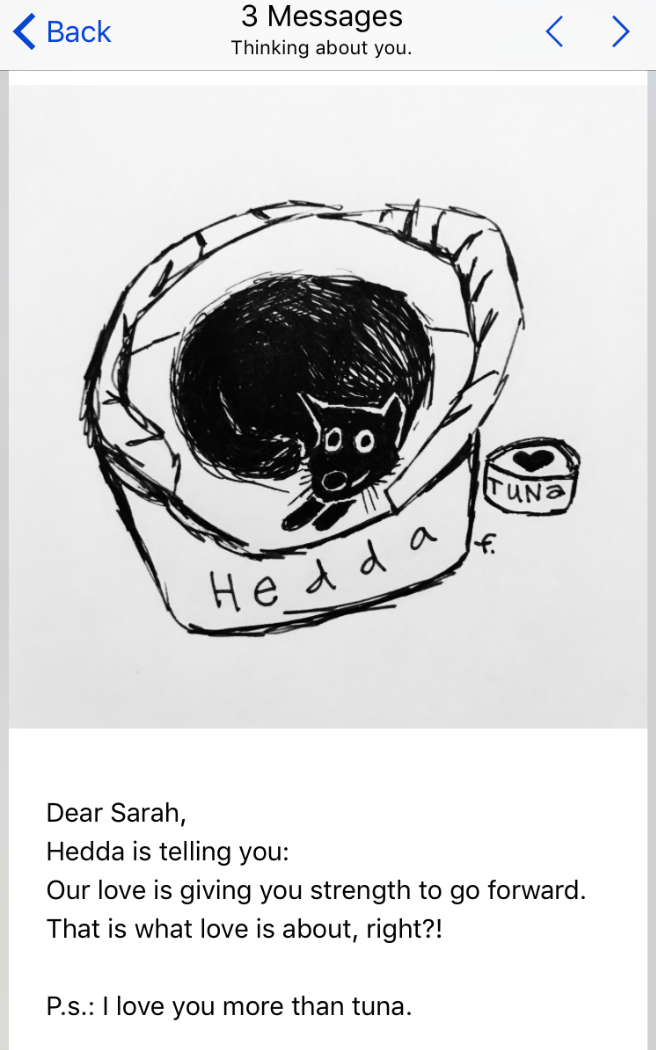
Thinking About You - Being Witnessed In Grief Is A Powerful Balm For Healing Blog


Inspired in part by Eckhart Tolle and Patrick McDonnell’s Guardians of Being and Charles M. Schultz’s Happiness is a Warm Puppy, P.S. I Love You More Than Tuna offers comfort and inspiration through New Yorker-style drawings and simple, evocative language. My goal was to make it heartfelt without being cloying.

Every year, six million Americans and Canadians must say a final goodbye to their cats—buddies who leapt into their hearts as kittens, purred away heartbreak through multiple breakups, snuggled by their side in homes large and small, and occasionally deleted folders of work by stretching out on a warm keyboard.

“Pet loss” is considered a disenfranchised form of grief; it’s not culturally sanctioned. We don’t have any universal rituals for this grief, like sitting shiva or holding a wake. This often leaves the bereaved feeling isolated and misunderstood, which compounds the grief and makes healing more difficult.

People grieving companion animals have a need to be seen, their grief validated. Being witnessed in grief is a powerful balm for healing.

Friends of those grieving companion animals are often at a loss for ways to show their support. P.S. I Love You More Than Tuna gives all of us the opportunity to make a profound impact with a simple gesture.

When Francis sent me the sketch and note, I felt seen. Francis’s gift acknowledged the bond I’d had with Hedda and my grief at her death. The present tense of the note also reminded me that Hedda was still with me, even if I couldn’t see her. That was significant in terms of helping me heal, and that’s the comfort I hope P.S. I Love You More Than Tuna will provide to other cat lovers.

Sounds True has created a lovely video preview for P.S. I Love You More Than Tuna. I hope you’ll check it out below.
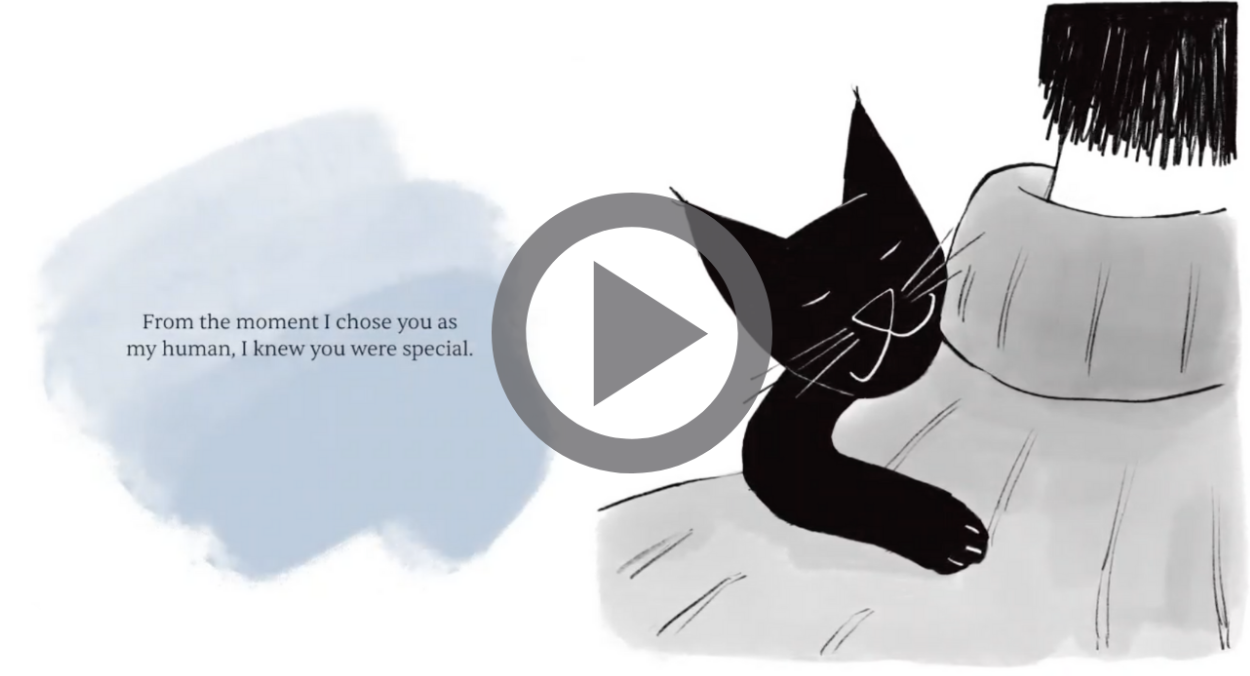
Best Friends Animal - Thinking About You - Being Witnessed In Grief Is A Powerful Balm For Healing Blog

Ultimately, I hope this book will benefit the world in multiple ways: for the recipient, witnessing and healing; for the giver, a tangible action they can take to help another; for Best Friends Animal Society, to which I’m donating 10 percent of my proceeds, contributing to their work of keeping pets in the home. This includes helping low-income people connect with resources they need to feed, train, and care for their companion animals. And of course, I hope this will benefit Sounds True and their work in the world, which is quickly becoming more needed than ever.

Take care,

Sarah Chauncey

Book Cover

Amazon  |  Barnes & Noble  |  IndieBound  |  Bookshop

Sarah Chauncey

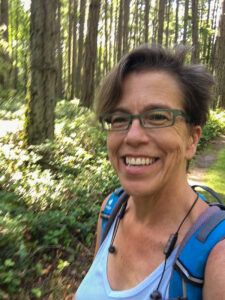
Sarah Chauncey has written and edited for nearly every medium over the past three decades, from print to television to digital. Her writing has been featured on EckhartTolle.com and Modern Loss, as well as in Lion's Roar and Canadian Living. She lives on Vancouver Island in British Columbia, where she divides her time between writing, editing nonfiction, and walking in nature. Learn more at sarahchauncey.com.

Author photo ©Tony Puerzer: Bright Idea Photography

Also By Author

However you need to grieve, that’s the right way for...

Grieving a cat—or any kind of grief—is not a one-size-fits-all experience (as though any experience or emotion were?). Some people can’t stop sobbing, while others reflect quietly. Some are comforted by hugs and rituals; others need solitude to process their loss.

There’s no “right” way to grieve, and there’s no “right” length of time. In fact, I don’t see a loss as something we “get over,” but rather something that becomes a part of our life experience. When our skin is gravely injured, it doesn’t go back to looking the way it did before; it heals, and we have a scar. 

Loss changes the fabric of our lives; it changes the way we perceive and interact with the world. And like a scar, walking through grief (not trying to circumvent it) makes something in us stronger, more resilient. Grief is something to be healed, not to transcend.

Grief is nonlinear, too. Our human minds would love to make grief into a process that has a distinct beginning, middle and end…but in my experience, that’s just not true. Grief, like life, is messy and unpredictable. As Jon Kabat-Zinn writes, “You can’t stop the waves, but you can learn to surf.”

We all grieve, and for each of us, our grief is as unique as a fingerprint. If we try to avoid grief, it will redouble its strength and burst forth anyway. However you need to grieve, that’s the right way for you.

An original post by Sarah Chancey, the author of P.S. I Love You More Than Tuna, the first gift book for people grieving the loss of their feline friend. This originally appeared on morethantuna.com.

sarah chaunceySarah Chauncey has written and edited for nearly every medium over the past three decades, from print to television to digital. Her writing has been featured on EckhartTolle.com and Modern Loss, as well as in Lion’s Roar and Canadian Living. She lives on Vancouver Island in British Columbia, where she divides her time between writing, editing nonfiction, and walking in nature. Learn more at morethantuna.com and sarahchauncey.com.


ps i love you more than tuna

Amazon  |  Barnes & Noble  |  IndieBound  |  Bookshop


Meet the author of . . . P.S. I Love You More Than Tun...

The Author

Sarah Chauncey is the coauthor of P.S. I Love You More Than Tuna along with illustrator, Francis Tremblay, coming October, 2020. She has written and edited for nearly every medium over the past three decades, from print to television to digital. Her writing has been featured on EckhartTolle.com and Modern Loss, as well as in Lion’s Roar and Canadian Living. She lives on Vancouver Island in British Columbia, where she divides her time between writing, editing nonfiction, and walking in nature. Learn more at sarahchauncey.com.

The Book

Book cover

Our cats occupy a unique space in our hearts. When they’re gone, the loss can be devastating, the grief profound.


P.S. I Love You More Than Tuna gives us an opportunity to give friends, loved ones, or ourselves tangible comfort during the grieving period, when so many of us feel isolated and misunderstood after a beloved pet dies.


Send us a photo of your sacred space.

sacred space

First Nation, Saysutshun Newcastle Island is an ancient forest and marine provincial park. Saysutshun, I’m told, means “training or preparation ground,” and indeed, for millennia before colonization, the Snuneymuxw brought healers to this small island to train “mentally, physically, and spiritually.” I knew none of this history when I first began walking long stretches of the uninhabited island’s 13.6 miles of trails. I only knew that the island seemed to lift away anything that wasn’t essential, easing my mind and making way for creative ideas to flow. I’d walk a bit, then sit and meditate, write for a while, then walk some more. This bench, under a circle of seven trees, became my favorite writing and meditation spot. The moss-covered trees became my friends, teaching me to stay rooted when things around me change. As I wrote in a 2016 essay about the island, “I have become a literal tree-hugger, and even—when nobody is looking—a tree-kisser.”

What was your favorite book as a child?

harold purple crayon

I was a total bookworm as a child. Instead of playing games at recess, I preferred to curl up under my desk and read. Of all the books I read—from every Encyclopedia Brown to Freaky Friday to The Short Stories of Ernest Hemingway (I was a precocious kid), the book with the most enduring impact was also the simplest: Harold and the Purple Crayon. I was enchanted by Harold’s adventures, amazed by his ability to draw his way out of every obstacle and ultimately find his way home. Long before I began seeing this as a metaphor for creativity (and life!), this story appealed to me. Fifty years later, I continue to find new layers of meaning in this little book. It’s a simple yet profound testament to the power of imagination and creativity.

What is one unexpected thing or habit that inspires your writing practice?

sarah chauncey forest new castle

Walking in nature is my creative “secret sauce” and the central practice to my writing. Several years ago, I realized that although my role in this world is as a writer, my job is to bring myself back into presence, over and over, to get into a place where words can flow through me. I walk to get out of my mind and into my body. I come into fierce presence by noticing the rain on my face, salal berries ripening into deep blue, or the texture of earth beneath my feet. When my body is occupied by walking, ideas bubble up from my subconscious. Whether I’m looking for ways to trim an over-long essay or searching for words to evoke a hard-to-articulate experience, as soon as my legs find their rhythm, ideas begin to flow.

Learn More

Book cover

Sounds True | Amazon | Barnes&Noble | Bookshop | Indiebound

Being Witnessed In Grief Is A Powerful Balm For Healin...

Dear friends,

Two days after my cat, Hedda, died in 2016, my friend Francis sent me a sketch with a note “from” Hedda that read, in part, “P.S. I love you more than tuna.” Through my tears, I thought that would be a great book title. I had a clear vision: an illustrated gift book that people would give to friends, family, colleagues, or clients after the loss of their cat. A step beyond a sympathy card, this would be the first “empathy book” for adults grieving the loss of a cat.

Thinking About You - Being Witnessed In Grief Is A Powerful Balm For Healing Blog


Inspired in part by Eckhart Tolle and Patrick McDonnell’s Guardians of Being and Charles M. Schultz’s Happiness is a Warm Puppy, P.S. I Love You More Than Tuna offers comfort and inspiration through New Yorker-style drawings and simple, evocative language. My goal was to make it heartfelt without being cloying.

Every year, six million Americans and Canadians must say a final goodbye to their cats—buddies who leapt into their hearts as kittens, purred away heartbreak through multiple breakups, snuggled by their side in homes large and small, and occasionally deleted folders of work by stretching out on a warm keyboard.

“Pet loss” is considered a disenfranchised form of grief; it’s not culturally sanctioned. We don’t have any universal rituals for this grief, like sitting shiva or holding a wake. This often leaves the bereaved feeling isolated and misunderstood, which compounds the grief and makes healing more difficult.

People grieving companion animals have a need to be seen, their grief validated. Being witnessed in grief is a powerful balm for healing.

Friends of those grieving companion animals are often at a loss for ways to show their support. P.S. I Love You More Than Tuna gives all of us the opportunity to make a profound impact with a simple gesture.

When Francis sent me the sketch and note, I felt seen. Francis’s gift acknowledged the bond I’d had with Hedda and my grief at her death. The present tense of the note also reminded me that Hedda was still with me, even if I couldn’t see her. That was significant in terms of helping me heal, and that’s the comfort I hope P.S. I Love You More Than Tuna will provide to other cat lovers.

Sounds True has created a lovely video preview for P.S. I Love You More Than Tuna. I hope you’ll check it out below.

Best Friends Animal - Thinking About You - Being Witnessed In Grief Is A Powerful Balm For Healing Blog

Ultimately, I hope this book will benefit the world in multiple ways: for the recipient, witnessing and healing; for the giver, a tangible action they can take to help another; for Best Friends Animal Society, to which I’m donating 10 percent of my proceeds, contributing to their work of keeping pets in the home. This includes helping low-income people connect with resources they need to feed, train, and care for their companion animals. And of course, I hope this will benefit Sounds True and their work in the world, which is quickly becoming more needed than ever.

Take care,

Sarah Chauncey

Book Cover

Amazon  |  Barnes & Noble  |  IndieBound  |  Bookshop

You Might Also Enjoy

Being with Dying: Roshi Joan Halifax on Compassionate ...

What if the most powerful thing you could do for someone who is dying is simply to stay?

Instead of fixing or solving, offer a steady, open presence that says: I am here, and you are not alone. For most of us, that kind of stillness is harder than it sounds. We reach for words, for solutions, for anything that keeps us from feeling the full weight of what is happening. In the practice of end-of-life care, though, the willingness to remain present without an agenda may be the most generous gift we can give.

For more than 40 years, we at Sounds True have been committed to sharing teachings that meet people at life’s most profound thresholds. In this piece, we look at Roshi Joan Halifax’s approach to compassionate end-of-life care, what contemplative care looks like in practice, and how a different relationship with death and dying can change the way we live.

Key Takeaways:

  • Presence Transforms the Dying Process: Being fully present with someone who is dying doesn’t require having all the answers. Halifax shows us that steady, open attention is the most generous thing we can offer to someone nearing the end of life.
  • Contemplative Care Begins Within: Mindfulness and self-awareness sit at the heart of Halifax’s approach, equipping caregivers, family members, and healthcare professionals to meet grief and fear with greater clarity and less reactivity.
  • Death as a Door to Awakening: Halifax invites us to release the story that dying equals failure and see it, instead, as a profound passage that can open the heart and deepen our connection to life.

Center Yourself With Meditative Teachings by Sounds True

Roshi Joan Halifax and the Work of Being with Dying 

Joan Halifax, Ph.D., is an anthropologist, Buddhist teacher, and writer who has worked with dying people since 1970. She has served on the faculties of Columbia University, the University of Miami School of Medicine, the New School for Social Research, the Naropa Institute, and the California Institute for Integral Studies. In 1994, she founded the Project on Being with Dying to train healthcare professionals in contemplative care, a program that shapes how practitioners, families, and spiritual seekers relate to death and dying.

Her work has shaped how practitioners, families, and spiritual seekers relate to death. Her voice is one of many you can hear through the Insights at the Edge Podcast, where Sounds True founder Tami Simon brings these kinds of conversations to life.

Learn Different Ways to Meet Death and Dying

Much of our culture frames death as something to be managed or delayed as long as possible. Halifax takes a different path. Rather than viewing dying as failure, she invites us to see it as a natural passage in the human experience, one that, when met with awareness and openness, can deepen our appreciation for life and sharpen our capacity to respond to the suffering of those we love.

The Practice of Compassionate Presence in Death

One of Halifax’s most essential teachings is compassionate presence at death, or the art of being fully with someone as they near the end of life. 

More than having the right words or eliminating pain, this approach is about offering steady attention and genuine care without needing to redirect what is happening. A hospice nurse who sits in silence with a patient, a son who holds his mother’s hand through the night without trying to reassure her. These are acts of compassionate presence that ask nothing of the dying person except to be witnessed.

When we bring that quality of attention to the dying process, we create space for people to feel seen and held, even in the most uncertain moments. Compassionate presence honors the emotional, spiritual, and relational dimensions of dying, which matter just as deeply as physical comfort. Caregivers looking to deepen their practice can find a range of teachings that address the whole person through our Health & Healing collection.

Build Relationships That Nourish And Sustain

Being with Dying: The Audio Learning Course

Halifax’s decades of work have been distilled into the Being with Dying audio learning course, a direct response to the question caregivers, family members, and spiritual seekers carry: How do I do this well?

The course draws on Eastern and Western psychology, philosophy, and contemplative practices from across spiritual traditions. The approach is kind, open, and dignified, designed to guide medical professionals, social workers, clergy, community activists, and spiritual seekers toward a path that takes the fear out of dying and replaces it with presence, clarity, and love. 

End of Life Care as a Path of Compassionate Service

Halifax has long taught that end-of-life care is not only a professional skill. Caring for someone through death is a practice of the heart, one that asks for patience, humility, and a genuine willingness to remain open to what is hard. A chaplain who sits with a grieving family long after visiting hours have ended, a social worker who stays present in the room when words have run out, these are the moments where caregiving becomes something closer to a calling.

What many caregivers find, alongside the grief, are unexpected gifts: moments of beauty, gratitude, and profound human connection that they did not anticipate. Death, when met with presence, does not only diminish. Death also reveals.

Contemplative Care: Integrating Mindfulness into Caregiving

Contemplative care dying weaves mindfulness, reflection, and compassionate awareness into caregiving at every level. Rather than managing the dying process from clinical distance, this approach asks both caregivers and the people they accompany to meet what arises, fear, grief, resistance, wonder, with honest, grounded presence.

For healthcare professionals, contemplative care means developing the inner resources to stay present in high-stress environments without shutting down emotionally. For family members, the practice offers a way to move through grief with tenderness rather than being swept away. Our Spirituality & Awakening collection brings together teachings that can help build that foundation at any stage of your path.

Seeing Death Not as Failure, But as Possibility

We have absorbed a quiet cultural story that says life equals success and death equals failure. Halifax challenges that story with great compassion and persistence. What if dying were not a defeat, but a doorway? What if the dying process could hold the conditions for awakening, for the kind of presence, love, and release that transforms everyone in its path?

Roshi Joan Halifax has spent more than 50 years demonstrating that this reorientation is both possible and necessary. When we stop relating to death as the enemy, we free ourselves to accompany others through it with courage and care. 

Our All Teachers & Authors page brings together many more voices who hold that same commitment, teachers and guides for every threshold life presents.

Awaken Something Greater Within You. Find Teachings that Speak to You With Sounds True.

Final Thoughts

Roshi Joan Halifax’s teachings on death and dying remind us that compassionate end-of-life care begins with presence, and that presence begins with the willingness to stay. When we approach the dying process with awareness and an open heart, we bring something no clinical protocol alone can match: the assurance that another person does not face their final passage alone.

Her work continues to shape how caregivers, loved ones, and practitioners meet life’s most profound transitions. We are grateful to carry her voice as part of the Sounds True community, and we hope her teachings open something tender and true in you.

Frequently Asked Questions About Being with Dying

What is Being with Dying?

Being with Dying is a training approach developed by Roshi Joan Halifax that focuses on mindful, compassionate support for people facing serious illness, aging, and the end of life.

Who is Roshi Joan Halifax?

Roshi Joan Halifax is a Zen Buddhist teacher, author, anthropologist, and hospice caregiver known for her work in contemplative practice, compassion training, and end-of-life care.

How does contemplative care differ from traditional caregiving?

Contemplative care incorporates mindfulness, self-awareness, and spiritual reflection into caregiving, helping both caregivers and patients navigate difficult experiences with greater clarity.

Can the principles of Being with Dying be applied outside hospice settings?

Yes. The principles can support anyone caring for a loved one, working in healthcare, or seeking to develop greater compassion in everyday life.

What challenges do caregivers commonly experience during end-of-life care?

Caregivers may face emotional exhaustion, grief, stress, and feelings of helplessness. Developing self-awareness and supportive practices can help address these challenges.

What role does spirituality play in end-of-life care?

Spirituality can offer comfort, meaning, and perspective during difficult times. It may help individuals connect with their values, beliefs, and sense of purpose.

Michelle Cassandra Johnson is an author, activist, spiritual teacher, racial equity consultant, and intuitive healer. She is the author of six books, including Skill in Action and Finding Refuge. Amy Burtaine is a leadership coach and racial equity trainer. With Robin DiAngelo, she is the coauthor of The Facilitator's Guide for White Affinity Groups. For more, visit https://www.michellecjohnson.com/wisdom-of-the-hive.

Fred Luskin on Forgiveness: The Stanford Research That...

Holding a grudge carries a cost, and science has measured it. Fred Luskin spent decades quantifying that cost through some of the most rigorous forgiveness research ever conducted at Stanford University, and what he found changes how we think about what letting go really means.

At Sounds True, we have spent forty years building a library of more than 3,000 titles to carry teachings like this one into people’s daily lives. Our mission began with nothing more than a tape recorder and a conviction that wisdom deserved a wider reach. That conviction still drives everything we do.

Here, we will look at Luskin’s background, what his research found, and what forgiveness does and does not require of us.

Key Takeaways:

  • Grudges Cost Your Health: Holding onto resentment is not just emotionally exhausting. Research shows it creates a measurable, chronic stress response that the body cannot simply shrug off.
  • What Stanford’s Research Found: Years of controlled studies, tested across continents and populations, reveal that forgiveness training reliably reduces stress, depression, and in some cases, blood pressure.
  • Forgiveness Is a Learnable Skill: Luskin’s method treats forgiveness as something you can build through structured practice, not something you either feel or don’t.

Meet Your Sorrow with Kindness. Learn Practices for Self-Compassion with Sounds True.

Who Is Fred Luskin?

Fred Luskin, PhD, directs the Stanford Forgiveness Projects and has spent more than thirty years researching and teaching the psychology of letting go. He holds a senior fellowship at the Stanford Center on Conflict and Negotiation and has taught wellness education at Stanford’s School of Medicine.

His approach grew from a core belief that forgiveness is not a moral obligation but a trainable capacity with measurable health implications. Everything from his research design to the programs he developed for hospitals, workplaces, and conflict survivors worldwide reflects that conviction.

Readers curious about how his work sits alongside that of other researchers and teachers can browse the full roster on our All Teachers & Authors page, where voices from many traditions and disciplines come together.

Inside the Stanford Forgiveness Project

The Stanford Forgiveness Project began under Luskin’s direct leadership as a randomized trial involving 55 students who completed a six-session training program. 

Results showed measurable increases in forgiveness and physical vitality compared with a control group. That initial study aligned with Luskin’s core belief that most of our suffering does not come from what happened, but from the ongoing story we tell ourselves about it. The project expanded in the years that followed:

  • A trial of 259 adults, the largest randomized forgiveness study conducted to date. Participants reported significant reductions in anger, stress, and depression after completing structured forgiveness training, confirming that the initial findings were not limited to a small or narrow population.
  • Work with hypertensive patients showing reduced anger and, in some cases, measurably lower blood pressure after completing the program. These results positioned forgiveness squarely within the domain of preventive health.
  • Training programs adapted for survivors of the Northern Ireland conflict and civil war in Sierra Leone, demonstrating that learning to forgive is possible even in the wake of profound, collective trauma.

One point Luskin returns to often surprises people: no one has to forgive. Forgiveness is a choice. As he defines it, forgiveness means releasing our suffering over a difficult situation. This does not mean returning to a hurtful relationship or excusing what happened. Even when what occurred was not acceptable, forgiveness is how we reclaim peace for ourselves.

Holding Grudges Health: What the Research Says About Forgiveness Health Benefits

The forgiveness health benefits Luskin’s research documents go well beyond feeling better in the moment. Across multiple studies, people reported reduced stress, less depression, and greater optimism after completing forgiveness training. Some trials also documented physical improvements, including lower blood pressure among people with hypertension.

One workplace study found a 24 percent increase in sales productivity among employees who completed forgiveness-focused training compared to matched coworkers who did not. That finding reflects something Luskin has long argued: unresolved anger does not stay in one corner of life. It spreads.

Conversations about findings like these, and what they mean outside a lab setting, come up regularly on our Insights at the Edge Podcast, where teachers and researchers bring science and lived practice together.

Center Yourself With Meditative Teachings by Sounds True

Spotlighting the Three Kinds of Forgiveness

Luskin identifies three distinct types of forgiveness, and recognizing which one applies to your situation can make the whole process feel more grounded and less abstract.

Interpersonal Forgiveness

Interpersonal forgiveness is the most commonly recognized kind. This is forgiveness directed at another person who has hurt you, a parent, a partner, a colleague. The negative effects of holding grudges are most prevalent in this area, as staying locked in blame keeps the body in a low-grade stress state, with stress hormones elevated long after the original event has passed.

Intra-Personal Forgiveness

Intra-personal forgiveness means forgiving yourself. This form is often the hardest to name, let alone practice. Shame, regret, and self-blame can be just as corrosive as resentment toward another person, and the same framework applies. Releasing blame toward yourself is not excusing past behavior. Choosing to stop letting an old wound define your present is where the real work begins.

Existential Forgiveness

Existential forgiveness arises when the hurt feels directed at life itself, at fate, or at the question “How could this happen?” This form surfaces alongside illness, loss, or circumstances beyond anyone’s control, and it is where the spiritual and psychological converge most clearly. That convergence is part of why Luskin’s research resonates so deeply in communities navigating grief and serious illness.

Applying These Findings to Daily Life

Luskin’s method does not require a clinical setting to start applying. A few grounding practices drawn directly from his work:

  1. Notice where the distress lives: Current pain over a past hurt usually comes from present thoughts, not the original event itself. Naming that shift, from then to now, creates space for something different. This awareness alone can interrupt the loop of replaying a grievance and redirect attention toward what remains within your control.
  2. Use a calming technique the moment old anger resurfaces: Luskin recommends bringing attention to the breath, then shifting focus to something beautiful or deeply loved. This two-step process interrupts the body’s stress response and creates room for a considered response rather than a reactive one. Practiced consistently, it becomes a reflex.
  3. Match the practice to the type of forgiveness you need: Interpersonal tension calls for releasing blame toward someone else. Self-criticism points toward intra-personal work. A sense that life has been fundamentally unfair opens the door to existential forgiveness. Connecting the type of hurt to the right practice makes the work feel more approachable.

Those building a broader toolkit around stress, resilience, and healing will find rich material in our Health & Healing collection, which brings together courses and programs from teachers across many traditions. Readers drawn to self-kindness as a companion to forgiveness work will also find a natural path in our Self-Compassion collection, which pairs well with everything Luskin’s framework asks of us.

Awaken Something Greater Within You. Find Teachings that Speak to You With Sounds True.

Final Thoughts

Fred Luskin’s research offers something rare in this space: forgiveness backed not by sentiment but by data collected across decades and continents. Letting go, in his framing, is less about being generous toward someone else and more about reclaiming a body and mind no longer running on old stress.

At Sounds True, our mission has always been to wake up the world, and Luskin’s work is a clear example of what that looks like when science and compassion move in the same direction. We keep returning to his research because it permits people to let go of what never served them in the first place.

Frequently Asked Questions About Fred Luskin

What is the Stanford Forgiveness Project?

It’s Fred Luskin’s ongoing series of research studies examining how forgiveness training affects health and well-being.

Does forgiveness really improve physical health?

Studies show reductions in stress, anger, and depression, with some trials also showing lower blood pressure.

Do I have to reconcile with someone to forgive them?

No. Luskin defines forgiveness as releasing blame, not necessarily reconciling or condoning what happened.

Can forgiveness be taught, or is it just a feeling?

Luskin’s research treats forgiveness as a learnable skill, using structured steps rather than relying on spontaneous emotion.

What are the Nine Steps to Forgiveness?

They are Luskin’s structured method for practicing forgiveness, which includes calming techniques and reframing past hurts.

Has this research been tested outside the United States?

Yes, including studies with survivors of conflict in Northern Ireland and Sierra Leone.

Where can I learn more about Fred Luskin’s work?

Sounds True offers books and programs from Fred Luskin, alongside those from other teachers focused on healing and resilience.

Michelle Cassandra Johnson is an author, activist, spiritual teacher, racial equity consultant, and intuitive healer. She is the author of six books, including Skill in Action and Finding Refuge. Amy Burtaine is a leadership coach and racial equity trainer. With Robin DiAngelo, she is the coauthor of The Facilitator's Guide for White Affinity Groups. For more, visit https://www.michellecjohnson.com/wisdom-of-the-hive.

Does Prayer Work? Larry Dossey on the Science of Heali...

Does prayer work? Larry Dossey’s honest answer is more nuanced than a simple yes or no. As a physician trained in conventional internal medicine, he built a career by questioning why prayer, intention, and compassion consistently produced measurable effects in controlled studies. The evidence he has spent forty years gathering suggests something worth taking seriously is happening.

At Sounds True, we have followed his work closely because it asks readers to sit with genuine uncertainty rather than rush toward belief or dismissal. Our mission has always been to wake up the world by offering access to conversations exactly like this one. 

In this piece, we look at his background, his theory of the mind, and what the research actually shows.

Key Takeaways:

  • Healing Intention and What It Means: Larry Dossey’s research asks whether focused intention can influence healing in ways conventional medicine has yet to fully explain. Forty years of evidence suggest the question is worth taking seriously.
  • Consciousness Without Boundaries: His theory of non-local mind proposes that consciousness is not confined to a single brain or body, and may connect individual minds to something far larger.
  • What the Studies Point To: Controlled studies point to measurable effects from prayer and focused intention, while scientific debate about mechanisms remains open and ongoing.

Uncover How Your Mind Works with Valuable Resources

Who Is Larry Dossey?

Larry Dossey, MD, served as a battalion surgeon in Vietnam before becoming chief of staff at Medical City Dallas Hospital, a fairly conventional trajectory for someone who would later challenge medicine’s assumptions from the inside. 

His book Healing Words became a New York Times bestseller and helped bring prayer healing into mainstream medical education. He is one of many teachers and researchers whose thinking we carry at Sounds True, and readers curious about how his ideas connect with others’ can find the full range of voices on our All Teachers & Authors page. Dossey frames the history of medicine in three stages:

  • Era I: The Body as Machine Era I treats the body as something to be fixed through physical interventions, including surgery, pharmaceuticals, and diagnostics. This approach defined medicine for centuries, and its focus on measurable, physical causes and effects laid the groundwork for how healthcare works today.
  • Era II: Mind Meets Body Era II acknowledges that thoughts, beliefs, and emotions can shape physical health outcomes. Research has since affirmed this connection through work on stress reduction, meditation, and breathwork.
  • Era III: Consciousness Beyond the Body Era III is the stage Dossey argues we are now entering, one where consciousness may reach beyond an individual’s skin and skull to influence outcomes at a distance. This is the most contested of the three, and the question his career has been devoted to building a case for.

The Non-Local Mind Theory

The idea of non-local mind sits at the center of nearly everything Dossey writes. He argues that consciousness is not confined to a single brain or body, which may help explain why one person’s intention can seem to affect another person or organism at a distance. This is the foundation of what he calls consciousness medicine: a way of approaching healing that takes seriously the possibility that the mind’s reach extends beyond the body.

Dossey describes a non-local mind as unbounded in space and time, and as incapable of remaining separate from other minds. Within this framework, the consciousness participates in something he calls the One Mind. Our working concept of mind has been expanding since the nineteenth century, with subdivisions like the conscious, preconscious, subconscious, and collective unconscious gradually filling out the picture. 

The Research Behind Prayer Healing

Much of the research Dossey cites comes from decades of controlled experiments, including studies by the Spindrift Organization examining whether focused intention can influence outcomes in bacteria, plants, and human patients. He reports that over 100 such studies point to a real, if modest, effect. Prayer healing is cited across this research as one of the clearest examples of non-local consciousness in action.

The evidence spans three distinct categories: healing in human patients, healing at a cellular level, and healing in plants and animals. Two case studies are offered in direct support of non-local healing, with the underlying question being whether medicine can afford to close the door on any reliable pathway toward recovery. 

We follow conversations like this one closely on our Insights at the Edge Podcast, where guests are invited to test their ideas through genuine dialogue rather than simply restate them.

Center Yourself With Meditative Teachings by Sounds True

Distant Healing and What Studies Suggest

Dossey’s writing on distant healing extends this logic outward, proposing that care, love, and focused attention can travel across space without any known physical mechanism. Studies within prayer research science have examined everything from cardiac patients to seed germination, and Dossey reads those results as evidence that the mind operates beyond the boundaries conventional science assumes.

This research disclosed that prayer had a measurable effect not only on human beings but also on bacteria, germinating seeds, and animals. Some cases of distant consciousness operating on non-humans are noted in the literature, but the central focus remains the healing power of intercessory prayer on humans and what that might mean for how medicine approaches care.

Critics, including psychologist Robert Baker, have argued that Dossey’s conclusions outpace what the data can firmly hold, and mainstream science has not settled the question. Those drawn to the terrain he is mapping will find a hands-on starting point in our Subtle Energy collection, which gathers programs and teachings on energy-based healing practices.

Also, our Spirituality & Awakening collection covers similar ground through a wider range of traditions, for anyone who wants to deepen this inquiry through practice as much as reading.

Dossey’s Influence on Modern Healthcare

Dossey’s work in consciousness medicine has shaped how integrative medicine is discussed at the federal level: he served as co-chair of the Panel on Mind-Body Interventions for the National Center for Complementary and Alternative Medicine at the National Institutes of Health, placing his ideas in federal research conversations. 

He was also appointed to Hillary Rodham Clinton’s Task Force on Health Care Reform and, for many years, served as executive editor of Explore, The Journal of Science and Healing, a peer-reviewed publication covering integrative approaches to medicine. Over the decades, he has lectured at Harvard, the Mayo Clinic, Johns Hopkins, and Cornell, before audiences not typically receptive to unverified claims. 

His legacy lies not only in the claims he has made but in the space he has kept open. Not every conclusion he draws may hold up under further study, yet Dossey has helped ensure that questions about prayer healing, non-local mind, and the mind’s potential role in physical recovery remain part of serious medical dialogue.

Awaken Something Greater Within You. Find Teachings that Speak to You With Sounds True.

Final Thoughts

Larry Dossey does not ask you to take his conclusions on faith. He asks you to look at the data, sit with an open question, and let the discomfort of not-knowing guide you toward something more honest than certainty. That spirit is something we recognize deeply at Sounds True.

Our mission has always been to wake up the world by giving you access to conversations exactly like this one, conversations that resist easy answers and honor complexity. We return to Dossey’s work because the question at its center has no tidy answer: whether focused intention and prayer healing represent a real frontier in medicine is something the research is still working out. 

Frequently Asked Questions About Larry Dossey

Is there scientific proof that prayer heals?

Evidence remains mixed and contested. Dossey cites supportive studies, while critics argue results are inconclusive or unproven.

What does non-local mind mean?

It describes consciousness as potentially unconfined to the brain, capable of influencing outcomes beyond physical proximity.

Is Larry Dossey a religious author?

No. He writes as a physician focused on evidence and research rather than any specific religious tradition.

Does distant healing have to involve prayer specifically?

No. Dossey includes compassion, meditation, and focused intention as forms of distant healing beyond formal prayer.

Do mainstream doctors accept these theories?

Not universally. Many medical schools now teach the topic, though consensus on mechanisms remains unresolved.

Where can I learn more about Larry Dossey’s work?

Sounds True features books, podcasts, and programs from Larry Dossey and researchers exploring similar questions.

Sources:

  1. Harding O. G. (2001). The healing power of intercessory prayer. The West Indian medical journal, 50(4), 269–272.

Michelle Cassandra Johnson is an author, activist, spiritual teacher, racial equity consultant, and intuitive healer. She is the author of six books, including Skill in Action and Finding Refuge. Amy Burtaine is a leadership coach and racial equity trainer. With Robin DiAngelo, she is the coauthor of The Facilitator's Guide for White Affinity Groups. For more, visit https://www.michellecjohnson.com/wisdom-of-the-hive.

Leave a Reply

Your email address will not be published. Required fields are marked *