Sarah Chauncey

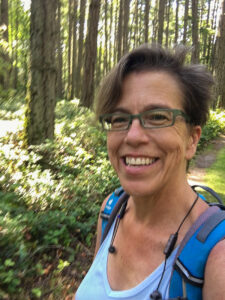
Sarah Chauncey has written and edited for nearly every medium over the past three decades, from print to television to digital. Her writing has been featured on EckhartTolle.com and Modern Loss, as well as in Lion's Roar and Canadian Living. She lives on Vancouver Island in British Columbia, where she divides her time between writing, editing nonfiction, and walking in nature. Learn more at sarahchauncey.com.

Author photo ©Tony Puerzer: Bright Idea Photography

Also By Author

However you need to grieve, that’s the right way for...

Grieving a cat—or any kind of grief—is not a one-size-fits-all experience (as though any experience or emotion were?). Some people can’t stop sobbing, while others reflect quietly. Some are comforted by hugs and rituals; others need solitude to process their loss.

There’s no “right” way to grieve, and there’s no “right” length of time. In fact, I don’t see a loss as something we “get over,” but rather something that becomes a part of our life experience. When our skin is gravely injured, it doesn’t go back to looking the way it did before; it heals, and we have a scar. 

Loss changes the fabric of our lives; it changes the way we perceive and interact with the world. And like a scar, walking through grief (not trying to circumvent it) makes something in us stronger, more resilient. Grief is something to be healed, not to transcend.

Grief is nonlinear, too. Our human minds would love to make grief into a process that has a distinct beginning, middle and end…but in my experience, that’s just not true. Grief, like life, is messy and unpredictable. As Jon Kabat-Zinn writes, “You can’t stop the waves, but you can learn to surf.”

We all grieve, and for each of us, our grief is as unique as a fingerprint. If we try to avoid grief, it will redouble its strength and burst forth anyway. However you need to grieve, that’s the right way for you.

An original post by Sarah Chancey, the author of P.S. I Love You More Than Tuna, the first gift book for people grieving the loss of their feline friend. This originally appeared on morethantuna.com.

sarah chaunceySarah Chauncey has written and edited for nearly every medium over the past three decades, from print to television to digital. Her writing has been featured on EckhartTolle.com and Modern Loss, as well as in Lion’s Roar and Canadian Living. She lives on Vancouver Island in British Columbia, where she divides her time between writing, editing nonfiction, and walking in nature. Learn more at morethantuna.com and sarahchauncey.com.
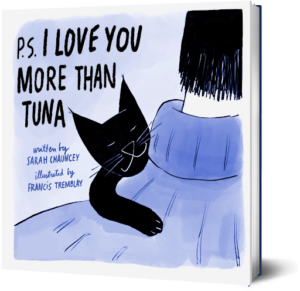


ps i love you more than tuna

Amazon  |  Barnes & Noble  |  IndieBound  |  Bookshop

 

Meet the author of . . . P.S. I Love You More Than Tun...

The Author

Sarah Chauncey is the coauthor of P.S. I Love You More Than Tuna along with illustrator, Francis Tremblay, coming October, 2020. She has written and edited for nearly every medium over the past three decades, from print to television to digital. Her writing has been featured on EckhartTolle.com and Modern Loss, as well as in Lion’s Roar and Canadian Living. She lives on Vancouver Island in British Columbia, where she divides her time between writing, editing nonfiction, and walking in nature. Learn more at sarahchauncey.com.

The Book

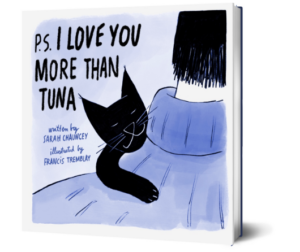
Book cover

Our cats occupy a unique space in our hearts. When they’re gone, the loss can be devastating, the grief profound.


P.S. I Love You More Than Tuna gives us an opportunity to give friends, loved ones, or ourselves tangible comfort during the grieving period, when so many of us feel isolated and misunderstood after a beloved pet dies.


Send us a photo of your sacred space.

sacred space

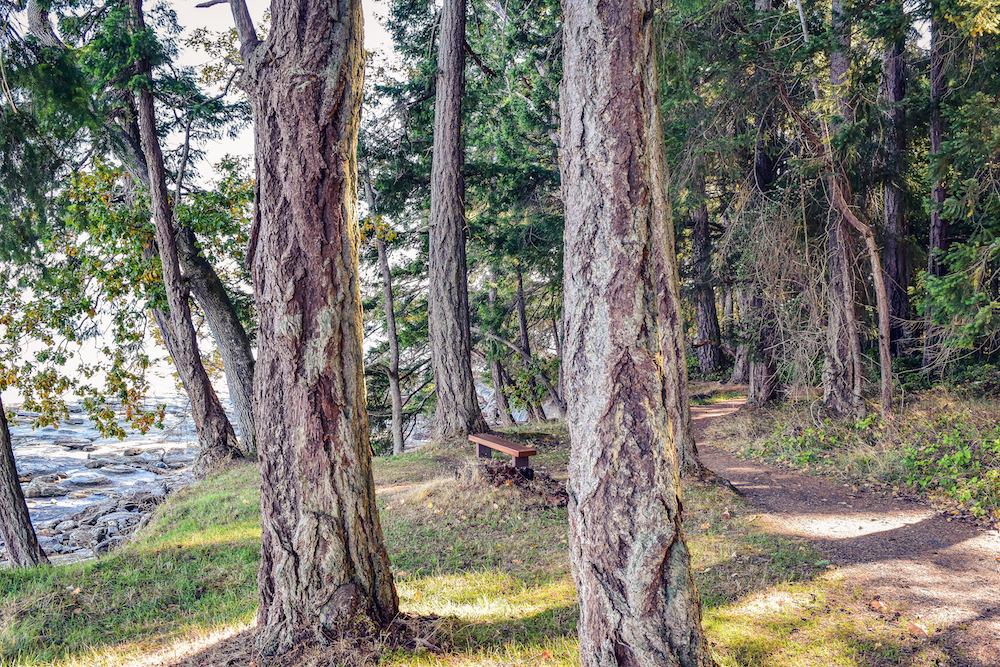
First Nation, Saysutshun Newcastle Island is an ancient forest and marine provincial park. Saysutshun, I’m told, means “training or preparation ground,” and indeed, for millennia before colonization, the Snuneymuxw brought healers to this small island to train “mentally, physically, and spiritually.” I knew none of this history when I first began walking long stretches of the uninhabited island’s 13.6 miles of trails. I only knew that the island seemed to lift away anything that wasn’t essential, easing my mind and making way for creative ideas to flow. I’d walk a bit, then sit and meditate, write for a while, then walk some more. This bench, under a circle of seven trees, became my favorite writing and meditation spot. The moss-covered trees became my friends, teaching me to stay rooted when things around me change. As I wrote in a 2016 essay about the island, “I have become a literal tree-hugger, and even—when nobody is looking—a tree-kisser.”

What was your favorite book as a child?

harold purple crayon

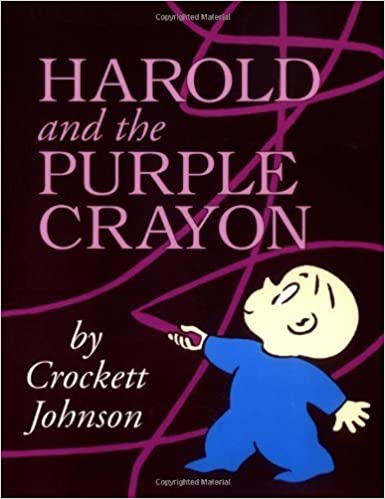
I was a total bookworm as a child. Instead of playing games at recess, I preferred to curl up under my desk and read. Of all the books I read—from every Encyclopedia Brown to Freaky Friday to The Short Stories of Ernest Hemingway (I was a precocious kid), the book with the most enduring impact was also the simplest: Harold and the Purple Crayon. I was enchanted by Harold’s adventures, amazed by his ability to draw his way out of every obstacle and ultimately find his way home. Long before I began seeing this as a metaphor for creativity (and life!), this story appealed to me. Fifty years later, I continue to find new layers of meaning in this little book. It’s a simple yet profound testament to the power of imagination and creativity.

What is one unexpected thing or habit that inspires your writing practice?

sarah chauncey forest new castle

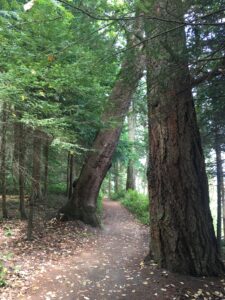
Walking in nature is my creative “secret sauce” and the central practice to my writing. Several years ago, I realized that although my role in this world is as a writer, my job is to bring myself back into presence, over and over, to get into a place where words can flow through me. I walk to get out of my mind and into my body. I come into fierce presence by noticing the rain on my face, salal berries ripening into deep blue, or the texture of earth beneath my feet. When my body is occupied by walking, ideas bubble up from my subconscious. Whether I’m looking for ways to trim an over-long essay or searching for words to evoke a hard-to-articulate experience, as soon as my legs find their rhythm, ideas begin to flow.

Learn More

Book cover

Sounds True | Amazon | Barnes&Noble | Bookshop | Indiebound

Being Witnessed In Grief Is A Powerful Balm For Healin...

Dear friends,

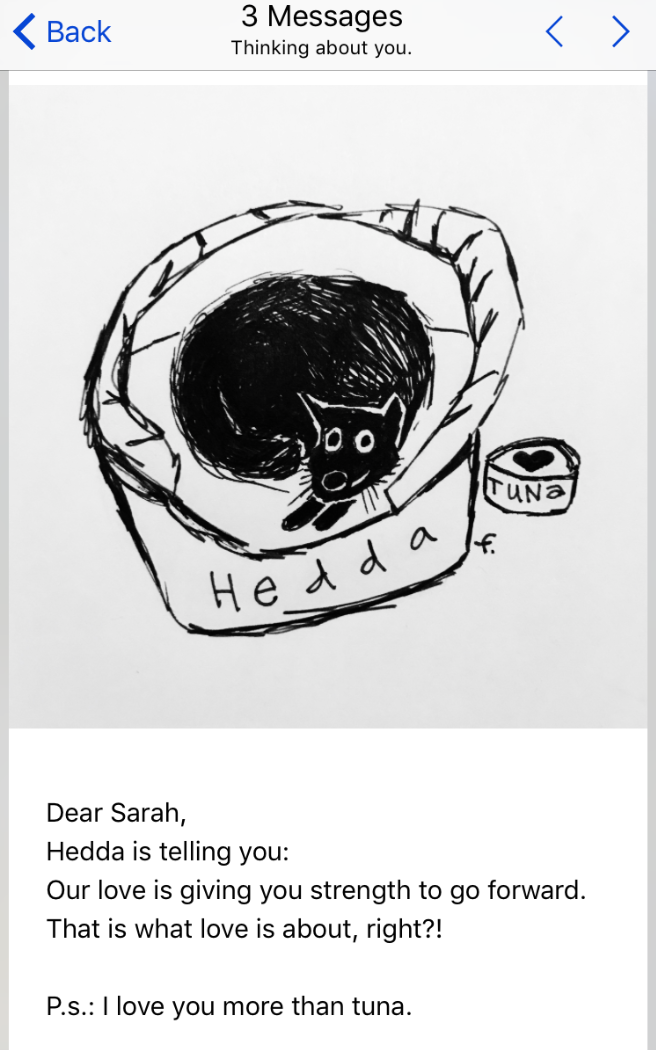
Two days after my cat, Hedda, died in 2016, my friend Francis sent me a sketch with a note “from” Hedda that read, in part, “P.S. I love you more than tuna.” Through my tears, I thought that would be a great book title. I had a clear vision: an illustrated gift book that people would give to friends, family, colleagues, or clients after the loss of their cat. A step beyond a sympathy card, this would be the first “empathy book” for adults grieving the loss of a cat.

Thinking About You - Being Witnessed In Grief Is A Powerful Balm For Healing Blog


Inspired in part by Eckhart Tolle and Patrick McDonnell’s Guardians of Being and Charles M. Schultz’s Happiness is a Warm Puppy, P.S. I Love You More Than Tuna offers comfort and inspiration through New Yorker-style drawings and simple, evocative language. My goal was to make it heartfelt without being cloying.

Every year, six million Americans and Canadians must say a final goodbye to their cats—buddies who leapt into their hearts as kittens, purred away heartbreak through multiple breakups, snuggled by their side in homes large and small, and occasionally deleted folders of work by stretching out on a warm keyboard.

“Pet loss” is considered a disenfranchised form of grief; it’s not culturally sanctioned. We don’t have any universal rituals for this grief, like sitting shiva or holding a wake. This often leaves the bereaved feeling isolated and misunderstood, which compounds the grief and makes healing more difficult.

People grieving companion animals have a need to be seen, their grief validated. Being witnessed in grief is a powerful balm for healing.

Friends of those grieving companion animals are often at a loss for ways to show their support. P.S. I Love You More Than Tuna gives all of us the opportunity to make a profound impact with a simple gesture.

When Francis sent me the sketch and note, I felt seen. Francis’s gift acknowledged the bond I’d had with Hedda and my grief at her death. The present tense of the note also reminded me that Hedda was still with me, even if I couldn’t see her. That was significant in terms of helping me heal, and that’s the comfort I hope P.S. I Love You More Than Tuna will provide to other cat lovers.

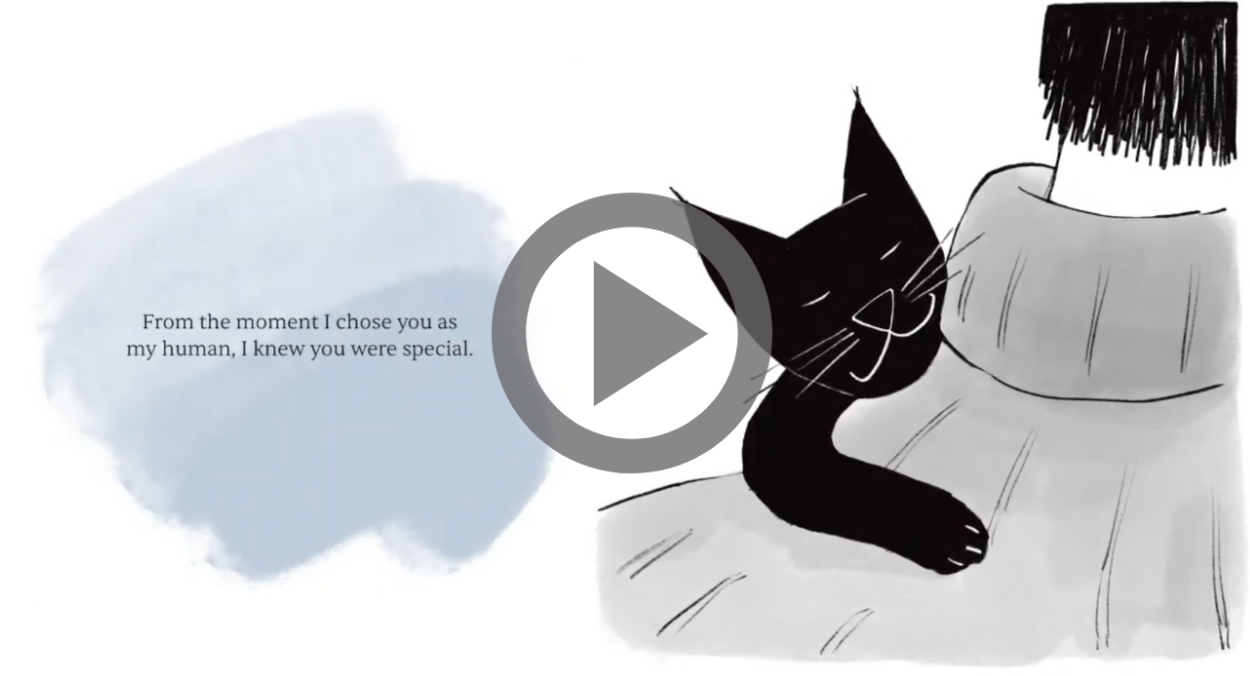
Sounds True has created a lovely video preview for P.S. I Love You More Than Tuna. I hope you’ll check it out below.

Best Friends Animal - Thinking About You - Being Witnessed In Grief Is A Powerful Balm For Healing Blog

Ultimately, I hope this book will benefit the world in multiple ways: for the recipient, witnessing and healing; for the giver, a tangible action they can take to help another; for Best Friends Animal Society, to which I’m donating 10 percent of my proceeds, contributing to their work of keeping pets in the home. This includes helping low-income people connect with resources they need to feed, train, and care for their companion animals. And of course, I hope this will benefit Sounds True and their work in the world, which is quickly becoming more needed than ever.

Take care,

Sarah Chauncey

Book Cover

Amazon  |  Barnes & Noble  |  IndieBound  |  Bookshop
You Might Also Enjoy

Beatrice Chestnut: “Going Deeper with the Enneag...

What if the type you’ve been typing yourself as isn’t the whole story? Tami Simon sits down with Enneagram pioneer Beatrice Chestnut to mark the re-release of her classic guide, The Complete Enneagram, and to ask why facing our shadow, not avoiding it, is the real path to waking up.

Beatrice Chestnut, PhD, is a global expert, researcher, and educator on the Enneagram. She holds a PhD in communication studies and a master’s degree in clinical psychology, and is a licensed psychotherapist, coach, and business consultant based in San Francisco. She is the author of several acclaimed books on the Enneagram, including the newly re-released edition of The Complete Enneagram: 27 Paths to Greater Self-Knowledge, widely considered a classic in Enneagram literature.

In this conversation, Tami and Beatrice explore:

  • The difference between personality (the protective “false self” formed in childhood) and our essential, true nature
  • Why each of the nine Enneagram types has its own distinct shadow challenge to confront and integrate
  • The 27 subtypes, and why Beatrice believes they matter far more than Enneagram “wings”
  • How the connecting lines, or arrows, reveal each type’s specific growth pathway — and why the order matters
  • What each type looks like at its highest, most evolved expression
  • Why more people may be ready to “wake up” to who they really are now than ever before

This episode is for anyone who’s taken an Enneagram test and wondered what to do next, as well as therapists, coaches, and longtime students of the system looking to go deeper with the subtypes.

Listen now to discover your own path to greater self-knowledge. →

This conversation offers genuine transmission, not just concepts about awakening, but the palpable presence of realized teachers exploring the growing edge of spiritual understanding together, and it originally aired on Sounds True One.

Get a FREE month of membership at https://bit.ly/STOne-Free-Month.

Just One Question | Gabor Maté: What Keeps Me from Be...

Why do some of the most hardened people—lifers on death row, people who’ve killed—turn out to be, underneath it all, remarkably sensitive? Physician and trauma expert Dr. Gabor Maté has spent decades working with addicts and prisoners, and he’s found a pattern that upends how we usually think about cruelty and compassion.

Dr. Gabor Maté is a physician and bestselling author whose work on trauma and addiction has shaped how millions understand pain, illness, and healing. He’s the author of In the Realm of Hungry Ghosts, When the Body Says No, Scattered Minds, and, with his son Daniel, The Myth of Normal.

In this conversation, Tami and Gabor explore:

  • Why compassion is wired into us from birth and what shuts it down
  • The neuroscience of care, drawing on affective neuroscientist Jaak Panksepp’s research on emotional systems
  • What Gabor has witnessed firsthand working with lifers and people on death row
  • The difference between “orchid” and “dandelion” temperaments, and why high sensitivity can become either a liability or a gift
  • Why genes linked to addiction may really be genes for sensitivity

This one’s for anyone trying to understand the roots of cruelty, or working through their own compassion fatigue; toward others, or toward themselves.

Taken from the full Insights at the Edge conversation with Gabor Maté titled “Gabor Maté: Healing Principles to Embody in a Traumatized World”

Just One Question | Lissa Rankin: Can Healing Our Trau...

Physician Lissa Rankin says trauma doesn’t just live in the mind; it can trigger measurable physical disease, from autoimmune conditions to chronic illness that conventional medicine can’t explain. But her most provocative claim is the reverse: that healing the nervous system may be the missing piece in reversing illnesses that have resisted every other treatment.

Dr. Rankin, a physician and author of Sacred Medicine and the New York Times bestseller Mind Over Medicine, has spent years studying the link between the nervous system and self-healing, including polyvagal theory and the ventral vagal branch of the vagus nerve. In this conversation with Tami Simon, she widens the definition of trauma well beyond childhood wounds to include systemic racism, environmental toxins, and the everyday stress of simply living in the world today.

In this conversation, Tami and Lissa explore:

  • Why Dr. Rankin believes trauma and chronic illness are intrinsically connected
  • How polyvagal theory and the vagus nerve point to a physical mechanism for healing
  • Why “developmental trauma” can affect even people who had privileged childhoods
  • How collective traumas — like systemic racism and white-body supremacy — show up in the body
  • Why treating trauma isn’t a guarantee of cure, but can still open the door to real healing

This episode is for anyone who has tried everything to heal a chronic or life-threatening illness and wants to understand what role the nervous system might play.

Taken from the full Insights at the Edge conversation with Lissa Rankin, “Is There a Holy Grail of Healing?”