6 Principles for Befriending Yourself: Part II

June 5, 2019

6 Principles for Befriending Yourself, Matt Licata, Jeff Foster


Enjoy this second installment in our new mini-series of Befriending Yourself, written by Jeff Foster and Matt Licata. Want to go deeper? Join their free webinar on Wednesday, June 5! Be sure to register here. 


In our previous excerpt (which you can view here if you missed it!), we discussed the first two principles of befriending yourself:

  1. STOP TRYING TO BE HAPPY (happiness is not something you can “do”)
  2. TRUE MEDITATION IS NOT WHAT YOU THINK (it’s what you are)


And now, we move on to Principles 3 and 4…


3.  “ONE MOMENT AT A TIME” (this one idea could save your life)

Don’t forget, befriending “what is” can only happen one moment at a time.

Actually, that’s all we ever have to face. A single present moment. Life is never truly bigger or more overwhelming than that. Present sounds, sensations, images, urges, impulses, fantasies, feelings, thoughts… we only ever have to process, digest or “deal with” a single instant of life.

Nothing more, nothing less.

Take some time to become curious about what you’re experiencing in a given moment of activation or trigger or stress, instead of shaming or blaming yourself (or others). Don’t abandon the moment when you need yourself more than ever.

Slow down, breathe deeply, open your senses, and acknowledge that you’ve become hooked, triggered, or thrown off center. You have to start by telling the truth of the moment, even if that’s humbling (which it often will be!). Start with, “I’m feeling overwhelmed,” or “I’m feeling really sad,” or “I feel completely lost and exhausted.” Know that this, too, is a holy moment, an invitation to meet yourself in a new way and to flood your experience with loving awareness. An invitation into that alchemical middle territory where the opposites (good and bad, right and wrong, sacred and profane) dance, where we discover the wisdom of immediate experience, and open to a new more creative response.

This “new, creative response” – choosing differently in a moment of overwhelm and activation – is what in neuroscience is referred to as neuroplasticity, that capacity of the brain to form new synapses, to encode new pathways, to rewire. Slowly, over time, as we familiarize ourselves more and more with this middle territory in between the extremes of denial and flooding, finding an “intimacy without fusion,” we begin to make new choices, fostering the miracle of neuroplasticity and the unlimited capacity of the human person to renew itself. This process, while having a scientific foundation, is in fact sacred, the expression of an outrageous sort of grace.

You don’t need to “be present” all day. Or even for a few minutes.

Don’t make “being present” into any kind of goal.

You only need to be present to a single moment.


Now.


It is essential to remember that staying with yourself for very short periods of time is what brings lasting transformation and change. We don’t need to “get in there” and resolve or root out our difficult experience, transcend, or purge it from our systems. This urge to “get to the root of it” (and quickly) is usually an enactment of earlier patterns of self-aggression and only reinforces in the nervous system that there is truly “something wrong.” By “very short periods of time,” we really do mean for a few seconds. For in that “few seconds” a revolution is born.

Over time, that “few seconds” very naturally expands, grows, and evolves on its own, organically as a byproduct of tending to ourselves in a new way, not from an urgent sense that something is wrong which must be fixed or healed very quickly. Trauma and other difficult experience can only unwind in an environment of love, of slow tending, of kindness. Yes, we can push ourselves a little, for a second or two more than might seem comfortable, for this will help us to build our tolerance and craft a scaffolding of love. But no more than that. Otherwise, we’ll just send ourselves outside our “windows of tolerance” and into overwhelm, retraumatization, all the while reinforcing the requirement that we meet future experience with fight-flight-freeze responses.

In other words, when you resist your experience, even very subtly by “trying” too hard to “be present” with it or even “accept” it, you’re still telling the body, there’s an enemy here, something I’m trying to get rid of.  When you slow down and go baby steps, moment by moment, you’re telling the body, it’s okay, I’m safe, this is uncomfortable and intense but I’m present with it, I’m safe. Once this requisite safety and resourcing is built into the nervous system – which happens slowly, one second at a time – then we can more organically, effectively, and compassionately begin to open our hearts to our pain, touch it with deeper levels of warmth, presence, and love, eventually even discovering that our pain is a true friend, an ally on the journey. But we cannot skip stages! We cannot just move straight to acceptance, forgiveness, and love from a field that is unsafe. It is an act of kindness and self-compassion to remember this and to honor where we are. While the mind may tell us, “Oh, just one or two seconds, big deal, can’t you do more than that? That’s not enough, you’ll never heal, you’re going too slowly, you’re falling behind, you’ve failed yet again,” in the reality of the nervous system and the heart, one second is the fertile soil of revolution.

Healing is not a competition. Remember, there is never any goal. There is no urgency on the path of love.

In the field of trauma, “titration” refers to tending to our difficult thoughts, feelings, and raw bodily sensations for a few seconds at a time, then stopping and shifting into a moment of self-nourishment and self-care, and then returning later, when we are ready. Pushing ourselves just a little, nudging ourselves gently into the dark and scary places, but not so much that we fall into overwhelm and flooding or dissociation.

Baby steps are courageous in this work and the material of revolution.

Moment by moment, even our dark and scary experience is bearable.

We cannot tend to the next moment’s pain and intensity, for that is truly overwhelming! We cannot “bear” a future moment of grief or loneliness. Just as we cannot experience or surrender to tomorrow’s sunrise, we cannot tolerate tomorrow’s – or even the next moment’s – fear or sorrow or pain. But we can come to see that this moment’s experience is workable. We can come out of tomorrow’s sadness, the next moment’s depression, and next week’s heartbreak into what is truly here now, which may be a lot more workable and tolerable than you think, not as devastating as you imagine, and in reality only a part of you that longs for a moment of your loving awareness.

A great inner confidence and trust and even joy can build from this. The joy of being alive and knowing we can meet anything life throws at us with courage and breath, slowness and presence. The joy of knowing that the Now is our true home and refuge. The joy of knowing that there is no such thing as a truly “unbearable” moment.


4. SUFFERING IS OPTIONAL (but sometimes pain and grief are inevitable)

What is worse, our pain… or our attempts to escape it (thereby making the pain into an internal enemy, mistake, or error)?

What is worse, our loneliness, fear, or sorrow… or our longing to be free from them, to get rid of them, to purge them from our being?

What is more painful, our pain, or our resistance to it, our refusal to experience it, the ways in which we hurt ourselves (and others) trying to numb ourselves from it? Abandoning ourselves in a moment when we long for true care?

What is worse, our difficult feelings, or the conclusions we’ve come to about what these experiences mean, the voices in the head about what these feelings say about us as a person (“I’m weak, I’m broken, I’m flawed, I’m damaged, I’m not whole, there’s something wrong with me…”) – the ways in which we judge ourselves for being the way we are?

What is worse, the rain as it falls, or our refusal to get wet?

We have come to believe that very ordinary human emotions, thoughts, and urges are in and of themselves the cause of our suffering and struggle. But is it the mere appearance of anger, sadness, disappointment, jealousy, uncertainty, or confusion that is really the problem? Or is it the abandonment of ourselves in the moment when these experiences arise? The shaming and judging of our authentic experience? The habitual conclusions we’ve come to – from our families, cultures, even our spiritualities – about what these very ordinary human experiences mean about us, our value, our worth, our progress along the path?

To take some time in our lives – in our inquiry, meditation, journaling, pondering – and really explore – this is a great gift we can give ourselves (and others). Just what is the source of my struggle and suffering? Is it true that I must convert my sadness to joy, doubt to clarity, rage to happiness, disappointment to gratitude, etc. in order to know true freedom, or is it a more radical invitation I am being called to? To not take anyone’s word for it – including our own! – but to become an alchemist or archaeologist of our own inner world and see.

It can be incredibly liberating and life-giving to discover that the freedom we are longing for is not found from these difficult experiences, but actually in them, at their very core. We continue to be amazed, astonished, and surprised as we witness those we work with as they go into their experience and illuminate this territory – and can be awed at the transformation that many are discovering in this inquiry. As Rumi reminds us, “The cure for the pain is in the pain” – this is a very profound alchemical truth that the ultimate medicine we are seeking is found inside the very wound itself. No, we cannot understand or make sense of this with the mind. But the body knows. The heart knows.

We need not “get rid of,” cure, transform, shift, or “heal” our immediate painful experience in order to be fully alive, connected, and free. When we come to see that it is not the thoughts and feelings, but the process of self-abandonment (turning from ourselves in a moment of activation, stress, or overwhelm and falling into the extremes of denial, repression, dissociation, or engaging in habitual or addictive behavior to cover over our pain) that generates so much of our unnecessary suffering, a new world opens.

Remember, difficult feelings and thoughts are like quicksand. The more you struggle against them, the more they suck you in. As we all know, we can quickly fall down the “rabbit hole” of cascading and looping thoughts and feelings, linking them together and weaving a very convincing story of how we’ve failed, done it wrong, are unlovable, and how there is fundamentally something wrong with us. But slowing down, pausing, feeling our feet on the ground, breathing deeply from our lower belly, we open into a new world. Gently allowing the thoughts and feelings to be here, breathing into them, even if they are intense and uncomfortable. Yes, it may feel counterintuitive to do this, but with some practice, you may come to experience them within the context of a lot of space. Even if they do not “go away,” somehow they release you from their grip when you call off the war and allow them to come and go, as they will by their very nature. Strangely, they may actually be your path to freedom. Release through relaxation, not endlessly “working on yourself” and turning your life into one unending project of self-improvement. We can start to see how even our spiritual and therapy goals can be yet another expression or enactment of a deep and core belief in our unworthiness, where “more” work on ourselves, paradoxically, begins another way to abandon and avoid ourselves as we are.

Of course, a certain amount of pain – physical and emotional – is inevitable, as long as we are alive. But begin to investigate how much of your pain is actually unnecessary. How much of your pain is actually resistance to your pain, thinking about your pain, ruminating on your pain, judging your pain, and judging yourself for having pain. How much of your suffering is actually self-created? You only have to deal with a moment at a time.


We hope you enjoyed this second installment in our new mini-series of Befriending Yourself, written by Jeff Foster and Matt Licata. Want to go deeper? Join their free webinar on Wednesday, June 5! Be sure to register here. 


ABOUT THE AUTHORS

JOIN JEFF FOSTER AND MATT LICATA EACH MONTH IN THEIR NEW “BEFRIENDING YOURSELF” MEMBERSHIP SITE: www.befriendingyourself.com

6 Principles for Befriending Yourself, Matt Licata, Jeff Foster

MATT LICATA

Matt Licata, PhD is a psychotherapist, writer, and independent researcher based in Boulder, Colorado. Over the last 25 years, he has been active in the ongoing dialogue between depth psychological and meditative approaches to emotional healing and spiritual transformation.

His psychotherapy and spiritual counseling practice has specialized in working with yogis, meditators, and seekers of all sorts who have come to a dead-end in their spiritual practice or therapy and are longing for a more embodied, creative, imaginative way to participate in their experience, in relationship with others, and in the sacred world.

Matt’s spiritual path and exploration has been interfaith in nature and includes three decades of study and practice in Vajrayana Buddhism, Sufism, Daoism, and Contemplative Christianity. His psychological training and influences have been in the larger field of relational psychoanalysis, Jung’s analytical and alchemical work, and Hillman’s archetypal psychology, to  name a few. He is the editor of A Healing Space blog and author of The Path is Everywhere: Uncovering the Jewels Hidden Within You (Wandering Yogi Press, 2017) and the forthcoming A Healing Space: Befriending Yourself in Difficult Times (Sounds True, 2020). His website is www.mattlicataphd.com


JEFF FOSTER

Jeff Foster studied Astrophysics at Cambridge University. In his mid-twenties, struggling with chronic shame and suicidal depression, he became addicted to the idea of “spiritual enlightenment” and began a near-obsessive spiritual quest for the ultimate truth of existence. The search came crashing down one day, unexpectedly, with the clear recognition of the non-dual nature of everything and the discovery of the “extraordinary in the ordinary.” Jeff fell in love with the simple present moment, and was given a deep understanding of the root illusion behind all human suffering and seeking.

For over a decade Jeff has been traveling the world offering meetings and retreats, inviting people into a place of radical self-acceptance and “Deep Rest.” He has published several books in over fifteen languages. His latest book is The Joy of True Meditation: Words of Encouragement for Tired Minds and Wild Hearts (New Sarum Press, 2019). His website is www.lifewithoutacentre.com


Jeff Foster

Photo of ()\

Jeff Foster shares from his own awakened experience a way out of seeking fulfillment in the future and into the acceptance of "all this, here and now." He studied astrophysics at Cambridge University. Following a period of depression and physical illness, he embarked on an intensive spiritual search that came to an end with the discovery that life itself was what he had always been seeking.

Foster, Jeff © Emily Goodman


Listen to Tami Simon's in-depth audio podcast interviews with Jeff Foster:
The Deepest Acceptance »
The Deepest Acceptance: Part 2 »
Unconditioned Awareness and the Challenges of Everyday Life »

Matt Licata

Matt Licata, PhD, is a practicing psychotherapist and hosts in-person retreats. His work incorporates developmental, psychoanalytic, and depth psychologies, as well as contemplative, meditative, and mindfulness-based approaches for transformation and healing. He co-facilitates a monthly online membership community called Befriending Yourself, is author of The Path Is Everywhere, and is the creator of the blog A Healing Space. He lives in Boulder, Colorado. For more, visit mattlicataphd.com.

Author photo © Krista Marleena

Listen to Tami Simon's in-depth audio podcast interview with Matt Licata:

The Alchemy Of Befriending Ourselves In Difficult Times  »

Also By Author

Victory! A Poem

Victory!

By Jeff Foster


You don’t have to be the best. 

You don’t have to win. 

You only have to be yourself.


You only have to be real. 

And speak from the heart. 

And know that you have the right to see how you see, 

and think how you think, and feel what you feel, 

and desire what you desire.


You don’t have to be a success in the eyes of the world 

and you don’t have to be an expert on living.


You only have to offer what you offer, 

breathe how you breathe, make mistakes and screw 

up 

and learn to love your stumbling and say the 

wrong thing 

and stop worrying so much about impressing anyone 

because in the end you only have to live with yourself


and joy is not given but found in the deepest 

recesses of your being 

so there can be joy in falling and joy in making 

mistakes 

and joy in making a fool of yourself and joy in 

forgetting joy 

and then holding yourself close as you crumble to 

the ground 

and weep out the old dreams.


Joy is closeness 

with the one you love: 

You.


You don’t have to be the best. 

You really don’t have to win.


You only have to remember this intimacy with 

the sky, the nearness of the mountains and feel the sun 

warming your shoulders and the nape of your neck


and know that you are alive, 

and that you are a success at being alive, 

and that you have won already, 

and you are victorious already, 

without having to prove 

a damn 

thing.


To anyone.

This poem is excerpted from You Were Never Broken: Poems to Save Your Life by Jeff Foster.


jeff fosterJeff Foster shares from his own awakened experience a way out of seeking fulfillment in the future and into the acceptance of “all this, here and now.” He studied astrophysics at Cambridge University. Following a period of depression and physical illness, he embarked on an intensive spiritual search that came to an end with the discovery that life itself was what he had always been seeking.


book cover

Learn More

Sounds True | Amazon | Barnes & Noble | Bookshop

The Courage to Stand Alone

The Courage to Stand Alone

It can be scary when we are called to confront our aloneness, the seemingly infinite depths of that empty, homeless feeling inside of us. When all our old protections fall away and the abandoned and neglected ones inside come begging for our love and attention. It can feel sometimes as though there’s nowhere to turn, like we want to crawl out of our own skin, urgently get out of the Now and into some other time or place.

It takes bravery to stop, breathe, and—slowly, slowly, slowly—turn back toward the lonely, dark, empty “void” inside (in reality, there is no void). To actually turn to face the sense of abandonment buried deep within our guts, to soften into the sense of separation that has been with us for as long as we can remember. We don’t have to make the feeling go away today, only lean into it, breathe into it, begin to make room for it, maybe even learn to trust its presence. 

quote image

Perhaps loneliness is like a cosmic nostalgia, a preverbal memory of a deep womb-connection, with ourselves, with the planet, with every being who has ever lived. In leaning into our own loneliness, shame, and existential anxiety, we may be able to touch into compassion for the loneliness of every human being, for every heart longing to connect, for every grieving heart, every frightened heart. 

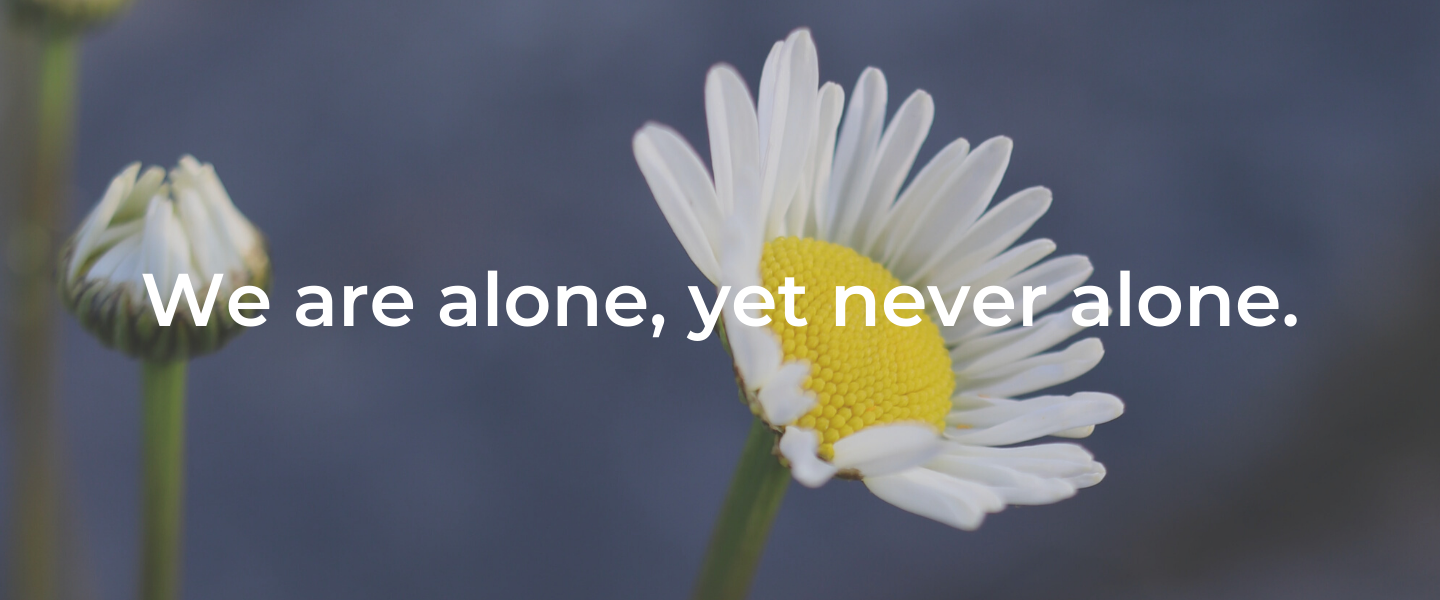
We are alone, yet never alone. This is the great paradox of existence. Our loneliness, when not resisted or numbed away, may actually end up connecting us more deeply to life and each other, like it did for me and my sweet father that winter evening. 

Let us learn to be alone, then! Alone, without distraction, which is true meditation. Alone, communing with the breath as it rises and falls. Alone with the mind and its incredible dance. Alone with the rain and the morning sun. Alone with the crackle of autumn leaves under our feet, or the crunch of winter snow. Alone with the hopes and joys and anxieties of this human form, living a single day on this remarkable planet. Alone with our precious selves, with this unfathomable sense of connection to all things, with birth and loss and death and their myriad mysteries. 

Alone, with all of life.

This is an excerpt from You Were Never Broken: Poems to Save Your Life by Jeff Foster.

jeff fosterJeff Foster shares from his own awakened experience a way out of seeking fulfillment in the future and into the acceptance of “all this, here and now.” He studied astrophysics at Cambridge University. Following a period of depression and physical illness, he embarked on an intensive spiritual search that came to an end with the discovery that life itself was what he had always been seeking.


book image of excerpt on lonliness

Learn More

Sounds True | Amazon | Barnes & Noble | Bookshop

Into the Belly of Meditation

Into the Belly of Meditation

By Jeff Foster


You are weary, friend. 

Sit. 

You are thirsty. 

Here. Drink.


You are hungry. Here. Take this. 

A piece of bread. 

A small bowl of soup. 

See how God has taken form! 

It is all I have but it will keep you alive.

image 1

I will light a fire that will never go out. 

A sacred flame. Unconditional in its burning. 

To illuminate us in the darkness.


Oh. I see you are wounded. 

Bruised. Bleeding.

Exhausted from the world. 

You have suffered much, I know.


image 2

Come. 

Take off these dirty rags. 

Don’t worry. It’s safe. 

There is strength in your nakedness.


Here. Wash. 

Rub this medicine onto your wounds.


Put on these robes, they are clean and dry. 

Lie down. Close your eyes. 

I will watch over us tonight.

image 3

Listen. You have not failed. 

I see new life breaking through. 

I see birth. An insurrection. 

The sharp edge of hope.


I have no teaching for you. 

No wise words.


I only want you to trust what you are going through. 

To bring this fire inside of you.

Until the end.


I have known this pain. Yes. 

This courage to keep moving. Yes. 

This courage to rest, too.

The sacrifice of the known world.

image 1

Friend. 

Drop into the belly of meditation now. 

The place you were always seeking. 

The vast silence at the Earth’s core which is your own core. 

Breathing into the gut now. 

The throat. The chest. 

Irradiating the nervous system with unspeakable 

tenderness. 

Flooding the body with soft, warm light. 

Drenching the human form with divine love. 

And sleep. 

And sleep.

image 2

I may not be here when you wake. 

We may not meet again in form.


Yet I leave you with all you need. 

Food. Water. A bed. 

A chance to rest. 

A touch of kindness.

And your unbreakable Self.

flowers

This poem is excerpted from You Were Never Broken: Poems to Save Your Life by Jeff Foster.


jeff fosterJeff Foster shares from his own awakened experience a way out of seeking fulfillment in the future and into the acceptance of “all this, here and now.” He studied astrophysics at Cambridge University. Following a period of depression and physical illness, he embarked on an intensive spiritual search that came to an end with the discovery that life itself was what he had always been seeking.


you were never broken cover

Learn More

Sounds True | Amazon | Barnes & Noble | Bookshop


You Might Also Enjoy

David Whyte on Being at the Frontier of Your Identity

There is a particular kind of tiredness that comes from trying to hold a fixed idea of who we are, year after year, as everything around us keeps changing anyway. David Whyte built an entire body of work around that tension, and Sounds True founder Tami Simon has called her conversation with him one of the most beloved episodes in Insights at the Edge history, still resonating with new listeners more than a decade after it first aired. Something about the way Whyte speaks, unhurried and image-rich, seems to reach people in exactly the season of life where old answers have quietly stopped working.

Sounds True has carried David Whyte’s poetry, prose, and audio programs for years because few voices manage to speak so plainly to both the individual soul and the modern workplace at once. His willingness to bring genuine poetry into rooms built for spreadsheets and quarterly targets reflects the same spirit our founder set out to preserve back in 1985: teaching captured in its own unscripted, living voice. 

What follows traces the frontier Whyte describes between who we were and who we are becoming, how exile trains us for that edge, and why a Yorkshire poet ended up teaching creativity inside boardrooms at Boeing and American Express.

Key Takeaways:

  • Originality Has an Address: Learn why David Whyte locates creativity at the frontier of identity, not behind it.
  • Exile Is a Skill: Understand why Whyte treats feeling like an outsider as something to develop, not escape.
  • Poetry Enters the Boardroom: See how poetry and leadership intersect in Whyte’s decades of corporate work.

Learn Practices for Self-Compassion with Sounds True.

Originality Lives at the Edge, Not the Center

Whyte traces originality back to what he calls an edge identity, a frontier conversation that shows up across many of the world’s wisdom traditions. Reality itself, in his framing, is conversational rather than fixed, which means the self is never a finished project so much as an ongoing exchange with everything it meets. 

Sounds True’s founder has described sitting with fourteen pages of notes on his teaching and underlining nearly every line, a reaction that says something about how differently Whyte approaches familiar questions of purpose and change, treating originality as a place a person stands rather than a trait they possess. 

You can hear the full exchange in David Whyte on Being at the Frontier of Your Identity, still one of the most requested episodes in the archive.

Exile as a Core Human Competency

Rather than treating exile, the felt sense of not quite belonging, as a wound to heal, Whyte reframes it as a competency worth developing on purpose. Most people spend enormous energy trying to eliminate the feeling of being an outsider, whereas Whyte suggests the more useful move is to learn to work with it deliberately. A few ideas anchor this reframing:

  • Exile Sharpens Perception: Standing slightly outside a group often reveals what belonging obscures.
  • Competency, Not Condition: Whyte treats exile as a trainable skill rather than permanent exclusion.
  • Frontier Over Center: Growth tends to happen at edges, not in comfortable middles.

This distinction matters because it removes the shame often attached to feeling like an outsider. Instead of a problem to solve, exile becomes a vantage point worth returning to on purpose.

The Frontier of Identity as a Living Threshold

The frontier of identity, Whyte’s central image, is not a line crossed once and left behind. It is a threshold a person returns to repeatedly, every time old certainties no longer fit a new season of life. Whyte suggests that vulnerability, often treated as weakness, actually functions here as enhanced perception, a heightened sensitivity that lets a person notice what a settled identity tends to miss.

He describes reality itself as conversational, meaning the self is shaped less by fixed traits and more by an ongoing exchange with circumstances, relationships, and unexpected turns. Standing at this frontier repeatedly, rather than resolving it once, is what Whyte considers the actual work of a lived, honest life.

Insight Is The First Step Toward Growth. Broaden Your Horizons With Sounds True.

Poetry and Leadership: An Unlikely Partnership

Long before this conversation, Whyte had already built a second career inside corporate life, consulting for companies including Boeing, Kodak, and American Express. His bestselling book, The Heart Aroused, argued that corporations suffered from too little poetry and too little humanity, a critique that landed him on business bestseller lists rather than only poetry shelves. This pairing of poetry and leadership runs through nearly everything Whyte has written since, treating verse not as decoration for executives but as a discipline for genuine reflection.

Whyte has predicted that the very word manager will eventually give way to something more alive with possibility, a shift he sees poetry as uniquely equipped to prepare leaders for. Rather than offering leadership frameworks or checklists, his workshops use verse to slow a room down enough to notice what usual business language tends to skip over entirely.

  • Work as Pilgrimage: Whyte frames a career less as a task list and more as a journey of identity.
  • Burnout Reconsidered: He suggests exhaustion can signal a need for renewal, not simple failure.
  • Conversational Leadership: Genuine leadership, in his view, requires ongoing dialogue, not fixed authority.

Tapping the Invisible Support That Surrounds Us

Whyte closes much of his teaching on a note of quiet reassurance: that unseen support often surrounds a person exactly when they feel most exposed at the frontier of their own becoming. Recognizing this support, rather than assuming isolation, changes how a person approaches uncertainty, whether it shows up as a career change, a creative block, or a simple shift in how someone sees themselves.

Where Poetry Meets Everyday Attention

Whyte often describes a good poem as revelatory, something that takes hold of a reader and surprises them into new understanding rather than confirming what they already believed. This distinction matters for how he teaches: poetry, in his hands, is not a retreat from ordinary life but a way of paying closer attention to it. A single well-chosen image, he suggests, can reorganize how someone relates to a problem that logic alone has failed to move.

Awaken Your Inner Healing Power

Final Thoughts

David Whyte’s teaching never promises a finished self waiting somewhere ahead. It offers something steadier: the frontier itself as home ground, revisited again and again across a lifetime of work and relationship. What makes this conversation endure, more than a decade after it first aired, may be exactly that refusal to offer a tidy arrival point. 

Sounds True keeps returning to this conversation because it captures exactly what our mission asks of us, waking up to the edges we usually try to avoid rather than the comfortable center we think we want.

If Whyte’s words found you today, his fuller catalog of poetry and prose is waiting to keep the conversation going, one frontier at a time.

Frequently Asked Questions About David Whyte

Who is David Whyte?

He is a Yorkshire-born poet, author, and Fortune 500 consultant known for blending poetry with leadership.

What Sounds True programs feature David Whyte?

Sounds True has released Clear Mind, Wild Heart and What to Remember When Waking with David Whyte.

Does David Whyte only write poetry?

No, he has also authored prose books, including Crossing the Unknown Sea and The Heart Aroused.

What companies has Whyte worked with as a consultant?

He has led workshops at Boeing, Kodak, American Express, and Bristol-Myers Squibb, among others.

What podcast features this conversation with Whyte?

It appears on Insights at the Edge, hosted by Sounds True founder Tami Simon.

Is this conversation relevant outside creative fields?

Yes, Whyte’s ideas on identity and leadership apply broadly across careers, relationships, and life stages.

Where can I explore more spiritual teachers like David Whyte?

Visit our All Teachers & Authors page to browse voices across many traditions and disciplines.

Does Sounds True offer related content on purpose and vocation?

Yes, related titles appear throughout our Conscious Business and Spirituality & Awakening collections.

Michelle Cassandra Johnson is an author, activist, spiritual teacher, racial equity consultant, and intuitive healer. She is the author of six books, including Skill in Action and Finding Refuge. Amy Burtaine is a leadership coach and racial equity trainer. With Robin DiAngelo, she is the coauthor of The Facilitator's Guide for White Affinity Groups. For more, visit https://www.michellecjohnson.com/wisdom-of-the-hive.

Reverend angel Kyodo williams: Warrior Spirit

Most people come to meditation looking for a break, a few quiet minutes away from a world that rarely slows down on its own. Reverend angel Kyodo williams spends much of this conversation gently taking apart that assumption, suggesting that real stillness was never about leaving the world behind at all. It’s a small shift in framing that ends up changing everything about how the rest of her teaching lands.

Rev. angel is an ordained Zen priest, activist, and founder of the Center for Transformative Change, recognized as the world’s second female Zen teacher of African descent and the author of Being Black and Radical Dharma. 

Sounds True has featured her teaching across our Meditation Summit and A Year of Mindfulness precisely because she refuses to separate inner practice from outer justice, treating the two as a single continuous act rather than competing priorities. What follows traces her case for a warrior spirit built on presence rather than escape, and the meditation practice she offers as its foundation.

Key Takeaways:

  • Retreat Isn’t the Goal: Learn why angel Kyodo williams reframes meditation as engagement, not escape.
  • Effort Meets Release: Understand the meditation practice she developed for people doing social change work.
  • A Different Kind of Fearlessness: See what warrior spirit means when it’s rooted in love rather than force.

Retreat Is Not What It Looks Like From Outside

Rev. angel opens by naming something many practitioners feel but rarely say aloud: the pull toward meditation often comes wrapped in a longing to retreat from an overwhelming world. She doesn’t dismiss that longing, but she does redirect it, suggesting that genuine practice engages our inner fullness rather than fleeing from outer noise. What looks like withdrawal from the outside, she argues, is closer to a deepening than a departure, a distinction that reframes the entire purpose of sitting down to practice in the first place.

Learn Practices for Self-Compassion with Sounds True.

Effort and Release Meditation: A Practice Born From Movement Work

Rev. angel developed a specific meditation practice she calls Effort and Release after years spent working alongside people doing demanding social change work. The practice blends deliberate effort with intentional letting go, addressing a pattern she noticed constantly among activists and organizers: a strong pull toward doing, accomplishing, and pushing that rarely leaves room for rest. She describes meditation and social change as inseparable, since the way a person relates to their own mind directly shapes what they find themselves willing to engage with in the wider world.

  • Naming the Pattern: Many changemakers carry a constant urgency that outlasts any single campaign, even during rest.
  • Effort With Purpose: The practice doesn’t reject action, only unconscious, exhausting overdrive.
  • Release as Skill: Letting go is treated as an active discipline, not passive collapse or avoidance.

Hear the complete teaching in her episode, Reverend angel Kyodo williams: Warrior Spirit

Inner Life and Outer World as One Continuous Fabric

A central thread running through Rev. Angel’s teaching rejects any hard line between internal awareness and external action. She describes our self-talk, the noise level of our minds, and our capacity for presence as directly shaping how we show up for others and what we find acceptable in the wider world. This isn’t a metaphor for her; it’s closer to a working principle behind everything she teaches, from meditation instruction to movement strategy. 

What we tolerate in the world outside us, she suggests, tends to trace directly back to what we’ve grown accustomed to tolerating within our own minds first, which is why she treats internal clarity as a precondition for meaningful external change rather than a separate, optional pursuit.

Warrior Spirit Rooted in Fearlessness, Not Force

The phrase “warrior spirit,” drawn from her earlier book Being Black, describes something quite different from combativeness or aggression directed outward at the world. For Rev. Angel, this spirit is built on truth-telling and responsibility, a foundation for genuine happiness rather than a posture of defensiveness. It asks practitioners to stay engaged with difficulty, including the difficulty of racism, patriarchy, and other inherited harms, rather than looking away or numbing out. This framing has resonated widely since the book’s original publication, offering readers across many backgrounds a way to hold fearlessness and tenderness together rather than treating them as opposites.

  • Truth Before Comfort: Warrior spirit requires naming what’s actually happening, even when it’s unwelcome.
  • Grace Alongside Fearlessness: Strength and tenderness are treated as complementary, not opposites.
  • Responsibility as Practice: Taking ownership of one’s own patterns becomes part of the discipline itself.

Build Relationships That Nourish and Sustain.

Bridging Personal Transformation and Collective Justice

Rev. angel has spent more than fifteen years shaping what she calls Transformative Social Change, a field built on the belief that lasting justice work requires equally serious inner work. She resists treating meditation as a private escape hatch separate from activism, instead framing contemplative practice as fuel for sustained, clear-eyed engagement with collective harm. Burnout among organizers, in her view, often stems from skipping this inner dimension entirely, treating stillness as optional rather than structural to the work itself. She has described this field as one she helped name and shape, watching it grow from a personal conviction into a recognized approach embraced across activist and spiritual communities alike.

What Radical Dharma Adds to This Conversation

Rev. Angel’s later book, Radical Dharma, co-written with Lama Rod Owens and Jasmine Syedullah, extends this same warrior spirit into a direct examination of race, love, and liberation within Buddhist communities themselves. The book argues that spiritual communities are not exempt from the patterns of harm found elsewhere in society, and that genuine awakening has to include an honest reckoning with those patterns rather than a spiritual bypass around them. This willingness to hold institutions, including her own tradition, accountable runs consistently through everything she teaches, from her earliest writing through her more recent contributions to Sounds True’s programming.

Awaken Your Inner Healing Power

Final Thoughts

Reverend angel Kyodo williams doesn’t offer meditation as a rest stop from the world’s demands. She offers it as a training ground for staying present with those demands without losing ourselves inside them. That distinction, subtle but significant, may be exactly what separates spiritual bypass from spiritual maturity, and it’s the thread that ties her meditation teaching to her justice work without contradiction. Listeners who come looking for a quick escape often leave with something more durable instead: a practice for staying rooted precisely where things are hardest. 

Sounds True continues sharing her teaching because our mission to wake up the world has never meant looking away from what’s hardest to face, and few teachers hold that tension as steadily as she does. Her books and audio programs remain in our library for anyone ready to bring the same steadiness into their own life and work.

Frequently Asked Questions About angel Kyodo williams

Who is Reverend angel Kyodo williams?

She is an ordained Zen priest, activist, author, and founder of the Center for Transformative Change.

What books has she written?

Her books include Being Black: Zen and the Art of Living with Fearlessness and Grace and Radical Dharma.

What is the Effort and Release practice?

A meditation method blending deliberate effort with intentional letting go, developed for activists and organizers.

Is this teaching only relevant to activists?

No, her ideas on presence and inner work apply to anyone navigating stress, urgency, or burnout in daily life.

What does warrior spirit mean in her teaching?

A fearless, truth-telling posture grounded in responsibility and grace, not aggression or combativeness.

Has Sounds True featured her in other programs?

Yes, she has appeared in Sounds True’s Meditation Summit and A Year of Mindfulness series.

What is the Center for Transformative Change?

An organization she founded connecting inner personal work with large-scale social transformation.

Where can I hear more conversations like this one?

Explore our Insights at the Edge Podcast for further interviews on mindfulness, justice, and social engagement.

Michelle Cassandra Johnson is an author, activist, spiritual teacher, racial equity consultant, and intuitive healer. She is the author of six books, including Skill in Action and Finding Refuge. Amy Burtaine is a leadership coach and racial equity trainer. With Robin DiAngelo, she is the coauthor of The Facilitator's Guide for White Affinity Groups. For more, visit https://www.michellecjohnson.com/wisdom-of-the-hive.

Iyanla Vanzant On Truth Is Light

What happens when the world around you feels like it has lost its grip on truth, and you’re left wondering how to hold onto faith anyway? That question sits at the heart of the exchange between Tami Simon and Iyanla Vanzant, one of the most trusted voices in personal empowerment today. 

Over 40 years, we at Sounds True have been devoted to bringing you the living wisdom of teachers like Iyanla Vanzant, an author of five New York Times bestsellers and a familiar face to millions as the host of Iyanla: Fix My Life. As the world’s largest living library of transformational teachings, and home to Tami Simon’s Insights at the Edge, we exist to preserve these conversations in their true, unscripted form. 

What Iyanla and Tami uncovered reaches into territory many of us have been quietly longing to name: intimacy with the divine, the erosion of trust and integrity, and the calling that shapes who you really are. 

Key Takeaways:

  • Faith Is a Practice, Not a Belief: Intimacy with the divine is a relationship you return to daily. Iyanla Vanzant reminds us that faith in difficult times is the practice that keeps you grounded when certainty runs out and the path forward feels unclear. 
  • Reclaiming Values We’ve Lost: Integrity, accountability, and trust are slipping quietly from modern life. Iyanla Vanzant and Tami Simon reflect on what this costs us personally and collectively, and what it takes to reclaim these values through honest daily living. 
  • Your Calling Reveals Your True Self: Rather than searching for purpose separately from identity, Iyanla Vanzant teaches that answering your calling is what gives birth to your most authentic self, with truth as the light that makes the path visible.

Cultivating Intimacy With The Divine

At the heart of what Iyanla Vanzant shares is something many of us long for but rarely name aloud: an intimate, ongoing relationship with God. A living connection you return to daily, the way you would a trusted friend. This is where everything else begins. 

Iyanla Vanzant reminds us that faith is lived, returned to moment by moment, a practice built most steadily through the very times when doubt feels easier than trust. That distinction matters more than it might first appear. Trying times reveal whether your faith is a story you tell about yourself or a relationship you live inside, moment by moment, choice by choice. 

We invite you to sit with that difference for a moment. Where in your life are you being asked to move from believing in something to actually leaning into it, even when the outcome is not yet clear, and even when trust feels like the harder path?

Find Teachings that Speak to You With Sounds True.

Values We’re Losing And Why They Matter

Beyond the personal work of faith, Iyanla Vanzant and Tami Simon turn their attention outward to something both women see slipping away in modern life. It is a quiet loss, the kind that shows up in small daily interactions long before it becomes a headline. Their conversation names three specific casualties worth sitting with:

Integrity

Iyanla Vanzant speaks to integrity as something deeper than simply telling the truth. The alignment between what you say, what you believe, and how you show up in the world each day. When that alignment breaks down, even in small ways, something essential within a community begins to quietly erode. A person who values honesty but withholds difficult truths from the people they love is already living out of alignment. 

Accountability

Accountability emerges as a value that seems increasingly rare: the willingness to own your actions and their consequences without deflecting or minimizing what happened. Iyanla Vanzant and Tami Simon reflect on what it costs a society when people stop holding themselves responsible to one another and to the truth. When accountability disappears from daily life, trust erodes alongside it, and the small moments of honesty that rebuild it become more vital. 

Trust

Perhaps most tender is their reflection on trust itself. Iyanla Vanzant speaks to how trust, once assumed as a baseline of human connection, now feels harder to extend and even harder to earn back. That raises an honest question about what it truly takes to rebuild something so foundational to how we relate. 

Build Relationships That Nourish and Sustain.

Your Unique Calling And The Self It Reveals

The exchange moves toward something deeply personal: the idea that every person carries a calling that is theirs alone to discover. Iyanla Vanzant and Tami Simon treat this as a truth available to anyone willing to sit with it. Three related threads open from there: 

  • Everyone Carries A Calling: Iyanla Vanzant speaks to the idea that a calling is not something reserved for the chosen few. It belongs to every person, waiting to be recognized rather than invented. This reframes the search for purpose as less about creating something entirely new and more about quietly uncovering what was already there within you all along.
  • Calling As The Birthplace Of Authenticity: Iyanla Vanzant and Tami Simon reflect on how answering your calling is what gives rise to your most authentic self. Purpose and identity are born together. The calling gradually shapes who you become, gently and surely, as you live in closer alignment with what you are here to do. Many of us spend years trying to figure out who we are before we feel ready to act. 
  • Truth As The Light That Reveals The Path: This is where Iyanla Vanzant on Truth Is Light offers its most grounding insight: truth is the light that makes your calling visible. Living honestly, with yourself and with what you believe, is what allows your calling to come into focus, clearing away the confusion and doubt that keep it hidden.

Center Yourself With Meditative Teachings by Sounds True

Final Thoughts

What stays with you is a felt sense of what it means to live honestly, with yourself, with the divine, and with the people around you. Iyanla Vanzant and Tami Simon remind us that faith in difficult times is about staying in relationship with something larger than the moment you are in, even when that moment feels unresolved. The quiet challenge they leave us with is this: notice where integrity, accountability, and trust have faded in your own life, and consider what living in closer alignment with your true calling might look like.

The teachings Iyanla Vanzant brings forward are part of a larger body of work we have been honored to carry for over 40 years. At Sounds True, we believe that wisdom shared becomes wisdom lived. Wherever these ideas meet something real in you, we encourage you to keep going. Our courses, community, and programs are here to hold you as you do.

Frequently Asked Questions About Iyanla Vanzant On Truth Is Light

Who is Iyanla Vanzant?

Iyanla Vanzant is an author and television host known for five New York Times bestsellers and her role as host of Iyanla: Fix My Life, along with several audio programs created with Sounds True.

What is this Iyanla Vanzant episode about?

This episode is a conversation between Iyanla Vanzant and Tami Simon exploring intimacy with the divine, fading values like trust and integrity, and the unique calling that shapes your most authentic self.

How do I hold onto faith when life feels hard?

Iyanla Vanzant reminds us that faith is not something you simply have but something you practice daily, especially when life gives you every reason to doubt and lose your footing.

Why do integrity, accountability, and trust matter so much right now?

Iyanla Vanzant and Tami Simon reflect on these values as ones quietly fading from modern life, and what is lost personally and collectively when we stop holding each other accountable.

How do I discover my own calling?

Iyanla Vanzant teaches that your calling is uncovered through living in truth with yourself, not invented from scratch. Our online courses offer structured paths for going deeper into this kind of work.

What does it mean to cultivate intimacy with God?

For Iyanla Vanzant, intimacy with the divine means a living, ongoing connection you return to daily, much like a trusted friendship, rather than a distant faith reserved only for hard times.

Where can I listen to more conversations like this one?

You can hear the full episode on Insights at the Edge, and find more conversations like it through Sounds True One, our community membership for ongoing teachings.

Michelle Cassandra Johnson is an author, activist, spiritual teacher, racial equity consultant, and intuitive healer. She is the author of six books, including Skill in Action and Finding Refuge. Amy Burtaine is a leadership coach and racial equity trainer. With Robin DiAngelo, she is the coauthor of The Facilitator's Guide for White Affinity Groups. For more, visit https://www.michellecjohnson.com/wisdom-of-the-hive.

One comment on “6 Principles for Befriending Yourself: Part II”

  1. Tui says:

    The idea of micro – meditations has been around for a long time now. However, neuroplasticity doesn’t seem to be explained and understood fully by the author of this text.

Leave a Reply

Your email address will not be published. Required fields are marked *