Though I’m fairly certain you’ve heard otherwise, emotions are a vital part of everything you are: every thought, every choice, every relationship, every dream, every failure, every triumph, every act of violence, and every act of love. When you can learn their language, you can change your life for the better.
And when we can all learn their language, we can change the world.
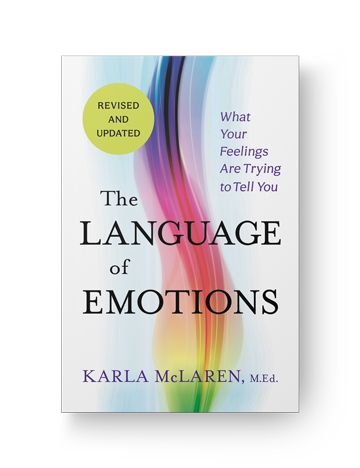
Hello! I’m Karla McLaren, and I’m excited to announce the upcoming release of the revised and updated edition of The Language of Emotions: What Your Feelings Are Trying to Tell You, which will be available in bookstores on June 27th.
Whether you’re a reader of the original Language of Emotions, or if you’re new to this work, I welcome you to this complete guide to the wisdom in every emotion you have.
The original 2010 version of The Language of Emotions was the first book to approach the emotions in terms of how they function, what they do, and how to work with them. Instead of treating emotions as problems to be solved or eradicated, I focused on them as essential aspects of meaning-making, behavior, and intelligence (which is what they truly are). I approached the emotional realm as an intelligent system that requires all of its members, including tragically disrespected emotions such as shame, anxiety, depression, jealousy, envy, panic, and the suicidal urge (among others). And in so doing, I discovered the healing messages inside all emotions.
But because most of us have been taught to distrust emotions, I was working without a net as I wrote the original version of this book, and I missed some things. Now, after more than a decade of further research and practice, and with the support and camaraderie of an international community of colleagues and friends, I’ve had the opportunity to understand the emotions more deeply.
For centuries, emotions have been repressed, idealized, distrusted, and even despised, yet they were never truly understood. I’m honored to share this updated celebration of the brilliance, ingenuity, healing power, and jaw-dropping genius of our emotions.
Welcome!
Karla McLaren, M.Ed.
Karla McLaren, M.Ed., is an award-winning author, social science researcher, and empathy innovator. She is CEO of Emotion Dynamics Inc., developer of Dynamic Emotional Integration®, and creator of EmpathyAcademy.org. Karla is the author of Embracing Anxiety, The Dynamic Emotional Integration Workbook, The Art of Empathy, The Power of Emotions at Work, and the multimedia online course Emotional Flow: Becoming Fluent in the Language of Emotions. For more, visit karlamclaren.com.
Karla McLaren, M.Ed., is an award-winning author, social science researcher, and empathy innovator. She is CEO of Emotion Dynamics, developer of Dynamic Emotional Integration®, and creator of EmpathyAcademy.org. Karla is the author of Embracing Anxiety, The Dynamic Emotional Integration Workbook, The Art of Empathy, The Power of Emotions at Work, and the multimedia online course Emotional Flow: Becoming Fluent in the Language of Emotions. For more, visit karlamclaren.com.
Emotions are Vital Aspects of Thinking, Acting, and Working
People once believed that emotions were the opposite of rationality, or that they were lower than or inferior to our allegedly logical processes. But decades of research on emotions and the brain have overturned those outdated beliefs, and we understand now that emotions are indispensable parts of rationality, logic, and consciousness itself. In fact, emotions contain their own internal logic, and they help us orient ourselves successfully within our social environments. Emotions help us attach meaning to data, they help us understand ourselves and others, and they help us identify problems and opportunities. Emotions don’t get in the way of rationality; they lead the way, because they’re vital to everything we think and everything we do. Emotions aren’t the problem; they’re pointing to the problem, and they’re trying to bring us the precise intelligence and energy we need to deal with the problem.
In this book, we’ll learn how to listen to emotions as uniquely intelligent carriers of information, and how to build healthy and effective social and emotional environments at work – not by ignoring or silencing emotions (you can’t), but by listening to them closely, learning their language, and creating a communal set of emotional skills that everyone can rely on. This work is not difficult at all, but it can be unusual in an environment that wrongly treats emotions as soft, irrational, or unprofessional.
The serious problems we’ve baked into the workplace don’t come from any specific management style or ideology, so I won’t focus on managers or leaders as if they’re uniquely powerful or uniquely to blame. These problems also aren’t limited to specific occupations or income brackets (though low-wage work is regularly dehumanizing and hazardous); these are long-term, widespread problems based on a failed workplace model – and on an outdated social and emotional approach that does not support (or in many cases, even comprehend) human relationships and human needs.
This book is the result of decades of exploration and study into how the workplace got to be so unworkable, plus decades of experience in how to access the existing genius in people’s emotional responses (in surprisingly simple ways once you understand how emotions and empathy work). With the help of the genius in our emotions, we can create emotionally well-regulated and worthwhile places for all of us to earn our living and spend our lives.
Luckily, we don’t have to do anything special to welcome emotions into the workplace, or even to make room for them, because emotions are and always have been in the workplace. They’re in the responses people have to workplace abuses; they’re in disengaged workers; they’re in workers seeking other jobs while on the job; they’re in workers who rightly avoid communicating upward about serious problems; they’re in low-wage workers who learn how to survive in hellscapes like call centers, fast-food restaurants, gig work, and robot-like warehouse jobs; they’re in living-wage workers who tolerate unhealthy workplaces because they can’t afford to leave their health insurance behind; and they’re in high-wage workers who may have to bow down to their superiors and compete with their colleagues to be seen as “winners” – and whose experiences of workplace abuse may not be taken seriously because they make so much money and therefore have no right to complain.
We can also see the emotions in our responses to workplace successes; in our healthy working relationships; in the ways we gather together to solve problems; in the ways empathic workers and leaders empower everyone around them; in the ways our colleagues support us when we’re struggling; in the ways businesses step up in times of loss; in the ways we create open communication and humane workflows; in the ways we teach each other; in the benefits, support, flexibility, and living wages we provide for our workers; in the honest sharing of business difficulties or financial losses; and in the laughter we share on great days and rotten days.
Emotions are everywhere in the workplace because emotions are a central feature of human nature. They aren’t removable, and in fact, trying to remove them is a huge part of what created the failed workplace model we have today. Emotions are crucial to everything we do and to every aspect of our work; therefore, we’ll learn how to listen to emotions, work with them, and respect their intelligence. And in so doing, we’ll build a better workplace – and a better world – from the ground up.
Karla McLaren, M.Ed.
Karla McLaren, M.Ed., is an award-winning author, social science researcher, and empathy innovator. Explore her books and audios on the power of emotion and creativity here.
This is part of a Conscious Business series brought to you by The Inner MBA®. You can learn more about the program at Innermbaprogram.com
Lorem ipsum dolor sit amet, consectetur adipiscing elit. Ut elit tellus, luctus nec ullamcorper mattis, pulvinar dapibus leo.
Karla McLaren, M.Ed., is an award-winning author, social science researcher, and empathy innovator. She is CEO of Emotion Dynamics Inc., developer of Dynamic Emotional Integration®, and creator of EmpathyAcademy.org. Karla is the author of Embracing Anxiety, The Dynamic Emotional Integration Workbook, The Art of Empathy, The Power of Emotions at Work, and the multimedia online course Emotional Flow: Becoming Fluent in the Language of Emotions. For more, visit karlamclaren.com.
Karla McLaren is an award-winning author, social science researcher, and renowned expert in emotions and empathy. Her work focuses on her grand unified theory of emotions, which reconsiders how we think of “negative” emotions and opens new pathways into self-awareness, communication, and empathy. With Sounds True, Karla is the author of the landmark book The Language of Emotions, a book on The Art of Empathy, and a new book called The Power of Emotions at Work: Accessing the Vital Intelligence in Your Workplace. In this episode of Insights at the Edge, Tami Simon speaks with Karla about why the full range of emotions is necessary for us to bring forth our best thinking. They discuss the “toxic positivity bias” that has become the norm in the contemporary workplace, how this leads to widespread suffering and dysfunction, and how we can achieve an “emotionally well-regulated” workplace that works for all of us.
What if aging isn’t the slow closing of your erotic life, but the doorway into its most alive season?
This week, Tami Simon speaks with Kimberly Ann Johnson—sexological body worker, somatic experiencing practitioner, birth doula, and author of the new Sounds True book Erotic Seasons: Tuning In to the Rhythms of Women’s Sexuality and Spirituality—about what she calls erotic sovereignty, and the sentence that closes her book: the female body is its own spiritual path.
Join Tami and Kimberly to explore:
Erotic sovereignty—your relationship to your own life force, and why it stays with you across every season
Why the goal isn’t a more regulated nervous system, but a more responsive one, and what it means to run more charge
The four erotic seasons—maiden, mother, virgin, crone—and the surprising reason virgin comes after mother
Why hormonal transitions are “wet clay”: golden opportunities for repatterning that our culture teaches us to rush past
Menopause as a death rehearsal, and the life review that arrives decades before we expect it
Hot sex and warm sex—widening the range beyond adrenaline, and learning the language of the pause
“Hormones are gods”: the collective endocrine system, and why living intergenerationally may be the original hormone therapy
Becoming a sexual alchemist—arousal as healing energy, and why care is the whole ethic
Whether you are 25 or 75, Kimberly offers a map for meeting your body’s changes as thresholds rather than losses.
Please note: this episode includes candid discussion of sexual abuse and sexual wounding, including Kimberly Ann Johnson’s own experience.
Listen now, and meet your body as the path. →
This conversation offers genuine transmission, not just concepts about awakening, but the palpable presence of realized teachers exploring the growing edge of spiritual understanding together, and it originally aired on Sounds True One.
What if the very thing that wounded you is the source of the medicine you’re here to give?
In this month’s Point of Insight, Tami Simon shares a personal story: minutes before going live with an archetypal astrologer, she was told—correctly, and within seconds—that she carried “the mother of all mother wounds.” That single moment became the culmination of a much longer, gradual unfolding: a lifetime’s worth of “drops,” from a mentor she called the Queen of the Reframe, to an interview with yoga teacher and activist Seane Corn titled “Your Pain Is Your Purpose,” to an email from a business coach whose four simple words reframed everything—your karma is your dharma.
Join Tami as she reflects on:
How a lifelong feeling of not belonging became the soil for a life’s work helping others feel connected
The difference between sudden insight and the slow, gradual “boiling water” of a tipping point
Why real breakthrough requires going all the way through pain, not around it
Joanna Macy’s question—”What breaks your heart?”—and how grief and care become fuel for service
Why “never turn away” may be one of the most important spiritual instructions there is
This is a shorter, solo reflection from Tami—released once a month on the Insights at the Edge feed—on where our deepest wounds and our clearest purpose meet.
Most people come to meditation looking for a break, a few quiet minutes away from a world that rarely slows down on its own. Reverend angel Kyodo williams spends much of this conversation gently taking apart that assumption, suggesting that real stillness was never about leaving the world behind at all. It’s a small shift in framing that ends up changing everything about how the rest of her teaching lands.
Rev. angel is an ordained Zen priest, activist, and founder of the Center for Transformative Change, recognized as the world’s second female Zen teacher of African descent and the author of Being Black and Radical Dharma.
Sounds True has featured her teaching across our Meditation Summit and A Year of Mindfulness precisely because she refuses to separate inner practice from outer justice, treating the two as a single continuous act rather than competing priorities. What follows traces her case for a warrior spirit built on presence rather than escape, and the meditation practice she offers as its foundation.
Key Takeaways:
Retreat Isn’t the Goal: Learn why angel Kyodo williams reframes meditation as engagement, not escape.
Effort Meets Release: Understand the meditation practice she developed for people doing social change work.
A Different Kind of Fearlessness: See what warrior spirit means when it’s rooted in love rather than force.
Retreat Is Not What It Looks Like From Outside
Rev. angel opens by naming something many practitioners feel but rarely say aloud: the pull toward meditation often comes wrapped in a longing to retreat from an overwhelming world. She doesn’t dismiss that longing, but she does redirect it, suggesting that genuine practice engages our inner fullness rather than fleeing from outer noise. What looks like withdrawal from the outside, she argues, is closer to a deepening than a departure, a distinction that reframes the entire purpose of sitting down to practice in the first place.
Effort and Release Meditation: A Practice Born From Movement Work
Rev. angel developed a specific meditation practice she calls Effort and Release after years spent working alongside people doing demanding social change work. The practice blends deliberate effort with intentional letting go, addressing a pattern she noticed constantly among activists and organizers: a strong pull toward doing, accomplishing, and pushing that rarely leaves room for rest. She describes meditation and social change as inseparable, since the way a person relates to their own mind directly shapes what they find themselves willing to engage with in the wider world.
Naming the Pattern: Many changemakers carry a constant urgency that outlasts any single campaign, even during rest.
Effort With Purpose: The practice doesn’t reject action, only unconscious, exhausting overdrive.
Release as Skill: Letting go is treated as an active discipline, not passive collapse or avoidance.
Inner Life and Outer World as One Continuous Fabric
A central thread running through Rev. Angel’s teaching rejects any hard line between internal awareness and external action. She describes our self-talk, the noise level of our minds, and our capacity for presence as directly shaping how we show up for others and what we find acceptable in the wider world. This isn’t a metaphor for her; it’s closer to a working principle behind everything she teaches, from meditation instruction to movement strategy.
What we tolerate in the world outside us, she suggests, tends to trace directly back to what we’ve grown accustomed to tolerating within our own minds first, which is why she treats internal clarity as a precondition for meaningful external change rather than a separate, optional pursuit.
Warrior Spirit Rooted in Fearlessness, Not Force
The phrase “warrior spirit,” drawn from her earlier book Being Black, describes something quite different from combativeness or aggression directed outward at the world. For Rev. Angel, this spirit is built on truth-telling and responsibility, a foundation for genuine happiness rather than a posture of defensiveness. It asks practitioners to stay engaged with difficulty, including the difficulty of racism, patriarchy, and other inherited harms, rather than looking away or numbing out. This framing has resonated widely since the book’s original publication, offering readers across many backgrounds a way to hold fearlessness and tenderness together rather than treating them as opposites.
Truth Before Comfort: Warrior spirit requires naming what’s actually happening, even when it’s unwelcome.
Grace Alongside Fearlessness: Strength and tenderness are treated as complementary, not opposites.
Responsibility as Practice: Taking ownership of one’s own patterns becomes part of the discipline itself.
Bridging Personal Transformation and Collective Justice
Rev. angel has spent more than fifteen years shaping what she calls Transformative Social Change, a field built on the belief that lasting justice work requires equally serious inner work. She resists treating meditation as a private escape hatch separate from activism, instead framing contemplative practice as fuel for sustained, clear-eyed engagement with collective harm. Burnout among organizers, in her view, often stems from skipping this inner dimension entirely, treating stillness as optional rather than structural to the work itself. She has described this field as one she helped name and shape, watching it grow from a personal conviction into a recognized approach embraced across activist and spiritual communities alike.
What Radical Dharma Adds to This Conversation
Rev. Angel’s later book, Radical Dharma, co-written with Lama Rod Owens and Jasmine Syedullah, extends this same warrior spirit into a direct examination of race, love, and liberation within Buddhist communities themselves. The book argues that spiritual communities are not exempt from the patterns of harm found elsewhere in society, and that genuine awakening has to include an honest reckoning with those patterns rather than a spiritual bypass around them. This willingness to hold institutions, including her own tradition, accountable runs consistently through everything she teaches, from her earliest writing through her more recent contributions to Sounds True’s programming.
Final Thoughts
Reverend angel Kyodo williams doesn’t offer meditation as a rest stop from the world’s demands. She offers it as a training ground for staying present with those demands without losing ourselves inside them. That distinction, subtle but significant, may be exactly what separates spiritual bypass from spiritual maturity, and it’s the thread that ties her meditation teaching to her justice work without contradiction. Listeners who come looking for a quick escape often leave with something more durable instead: a practice for staying rooted precisely where things are hardest.
Sounds True continues sharing her teaching because our mission to wake up the world has never meant looking away from what’s hardest to face, and few teachers hold that tension as steadily as she does. Her books and audio programs remain in our library for anyone ready to bring the same steadiness into their own life and work.
Frequently Asked Questions About angel Kyodo williams
Who is Reverend angel Kyodo williams?
She is an ordained Zen priest, activist, author, and founder of the Center for Transformative Change.
What books has she written?
Her books include Being Black: Zen and the Art of Living with Fearlessness and Grace and Radical Dharma.
What is the Effort and Release practice?
A meditation method blending deliberate effort with intentional letting go, developed for activists and organizers.
Is this teaching only relevant to activists?
No, her ideas on presence and inner work apply to anyone navigating stress, urgency, or burnout in daily life.
What does warrior spirit mean in her teaching?
A fearless, truth-telling posture grounded in responsibility and grace, not aggression or combativeness.
Has Sounds True featured her in other programs?
Yes, she has appeared in Sounds True’s Meditation Summit and A Year of Mindfulness series.
What is the Center for Transformative Change?
An organization she founded connecting inner personal work with large-scale social transformation.
Where can I hear more conversations like this one?
Explore our Insights at the Edge Podcast for further interviews on mindfulness, justice, and social engagement.
Michelle Cassandra Johnson is an author, activist, spiritual teacher, racial equity consultant, and intuitive healer. She is the author of six books, including Skill in Action and Finding Refuge. Amy Burtaine is a leadership coach and racial equity trainer. With Robin DiAngelo, she is the coauthor of The Facilitator’s Guide for White Affinity Groups. For more, visit https://www.michellecjohnson.com/wisdom-of-the-hive.