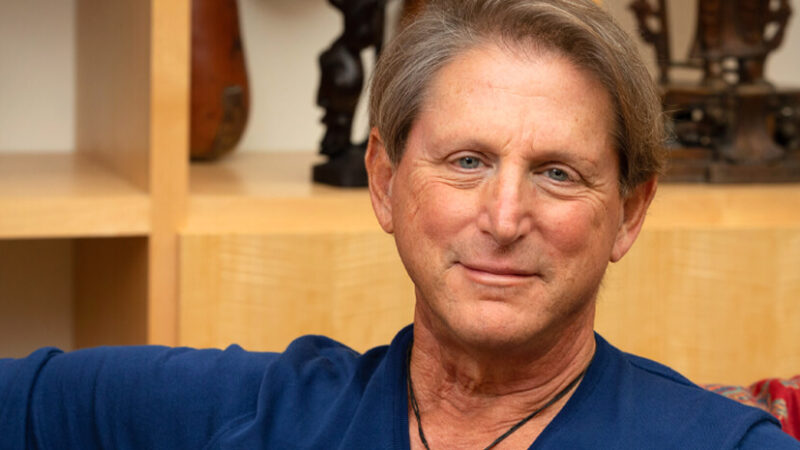
Most of us were raised to chase happiness as the finish line, yet Jungian analyst James Hollis has spent his career arguing that happiness was never a reliable measure to begin with.
Sounds True has carried this conversation between depth psychology and everyday struggle for decades, and Hollis remains one of our clearest voices on the subject.
In this piece, we look at why Jungian psychology treats happiness as an unreliable goal, how the soul signals when we’ve drifted off course, and what resilience looks like without the comfort of certainty.
Key Takeaways:
- A Different Measure: Learn why James Hollis treats happiness as an unreliable goal to build a life around.
- The Soul Sends Signals: Understand how restlessness and dread can point toward a wrong turn.
- Resilience Without Certainty: See how meaning sustains people through periods without clear answers.
A Different Measure for a Well-Lived Life
Hollis tells Tami Simon that happiness is only ever transiently possible, while meaning, once found, tends to abide. This is not a small semantic distinction; it reorganizes how a person might evaluate an entire life, past and future.
Listen to this conversation in James Hollis: The Goal of Life Is Meaning, Not Happiness, part of the Insights at the Edge series.

Jungian Psychology’s Case Against Chasing Happiness
Drawing on Jungian psychology, Hollis explains why treating happiness as life’s organizing goal sets people up for repeated disappointment. Moods shift, circumstances change, and pleasure fades on its own schedule regardless of effort. Meaning operates differently in his framework, built less on favorable conditions and more on alignment between a person’s actions and their deeper psychological truth. This idea traces back through decades of depth psychology, which has long treated symptom and suffering as data rather than simply obstacles to remove. Hollis extends that lineage into plain, accessible language for readers outside clinical settings.
- Happiness Is Transient: It depends on circumstances that are largely outside our control.
- Meaning Is Durable: It persists even through hardship, loss, and difficult seasons.
- Alignment Over Pleasure: True satisfaction comes from congruence, not from comfort alone.
How the Soul Signals a Wrong Turn
Hollis describes a kind of inner feedback system, subtle but consistent, that lets a person know when they’ve drifted from their own path: a persistent restlessness, a low-grade dread, symptoms that resist easy explanation. Rather than pathologizing these signals, Hollis treats them as intelligent messages worth decoding instead of medicating them away entirely. This reframing runs through much of his later work, including Living Between Worlds, where he writes at length about resilience during periods of upheaval.
He is careful to add that decoding these signals takes patience. The soul rarely communicates in plain language, and learning to translate restlessness into useful insight is itself a skill built slowly, often with the help of therapy, journaling, or sustained reflection over time.
Resilience Without Certainty
Much of this conversation addresses a question many listeners were quietly asking during a period of global instability: how does a person stay steady without pretending to have answers they don’t have? Hollis’s version of resilience does not rely on optimism. It relies on tolerance for ambiguity and a willingness to keep showing up for the questions life keeps asking, even when no clear resolution is in sight and the ground itself keeps shifting underfoot.
- Repetition Builds Strength: Resilience grows through repeated encounters with difficulty, not avoidance of it.
- Certainty Can Deceive: It often functions as a defense against anxiety rather than as an accurate perception.
- Living Between Worlds: The title itself names the space between old certainties and whatever comes next.
Why Meaning Requires Ongoing Attention
Unlike a goal that can be checked off, meaning in Hollis’s framework demands continual renewal. It is less a destination reached once than a practice sustained through the accumulation of honest choices over time, which is part of why his work resists any tidy self-help formula or five-step solution. A person can find meaning in one season of life and still need to relocate it in the next, since circumstances, relationships, and inner priorities continue to shift.

The Difference Age Makes
Hollis suggests that this pursuit shifts noticeably across a lifetime. What felt meaningful in early adulthood, often tied to achievement or external validation, tends to lose its hold as people age, replaced by quieter, more internally sourced sources of significance. This isn’t decline, in Hollis’s reading, but maturation, a gradual trading of performance for depth. He describes the second half of life as an invitation to finally ask what was being pursued all along and whether it still fits.
A Fifteen-Book Case for Meaning
By the time of this conversation, Hollis had already authored fifteen books exploring meaning, purpose, and depth psychology, including Finding Meaning in the Second Half of Life and What Matters Most. Hollis describes the search for meaning as the defining topic of his life’s work, one he approaches not as an academic exercise but as something he watches play out daily in his clinical practice with real people navigating real crises, decade after decade, with remarkably consistent patterns.
The Weight of a Global Moment
This particular episode was recorded during a period of widespread uncertainty, and Hollis addresses that context directly rather than avoiding it. He suggests that collective instability tends to surface exactly the kind of questions his work has always centered: what actually matters when the usual supports fall away, and what remains standing once distraction is stripped back. Crisis, in his view, has a way of accelerating psychological work that might otherwise take decades to surface on its own.
What Meaning Asks Us to Give Up
Choosing meaning over happiness, Hollis suggests, often means giving up the comfort of a simpler narrative. It is easier to chase pleasure and call it a life well lived than to sit with the harder, slower project of aligning daily choices with something deeper than mood. Hollis doesn’t romanticize this trade-off; he describes it plainly as more demanding, and ultimately more honest, than the alternative most of us default toward without noticing, especially in a culture that constantly rewards comfort over depth.
The Sounds True Foundation and Wider Access
This particular episode also introduces listeners to the Sounds True Foundation, a nonprofit dedicated to making tools like mindfulness and self-compassion available regardless of financial or social circumstance. It’s a fitting companion to Hollis’s message, since meaning, unlike many luxuries, is something every listener deserves genuine access to explore, regardless of where they happen to start from.

Final Thoughts
James Hollis offers no promise that meaning arrives easily or stays without tending, only that it holds weight happiness alone cannot carry.
Sounds True continues sharing this conversation because it captures something central to our mission of waking up the world: that a considered life asks more of us than comfort, and gives back more in return.
Choosing meaning is rarely a single decision; it is a posture practiced again each time comfort tempts us toward the smaller path. Hollis’s broader catalog remains available for anyone ready to keep asking these questions.
Frequently Asked Questions About James Hollis
How many books has James Hollis written?
Hollis is the author of sixteen books, including Finding Meaning in the Second Half of Life.
What is Living Between Worlds about?
It explores personal resilience during periods of significant change, uncertainty, and cultural upheaval.
Was Hollis a university professor?
Yes, he taught Jungian studies at Saybrook University across its San Francisco and Houston programs.
Does Sounds True offer audio versions of Hollis’s teaching?
Yes, Sounds True has produced the audio learning series Through the Dark Wood with Hollis.
What is the Sounds True Foundation?
A nonprofit making transformational tools accessible to at-risk youth, veterans, and underserved communities worldwide.
Is meaning the same as religious belief, according to Hollis?
No, Hollis frames meaning as a psychological and personal experience, independent of any specific faith.
Where did James Hollis train as an analyst?
He trained at the C.G. Jung Institute in Zurich before practicing as a licensed analyst.
Can this teaching help during periods of grief?
Yes, many listeners find Hollis’s framework useful for locating meaning within difficult, uncertain seasons.