Loch Kelly is a meditation teacher, author, and founder of the Open-Hearted Awareness Institute. With Sounds True, Loch has just published the book and a companion audio series Shift into Freedom: The Science and Practice of Open-Hearted Awareness. In this episode of Insights at the Edge, Loch and Tami Simon speak on the discovery of “awake awareness” and how to get in touch with a state that is already present in all of us. They also talk about the difference between effortful and effortless mindfulness practice, as well as methods of “unhooking” from the relentless flow of thought. Finally, Tami and Loch discuss stabilizing one’s mindfulness practice and living from awake awareness in every moment. (64 minutes)
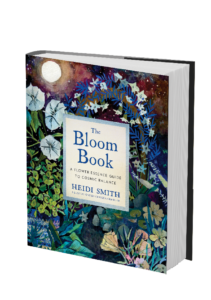
What does the moon have to do with flower essences and ritual? As we discussed in an earlier chapter, the moon represents a time before the dominant culture came into power. While the moon has no gender, it is a metaphor for the divine feminine and a symbol for the creative, the intuitive, the unconscious, and the shadow. Before the Gregorian calendar came into use in the sixteenth century, many cycles of time were measured on a lunar basis, as are the Islamic, Chinese, and Jewish calendars today. All ancient agriculture was organized around lunar and astrological transits, which is one of the basic practices of biodynamic farming today. Many of us feel a fascination with the moon, and I feel it beckons us back to a different consciousness, where much healing potential awaits.
Creating altars or sacred spaces outdoors can be another place for ritual work. While I can’t have a moon garden in the city, I can have a few lunar plants in my windowsill to catch the moonlight.
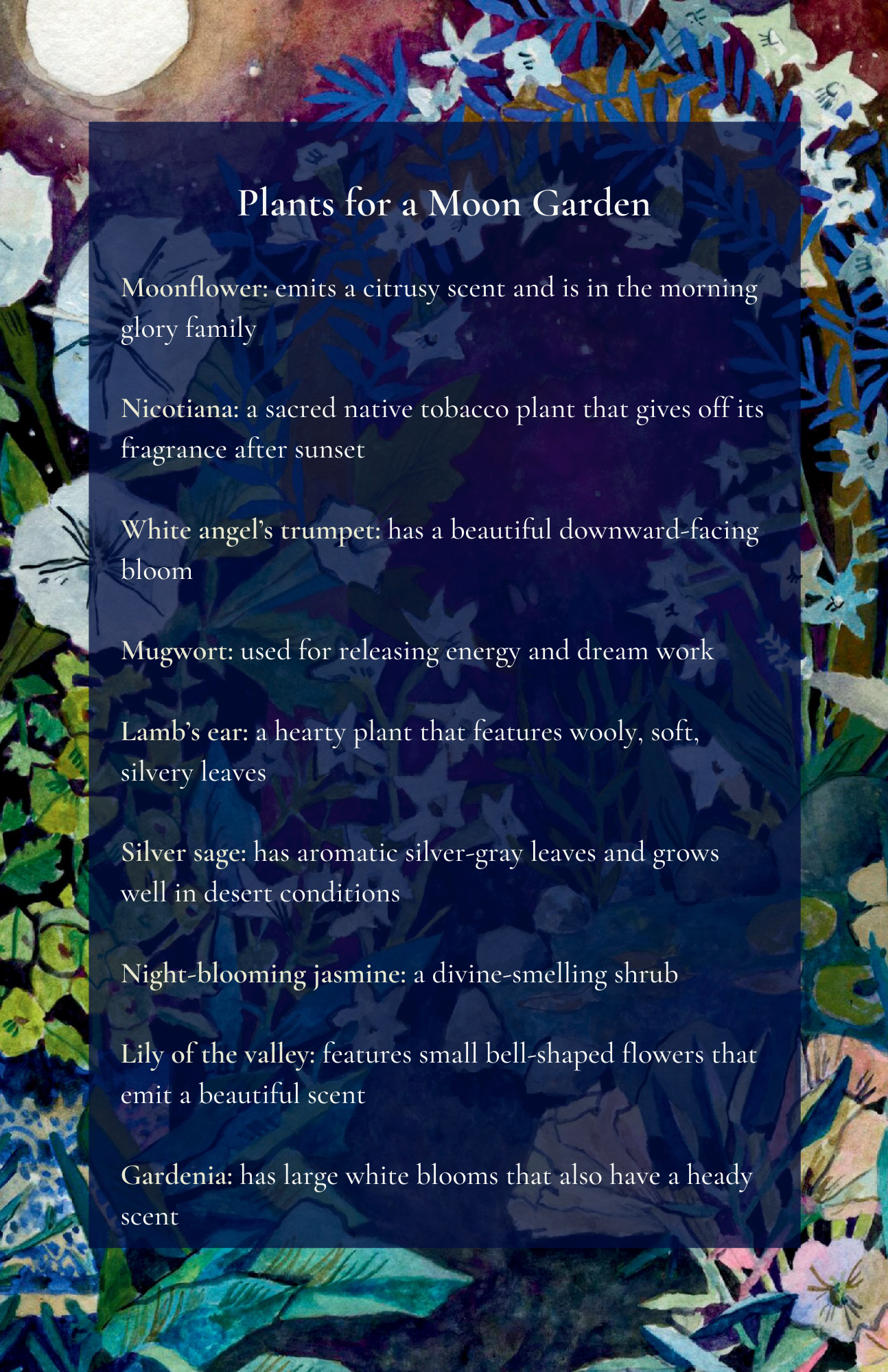
Not all flowers bloom in the sunlight. Some plants prefer the darkness, opening to the night. Moon plants can be cultivated in any terrain. Many night bloomers are also very fragrant. I consider all plants medicinal to some degree; however, some of the moon garden plants may be more therapeutic than others. These can also be plants that you use for making your own flower essences. Or, if you like to make dried sticks of herbs to burn, you can use the plants from your moon garden, such as mugwort.
You can see the lunar signature of mugwort by observing the underside of the leaf, which is silver. The Latin name for it is Artemisia vulgaris; Artemis, if you remember, was the Greek goddess of the moon! Plants with light and white blooms work best, as well as gray and silvery leaves.
Heidi Smith, MA, RH (AHG), is a psychosomatic therapist, registered herbalist, and flower essence practitioner. Within her private practice, Moon & Bloom, Heidi works collaboratively with her clients to empower greater balance, actualization, and soul-level healing within themselves. She is passionate about engaging both the spiritual and scientific dimensions of the plant kingdom, and sees plant medicine and ritual as radical ways to promote individual, collective, and planetary healing. She lives in Brooklyn, New York, with her partner and two cats. For more, visit moonandbloom.com.
Are certain individuals more inclined to awaken spiritually? Do some of us have a natural proclivity to experience spiritual states of oneness? Welcome to the first episode in our new podcast series, Being Open: Spirituality and the Neurodivergent Mind. In this illuminating conversation, Tami Simon speaks with intuitive energy healer and awakening trail guide Sarah Taylor about the empowering revelations and approaches she has discovered throughout the course of her life—including the late-in-life realization that she has both autism and ADHD.
Give a listen to this compelling and informative dialogue on: waking up to our interconnection; the shift from “head awakening” to “heart awakening”; Dzogchen and “the one taste”; the receptivity and porousness of neurodivergent people; the healing power of integration and embodiment; the critical importance of downtime and self-care; experiencing equanimity; unraveling the adaption strategies that no longer serve you; living with a high level of “raw sensitivity”; owning your truths—instead of masking your wants, needs, and authenticity; the misunderstood habit of “stimming” (or self-stimulation); the concept of samskaras (or energetic blockages in your subtle anatomy); reckoning with grief; the futility and harm of self-labeling; reframing limitations as gifts; managing your energy and seeking support when you need it; the connection between our increased understanding of the neurodivergent brain and the collective evolution of humanity; and more.
Note: This episode originally aired on Sounds True One, where these special episodes of Insights at the Edge are available to watch live on video and with exclusive access to Q&As with our guests. Learn more at join.soundstrue.com.
Curious about energy healing but unsure where to begin? The best beginner courses for energy healing meet learners exactly where they are, with clear guidance, warm instruction, and a genuine willingness to learn being the only requirement.
Sounds True has spent more than four decades partnering with pioneering energy healers and researchers, publishing foundational teachings long before “energy medicine” entered the mainstream conversation. That depth of experience shapes the course recommendations below. The following sections cover what to look for in a beginner-friendly energy-healing course, along with top picks and guidance on choosing the right path forward.
Key Takeaways:
Build From the Ground Up: The best beginner courses center on energy awareness, grounding, and hands-on technique before deepening into more advanced work.
The Right Format Shapes Your Journey: Online courses offer flexibility and ease, while in-person training provides real-time feedback and hands-on correction for tactile learners.
Everyone Starts Somewhere: Many beginner energy healing training programs welcome complete newcomers with zero background in healing or wellness practices.
What To Look For In A Beginner Energy Healing Course
A strong beginner course keeps things simple, safe, and hands-on. Look for these signs before enrolling.
Clear Beginner Focus
Choose a course built for newcomers that starts with energy awareness and grounding. Programs that begin with foundational concepts, such as sensing subtle shifts in the body or learning basic centering techniques, give beginners a stable footing before advancing to more complex work.
Experienced, Trusted Teacher
Pick training led by a practitioner with teaching experience and a grounded, warm approach. A teacher with a clear lineage or defined method tends to offer more depth than one relying purely on theory, and the relationship between student and teacher matters as much as the curriculum.
Practical, Guided Exercises
Good courses include guided practices learners can try right away, with exercises that build confidence through repetition. Short, repeatable practices, like a five-minute grounding sequence or a partnered energy awareness exercise, help techniques become intuitive with time.
Key Skills Taught In Energy Healing Training
Beginner courses typically build a core set of skills, including:
Grounding and centering: Stabilizing the body’s energy before a session.
Sensing subtle energy: Recognizing shifts, blocks, or imbalances.
Hands-on or hands-off techniques: Directing energy through touch or proximity.
Chakra and biofield awareness: Understanding the body’s energy centers and field.
Intuitive assessment: Reading where a client may need support.
Self-protection practices: Clearing and shielding personal energy after sessions.
Online vs. In-Person Energy Healing Courses
Both online and in-person formats may be suitable for beginners, depending on schedule, budget, and preferred learning style.
Online Energy Healing Courses
Online courses often offer flexible, at-home, and sometimes self-paced learning. They may be lower-cost than in-person options depending on the provider, which makes them an accessible starting point for those exploring the field for the first time.
In-Person Training
In-person training offers hands-on feedback and immediate correction, making it ideal for tactile learners. Having a teacher present to adjust hand position or guide a grounding exercise can accelerate early skill development in ways that recorded content alone cannot replicate.
Hybrid Options
Some programs blend online lessons with live sessions, combining flexibility with real-time guidance. This format suits learners who want structure and accountability without sacrificing the convenience of remote access.
Best Beginner Courses For Energy Healing: Top Picks
The right starting point depends on learning style and available time. A few standout options for beginners include:
Foundational energy healing certifications: Structured, multi-week programs covering theory, technique, and supervised practice, ideal for those who want a credential-backed foundation.
Short introductory workshops: Single-session or weekend courses that introduce core concepts like grounding, sensing energy, and basic hand positions, well-suited for casual exploration.
Teacher-led immersions: Courses taught by recognized practitioners, offering direct mentorship and Q&A alongside the curriculum.
Self-paced online programs: Flexible video-based training for beginners who prefer to learn on their own schedule.
Sounds True’s Subtle Energy Healing Immersion, taught by Laurie Nealon, Robert Peng, and Shamini Jain, PhD, is one example built specifically for newcomers ready to begin practicing. For a broader look at what’s available, exploring subtle energy courses can help you find the format and depth that fits your learning goals.
How Long It Takes To Learn Energy Healing Basics
Beginners shouldn’t expect instant results. Regular, patient practice tends to matter more than the length of any single course. Timelines vary depending on depth and consistency of practice:
Introductory understanding: A weekend workshop or short course can cover core concepts such as grounding, sensing energy, and basic techniques in a few hours.
Working proficiency: Most beginner programs run 4 to 8 weeks, giving enough time to practice techniques regularly and build confidence.
Comfortable, intuitive skill: Many practitioners report needing 6 months to a year of consistent practice before energy work feels natural rather than effortful.
Ongoing mastery: Like most healing arts, energy work is a lifelong practice; even experienced practitioners continue refining their sensitivity and technique over years.
Final Thoughts
The best beginner courses for energy healing meet learners with patience and clear, practical guidance. Start where you are, practice consistently, and let curiosity lead. Sounds True’s beginner energy healing courses offer a warm, grounded place to begin that path.
Frequently Asked Questions About The Best Courses For Learning Energy Healing As A Beginner
How can I learn to be an energy healer?
Start with a beginner energy healing course that teaches grounding, sensing energy, and basic hands-on techniques.
Do I need any prior experience to start a beginner energy healing course?
No, many beginner courses are designed for complete newcomers with no background required.
Which energy healing modality is best for complete beginners?
Reiki Level 1 is one of the most accessible entry points for beginners, as many programs require no prior experience.
How much do online energy healing courses cost?
Online course prices vary widely, from low-cost introductory classes to several-hundred-dollar certification programs.
Should I choose a self-paced or live instructor-led energy healing course?
Choose self-paced for flexibility, or live instruction for real-time feedback.
Does energy healing certification need to be accredited to be legitimate?
Energy healing certifications are generally not regulated like medical licenses in the United States, though local laws may affect what practitioners can advertise or perform.
Michelle Cassandra Johnson is an author, activist, spiritual teacher, racial equity consultant, and intuitive healer. She is the author of six books, including Skill in Action and Finding Refuge. Amy Burtaine is a leadership coach and racial equity trainer. With Robin DiAngelo, she is the coauthor of The Facilitator’s Guide for White Affinity Groups. For more, visit https://www.michellecjohnson.com/wisdom-of-the-hive.
Snatam Kaur is an American-born, internationally renowned kirtan singer raised in the Sikh and kundalini yoga tradition. Known for her blends of ancient chant and modern instrumentation, Snatam also teaches meditation and yoga. With Sounds True, she has published the book-and-CD set Original Light: The Morning Practice of Kundalini Yoga. In this episode of Insights at the Edge, Tami Simon and Snatam discuss the roots of her spiritual practices and the meaning of the Aquarian Sadhana, which is one of the most important aspects of Original Light. They speak on the tradition of Japji meditation and why working with the spine is an essential part of kundalini yoga. Finally, Snatam shares a pair of potent chants for expressing and celebrating one’s own sense of kundalini. (71 minutes)
Pleasurable experiences can open you and awaken a beautiful flow of energy, but if that energy flow depends on particular conditions, it will fade over time. That does not mean you have to reject love, success, or other positive experiences; you can enjoy them, learn from them, and let them pass without clinging. When you stop closing your heart whenever life differs from your expectations, you become open to the unconditional well-being that was within you all along.



 Heidi Smith, MA, RH (AHG),