Tami Simon speaks with Matthieu Ricard, an author and photographer who earned a PhD in cell genetics. He is also a Buddhist monk who has served as the Dalai Lama’s French interpreter since 1989. Matthieu has written several books, including The Monk and the Philosopher, The Quantum and the Lotus, as well as The Art of Meditation. With Sounds True, he has released an audio learning program based on his book Happiness. Matthieu speaks about the skill of happiness, as well as the conditions for happiness. He also discusses the physical and psychological effects of meditation, along with the ways to track the progress you make in your spiritual practice. (37 minutes)
Right before the holidays, I had the opportunity to interview author and business philosopher Peter Block. I love talking with Peter because he often challenges the status quo and underlying assumptions of business; very often when I speak with Peter, I feel like I am being held by my feet upside down (the way little kids are sometimes dangled by their parents) and out comes a bunch of unexamined beliefs and behavior patterns.
In my most recent conversation with Peter (an interview for Insights at the Edge), we discussed creating work in the world that matters, work that communicates our whole-heartedness and honors our relatedness with other people. And in the discussion, he questioned two assumptions that are embedded in contemporary business life: that “scale” is critical for success and that we better move quickly if we are going to accomplish our goals.
I pushed Peter on this notion of scale not being important. Scale-ability is of course one of the first things an investor looks at when analyzing a potential investment opportunity. How could this not be an important consideration? If your business can’t scale easily, how can it grow rapidly and attract investment capital if needed? Peter was dismissive of my concerns. His focus was on the value of small businesses to create jobs that are soul-satisfying for people, businesses that have a hand-made quality and are not dependent on investment dollars for success. As Peter was talking about ignoring scale-ability as a design criteria for business, I thought about the business person as an artist, someone who creates with the ingredients that he or she has at hand and is not particularly concerned about whether or not such an artistic creation will ever be repeated.
But then our conversation moved on to the notion of speed and Peter’s comment that “speed is the enemy of depth.” This statement hit me where it hurts, so to speak, right in my gut, and even more so, in my heart. For the last 3 months of the year, I had been moving at such a speed that I had lost track of my softness and feeling connection (and a bit of my sanity, truth be told). I simply couldn’t digest or assimilate everything that was happening (both in my personal life and in my professional life), and I think it is fair to say that I ended the year resembling a flattened pancake of a person. Life had rolled over me and I hadn’t taken the time to “feel into and through” everything that was occurring. I spent the first week of the holidays resting and reflecting on Peter’s statement, “speed is the enemy of depth” until I felt my feet and the earth back beneath me.
It is now the new year and I have had plenty of time to rest and pad around the house in my pajamas and be with my great love and our cocker spaniel and friends, and write cards, and stare at the falling snow. I feel plump again (figuratively speaking, of course), not flat and surface-like. And now I face the question, how do I not let myself get caught in the speed trap again? I am convinced that no creative endeavor — and certainly a business is a creative endeavor — benefits from an excess of speed. And when it comes to relating with other people (or to ourselves) speed seems to create jaggedness and not contact and understanding. Interestingly, in speaking with one Sounds True author about a potential recording project that we were designing together, we talked about how in her presentation she wanted to cover various life topics such as personal health and relationships and spiritual connection. I asked her “what about our business or career life?” And she said, “We’ll cover that in the relationships section because really what is business but relationship? That is really all it is. Look around you,” and she made a gesture pointing to the Sounds True office that houses 80 employees and 20 or so dogs and on some days a couple of birds and children, “all of this is based on relationships.”
And so SLOWING DOWN is my orienting principle as 2014 begins. I want to relish the richness of my life and not be flattened by it. If you have any slow-down suggestions for me, I am all ears, as they say. I will slowly read your responses (without skimming), at least I hope so.
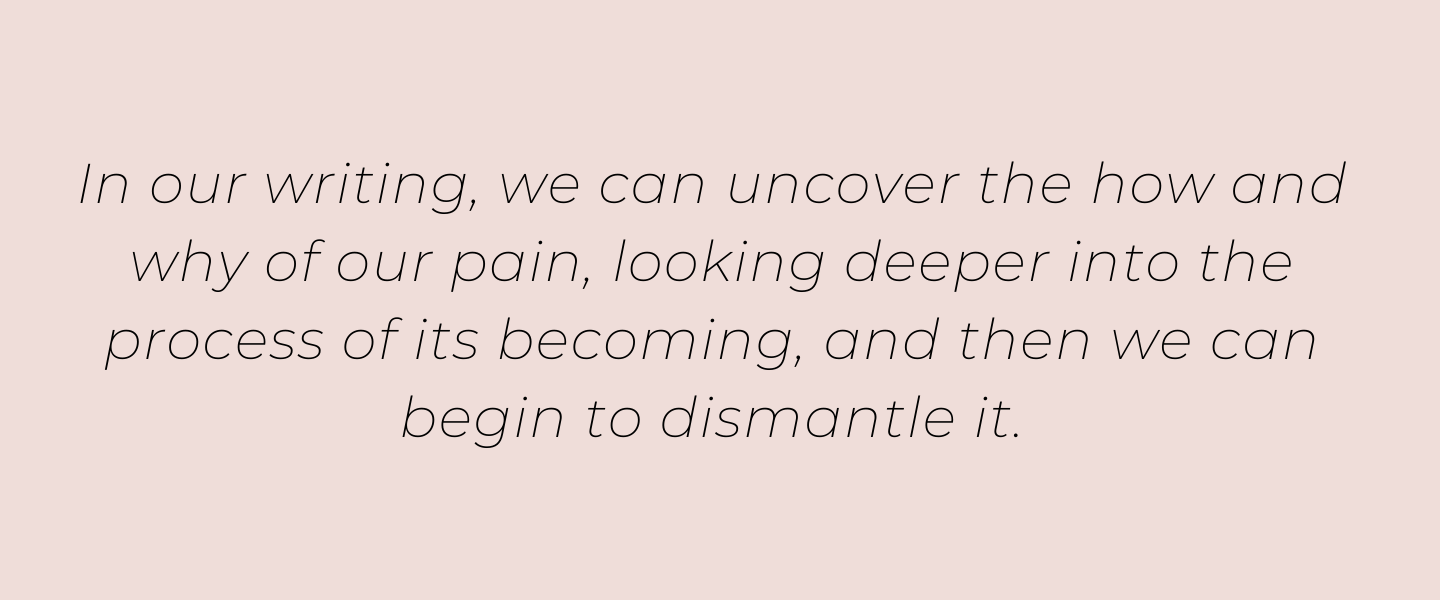
This is a tender exercise, a tracing of pain, the path back to the deepest wound. For myself, a huge hurt that I carry is often the source of great realizations and growth. I’ve worked with many different types of therapy for years to figure out where my pain stems from, and my curiosity has been my greatest guide in this effort. I want to know why I am the way I am, and my trauma informs so much of my mindset. Do you know where your pain comes from? Does it point back to a certain occurrence? Do you have only a vague idea, a slight memory, that seems to be the source? What do you do to familiarize yourself with the hurt you carry?
There are countless, well-trusted methodologies to help us become acquainted with our pain, and when we dig into this work, the cave of our understanding becomes incredibly deep.
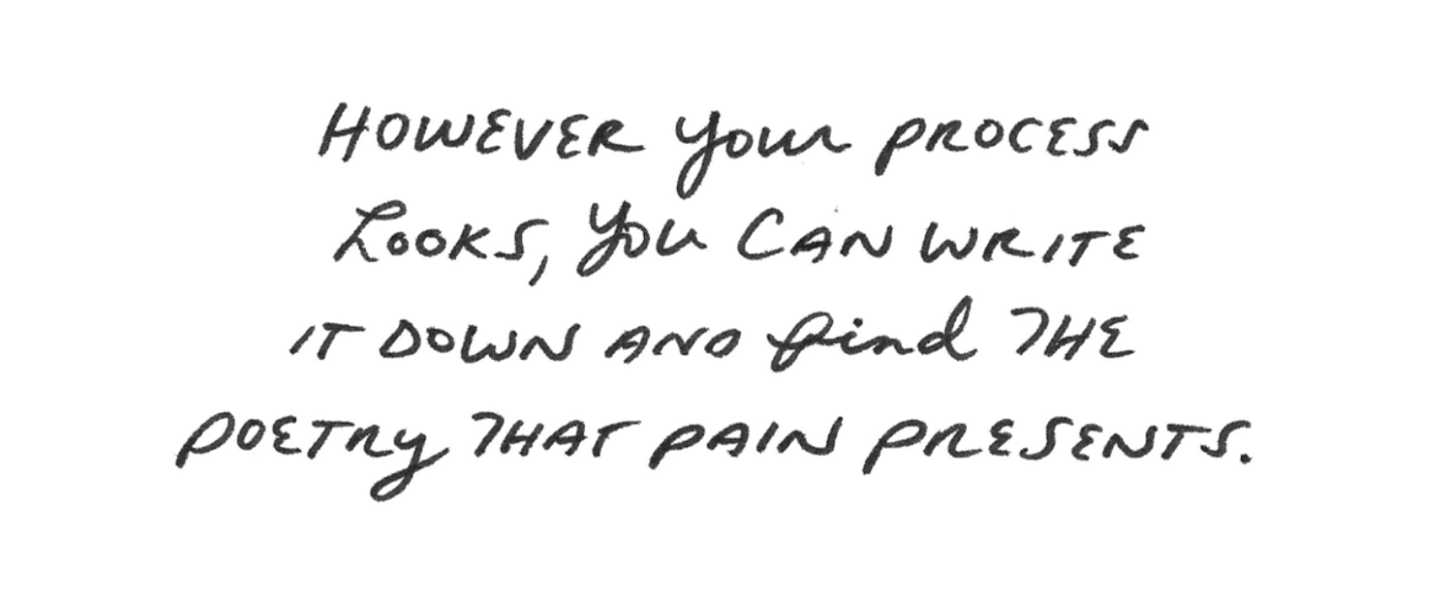
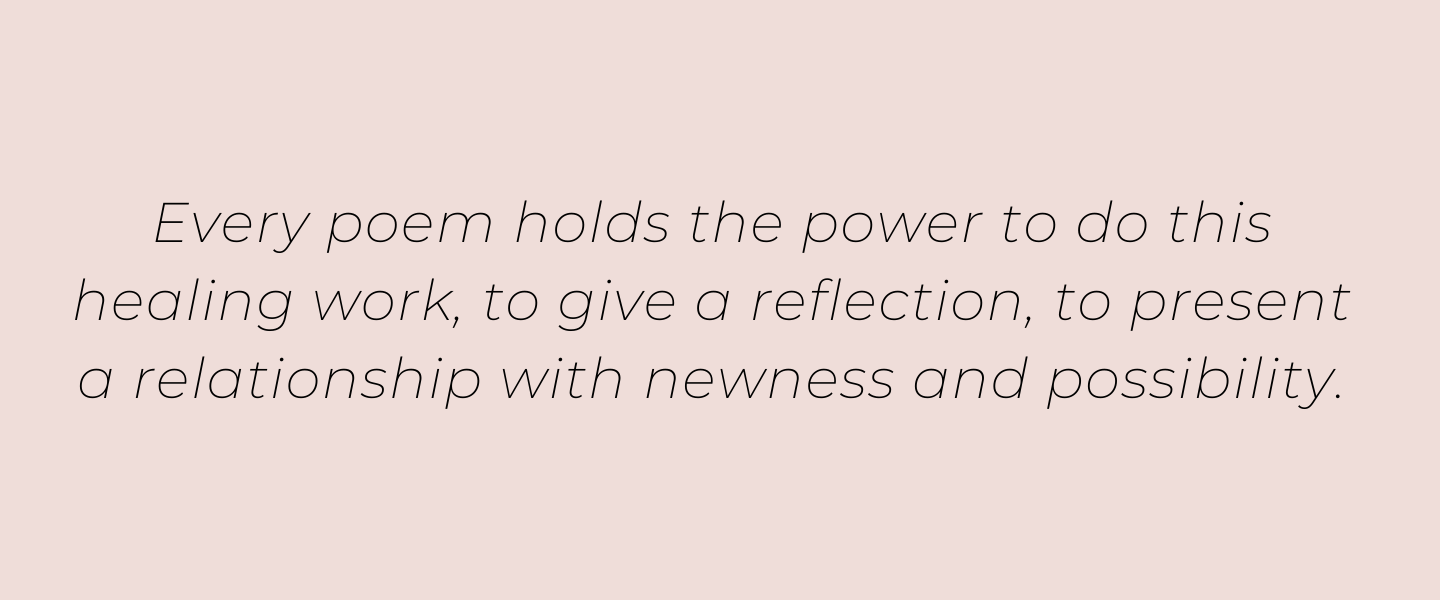
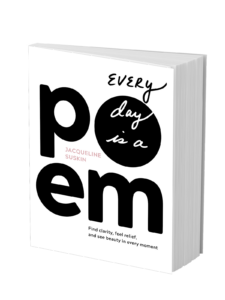
I like to turn my pain into a guide. I follow its directions, meditating on where it all began. It’s at these starting points where I find the most potent feelings. My heartbreak from a failed relationship will often give me a chance to let out my sadness in verse, but not before I try to unpack the whole story. Only when I attempt to understand the many aspects of this failed relationship can I fully feel it and pay tribute to it. I begin this kind of investigation by rambling in my journal. Then, if I feel inclined, I might pull the heart of my understanding into poetic form. I recently wrote a book of poetry called Help in the Dark Season, which focuses on my childhood trauma, the way it affects my adult relationships, and the modes of healing that have helped me grow. Writing this book was extremely hard, but after I finished, I felt like I’d turned coal into gold. I pulled back the curtain inside myself and let light do its thing. Now I not only get to feel the inner effects of my work but I’m also able to witness the importance of sharing this book with others, the way my words act as a key to unlock their personal process of healing. The result of this revealing has been an honesty and a newness that I couldn’t have reached without the alchemy of writing poetry.
I urge you to do this hard work with your trauma, if you’re able. Give yourself permission to move into the realm of blame. Maybe move beyond it toward forgiveness.
Our traumas create our fears, and our responses to these fears can be as poetic and beautiful as we make them. Let your pain be a source of inspiration, turn this heavy load into poetry, own it, use it, and take as much from it now as it has taken from you in the past.
Close your eyes and meditate on the hidden ache you carry. I like to start with my childhood because that’s what makes sense for me, but you can start anywhere along your timeline. Do you see any images attached to your discomfort? Can you try and put words to your grief and your loss? Who hurt you? What was their childhood like? Why did they do what they did? Make use of the pain of being alive. See the universality in whatever caused you harm, and focus on the connection to others who have survived similar experiences. When I sit with my wounds, I find my resilience, and that makes me want to linger there, gather up the lessons left in the aftermath, and use them for my own creation. Writing about my pain enables me to claim it as my own, and this ownership is empowering.
How can you show your reader your personal methods of self-care in a poetic way? Maybe start by writing a list of poems or even song lyrics that have been healing for you in the past. I have poems dog-eared and underlined in every book on my shelf, and I’ll pull them out in a moment of need. They’re my reminders that yes, it is indeed hard to be alive for everyone.
Jacqueline Suskin has composed over forty thousand poems with her ongoing improvisational writing project, Poem Store. She is the author of six books, including Help in the Dark Season. Her work has been featured in the New York Times, the Atlantic, and Yes! magazine. She lives in Northern California. For more, see jacquelinesuskin.com.
The wounds, scars, and pain we carry as men have a place in our lives. A function that can lead us directly to the core of deep meaning and fulfillment and provide a positive path forward. This is what initiation was supposed to teach us as men—how to descend into the depths of our own darkness and return a more complete and contributive participant in society.
However, this is where a man’s real problem resides: He has not been taught the skill or alchemy of initiation. He has not learned how to deal with his pain, or the pain of the world, and so he bucks against it.
I realized over the years of grappling with how to heal that not only was I ill-equipped to deal with the hurt I’d been given, but I also seemed to be woefully ill-equipped to reconcile with, and put a halt to, the perpetual hurt I passed on to others. Like many men, I was good at inflicting pain—and men who are good at something tend to do that thing a lot.
Not only was I undereducated in the alchemical craft of turning pain into purpose, but almost every man I knew was in relatively the same situation. Most men simply haven’t been taught how to deal with their pain and use it to become something better.
And this aspect of the journey is the missing link in male initiation, which has historically played the role of guiding a man through the transitory period between adolescence and adulthood, teaching him the skills of discipline, sovereignty, and the ability to face some of the most challenging aspects of his own life.
In fact, I began to see that not only have most men not been given the tools or resources to deal with the pain and suffering in their lives, but we as men are actively taught the opposite—the idiotic tactic of constant emotional avoidance. Not only this, but our emotional avoidance is seen as a theoretical and rational strength in certain circles.
Seeing this brings about a multitude of questions that both illuminate the foundational cracks within current masculine culture and also highlight the work we must embark on if we are to do our individual and collective parts as men in building a thriving society.
There’s more: I began to see the direct correlation between a man’s ability and willingness to face his own darkness and having a clear purpose, deep fulfillment, and clarity of contribution to the things that matter most to him.
But how can we as men give our pain a purpose in a culture where we are largely devoid of emotional permissions? Where the archetype of man, in order to be classified or quantified as a man, must do the impossible task of being brave and courageous without being vulnerable?
This is one of the biggest masculine myths—the false idea that you can be courageous without being inherently vulnerable. When we are rewarded for giving our lives, our hearts, and our emotional bodies up for sacrifice to maintain the illusion of invulnerable strength, we prioritize victory over connection. We praise ourselves for performance in the boardroom, bedroom, and bars, but we lack recognition for our performance in reconciliation, repair, and reparation.
There’s another way. A way where victory is found within the work, and part of that work is facing our own darkness.
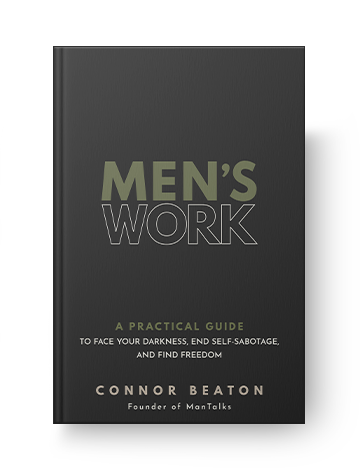
Excerpted from Men’s Work: A Practical Guide to Face Your Darkness, End Self-Sabotage, and Find Freedom by Connor Beaton.
CONNOR BEATON is the founder of ManTalks, an international organization dedicated to the personal growth of men. He is a facilitator dedicated to building better men, an entrepreneur, a writer, and a keynote speaker. Connor has spoken to large corporate brands, nonprofits, schools, and international organizations such as the United Nations, Microsoft, Johnson & Johnson, Apple, TED, and Entrepreneurs’ Organization. For more, visit mantalks.com.
Can we allow another to deeply matter to us? Are we willing to take the risk to let them all the way inside – to really see, know, and touch our most core vulnerabilities; to open ourselves so profoundly that we’re left utterly naked and fully exposed, knowing that in any moment our hearts could shatter into millions of pieces? Many of our childhood biographies involved a very unstable environment, an uncertain reality where it was not safe to let another become too important, where we spent much of our time and energy learning exactly what we had to say and do in order to receive the love, care, affection, attention, and holding that we so sweetly needed. We can be quick to judge and admonish these early adaptive strategies, seeing them as “unspiritual” or neurotic or crazy, but perhaps they were in actuality the most luminous expressions of a certain kind of intelligence and creativity. Perhaps, upon deeper examination, they might come to be seen as special forms of grace, put in play by the great architect of love to ensure our own survival, as profound gifts sent to ensure the flowering of our precious hearts and nervous systems. As innocent little ones, we very naturally allow others to deeply matter; it is part of who we are. Over time, though, many of us have come to see that this sort of exposure is tremendously risky; it’s just too raw, too open, too scary. But as little ones we can’t really help it; we’re wired to connect.
Often in the challenges inherent in intimate relationship, we become convinced that it is our partner who is causing us to feel so bad. The evidence is so clear… isn’t it? They don’t respect us, they speak unkindly to us, they don’t understand us, they’re never there when we really need them, they just can’t quite connect with who we are at the deepest levels; and the big one – they just don’t meet our needs. We put a lot of pressure on our partners (and on ourselves, for that matter) to “meet our needs.” Before we know it, much of our lives become organized around getting our needs met; and there is something about this that can start to feel a bit off. It can be really helpful to take some time and look at this carefully. Of course there is likely some relative truth in these traits and behaviors in our partners, and they are worth exploring. This is not to say that the other person isn’t actually speaking and acting in unkind, overly defensive, or critical ways, and that this shouldn’t be related with. But we might also come to see that just by being in relationship, we will be forced to feel feelings that we really don’t want to feel.
To allow in those intense and challenging emotions and sensations which have previously been lodged in the body can be terrifying. Do we really want to do this? Maybe tomorrow; for now, it’s best to go take a walk, listen to some music, write another rambling facebook post, contemplate how awakened we are, make another cup of tea, or do some meditation. It’s not so much that our partner is doing something *to* us, but rather when we open ourselves to love, there are previously unmet emotions and sensations there, lurking in the unconscious, seeking the light of day. For many, it is in the context of a vulnerable, naked, intimate relationship where that which is still unresolved will most powerfully present itself to be metabolized and healed. If we look closely, perhaps we can see how we organize our lives around not having to feel certain feelings. To see this can be quite illuminating – and often very disturbing. It is easy to then fall into our old habitual patterns of self-aggression or avoidance, to start to become unkind to ourselves, falling into spiritual superegoic judgment, self-hatred, and shame.
Another option is to make the radical commitment to practicing the yoga of love, of holding ourselves in an enormous environment of kindness. We stay unconditionally committed to the truth that whatever arises in our experience – no matter how disturbing, anxiety-provoking, “unspiritual,” confusing, painful, or difficult – that it is ultimately workable, that it is a precious part of our own hearts that we wish to know deeper and to integrate into the entirety of what we are. We can be grateful for the gift of clear seeing, even if what we see is disturbing and anxiety provoking, for it is a certain kind of grace which allows us to finally see the ways we organize our experience, and how all of our neurosis and our strategies were our best efforts at the time to take care of ourselves. We are being given a gift, a fierce gift you could say, and an opportunity to let love dismantle those protective strategies that once served us, but no longer are.
Let us all hold those we’re in relationship with, including ourselves, by committing to taking love’s journey with them, knowing nothing about the route or the destination. Let us be kind to ourselves and our partners if we decide to truly take up the most vulnerable yoga of intimacy, knowing that it will take everything we have and are to navigate, as it offers fruits beyond this world.
Seane Corn is a celebrated yoga teacher, philanthropist, and the cofounder of Off the Matt, Into the World—a leadership training organization devoted to the use of yogic principles to foster global activism and education. With Sounds True, she has most recently released The Yoga of Awakening, a trilogy of instructional DVDs intended to guide viewers from the purely physical aspects of yoga into its more openly spiritual depths. In this episode of Insights at the Edge, Seane and Tami Simon talk about yoga as a path of inquiry, and how that path could be a palliative for a world still saturated with conflict. They discuss the possibility of healing trauma through yoga, as well as how that trauma has long-term effects on the chakras. Finally, Tami and Seane speak on what it means to live purposefully and seven essential aspects of a fully embodied heart. (71 minutes)