Metabolizing Experience
In order to know and befriend ourselves at the deepest levels, one of the core foundations for true healing, we must cultivate a new way of relating with ourselves that allows even our most difficult and challenging experience to disclose its meaning, intelligence, and purpose in our lives. To do this, we have to slow down and shift our relationship from one of thinking about our experience to fully embodying it. We have to allow ourselves to truly touch it and be touched by it rather than merely orbiting around it, where we are sure to continue to feel some degree of disconnection. Just as we must properly digest the food we eat to absorb its nutrients, we must also assimilate our experience to receive the wisdom and sacred data within it. All through the day and night, we are receiving impressions—through our mental, emotional, somatic (i.e., body-based), imaginal, and spiritual bodies. Life is a constant stream of experience—conversations with friends, caring for our kids, cooking a meal, wandering in nature, practicing yoga or meditation, engaging our work and creative projects, reading a book, shopping for groceries, running errands. But to what degree are we experiencing all of this? How present are we to our moment-to-moment experience, embodied and engaged, allowing it to penetrate us, where it can become true experience and not just some passing event? To what degree are we on autopilot as we make our way through the day, only partially connecting with our friends and family and engaging the sensory reality of what we see, hear, smell, taste, and touch?
I’m pointing toward a way of “metabolizing” our experience that allows us to touch and engage it at the most subtle levels, where it is able to disclose its qualities, intelligence, and purpose. By evoking “metabolization,” I am making use of a biological process in a metaphorical way to refer to working through and integrating our experience, especially those thoughts, feelings, sensations, and parts of ourselves that historically we have pushed away. Other words from the biological sciences, for example “digestion,” “absorption,” or “assimilation” can be used to point to the same idea, indicating that it requires concentration, attention, and a certain fire or warmth to “make use” of our experience and mine the “nutrients” contained within it.
Just because we “have” an experience does not mean we properly digest and absorb it. If our emotional and sensory experience remain partly processed, they become leaky (a psychic version, if you will, of “leaky gut syndrome”) and unable to provide the fuel required to live a life of intimacy, connection, and spontaneity. This inner psychic situation is analogous to not properly chewing and breaking down the food we eat and thus not being able to mine the energy and nutrients our bodies need to function optimally.
Although the desire for change and transformation is natural, noble, and worthy of our honor and attention, if we are not careful, it can serve as a powerful reminder and expression of the painful realities of materialism and self-abandonment. One of the shadow sides of spiritual seeking and the (seemingly) endless project of self-improvement is that we never slow down enough to digest what we have already been given, often much more than we consciously realize. In some sense, most of us have been given everything in terms of the basic alchemical prima materia required to live a life of integrity and inner richness, but not the “everything” the mind thinks it needs to be happy and fulfilled, found by way of a journey of internal and external consumerism. And not the “everything” that conforms to our hopes, fears, and dreams of power and control and that keeps us consistently safe and protected from the implications of what it means to have a tender (and breakable) human heart, but the “everything” already here as part of our true nature, the raw materials for a life of inner contentment and abundance, revealed by way of slowness and humility, not unconscious acquisition.
It is important to remember that for most of us, healing happens gradually, slowly, over time when we begin to perceive ourselves and our lives in a new way. Each micro-moment of new insight, understanding, and perspective must be integrated and digested on its own, honored and tended to with curiosity, care, and attention. Before we “move forward” to the next moment, we must fully apprehend and open our hearts to this one; this slow tending (metabolization) is one of the true essences of a lasting, transformative, and deep healing. If we are not able to metabolize even our most intense and disturbing experience, we will remain in opposition to it, at subtle war with it, and not able to be in relationship with it as a healing ally.
In Tibetan tradition, there is an image of the hungry ghost, a figure of the imaginal realms with a large, distended belly and tiny mouth. No matter how much food (experience) is consumed, there is a deep ache and longing for more. Regardless of how much is taken in, the ghost retains an insatiable hunger. Because this one is not able to digest, make use of, or enjoy what is given, a primordial hole is left behind that can never seem to be filled. One invitation, as this image appears in our own lives, is to slow way down and send awareness and compas- sion directly into the hole, infusing it with presence and warmth, and finally tend to what is already here, not what is missing and might come one day in the future by way of further procurement.
Just as with food—choosing wisely, chewing mindfully, allowing ourselves to taste the bounty of what is being offered, and stopping before we are full—we can honor the validity, workability, and intelligence of our inner experience, even if it is difficult or disturbing. The willingness to fully digest our own vulnerability, tenderness, confusion, and suffering is an act of love and fierce, revolutionary kindness. There are soul nutrients buried in the food of our embodied experience that yearn to be integrated, metabolized, and assimilated in the flame of the heart. But this digestion requires the enzymes of presence, embodi- ment, compassion, and curiosity about what is here now.
Let us slow down and become mindful of the ways we seek to fill the empty hole in the center, whether it be with food when we’re not hungry or experience when we are already full. And in this way, we can walk lightly together in this world, on this precious planet, not as hungry ghosts desperate to be fed but as kindred travelers of interior wealth, richness, and meaning.
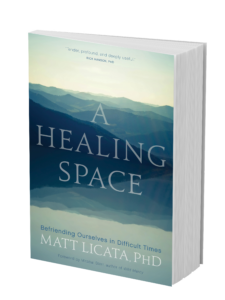
This is an excerpt from A Healing Space: Befriending Ourselves in Difficult Times by Matt Licata, PhD.
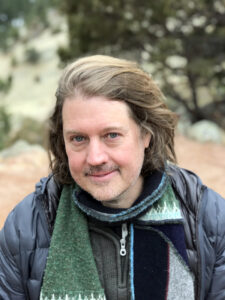 Matt Licata, PhD, is a practicing psychotherapist and hosts in-person retreats. His work incorporates developmental, psychoanalytic, and depth psychologies, as well as contemplative, meditative, and mindfulness-based approaches for transformation and healing. He co-facilitates a monthly online membership community called Befriending Yourself, is author of The Path Is Everywhere, and is the creator of the blog A Healing Space. He lives in Boulder, Colorado. For more, visit mattlicataphd.com.
Learn More
Sounds True | Amazon | Barnes & Noble | Bookshop | Indiebound