6 Principles for Befriending Yourself: Part I

June 4, 2019

6 Principles for Befriending Yourself, Matt Licata, Jeff Foster


Enjoy this excerpt in our new mini-series of Befriending Yourself, written by Jeff Foster and Matt Licata. Want to go deeper? Join their free webinar on Wednesday, June 5! Be sure to register here. 


“I wish I could show you when you are lonely or in darkness the astonishing light of your own being.” – Hafiz

Here’s the honest truth: Sometimes, no matter how much healing, spiritual, and therapeutic work we’ve done on ourselves, we just feel stuck, blocked, triggered, defeated, or tired. We feel separate from life, far from where we “want to be,” or think we “should” be. Our usual default or habit is to go to war with ourselves in some way. We run from the present moment and life becomes a battleground. And we end up exhausted – physically, emotionally, and spiritually. How can we call off the inner war?

We want to invite you to slow down and tune into the alchemical medicine contained within your difficult thoughts and feelings and other “unwanted” states and experiences. To step off the battlefield with life and open to the guidance buried inside you, exactly as you are, now. This guidance is already here, not the product of some exhausting search. Life, or love, is not waiting for you to heal, awaken, or transform. What you seek is here now, unfolding and disclosing itself, and can always be found in the very core of where we have most forgotten to look.


THE DISCOVERY OF THE SACRED MIDDLE

We can so easily forget about the sacred “alchemical middle,” an alternative to repression or unconscious expression, which is available in every moment; a new and creative pathway in between the primordial pathways of fight-flight-freeze: The invitation to be present with the difficult material. Breathe into it. Infuse it with curiosity and love. This is our true route to healing, if we are ready to let go of our suffering.

Here is a principle that has the potential to change your life, if you really take it in:


TRUE HEALING HAS NOTHING TO DO WITH GETTING RID OF “NEGATIVE” THOUGHTS AND FEELINGS. TRUE HEALING HAPPENS WHEN WE ACTUALLY STOP “TRYING” TO HEAL ALTOGETHER, LET GO OF “HEALING” AS A DESTINATION, AND SURRENDER TO THE PRESENT MOMENT OF LIFE, HOWEVER INTENSE OR UNCOMFORTABLE IT IS. THERE IS UNEXPECTED MEDICINE HIDDEN INSIDE THIS “ALCHEMICAL MIDDLE,” THE WISDOM OF YOUR OWN HEART, RELEASED WHEN YOU TURN BACK TOWARD YOURSELF IN A MOMENT WHEN YOU NEED YOURSELF MORE THAN EVER.


We want to help you stop struggling against life and truly “befriend” yourself, love and care for yourself – even in a moment when you really want to escape, when you have been caught in habitual and addictive ways of responding, and the trance of judgement, unworthiness, and self-abandonment has taken you over.

We want to show you that even your deepest shame, longings, sorrows, and loneliness are not mistakes, and not “blocks” to freedom and peace at all, but actually forgotten and misunderstood doorways or portals into the life that you long to live.

As Joseph Campbell said, “… in the cave you fear to enter, lies the treasure you seek.” Sometimes we have to allow ourselves to feel worse, to bravely touch into the darkness and “negativity” of the moment, in order to find the light, in order to remember our true strength, and get “better.” This is the law of “paradoxical intention,” a concept introduced by psychiatrist Viktor Frankl. The great alchemists and tantric practitioners of the past also discovered potent medicine buried in the very core of our most difficult emotional states. In order to tap into this wisdom and bring it into our lives and the world, we have to turn towards the uncomfortable place, however counterintuitive that sounds – surround and infuse it with our curiosity, attention, love, interest and care, and allow it to disclose its mysteries.

Here is Part I in our Mini-Series of some effective pathways into befriending…


THE SIX PRINCIPLES 

  1. STOP TRYING TO BE HAPPY (happiness is not something you can “do”)

There is so much pressure on us these days from society – our friends, family members, social media, and even self-help authors and spiritual teachers –  to be “happy,” to be “up,” to be joyful, to be at peace and to have everything “together.” It can be so exhausting, this journey of “becoming”… and especially “becoming happy.”

Happiness is one state among many, one band or flavor of the spectrum of our humanness, a lovely experience, but if we become entranced with it, if we become addicted to it, we lose touch with the other shades of the spectrum, where profound creativity, realization, and insights may also dwell. If our journey to happiness entails a subtle denial of these other shades, we send parts and pieces of ourselves into the shadow where they will inevitably return (especially in our relationships) in less-than-conscious ways, generating unnecessary suffering for ourselves and others.

We unconsciously seek this kind of one-sided “happiness,” that sense that everything is “up” all the time, clear, free of doubt, certain, sure, positive. But it’s a concept that hurts us in the end, an impossible ideal that actually takes us away from ourselves and makes us distrust our “authentic unhappiness.” We forget the wisdom in our “shadow,” that which is hidden in the core of our wounds, in those places we’d least expect to find it. But to learn to trust our deepest experience will go against the grain of a culture and society that have lost contact with the wisdom in the unwanted. It requires a reorganization of our perception and nervous system, and training ourselves to rest and explore and open to the unknown, into unstructured states of being, which is always going to feel a bit risky, shaky, and yet also full of life.

The truth is that we simply aren’t meant to feel happy, inspired, joyful, and full of energy all of the time. We aren’t meant to be “up” all the time, or even most of the time! It’s so exhausting trying to stay in any particular state. It’s a relief to be allowed to be “down.” Imagine how a dear and trusted friend – a partner, a teacher, a therapist, or even a pet or some friend in the natural world – would just allow you to be down if you felt down, and not fix or judge you or try to make you “up” again, but simply hold you and allow you to cry if you needed to cry. Held in that kind of unconditional love, great healing could emerge. Through the darkness, to the light. This is the power of love.

We are actually built to contain all of life – the sorrow and loneliness and doubt and exhaustion as well as the joy and excitement, just as the sky is “built” to contain all kinds of weather, and just as a movie screen is “built” to allow all kinds of life scenes to pass through it. There is nothing wrong with you if feelings of sorrow and fear and even despair move through you, just as there is nothing wrong with the sky during even the biggest storm. The sky simply allows all of its weather. That is its nature. It doesn’t have to do anything except be what it is. Open, loving and vast.

We are actually meant to feel down – lost, disconnected, sad, and lonely –  sometimes! It’s good and healthy to make room in ourselves for this “negative” weather, too – the rain, the snow, the fog, and the thunderstorms as well as the pleasant sunny days. These are also sacred and healthy and even life-giving experiences, and we need to take some time in our day to really allow ourselves to feel whatever it is that what we are feeling, even if everyone around us is calling us “negative” or “broken” and trying to fix us and give us advice… or even “enlighten” us. There are gifts that are important for our journey – experiences, feelings, realizations, insights, and discoveries – that are available in states of doubt, confusion, despair, and grief that are simply not available in higher, brighter, and more certain states. You are vast, a majestic holding field that contains all of life, all of love’s art and creativity. It takes courage to turn from the advice of others, and the advice of our own minds (which is in large part only an expression of past conditioning), and surrender to our genuine present-moment experience. It takes bravery to be authentically as we are, in a world that wants us to be different. Here, in our authenticity, we will find our true happiness – a happiness that is not the opposite of sorrow, a joy that is not at war with darkness.

The deepest longing in your heart will only be met by discovering this true authenticity, inside your own eccentricity and wildness, in your unwillingness to go with the status quo if the price tag of doing so is the abandonment of your one unprecedented heart. It is risky to walk your own path, but there is a very unique gift of creativity inside of you that aches to be allowed into this world, one that is utterly unique and one only you can reveal here.

To be truly happy, you have to be prepared to allow yourself to be truly “unhappy,” however counterintuitive and paradoxical that sounds.


2. TRUE MEDITATION IS NOT WHAT YOU THINK (it’s what you are)

Here is the paradox: when we allow ourselves to be authentically unhappy, to embrace the “negative” aspects of experience, we can actually touch a deeper kind of happiness. The happiness of true self-acceptance, the joy of being exactly what we are. Again, we must embrace this paradox, not try to understand it! As the alchemists remind us, we cannot skip stages, we cannot abandon the moon for the sun or replace one with the other, for the gold we long for is only found in the embrace of both.

Befriending ourselves means giving ourselves a break from the exhausting Self-Improvement Project that so many of us have become tangled up in, and slowing down, taking a few deep breaths, and allowing ourselves to experience the entirety of the present moment without trying to fix or change it, even if it’s uncomfortable or intense or “negative.” To discover for ourselves whether this moment truly needs to be improved, or is somehow already complete. Not the picture or idea of “complete” the mind thinks or has been told it needs or requires, but a completeness of the heart, a wholeness, a vastness that is always already present and will never be found by means of more and more acquisition of material things, concepts, experiences, or insights. The completeness and wholeness of the sky, even in the midst of a storm.

Meditation doesn’t mean working yourself into a blissful, transcendent, or even relaxed state. These (and many other) states may of course come and go as byproducts of meditation and are also welcome and embraced, but they are not the goal. True meditation has no goal, however strange that sounds to the rational mind. Meditation is not even a “practice” really; it’s more of an attitude, a way of relating to the moment, dancing and playing with it, leaning in and leaning out of it. Meditation in the true sense of the word means getting really curious about your present-moment experience instead of trying to alter it, distract yourself from it, or even to cure, shift, transform, or heal it. But to truly inhabit and befriend it. And trust it to the core. To even “trust” in those moments when you cannot trust; to accept those moments you cannot accept. Even in the core of our  “non-acceptance” and resistance, our states of doubt and “not being able to trust,” if met in deep embrace, are also doorways to freedom. The goal is not to “shift” or “translate” non-acceptance to acceptance – but to open into the way psyche or soul is appearing now, as valid, workable, and worthy of our compassionate tending.

We can accept that we are in non-acceptance right now. We can trust our doubt. We can experiment with not resisting our resistance. We can allow our non-allowing, and give a big YES to the “No” within. We can allow ourselves to be exactly as we are, the way that beloved friend or pet would allow us.

You could trust the weather, even if you didn’t like it. You might say “this isn’t the weather I had hoped for, or wanted, but I trust that it’s here today, and it will pass in time. But for now, I’m going to walk out into the rain, the fog, the snow, the darkness….” We can find the rain, the fog, the snow, and darkness inside our own bodies and neural pathways, inside the cells of our hearts and nervous systems, along with their friends the sun, the springtime, the warmth, and the flowering, too. Let’s make room for all of the weather, in any given moment of our lives.

Meditation means letting the present moment be as it is, “kindling a light in the darkness”, as Carl Jung put it. Jung also reminded us that we’ll never discover “enlightenment” by “imagining figures of light,” but only by providing sanctuary for the darkness – allowing our repressed fear, the shame, the deep feelings of loneliness and sorrow to emerge into the light of our conscious awareness. In any moment of your life you can simply get curious about what you’re feeling now, what you’re seeing, hearing, smelling, and touching in this very unique instant of your life.

You can “en-lighten” the moment, instead of waiting forever to become enlightened!

Beholding the moment as a work of art, rather than something to fix or mend; this is true meditation – seeing any moment through eyes of curiosity and fascination. And you can always begin where you are. No matter how things are going in your life, you can always begin now.

With the way your feet feel. Your hands. With a sense of pressure between the eyes. With the weight of your clothes on your body. With the rising and falling sensations of the breath. With a feeling of joy or boredom, bliss or confusion. With a sense of numbness or emptiness (yes, you can even get curious about your lack of curiosity!). All states – both sacred and profane –  and experiences – both pleasant and unpleasant –  are worthy of your curious attention. Meditation means falling in love with where you are, even if where you are is hot and sticky and unpleasant and a bit scary and groundless. Even if you have to begin with falling in love with the part of you that wants to be somewhere else. Even this “weather” is not a mistake. Remember the sky…


We hope you enjoyed this excerpt in our new mini-series of Befriending Yourself, written by Jeff Foster and Matt Licata. Want to go deeper? Join their free webinar on Wednesday, June 5! Be sure to register here. 


ABOUT THE AUTHORS

JOIN JEFF FOSTER AND MATT LICATA EACH MONTH IN THEIR NEW “BEFRIENDING YOURSELF” MEMBERSHIP SITE: www.befriendingyourself.com

6 Principles for Befriending Yourself, Matt Licata, Jeff Foster

MATT LICATA

Matt Licata, PhD is a psychotherapist, writer, and independent researcher based in Boulder, Colorado. Over the last 25 years, he has been active in the ongoing dialogue between depth psychological and meditative approaches to emotional healing and spiritual transformation.

His psychotherapy and spiritual counseling practice has specialized in working with yogis, meditators, and seekers of all sorts who have come to a dead-end in their spiritual practice or therapy and are longing for a more embodied, creative, imaginative way to participate in their experience, in relationship with others, and in the sacred world.

Matt’s spiritual path and exploration has been interfaith in nature and includes three decades of study and practice in Vajrayana Buddhism, Sufism, Daoism, and Contemplative Christianity. His psychological training and influences have been in the larger field of relational psychoanalysis, Jung’s analytical and alchemical work, and Hillman’s archetypal psychology, to  name a few. He is the editor of A Healing Space blog and author of The Path is Everywhere: Uncovering the Jewels Hidden Within You (Wandering Yogi Press, 2017) and the forthcoming A Healing Space: Befriending Yourself in Difficult Times (Sounds True, 2020). His website is www.mattlicataphd.com


JEFF FOSTER

Jeff Foster studied Astrophysics at Cambridge University. In his mid-twenties, struggling with chronic shame and suicidal depression, he became addicted to the idea of “spiritual enlightenment” and began a near-obsessive spiritual quest for the ultimate truth of existence. The search came crashing down one day, unexpectedly, with the clear recognition of the non-dual nature of everything and the discovery of the “extraordinary in the ordinary.” Jeff fell in love with the simple present moment, and was given a deep understanding of the root illusion behind all human suffering and seeking.

For over a decade Jeff has been traveling the world offering meetings and retreats, inviting people into a place of radical self-acceptance and “Deep Rest.” He has published several books in over fifteen languages. His latest book is The Joy of True Meditation: Words of Encouragement for Tired Minds and Wild Hearts (New Sarum Press, 2019). His website is www.lifewithoutacentre.com


Jeff Foster

Photo of ()\

Jeff Foster shares from his own awakened experience a way out of seeking fulfillment in the future and into the acceptance of "all this, here and now." He studied astrophysics at Cambridge University. Following a period of depression and physical illness, he embarked on an intensive spiritual search that came to an end with the discovery that life itself was what he had always been seeking.

Foster, Jeff © Emily Goodman


Listen to Tami Simon's in-depth audio podcast interviews with Jeff Foster:
The Deepest Acceptance »
The Deepest Acceptance: Part 2 »
Unconditioned Awareness and the Challenges of Everyday Life »

Matt Licata

Matt Licata, PhD, is a practicing psychotherapist and hosts in-person retreats. His work incorporates developmental, psychoanalytic, and depth psychologies, as well as contemplative, meditative, and mindfulness-based approaches for transformation and healing. He co-facilitates a monthly online membership community called Befriending Yourself, is author of The Path Is Everywhere, and is the creator of the blog A Healing Space. He lives in Boulder, Colorado. For more, visit mattlicataphd.com.

Author photo © Krista Marleena

Listen to Tami Simon's in-depth audio podcast interview with Matt Licata:

The Alchemy Of Befriending Ourselves In Difficult Times  »

Also By Author

Victory! A Poem

Victory!

By Jeff Foster


You don’t have to be the best. 

You don’t have to win. 

You only have to be yourself.


You only have to be real. 

And speak from the heart. 

And know that you have the right to see how you see, 

and think how you think, and feel what you feel, 

and desire what you desire.


You don’t have to be a success in the eyes of the world 

and you don’t have to be an expert on living.


You only have to offer what you offer, 

breathe how you breathe, make mistakes and screw 

up 

and learn to love your stumbling and say the 

wrong thing 

and stop worrying so much about impressing anyone 

because in the end you only have to live with yourself


and joy is not given but found in the deepest 

recesses of your being 

so there can be joy in falling and joy in making 

mistakes 

and joy in making a fool of yourself and joy in 

forgetting joy 

and then holding yourself close as you crumble to 

the ground 

and weep out the old dreams.


Joy is closeness 

with the one you love: 

You.


You don’t have to be the best. 

You really don’t have to win.


You only have to remember this intimacy with 

the sky, the nearness of the mountains and feel the sun 

warming your shoulders and the nape of your neck


and know that you are alive, 

and that you are a success at being alive, 

and that you have won already, 

and you are victorious already, 

without having to prove 

a damn 

thing.


To anyone.

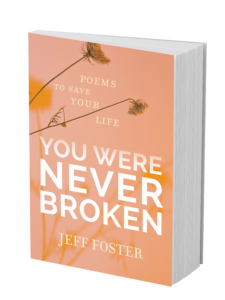
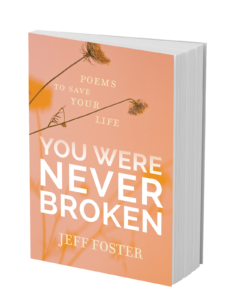
This poem is excerpted from You Were Never Broken: Poems to Save Your Life by Jeff Foster.


jeff fosterJeff Foster shares from his own awakened experience a way out of seeking fulfillment in the future and into the acceptance of “all this, here and now.” He studied astrophysics at Cambridge University. Following a period of depression and physical illness, he embarked on an intensive spiritual search that came to an end with the discovery that life itself was what he had always been seeking.


book cover

Learn More

Sounds True | Amazon | Barnes & Noble | Bookshop

The Courage to Stand Alone

The Courage to Stand Alone

It can be scary when we are called to confront our aloneness, the seemingly infinite depths of that empty, homeless feeling inside of us. When all our old protections fall away and the abandoned and neglected ones inside come begging for our love and attention. It can feel sometimes as though there’s nowhere to turn, like we want to crawl out of our own skin, urgently get out of the Now and into some other time or place.

It takes bravery to stop, breathe, and—slowly, slowly, slowly—turn back toward the lonely, dark, empty “void” inside (in reality, there is no void). To actually turn to face the sense of abandonment buried deep within our guts, to soften into the sense of separation that has been with us for as long as we can remember. We don’t have to make the feeling go away today, only lean into it, breathe into it, begin to make room for it, maybe even learn to trust its presence. 

quote image

Perhaps loneliness is like a cosmic nostalgia, a preverbal memory of a deep womb-connection, with ourselves, with the planet, with every being who has ever lived. In leaning into our own loneliness, shame, and existential anxiety, we may be able to touch into compassion for the loneliness of every human being, for every heart longing to connect, for every grieving heart, every frightened heart. 

We are alone, yet never alone. This is the great paradox of existence. Our loneliness, when not resisted or numbed away, may actually end up connecting us more deeply to life and each other, like it did for me and my sweet father that winter evening. 

Let us learn to be alone, then! Alone, without distraction, which is true meditation. Alone, communing with the breath as it rises and falls. Alone with the mind and its incredible dance. Alone with the rain and the morning sun. Alone with the crackle of autumn leaves under our feet, or the crunch of winter snow. Alone with the hopes and joys and anxieties of this human form, living a single day on this remarkable planet. Alone with our precious selves, with this unfathomable sense of connection to all things, with birth and loss and death and their myriad mysteries. 

Alone, with all of life.

This is an excerpt from You Were Never Broken: Poems to Save Your Life by Jeff Foster.

jeff fosterJeff Foster shares from his own awakened experience a way out of seeking fulfillment in the future and into the acceptance of “all this, here and now.” He studied astrophysics at Cambridge University. Following a period of depression and physical illness, he embarked on an intensive spiritual search that came to an end with the discovery that life itself was what he had always been seeking.


book image of excerpt on lonliness

Learn More

Sounds True | Amazon | Barnes & Noble | Bookshop

Into the Belly of Meditation

Into the Belly of Meditation

By Jeff Foster


You are weary, friend. 

Sit. 

You are thirsty. 

Here. Drink.


You are hungry. Here. Take this. 

A piece of bread. 

A small bowl of soup. 

See how God has taken form! 

It is all I have but it will keep you alive.

image 1

I will light a fire that will never go out. 

A sacred flame. Unconditional in its burning. 

To illuminate us in the darkness.


Oh. I see you are wounded. 

Bruised. Bleeding.

Exhausted from the world. 

You have suffered much, I know.


image 2

Come. 

Take off these dirty rags. 

Don’t worry. It’s safe. 

There is strength in your nakedness.


Here. Wash. 

Rub this medicine onto your wounds.


Put on these robes, they are clean and dry. 

Lie down. Close your eyes. 

I will watch over us tonight.

image 3

Listen. You have not failed. 

I see new life breaking through. 

I see birth. An insurrection. 

The sharp edge of hope.


I have no teaching for you. 

No wise words.


I only want you to trust what you are going through. 

To bring this fire inside of you.

Until the end.


I have known this pain. Yes

This courage to keep moving. Yes

This courage to rest, too.

The sacrifice of the known world.

image 1

Friend. 

Drop into the belly of meditation now. 

The place you were always seeking. 

The vast silence at the Earth’s core which is your own core. 

Breathing into the gut now. 

The throat. The chest. 

Irradiating the nervous system with unspeakable 

tenderness. 

Flooding the body with soft, warm light. 

Drenching the human form with divine love. 

And sleep. 

And sleep.

image 2

I may not be here when you wake. 

We may not meet again in form.


Yet I leave you with all you need. 

Food. Water. A bed. 

A chance to rest. 

A touch of kindness.

And your unbreakable Self.

flowers

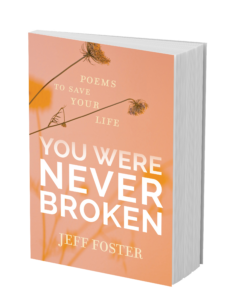
This poem is excerpted from You Were Never Broken: Poems to Save Your Life by Jeff Foster.


jeff fosterJeff Foster shares from his own awakened experience a way out of seeking fulfillment in the future and into the acceptance of “all this, here and now.” He studied astrophysics at Cambridge University. Following a period of depression and physical illness, he embarked on an intensive spiritual search that came to an end with the discovery that life itself was what he had always been seeking.


you were never broken cover

Learn More

Sounds True | Amazon | Barnes & Noble | Bookshop


You Might Also Enjoy

Shi Heng Yi: The Shaolin Shift: This Is It


What if the greatest battle you’ll ever face is the one happening inside your own mind?

This week, Tami Simon speaks with Shi Heng Yi—a 35th generation Shaolin master, founder of the Shaolin Temple Europe, and author of Shaolin Spirit: The Way to Self-Mastery—about what it truly means to master yourself from the inside out.

Born in Germany to Vietnamese immigrant parents, Master Shi Heng Yi began martial arts training at age four and has spent decades making the profound teachings of Shaolin Buddhism accessible to modern seekers worldwide.

Join Tami and Shi Heng Yi to explore:

  • What self-mastery actually means—and why it has nothing to do with control
  • The difference between the self and the persona, and why most suffering comes from confusing the two
  • The concept of elevation—how life becomes lighter when we stop grasping
  • How the body becomes a doorway to discovering what lies beyond it
  • The mind lessons hidden inside the Shaolin horse stance (mabu)
  • Why the heart of a Buddha and the fight of a warrior are not opposites
  • The yin dimension within one of the world’s most physically demanding traditions

Whether you’re carrying the weight of a heavy identity, stuck in a cycle of suffering, or simply curious about what ancient wisdom has to say to the modern world, listen in to discover the freedom that comes from turning inward.

This conversation offers genuine transmission—not just concepts about awakening, but the palpable presence of realized teachers exploring the growing edge of spiritual understanding together. Originally aired on Sounds True One.

Love Beyond Death: Cynthia Bourgeault on Eternal Conne...

Love is one of the deepest forces we know. When someone we love dies, it can feel as though that bond has been broken beyond repair. Yet many spiritual traditions suggest something different. They point to the possibility that love after death is not a fantasy or a coping mechanism, but a mystery woven into the fabric of existence itself. The question is not only what happens to us when we die, but what happens to the love we have shared.

For more than four decades, we have been devoted to sharing the living wisdom of the world’s great spiritual teachers. From contemplative Christianity to Buddhist psychology and beyond, our work preserves authentic, heart-led teachings in the voices of those who embody them. Through our books, audio programs, and podcasts, we offer a trusted space for seekers to engage life’s most profound questions with depth and clarity.

Here, we will reflect on love after death through Cynthia Bourgeault’s mystical understanding of eternal connection, and consider how spiritual practice reshapes our experience of grief, relationships, and enduring love.

Key Takeaways:

  • Divine Source: Love after death is rooted in divine life, not limited to physical existence.
  • Inner Communion: Spiritual connection with the deceased may be experienced through prayer and contemplative awareness.
  • Transformative Grief: Mystical love reshapes grief, allowing sorrow to deepen trust in eternal love.

Build relationships that nourish and sustain

Love After Death: A Spiritual Vision of Eternal Love

What does love after death truly mean? For Cynthia Bourgeault, it is not sentimentality or denial of loss. It is a spiritual insight rooted in the Christian mystical tradition.

Mystics teach that love does not originate in personality or physical presence. Love arises from the divine ground itself. If love is rooted in God, then it is not subject to decay. Death may change the form of a relationship, but it does not erase the essence of what was shared.

This vision reframes grief. We still mourn the absence of voice, touch, and daily companionship. Yet beneath that sorrow, there can be a quiet recognition that the bond continues in another way. Eternal love is not about clinging to memory. It is about trusting that what was real in love participates in something timeless.

In Love Is Stronger Than Death, we share teachings that echo this truth: love belongs to a deeper order of reality than mortality. When two people meet in authentic love, they participate in a current of divine life that does not end at the grave.

Cynthia invites us to see death not as a severing, but as a threshold. The outer form changes. The inner communion remains. In this sense, mystical love reveals that what is grounded in God cannot be undone by death.

How Love Transcends Death in the Christian Mystical Tradition

Cynthia Bourgeault approaches love after death through the lens of Christian mysticism. In this tradition, love is not limited to emotion or memory. It is participation in divine life. If love arises from God, then love transcends death because its source is eternal.

Love as Participation in Divine Being

Mystics teach that our deepest identity is rooted in God. When we love from that depth, the bond is more than attachment. It becomes communion grounded in being itself.

In Is There Life After Death, we reflect on what continues beyond the body. Cynthia shifts the focus toward the quality of love we share. If it is rooted in divine presence, it already belongs to eternity.

The Contemplative Path and Spiritual Connection with the Deceased

Contemplative practice helps us experience this truth directly. In silence, we rest in the presence that holds both the living and the departed. Through Centering Prayer Course, many begin to sense a peaceful spiritual connection with the deceased. This is not about clinging or attempting to retrieve the past. It is about recognizing shared participation in eternal love. Grief remains, but it is held within a wider field of trust.

Mystical Love and the Ongoing Spiritual Connection with the Deceased

Cynthia Bourgeault teaches that mystical love is not confined to time. When someone dies, the outer relationship changes, but the deeper communion remains. Love rooted in God continues because its source is eternal.

Moving from Memory to Living Presence

Grief often begins in memory, yet mystical love invites us beyond recollection into living presence. A spiritual connection with the deceased is not about imagination or clinging. It arises from shared participation in divine life. Whatever Arises, Love That reflects this same invitation — to meet every experience, including loss and grief, with unconditional openness rather than resistance. That inner transformation does not disappear at death. What love has formed within us continues.

Love Transcends Death Through Inner Transformation

Love changes our being. When we have loved deeply, we are altered at the core. That change remains part of us.

In this sense, love transcends death because its imprint endures. The beloved’s physical absence is real, yet the communion grounded in eternal love continues to unfold within the heart.

Awaken Your Inner Healing Power

Eternal Love as a Living Reality, Not a Memory

In Cynthia Bourgeault’s teaching, eternal love is not confined to the past. It is not something we visit only through recollection. It is a present reality grounded in divine life.

When we reduce love after death to memory alone, we unintentionally limit it. Memory can comfort us, but mystical love points to something deeper. Love that is rooted in God continues to live and move, even when the beloved is no longer physically here.

Beyond Sentimentality Toward Spiritual Maturity

There is a difference between holding onto sentiment and growing into spiritual maturity. Sentimentality can keep us tethered to what was. Spiritual maturity invites us to trust what still is. The Great Transformation speaks directly to this deepening, offering a framework for the kind of inner shift that allows grief to open the heart rather than close it. As we mature spiritually, we begin to sense that eternal love is not fragile. It does not depend on circumstances. It abides because it participates in divine being.

Living in Relationship Across the Threshold

To live in a relationship across the threshold of death requires inner stillness and trust. It does not mean attempting to recreate the old dynamic. Instead, it means allowing the relationship to assume a new form. Presence Online Course supports this quality of awareness, cultivating the steady inner attentiveness through which love after death becomes a quiet companionship carried in prayer, silence, and daily awareness of God’s presence. The connection is no longer defined by physical exchange, yet it remains real.

The Spiritual Connection Deceased Loved Ones Continue to Offer

Cynthia Bourgeault reminds us that a spiritual connection with the deceased is not a one-sided longing. Love continues to shape and guide us. While the physical presence is gone, the inner bond often deepens in subtle and meaningful ways.

This ongoing connection may express itself through:

  • A deepened capacity for compassion, as the love you shared softens your heart toward others
  • Inner guidance that arises in prayer or quiet reflection, reflecting the wisdom of the relationship
  • A renewed commitment to live with integrity, inspired by the life and values of the one who has passed
  • A sense of companionship in solitude, especially during moments of contemplationA widening trust in eternal love, as grief gradually opens into surrender

These expressions are not fantasies. They are signs that love after death continues to bear fruit. The relationship evolves, yet its spiritual essence remains active. In this way, love transcends death by continuing to shape who we are and how we walk our path.

Love Transcends Death: Insights from Contemplative Prayer

Cynthia Bourgeault teaches that contemplative prayer reveals how love transcends death. In silence, we shift from surface thoughts into deeper awareness. From that depth, separation feels less absolute.

Prayer does not attempt to prove what happens after death. Instead, it grounds us in the divine presence that holds both the living and the departed. As we rest there, grief is steadied by trust.

Through this contemplative awareness, love after death becomes less an idea and more a lived knowing that what is rooted in God endures.

Mystical Love and the Transformation of Grief

Cynthia Bourgeault does not dismiss grief. In the mystical path, grief is honored as the natural response to deep love. The pain of loss reflects the depth of the bond.

Over time, mystical love reshapes how grief is carried. Sorrow may soften into gratitude and quiet companionship. The relationship is no longer expressed through physical presence, yet it continues inwardly.

In this way, love after death does not erase grief. It transforms it, allowing eternal love to widen the heart even in loss.

Love After Death and the Mystery of Eternal Connection

Love after death invites us into mystery rather than certainty. Cynthia Bourgeault reminds us that eternal love is not something we control or define. It is something we participate in.

The form of the relationship changes at death, yet the deeper bond remains within divine life. What was shared in truth is not erased but gathered into a larger communion.

In this mystery of eternal connection, we are asked to trust that love transcends death because it is rooted in something greater than time.

Discover the power of daily meditation

Final Thoughts

Love after death invites us into mystery. Through Cynthia Bourgeault’s teaching, we see that eternal love is rooted in divine life, not limited by physical form.

Grief remains real, yet mystical love widens our trust. What is grounded in God endures, and the spiritual connection with the deceased continues within that greater communion.

Frequently Asked Questions About Love Beyond Death and Love After Death

What does love after death mean in spiritual terms?

Love after death refers to the understanding that love is not limited to physical existence. Spiritually, it suggests that love continues as a form of connection rooted in divine reality rather than the body alone.

Is love after death a belief or a mystical experience?

For many contemplatives, it is both. Some approach it as a belief grounded in faith, while others describe it as a lived mystical experience of ongoing communion through prayer and inner awareness.

How is eternal love different from romantic attachment?

Eternal love points to a deeper spiritual bond that is not dependent on physical closeness or emotional intensity. It reflects a connection grounded in shared being rather than circumstance.

Can grief coexist with trust in love after death?

Yes. Trusting that love continues does not remove sorrow. Grief and faith can exist together, allowing mourning to unfold within a wider spiritual framework.

What role does prayer play in sensing a continued connection?

Prayer creates inner stillness and receptivity. In that space, some people report a quiet awareness of connection that feels peaceful rather than driven by longing.

Is the idea that love transcends death unique to Christianity?

No. While Cynthia Bourgeault speaks from the Christian mystical tradition, many spiritual paths affirm that love transcends death in different theological languages.

Does believing in love after death prevent healthy grieving?

Not necessarily. When grounded in spiritual maturity, this belief can support healing by offering hope without denying emotional reality.

What is meant by a spiritual connection with the deceased?

It refers to an inward sense of continued relationship that may arise through memory, prayer, intuition, or moral inspiration, without requiring physical interaction.

How does mystical love shape our understanding of mortality?

Mystical love reframes mortality as a transition rather than an absolute ending. It encourages seeing life as participation in something larger than the individual self.

Why does the topic of love after death resonate so deeply?

Because love is central to human identity. Questions about its endurance touch our deepest fears and hopes about meaning, continuity, and belonging.

Michelle Cassandra Johnson is an author, activist, spiritual teacher, racial equity consultant, and intuitive healer. She is the author of six books, including Skill in Action and Finding Refuge. Amy Burtaine is a leadership coach and racial equity trainer. With Robin DiAngelo, she is the coauthor of The Facilitator's Guide for White Affinity Groups. For more, visit https://www.michellecjohnson.com/wisdom-of-the-hive.

Radical Forgiveness: A Revolutionary Approach to Letti...

Forgiveness can sound simple in theory and nearly impossible in practice. Many of us know what it feels like to carry resentment long after a moment has passed. A conversation replays in the mind. A betrayal lingers in the body. Even when we want to move forward, something inside resists. Radical forgiveness offers another way to meet these experiences. It invites us to look beyond the surface of what happened and consider how our interpretation of the event shapes our inner life.

For more than three decades, we have been devoted to sharing the living wisdom of spiritual teachers in their own unscripted voices. From respected pioneers in mindfulness and compassion to contemporary leaders in personal transformation, our work has centered on teachings that support genuine awakening. Through thousands of audio programs, books, and in-depth conversations, we have witnessed how forgiveness becomes a doorway to freedom rather than a moral obligation.

Here, we will discuss radical forgiveness as a revolutionary approach to letting go, including how to forgive, how to release resentment, and how a steady forgiveness practice can support healing through forgiveness in everyday life.

Key Takeaways:

  • Perception Shift: Radical forgiveness reframes painful experiences as opportunities for spiritual growth rather than proof of victimhood.
  • Emotional Freedom: A steady forgiveness practice helps release resentment and restore inner balance without denying emotional truth.
  • Self-Inclusion: Healing through forgiveness deepens when we extend compassion to ourselves alongside others.

Awaken Something Greater

What Is Radical Forgiveness?

Radical forgiveness is a spiritual approach to letting go that shifts our perception of harm, blame, and victimhood. Rather than focusing solely on releasing anger toward someone who hurt us, radical forgiveness invites us to question the deeper meaning of the experience itself.

This perspective suggests that life is not happening against us, but for our awakening. That does not excuse harmful behavior. Instead, it calls us to release the story that we are powerless or defined by what happened.

In the teachings of Radical Forgiveness, we are encouraged to see painful events through a wider spiritual lens. When we loosen our grip on blame and resentment, we create space for peace. The shift is subtle but profound. We move from asking why something happened to asking what it is here to teach.

Radical forgiveness is not about bypassing emotion. It is about allowing anger, grief, and disappointment to move through us without building a permanent home inside us. It is a practice of reclaiming our inner freedom by choosing a new interpretation of our experience.

How to Forgive: Understanding Radical Forgiveness as a Spiritual Path

Learning how to forgive is rarely about forcing ourselves to move on. In radical forgiveness, it becomes a spiritual shift in perception. Instead of staying fixed on blame, we begin to ask what the experience is revealing within us.

Moving Beyond Blame

Radical forgiveness invites us to release the identity of the victim. While blame can feel justified, it often keeps us tied to the past. Forgiveness begins with curiosity. What belief was triggered? What fear surfaced?

This approach does not excuse harm. It restores our agency. Our healing no longer depends on someone else changing.

Choosing a New Interpretation

At the heart of a forgiveness practice is the willingness to see differently. We can interpret painful events through separation, or we can consider that they may hold meaning for our growth. Choosing a new interpretation takes repetition. It is a daily return to openness. Radical Compassion Challenge supports this process by helping cultivate the open-hearted awareness that makes a new interpretation possible. As we learn how to forgive in this way, resentment softens and our energy returns to the present.

Letting Go of Resentment Through a Conscious Forgiveness Practice

Letting go of resentment does not mean denying anger. It means choosing not to build our identity around past pain. A steady forgiveness practice helps us make that shift.

Recognizing the Cost of Resentment

Resentment can feel justified, yet it keeps us tethered to the story of what happened. Radical forgiveness invites us to ask: What is holding onto this anger costing us? Peace, connection, presence?

Awareness is often the first step toward release.

Practicing Release with Intention

Forgiveness becomes real through repetition. Journaling, guided reflection, and structured inquiry support us in reframing our experience and loosening blame. For deeper personal work, The Power of Self-Compassion provides practical tools for working with guilt, shame, and unresolved hurt — meeting ourselves with the same care we are learning to extend to others. Over time, letting go of resentment becomes less about a dramatic breakthrough and more about returning, again and again, to willingness.

Awaken Your Inner Healing Power

Healing Through Forgiveness: The Transformative Power of Radical Forgiveness

Healing through forgiveness is about changing how the past lives within us. Radical forgiveness offers a spiritual framework for that shift, helping us release emotional charge without denying our experience.

From Reaction to Reflection

Pain can leave lasting emotional patterns. Radical forgiveness encourages us to feel what arises while also asking a deeper question: What might this experience be teaching me? This shift moves us from automatic reaction to conscious reflection.

Through this lens, healing through forgiveness becomes an inner process rather than a negotiation with others.

Reclaiming Inner Freedom

As blame softens, we regain emotional space. The memory may remain, but its intensity begins to fade. Radical forgiveness restores our capacity to choose how we respond instead of reliving old pain. Whatever Arises, Love That deepens this work, offering a practice of meeting every experience — including pain and resentment — with unconditional openness rather than resistance. This is the transformative power of the practice. We are no longer defined by what happened, but strengthened by how we grow beyond it.

A Daily Forgiveness Practice for Radical Letting Go

Radical forgiveness becomes real through daily application. A consistent forgiveness practice supports radical letting go by helping us shift from reaction to reflection in the middle of ordinary life.

A Simple Structure for Daily Practice

You might begin with a few intentional steps:

  • Pause and name the feeling. Acknowledge anger, hurt, or disappointment without judgment.
  • Identify the story you are telling about what happened. Notice where blame or victimhood may be shaping your interpretation.
  • Ask what this experience is inviting you to see or learn. Stay open rather than forcing an answer.
  • Consciously choose willingness. You may not feel full forgiveness yet, but you can choose openness to it.
  • Close with reflection or meditation to anchor the shift in your body and breath.

For guided support, Forgiveness Meditation offers a structured way to sit with difficult emotions and gently release resentment.

A daily forgiveness practice does not require perfection. Some days the shift will feel natural. Other days, it may feel resistant. What matters is the steady return. Radical letting go unfolds through repetition, patience, and a growing trust that inner freedom is possible.

Radical Self-Forgiveness as the Foundation of Healing Through Forgiveness

Radical self-forgiveness is essential to healing through forgiveness. While we may focus on releasing resentment toward others, unresolved guilt and shame often remain beneath the surface. When we judge ourselves harshly, we reinforce the belief that we are defined by our mistakes. Healing Trauma Online Course offers gentle, structured support for this layer of the work — helping practitioners move through unresolved pain with care and build a more compassionate relationship with their own history.

Radical self-forgiveness invites a different response. It asks us to take responsibility with compassion rather than self-condemnation. We acknowledge what happened, learn from it, and allow ourselves to grow beyond it. When we include ourselves in the process of forgiveness, healing deepens. We stop replaying old regret and begin living with greater wholeness and self-trust.

Getting Unstuck: How to Forgive When You Feel Stuck in Resentment

There are times when forgiveness feels distant, even when we want it. Feeling stuck in resentment often means a deeper layer of hurt has not yet been acknowledged. Before we can release anger, we may need to fully admit how much something affected us.

How to forgive in these moments begins with gently questioning the story we are repeating. Is there another way to interpret what happened? What belief is keeping the resentment alive?

Getting unstuck is usually a gradual shift. With patience and a steady forgiveness practice, the emotional charge begins to soften, and space opens for a new response.

Forgiveness Meditation as a Practice for Letting Go of Resentment

Forgiveness meditation offers a steady way to practice letting go of resentment. Instead of replaying the story of what happened, we turn our attention to the emotions held in the body and meet them with awareness.

By sitting quietly, acknowledging the hurt, and extending compassion to ourselves and others, we begin to loosen the grip of anger. We are not forcing forgiveness. We are creating space for it.

Over time, this practice softens emotional reactivity and supports a deeper sense of inner peace.

Discover the power of daily meditation

Final Thoughts

Radical forgiveness invites us to live with a wider lens. It asks us to release resentment, question the stories that keep us stuck, and include ourselves in the circle of compassion. Through a steady forgiveness practice, healing through forgiveness becomes less about changing the past and more about reclaiming our inner freedom.

Letting go is rarely a single moment. It is a willingness we return to again and again. In that return, we begin to experience the quiet strength of a heart no longer defined by what has happened, but guided by what is possible now.

Frequently Asked Questions About Radical Forgiveness

What makes radical forgiveness different from traditional forgiveness?

Radical forgiveness shifts the focus from resolving interpersonal conflict to transforming personal perception. Instead of centering on apology or reconciliation, it emphasizes inner awareness and spiritual growth as the primary outcome.

Is radical forgiveness connected to a specific spiritual belief system?

Radical forgiveness can be practiced within many spiritual traditions, but it is not limited to one path. It rests on the idea that life events can hold meaning beyond surface appearances, allowing individuals to interpret experiences through a lens of consciousness rather than punishment.

Does radical forgiveness mean reconciling with someone who caused harm?

Not necessarily. Radical forgiveness is an internal process. Reconciliation may or may not be appropriate. The practice centers on releasing inner hostility, not forcing renewed relationships or trust.

Can radical forgiveness help with long-standing family conflict?

Yes. Because it addresses the internal narrative rather than external behavior, radical forgiveness can shift deeply rooted patterns. Even if family dynamics remain unchanged, one’s emotional experience of them can transform.

How long does it take to practice radical forgiveness effectively?

There is no fixed timeline. Some situations may soften quickly, while others require ongoing reflection. Radical forgiveness is less about speed and more about sustained willingness.

Is radical forgiveness psychologically safe for trauma survivors?

For individuals with significant trauma, it is important to proceed gently and, when needed, with professional support. Radical forgiveness is not about bypassing pain but integrating it consciously. Timing and readiness matter.

Can radical forgiveness improve physical health?

Chronic resentment has been linked to stress-related physical symptoms. While radical forgiveness is not a medical treatment, releasing emotional tension may support overall well-being by reducing stress responses.

What role does accountability play in radical forgiveness?

Accountability remains important. Radical forgiveness does not remove responsibility for harmful actions. Instead, it separates accountability from ongoing emotional entanglement.

How does radical forgiveness relate to personal boundaries?

Forgiveness and boundaries can coexist. Releasing resentment does not mean allowing repeated harm. Healthy boundaries often become clearer when resentment is no longer clouding perception.

Can radical forgiveness be practiced without meditation?

Yes. While meditation can support the process, radical forgiveness can also be practiced through journaling, dialogue, reflection, or guided inquiry. The essential element is a willingness to reinterpret the experience.

Michelle Cassandra Johnson is an author, activist, spiritual teacher, racial equity consultant, and intuitive healer. She is the author of six books, including Skill in Action and Finding Refuge. Amy Burtaine is a leadership coach and racial equity trainer. With Robin DiAngelo, she is the coauthor of The Facilitator's Guide for White Affinity Groups. For more, visit https://www.michellecjohnson.com/wisdom-of-the-hive.

  • Anonymous says:

    How do you define the authentic self and what would be its opposite?

  • clapetri says:

    Awareness, consciousness and the opposite believing thoughts and acting on it

  • >
    Share via
    Copy link
    Powered by Social Snap