A doctor of Chinese medicine who was a famous bonesetter in China once said to me with a heavy accent, “Here, you [meaning Americans] don’t like to feel pain. You don’t like to suffer.” He said this as he wrung my neck as one would a chicken’s, snapping it back and forth in a way I had never experienced. I screamed as if he were breaking my bones.
For a month prior, I hadn’t been able to move my head to the left or right. My left arm was nearly immobile. I had just started a new job that probably should have ended the moment my body locked up. I went for acupuncture, then pain pills; used ice and hot water bottles. I went to medical doctors, and they X-rayed the area and gave me more pills and a brace to keep my head still—the kind used for whiplash. I later tried one of the best chiropractors in the city, and she gave me the number of a neurosurgeon, thinking I had a herniated disk and would need surgery. I did not seek out the surgeon and stayed in pain for weeks. Finally, a friend from my job gave me the number of her doctor, the famous bonesetter mentioned above. I called him at 10:00 pm that night. That’s how much pain I was in. To my surprise, he answered the phone. He said, “Come in. I wait for you.”
I said, “Now?”
“Yes!” he said. “You have pain, come now.”
Wow, I thought. Now that’s a healer. It didn’t matter that it was the middle of the night.
My partner at the time drove me across the Bay Bridge to San Francisco, and I met my friend from work at the healer’s office. She had come to translate from Mandarin to English. The place was tiny, with photos on the wall of city dignitaries and other famous people who were his clients.
“Hi.” The bonesetter smiled like a boy. “I’m Dr. Fu.”
I sat down in his small room and showed him my X-ray. He threw it on the floor without looking at it. He took the brace off my neck and threw that on the floor, too, right next to the X-ray. Then he twisted me into a pretzel. I howled, yelped, screamed, and hollered.
All of it. No wonder he had me come when no other patients were there. He told me to breathe, and I did my best. Suddenly, at the peak of the pain, I felt my muscles release in my neck, shoulders, and back. It was in fact a miracle to me. I had suffered so long.
I carried my brace and X-ray out in my hands. It was as if I had never been in pain or unable to move. The night sky filled with stars made me feel like I was on another planet. I was in bliss. When I returned to work, everyone was shocked. Was it a miracle, or was it the ability to withstand a greater amount pain to be free of the pain? I would have never imagined that I needed to go deeper into the pain, deeper into the darkness of it. All I had wanted was out.
We are averse to pain and suffering and understandably so, given our American sensibility. We have access to a large market of remedies, products, spiritual paths, and, yes, gateways to the freedom from suffering. I wonder how many times we have diverted our own freedom when we have discovered there is more pain, more trouble, more darkness ahead and we keep adding on remedies. What is the mindset, along with fear and terror, that causes us to avoid our suffering rather than go deeper into seeing what is there? Yes, I should have quit that job on the spot when the pain started, even though I had been there for only a few weeks. I didn’t know at the time, but the pain that was deep inside was because I wanted something different for my life than the job I had accepted. The pain was my impatience, and it was at the same time physical pain in real time. I didn’t wait to allow that“something different” to be revealed in the darkness.
Since all paths—religious, spiritual, or without name—intersect in the place of darkness, darkness is the place where the mind is forced to detach itself from whatever it has grabbed onto in life. And in that nothingness, in that dark place, we awaken.
What of darkness terrorizes us so that we run from it, rather than go deeper into it? How can we bear dark times, or, more explicitly, horrifying times, with the skill of an awakened one? Misery, struggle, and sorrow are not the sole intentions of this life. Yet we can respect our interrelationship with everything in the world, including the suffering in, around, and between us. Is there a way to live in unsettling times that we have forgotten?
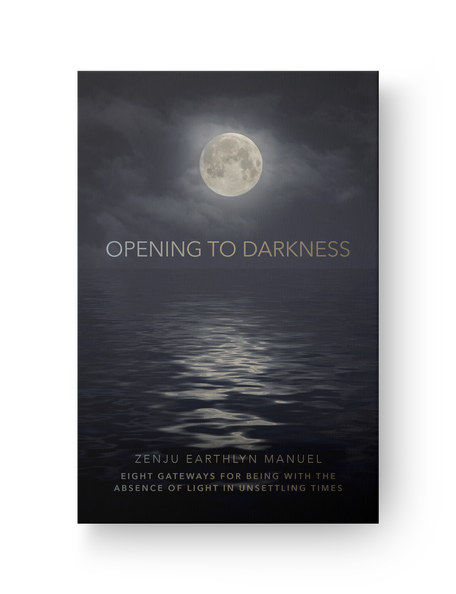
Excerpted from Opening to Darkness: Eight Gateways for Being with the Absence of Light in Unsettling Times by Zenju Earthlyn Manuel.
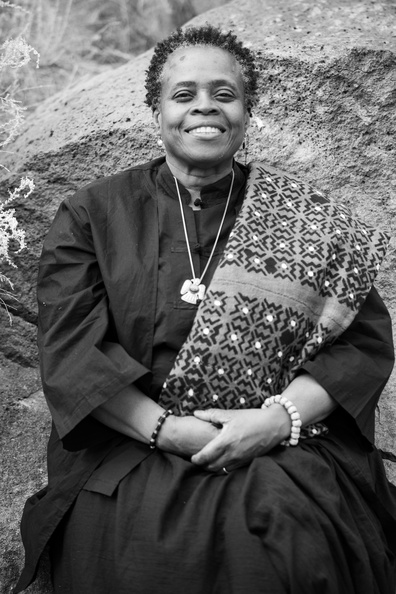
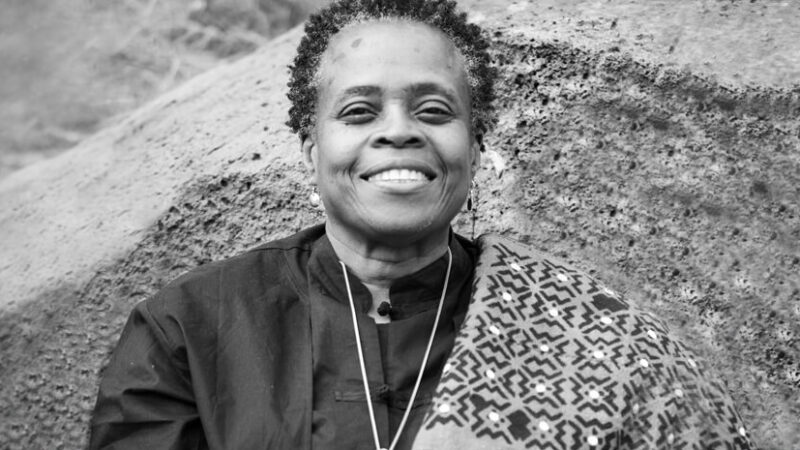
Osho Zenju Earthlyn Manuel, PhD, is an author, poet, ordained Zen Buddhist priest, teacher, and artist, whose diverse background, education, and experience all provide a unique integral and cultural perspective within the space of religion and spirituality. She is the author of The Shamanic Bones of Zen, The Way of Tenderness, The Deepest Peace, and more. Manuel is a native of California and now resides in New Mexico. Learn more at zenju.org.
Osho Zenju Earthlyn Manuel, PhD, is an author, poet, ordained Zen Buddhist priest, teacher, and artist, whose diverse background, education, and experience all provide a unique integral and cultural perspective within the space of religion and spirituality. She is the author of The Shamanic Bones of Zen, The Way of Tenderness, The Deepest Peace, and more. Manuel is a native of California and now resides in New Mexico. Learn more at zenju.org.
When we heard Osho Zenju Earthlyn Manuel share her story of a terrifying night she couldn’t breathe, it was eerily similar to a personal experience—and helpful too. We knew we had to share this moment from her conversation with Tami Simon on Insights at the Edge, in which she tells the story of the night she nearly died from a severe anaphylactic reaction and how she got through it not by searching for light at the end of the tunnel, but by staying present with the darkness itself.
Zenju, a poet and ordained Zen Buddhist priest, challenges the instinct most of us have to fear darkness, rush out of it, or wait for a gift on the other side. Instead, she describes an experience of profound non-struggle — a moment of near-death where she wasn’t afraid, didn’t fight, and somehow found a way to keep breathing by trusting her body completely.
Key themes from this episode:
Why darkness — and even light — may be far more unknown and unknowable than we assume
How struggling against a frightening experience can make it worse, while staying present with it can be transformative
A firsthand account of surviving a full-blown anaphylactic shock without fear
Rethinking our cultural instinct to rush ourselves and others out of difficult emotional or physical states
Why “the absence of light” might be less about despair and more about a different kind of awakening
Taken from the full Insights at the Edge conversation with Zenju Earthlyn Manuel “Opening to Darkness,” which is also the title of her book. Find the complete interview in this feed or at soundstrue.com.
This episode is sponsored by Omega Institute, a global gathering hub for lifelong learning and spiritual exploration. Omega offers weekend workshops, special events, rest and rejuvenation retreats, professional training, online learning, and more. Discover what calls to you ateomega.org/true.
Darkness is an inseparable part of life. Yet instead of resisting it or trying to eradicate it, as society would often have us do, how can we use darkness as fodder for our growth and evolution? In this podcast, Tami Simon speaks with poet, Zen Buddhist priest, and artist Zenju Earthlyn Manuel about her new book, Opening to Darkness: Eight Gateways for Being with the Absence of Light in Unsettling Times, and how we can begin to change the way we relate to darkness and blackness.
We invite you to turn off the lights and close your eyes (assuming you’re not driving), as you listen to this insightful and provocative conversation exploring “zenju,” or complete tenderness; our longing for light and the call to “enter our caves”; the connection between the bias toward light and the oppression of Black-bodied people; the evolutionary force of blackness; creativity and darkness; the notion of “the absence of light”; the price we pay by avoiding darkness at all costs; how we can’t really know but can only experience light or darkness; the teacher of darkness called death, and the willingness to look at something beyond our control; the inner capacities to stay with darkness; recognizing the spiritual component to darkness; building an intuition and going beyond what is taught and learned about darkness and blackness; being with suffering; silence and darkness; and more.
Note: This episode originally aired on Sounds True One, where these special episodes of Insights at the Edge are available to watch live on video and with exclusive access to Q&As with our guests. Learn more at join.soundstrue.com.
A doctor of Chinese medicine who was a famous bonesetter in China once said to me with a heavy accent, “Here, you [meaning Americans] don’t like to feel pain. You don’t like to suffer.” He said this as he wrung my neck as one would a chicken’s, snapping it back and forth in a way I had never experienced. I screamed as if he were breaking my bones.
For a month prior, I hadn’t been able to move my head to the left or right. My left arm was nearly immobile. I had just started a new job that probably should have ended the moment my body locked up. I went for acupuncture, then pain pills; used ice and hot water bottles. I went to medical doctors, and they X-rayed the area and gave me more pills and a brace to keep my head still—the kind used for whiplash. I later tried one of the best chiropractors in the city, and she gave me the number of a neurosurgeon, thinking I had a herniated disk and would need surgery. I did not seek out the surgeon and stayed in pain for weeks. Finally, a friend from my job gave me the number of her doctor, the famous bonesetter mentioned above. I called him at 10:00 pm that night. That’s how much pain I was in. To my surprise, he answered the phone. He said, “Come in. I wait for you.”
I said, “Now?”
“Yes!” he said. “You have pain, come now.”
Wow, I thought. Now that’s a healer. It didn’t matter that it was the middle of the night.
My partner at the time drove me across the Bay Bridge to San Francisco, and I met my friend from work at the healer’s office. She had come to translate from Mandarin to English. The place was tiny, with photos on the wall of city dignitaries and other famous people who were his clients.
“Hi.” The bonesetter smiled like a boy. “I’m Dr. Fu.”
I sat down in his small room and showed him my X-ray. He threw it on the floor without looking at it. He took the brace off my neck and threw that on the floor, too, right next to the X-ray. Then he twisted me into a pretzel. I howled, yelped, screamed, and hollered.
All of it. No wonder he had me come when no other patients were there. He told me to breathe, and I did my best. Suddenly, at the peak of the pain, I felt my muscles release in my neck, shoulders, and back. It was in fact a miracle to me. I had suffered so long.
I carried my brace and X-ray out in my hands. It was as if I had never been in pain or unable to move. The night sky filled with stars made me feel like I was on another planet. I was in bliss. When I returned to work, everyone was shocked. Was it a miracle, or was it the ability to withstand a greater amount pain to be free of the pain? I would have never imagined that I needed to go deeper into the pain, deeper into the darkness of it. All I had wanted was out.
We are averse to pain and suffering and understandably so, given our American sensibility. We have access to a large market of remedies, products, spiritual paths, and, yes, gateways to the freedom from suffering. I wonder how many times we have diverted our own freedom when we have discovered there is more pain, more trouble, more darkness ahead and we keep adding on remedies. What is the mindset, along with fear and terror, that causes us to avoid our suffering rather than go deeper into seeing what is there? Yes, I should have quit that job on the spot when the pain started, even though I had been there for only a few weeks. I didn’t know at the time, but the pain that was deep inside was because I wanted something different for my life than the job I had accepted. The pain was my impatience, and it was at the same time physical pain in real time. I didn’t wait to allow that“something different” to be revealed in the darkness.
Since all paths—religious, spiritual, or without name—intersect in the place of darkness, darkness is the place where the mind is forced to detach itself from whatever it has grabbed onto in life. And in that nothingness, in that dark place, we awaken.
What of darkness terrorizes us so that we run from it, rather than go deeper into it? How can we bear dark times, or, more explicitly, horrifying times, with the skill of an awakened one? Misery, struggle, and sorrow are not the sole intentions of this life. Yet we can respect our interrelationship with everything in the world, including the suffering in, around, and between us. Is there a way to live in unsettling times that we have forgotten?
Excerpted from Opening to Darkness: Eight Gateways for Being with the Absence of Light in Unsettling Times by Zenju Earthlyn Manuel.
Osho Zenju Earthlyn Manuel, PhD, is an author, poet, ordained Zen Buddhist priest, teacher, and artist, whose diverse background, education, and experience all provide a unique integral and cultural perspective within the space of religion and spirituality. She is the author of The Shamanic Bones of Zen, The Way of Tenderness, The Deepest Peace, and more. Manuel is a native of California and now resides in New Mexico. Learn more at zenju.org.
Is a spiritual awakening only real if it completely rearranges your life? That’s the question Tami Simon puts to Adyashanti in this episode, and his answer digs into something a lot of seekers wrestle with: the gap between a powerful glimpse of clarity and the ongoing work of actually living from it.
Adya, the American-born teacher behind books like The End of Your World and Falling into Grace, walks through why those temporary tastes of awakening are real, even when they fade, and offers a surprisingly practical way to hold onto what they revealed without grasping at them. Then he does something rare: he tells the story of his own first major awakening, a moment he describes as feeling like a nuclear explosion going off inside him.
Here’s what we cover:
Why a fleeting shift still counts as a real awakening, even if it doesn’t stick
The two (seemingly contradictory) pieces of advice Adya gives people chasing a past peak experience
How the first awakening can feel like a “freebie,” while everything after asks you to participate consciously
Adya’s own account of the night everything fell away and the still, small voice that told him, “This isn’t all of it. Keep going.”
What if aging isn’t the slow closing of your erotic life, but the doorway into its most alive season?
This week, Tami Simon speaks with Kimberly Ann Johnson—sexological body worker, somatic experiencing practitioner, birth doula, and author of the new Sounds True book Erotic Seasons: Tuning In to the Rhythms of Women’s Sexuality and Spirituality—about what she calls erotic sovereignty, and the sentence that closes her book: the female body is its own spiritual path.
Join Tami and Kimberly to explore:
Erotic sovereignty—your relationship to your own life force, and why it stays with you across every season
Why the goal isn’t a more regulated nervous system, but a more responsive one, and what it means to run more charge
The four erotic seasons—maiden, mother, virgin, crone—and the surprising reason virgin comes after mother
Why hormonal transitions are “wet clay”: golden opportunities for repatterning that our culture teaches us to rush past
Menopause as a death rehearsal, and the life review that arrives decades before we expect it
Hot sex and warm sex—widening the range beyond adrenaline, and learning the language of the pause
“Hormones are gods”: the collective endocrine system, and why living intergenerationally may be the original hormone therapy
Becoming a sexual alchemist—arousal as healing energy, and why care is the whole ethic
Whether you are 25 or 75, Kimberly offers a map for meeting your body’s changes as thresholds rather than losses.
Please note: this episode includes candid discussion of sexual abuse and sexual wounding, including Kimberly Ann Johnson’s own experience.
Listen now, and meet your body as the path. →
This conversation offers genuine transmission, not just concepts about awakening, but the palpable presence of realized teachers exploring the growing edge of spiritual understanding together, and it originally aired on Sounds True One.
What if the very thing that wounded you is the source of the medicine you’re here to give?
In this month’s Point of Insight, Tami Simon shares a personal story: minutes before going live with an archetypal astrologer, she was told—correctly, and within seconds—that she carried “the mother of all mother wounds.” That single moment became the culmination of a much longer, gradual unfolding: a lifetime’s worth of “drops,” from a mentor she called the Queen of the Reframe, to an interview with yoga teacher and activist Seane Corn titled “Your Pain Is Your Purpose,” to an email from a business coach whose four simple words reframed everything—your karma is your dharma.
Join Tami as she reflects on:
How a lifelong feeling of not belonging became the soil for a life’s work helping others feel connected
The difference between sudden insight and the slow, gradual “boiling water” of a tipping point
Why real breakthrough requires going all the way through pain, not around it
Joanna Macy’s question—”What breaks your heart?”—and how grief and care become fuel for service
Why “never turn away” may be one of the most important spiritual instructions there is
This is a shorter, solo reflection from Tami—released once a month on the Insights at the Edge feed—on where our deepest wounds and our clearest purpose meet.