Stop Trying to Be Happy: Jeff Foster on Being Held, Not Healed

    —
June 19, 2017

“Your pain, your sorrow, your doubts, your longings, your fearful thoughts: they are not mistakes, and they are not asking to be ‘healed.’ They are asking to be held. Here, now, lightly, in the loving, healing arms of present awareness . . .”

There is so much pressure on us these days to “feel good.” But it’s exactly our attempts to feel good that can make us feel so bad! Conceiving of happiness as a destination rather than the all-embracing non-dual present awareness that we are, we go to war with our unhappiness and feel shame around it. We split ourselves in two and feel far away from Home. I know—I spent much of my life suicidally depressed. These days I love myself exactly as I am; I see the beauty in my imperfections, and I want to share the secrets of self-love with you.

In my new book, The Way of Rest, through prose and poetry I invite you—and this sounds like a paradox at first—to stop trying to be happy, stop trying to awaken or even “heal,” and instead courageously embrace yourself exactly as you are, including your present unhappiness—your painful feelings, your strange thoughts and longings, even your fear and exhaustion. See them all as perfectly placed pieces of you rather than mistakes or aberrations or signs of your failure.

Today, try this:

If you feel sad or afraid, or feel a tension in your body, just for a moment stop trying to “let go.” Forget about “raising your vibration” too! Instead, simply be with the discomfort. Get curious about it. Soften around it. Breathe into it. Give it space, room, some time. Forget about understanding, “releasing,” or “fixing” it today and just allow it to be here for as long as it needs to be here. Let it stay if it wants to stay. Let it go if it wants to go! Let it come back if it wants to come back. Treat it like a welcome guest in the vast Rest Home of your being, a beloved child that truly belongs.

If you’re tired of the fight, exhausted from the struggle, fed up with trying to “fit in,” I invite you to discover a deeper kind of healing: The Way of Rest.

With love from yourself,

Jeff Foster

Jeff Foster

Photo of ()\

Jeff Foster shares from his own awakened experience a way out of seeking fulfillment in the future and into the acceptance of "all this, here and now." He studied astrophysics at Cambridge University. Following a period of depression and physical illness, he embarked on an intensive spiritual search that came to an end with the discovery that life itself was what he had always been seeking.

Foster, Jeff © Emily Goodman


Listen to Tami Simon's in-depth audio podcast interviews with Jeff Foster:
The Deepest Acceptance »
The Deepest Acceptance: Part 2 »
Unconditioned Awareness and the Challenges of Everyday Life »

Also By Author

Victory! A Poem

Victory!

By Jeff Foster


You don’t have to be the best. 

You don’t have to win. 

You only have to be yourself.


You only have to be real. 

And speak from the heart. 

And know that you have the right to see how you see, 

and think how you think, and feel what you feel, 

and desire what you desire.


You don’t have to be a success in the eyes of the world 

and you don’t have to be an expert on living.


You only have to offer what you offer, 

breathe how you breathe, make mistakes and screw 

up 

and learn to love your stumbling and say the 

wrong thing 

and stop worrying so much about impressing anyone 

because in the end you only have to live with yourself


and joy is not given but found in the deepest 

recesses of your being 

so there can be joy in falling and joy in making 

mistakes 

and joy in making a fool of yourself and joy in 

forgetting joy 

and then holding yourself close as you crumble to 

the ground 

and weep out the old dreams.


Joy is closeness 

with the one you love: 

You.


You don’t have to be the best. 

You really don’t have to win.


You only have to remember this intimacy with 

the sky, the nearness of the mountains and feel the sun 

warming your shoulders and the nape of your neck


and know that you are alive, 

and that you are a success at being alive, 

and that you have won already, 

and you are victorious already, 

without having to prove 

a damn 

thing.


To anyone.

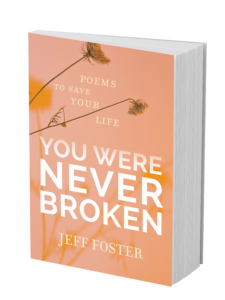
This poem is excerpted from You Were Never Broken: Poems to Save Your Life by Jeff Foster.


jeff fosterJeff Foster shares from his own awakened experience a way out of seeking fulfillment in the future and into the acceptance of “all this, here and now.” He studied astrophysics at Cambridge University. Following a period of depression and physical illness, he embarked on an intensive spiritual search that came to an end with the discovery that life itself was what he had always been seeking.


book cover

Learn More

Sounds True | Amazon | Barnes & Noble | Bookshop

The Courage to Stand Alone

The Courage to Stand Alone

It can be scary when we are called to confront our aloneness, the seemingly infinite depths of that empty, homeless feeling inside of us. When all our old protections fall away and the abandoned and neglected ones inside come begging for our love and attention. It can feel sometimes as though there’s nowhere to turn, like we want to crawl out of our own skin, urgently get out of the Now and into some other time or place.

It takes bravery to stop, breathe, and—slowly, slowly, slowly—turn back toward the lonely, dark, empty “void” inside (in reality, there is no void). To actually turn to face the sense of abandonment buried deep within our guts, to soften into the sense of separation that has been with us for as long as we can remember. We don’t have to make the feeling go away today, only lean into it, breathe into it, begin to make room for it, maybe even learn to trust its presence. 

quote image

Perhaps loneliness is like a cosmic nostalgia, a preverbal memory of a deep womb-connection, with ourselves, with the planet, with every being who has ever lived. In leaning into our own loneliness, shame, and existential anxiety, we may be able to touch into compassion for the loneliness of every human being, for every heart longing to connect, for every grieving heart, every frightened heart. 

We are alone, yet never alone. This is the great paradox of existence. Our loneliness, when not resisted or numbed away, may actually end up connecting us more deeply to life and each other, like it did for me and my sweet father that winter evening. 

Let us learn to be alone, then! Alone, without distraction, which is true meditation. Alone, communing with the breath as it rises and falls. Alone with the mind and its incredible dance. Alone with the rain and the morning sun. Alone with the crackle of autumn leaves under our feet, or the crunch of winter snow. Alone with the hopes and joys and anxieties of this human form, living a single day on this remarkable planet. Alone with our precious selves, with this unfathomable sense of connection to all things, with birth and loss and death and their myriad mysteries. 

Alone, with all of life.

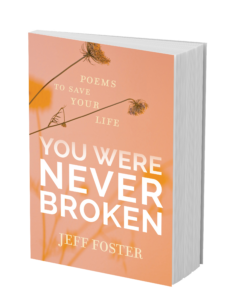
This is an excerpt from You Were Never Broken: Poems to Save Your Life by Jeff Foster.

jeff fosterJeff Foster shares from his own awakened experience a way out of seeking fulfillment in the future and into the acceptance of “all this, here and now.” He studied astrophysics at Cambridge University. Following a period of depression and physical illness, he embarked on an intensive spiritual search that came to an end with the discovery that life itself was what he had always been seeking.


book image of excerpt on lonliness

Learn More

Sounds True | Amazon | Barnes & Noble | Bookshop

Into the Belly of Meditation

Into the Belly of Meditation

By Jeff Foster


You are weary, friend. 

Sit. 

You are thirsty. 

Here. Drink.


You are hungry. Here. Take this. 

A piece of bread. 

A small bowl of soup. 

See how God has taken form! 

It is all I have but it will keep you alive.

image 1

I will light a fire that will never go out. 

A sacred flame. Unconditional in its burning. 

To illuminate us in the darkness.


Oh. I see you are wounded. 

Bruised. Bleeding.

Exhausted from the world. 

You have suffered much, I know.


image 2

Come. 

Take off these dirty rags. 

Don’t worry. It’s safe. 

There is strength in your nakedness.


Here. Wash. 

Rub this medicine onto your wounds.


Put on these robes, they are clean and dry. 

Lie down. Close your eyes. 

I will watch over us tonight.

image 3

Listen. You have not failed. 

I see new life breaking through. 

I see birth. An insurrection. 

The sharp edge of hope.


I have no teaching for you. 

No wise words.


I only want you to trust what you are going through. 

To bring this fire inside of you.

Until the end.


I have known this pain. Yes. 

This courage to keep moving. Yes. 

This courage to rest, too.

The sacrifice of the known world.

image 1

Friend. 

Drop into the belly of meditation now. 

The place you were always seeking. 

The vast silence at the Earth’s core which is your own core. 

Breathing into the gut now. 

The throat. The chest. 

Irradiating the nervous system with unspeakable 

tenderness. 

Flooding the body with soft, warm light. 

Drenching the human form with divine love. 

And sleep. 

And sleep.

image 2

I may not be here when you wake. 

We may not meet again in form.


Yet I leave you with all you need. 

Food. Water. A bed. 

A chance to rest. 

A touch of kindness.

And your unbreakable Self.

flowers

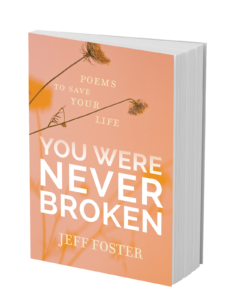
This poem is excerpted from You Were Never Broken: Poems to Save Your Life by Jeff Foster.


jeff fosterJeff Foster shares from his own awakened experience a way out of seeking fulfillment in the future and into the acceptance of “all this, here and now.” He studied astrophysics at Cambridge University. Following a period of depression and physical illness, he embarked on an intensive spiritual search that came to an end with the discovery that life itself was what he had always been seeking.


you were never broken cover

Learn More

Sounds True | Amazon | Barnes & Noble | Bookshop


You Might Also Enjoy

Kimberly Ann Johnson: “Becoming a Sexual Alchemi...

What if aging isn’t the slow closing of your erotic life, but the doorway into its most alive season?

This week, Tami Simon speaks with Kimberly Ann Johnson—sexological body worker, somatic experiencing practitioner, birth doula, and author of the new Sounds True book Erotic Seasons: Tuning In to the Rhythms of Women’s Sexuality and Spirituality—about what she calls erotic sovereignty, and the sentence that closes her book: the female body is its own spiritual path.

Join Tami and Kimberly to explore:

  • Erotic sovereignty—your relationship to your own life force, and why it stays with you across every season
  • Why the goal isn’t a more regulated nervous system, but a more responsive one, and what it means to run more charge
  • The four erotic seasons—maiden, mother, virgin, crone—and the surprising reason virgin comes after mother
  • Why hormonal transitions are “wet clay”: golden opportunities for repatterning that our culture teaches us to rush past
  • Menopause as a death rehearsal, and the life review that arrives decades before we expect it
  • Hot sex and warm sex—widening the range beyond adrenaline, and learning the language of the pause
  • “Hormones are gods”: the collective endocrine system, and why living intergenerationally may be the original hormone therapy
  • Becoming a sexual alchemist—arousal as healing energy, and why care is the whole ethic

Whether you are 25 or 75, Kimberly offers a map for meeting your body’s changes as thresholds rather than losses.

Please note: this episode includes candid discussion of sexual abuse and sexual wounding, including Kimberly Ann Johnson’s own experience.

Listen now, and meet your body as the path. →

This conversation offers genuine transmission, not just concepts about awakening, but the palpable presence of realized teachers exploring the growing edge of spiritual understanding together, and it originally aired on Sounds True One.

Get a FREE month of membership at https://bit.ly/STOne-Free-Month.

The Point of Insight | Our Medicine Lives in the Wound


What if the very thing that wounded you is the source of the medicine you’re here to give?

In this month’s Point of Insight, Tami Simon shares a personal story: minutes before going live with an archetypal astrologer, she was told—correctly, and within seconds—that she carried “the mother of all mother wounds.” That single moment became the culmination of a much longer, gradual unfolding: a lifetime’s worth of “drops,” from a mentor she called the Queen of the Reframe, to an interview with yoga teacher and activist Seane Corn titled “Your Pain Is Your Purpose,” to an email from a business coach whose four simple words reframed everything—your karma is your dharma.

Join Tami as she reflects on:

  • How a lifelong feeling of not belonging became the soil for a life’s work helping others feel connected
  • The difference between sudden insight and the slow, gradual “boiling water” of a tipping point
  • Why real breakthrough requires going all the way through pain, not around it
  • Joanna Macy’s question—”What breaks your heart?”—and how grief and care become fuel for service
  • Why “never turn away” may be one of the most important spiritual instructions there is

This is a shorter, solo reflection from Tami—released once a month on the Insights at the Edge feed—on where our deepest wounds and our clearest purpose meet.

Listen now. →

Find the original Insights at the Edge episodes here: “Seane Corn: Your Pain Is Your Purpose“

David Whyte on Being at the Frontier of Your Identity

There is a particular kind of tiredness that comes from trying to hold a fixed idea of who we are, year after year, as everything around us keeps changing anyway. David Whyte built an entire body of work around that tension, and Sounds True founder Tami Simon has called her conversation with him one of the most beloved episodes in Insights at the Edge history, still resonating with new listeners more than a decade after it first aired. Something about the way Whyte speaks, unhurried and image-rich, seems to reach people in exactly the season of life where old answers have quietly stopped working.

Sounds True has carried David Whyte’s poetry, prose, and audio programs for years because few voices manage to speak so plainly to both the individual soul and the modern workplace at once. His willingness to bring genuine poetry into rooms built for spreadsheets and quarterly targets reflects the same spirit our founder set out to preserve back in 1985: teaching captured in its own unscripted, living voice. 

What follows traces the frontier Whyte describes between who we were and who we are becoming, how exile trains us for that edge, and why a Yorkshire poet ended up teaching creativity inside boardrooms at Boeing and American Express.

Key Takeaways:

  • Originality Has an Address: Learn why David Whyte locates creativity at the frontier of identity, not behind it.
  • Exile Is a Skill: Understand why Whyte treats feeling like an outsider as something to develop, not escape.
  • Poetry Enters the Boardroom: See how poetry and leadership intersect in Whyte’s decades of corporate work.

Learn Practices for Self-Compassion with Sounds True.

Originality Lives at the Edge, Not the Center

Whyte traces originality back to what he calls an edge identity, a frontier conversation that shows up across many of the world’s wisdom traditions. Reality itself, in his framing, is conversational rather than fixed, which means the self is never a finished project so much as an ongoing exchange with everything it meets. 

Sounds True’s founder has described sitting with fourteen pages of notes on his teaching and underlining nearly every line, a reaction that says something about how differently Whyte approaches familiar questions of purpose and change, treating originality as a place a person stands rather than a trait they possess. 

You can hear the full exchange in David Whyte on Being at the Frontier of Your Identity, still one of the most requested episodes in the archive.

Exile as a Core Human Competency

Rather than treating exile, the felt sense of not quite belonging, as a wound to heal, Whyte reframes it as a competency worth developing on purpose. Most people spend enormous energy trying to eliminate the feeling of being an outsider, whereas Whyte suggests the more useful move is to learn to work with it deliberately. A few ideas anchor this reframing:

  • Exile Sharpens Perception: Standing slightly outside a group often reveals what belonging obscures.
  • Competency, Not Condition: Whyte treats exile as a trainable skill rather than permanent exclusion.
  • Frontier Over Center: Growth tends to happen at edges, not in comfortable middles.

This distinction matters because it removes the shame often attached to feeling like an outsider. Instead of a problem to solve, exile becomes a vantage point worth returning to on purpose.

The Frontier of Identity as a Living Threshold

The frontier of identity, Whyte’s central image, is not a line crossed once and left behind. It is a threshold a person returns to repeatedly, every time old certainties no longer fit a new season of life. Whyte suggests that vulnerability, often treated as weakness, actually functions here as enhanced perception, a heightened sensitivity that lets a person notice what a settled identity tends to miss.

He describes reality itself as conversational, meaning the self is shaped less by fixed traits and more by an ongoing exchange with circumstances, relationships, and unexpected turns. Standing at this frontier repeatedly, rather than resolving it once, is what Whyte considers the actual work of a lived, honest life.

Insight Is The First Step Toward Growth. Broaden Your Horizons With Sounds True.

Poetry and Leadership: An Unlikely Partnership

Long before this conversation, Whyte had already built a second career inside corporate life, consulting for companies including Boeing, Kodak, and American Express. His bestselling book, The Heart Aroused, argued that corporations suffered from too little poetry and too little humanity, a critique that landed him on business bestseller lists rather than only poetry shelves. This pairing of poetry and leadership runs through nearly everything Whyte has written since, treating verse not as decoration for executives but as a discipline for genuine reflection.

Whyte has predicted that the very word manager will eventually give way to something more alive with possibility, a shift he sees poetry as uniquely equipped to prepare leaders for. Rather than offering leadership frameworks or checklists, his workshops use verse to slow a room down enough to notice what usual business language tends to skip over entirely.

  • Work as Pilgrimage: Whyte frames a career less as a task list and more as a journey of identity.
  • Burnout Reconsidered: He suggests exhaustion can signal a need for renewal, not simple failure.
  • Conversational Leadership: Genuine leadership, in his view, requires ongoing dialogue, not fixed authority.

Tapping the Invisible Support That Surrounds Us

Whyte closes much of his teaching on a note of quiet reassurance: that unseen support often surrounds a person exactly when they feel most exposed at the frontier of their own becoming. Recognizing this support, rather than assuming isolation, changes how a person approaches uncertainty, whether it shows up as a career change, a creative block, or a simple shift in how someone sees themselves.

Where Poetry Meets Everyday Attention

Whyte often describes a good poem as revelatory, something that takes hold of a reader and surprises them into new understanding rather than confirming what they already believed. This distinction matters for how he teaches: poetry, in his hands, is not a retreat from ordinary life but a way of paying closer attention to it. A single well-chosen image, he suggests, can reorganize how someone relates to a problem that logic alone has failed to move.

Awaken Your Inner Healing Power

Final Thoughts

David Whyte’s teaching never promises a finished self waiting somewhere ahead. It offers something steadier: the frontier itself as home ground, revisited again and again across a lifetime of work and relationship. What makes this conversation endure, more than a decade after it first aired, may be exactly that refusal to offer a tidy arrival point. 

Sounds True keeps returning to this conversation because it captures exactly what our mission asks of us, waking up to the edges we usually try to avoid rather than the comfortable center we think we want.

If Whyte’s words found you today, his fuller catalog of poetry and prose is waiting to keep the conversation going, one frontier at a time.

Frequently Asked Questions About David Whyte

Who is David Whyte?

He is a Yorkshire-born poet, author, and Fortune 500 consultant known for blending poetry with leadership.

What Sounds True programs feature David Whyte?

Sounds True has released Clear Mind, Wild Heart and What to Remember When Waking with David Whyte.

Does David Whyte only write poetry?

No, he has also authored prose books, including Crossing the Unknown Sea and The Heart Aroused.

What companies has Whyte worked with as a consultant?

He has led workshops at Boeing, Kodak, American Express, and Bristol-Myers Squibb, among others.

What podcast features this conversation with Whyte?

It appears on Insights at the Edge, hosted by Sounds True founder Tami Simon.

Is this conversation relevant outside creative fields?

Yes, Whyte’s ideas on identity and leadership apply broadly across careers, relationships, and life stages.

Where can I explore more spiritual teachers like David Whyte?

Visit our All Teachers & Authors page to browse voices across many traditions and disciplines.

Does Sounds True offer related content on purpose and vocation?

Yes, related titles appear throughout our Conscious Business and Spirituality & Awakening collections.

Michelle Cassandra Johnson is an author, activist, spiritual teacher, racial equity consultant, and intuitive healer. She is the author of six books, including Skill in Action and Finding Refuge. Amy Burtaine is a leadership coach and racial equity trainer. With Robin DiAngelo, she is the coauthor of The Facilitator's Guide for White Affinity Groups. For more, visit https://www.michellecjohnson.com/wisdom-of-the-hive.

3 comments on Stop Trying to Be Happy: Jeff Foster on Being Held, Not Healed

  1. Stephan says:

    Hi Jeff, Right on!!! Excellent advice. Keep up the good work. This is what I tell my friends and family. It is the truth. Much Love, Stephan

  2. Anne says:

    Beautiful Jeff and it feels so true. Like giving yourself a hug.

  3. Phyl says:

    Wise words indeed

Leave a Reply

Your email address will not be published. Required fields are marked *