Amelia Knott

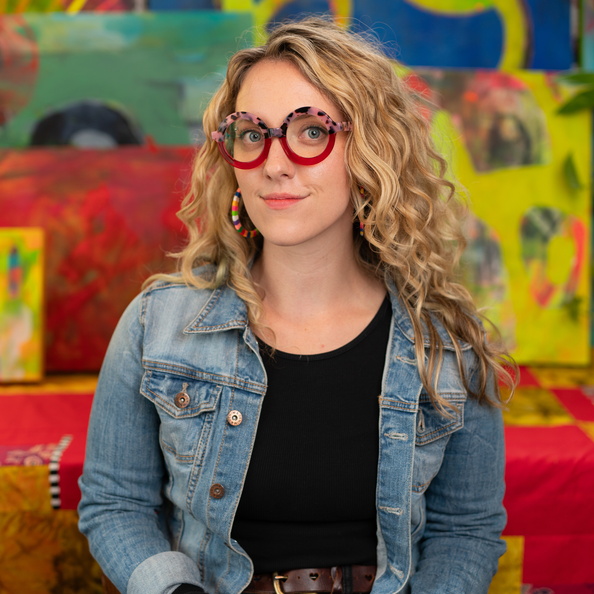
Amelia Knott, RP, RCAT, is an art psychotherapist who specializes in the mental health impacts of hustle culture and social media. With over a decade of facilitation experience, she offers meaningful mental health care through one-on-one art therapy, group sessions, and workshops. She also hosts Anti-Hustle Art Studio, digital coworking sessions to help others care for themselves with creativity and community. She lives in Slocan, British Columbia. For more, visit arttherapyinreallife.com.

Author photo © Kenton Doupe

Also By Author

Learning the Art of Thriving Online

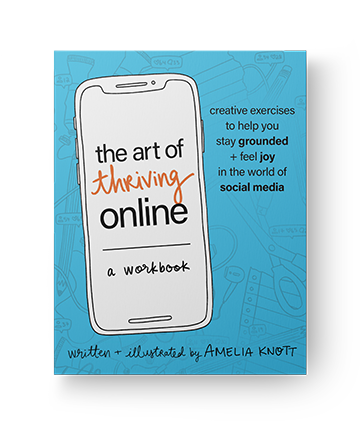
Amelia Knott is an art psychotherapist who specializes in the mental health impacts of hustle culture and social media. In the video below (3:22 minutes), she shares her inspiration behind her written and illustrated workbook, The Art of Thriving Online: Creative Exercises to Help You Stay Grounded and Feel Joy in the World of Social Media and invites you in on the journey of reimagining a healthier relationship with the digital world.

You can also read the video transcript below:

It’s been half my life—literally half the years of my life—lifting my chin for pictures, anticipating the critical gaze of a digital audience, offering my presence half-heartedly to the world around me to to draft a clever caption, choose a flattering filter, and watch as my phone tells me if this time my work will be rewarded with worthiness.

Too many nights avoiding myself, letting the blue-light-lullaby of my screen become a substitute for true soothing. It’s been half my life; holding up the mirror of comparison to everyone’s best days and hottest takes, highlight reels curated with effortless nonchalance, and now the mirror of comparison to a perfected self made in the algorithm’s image. It’s been half my life of fractured attention, commodified vulnerability, fury, and fear taking turns with despondence.

What if my real life stopped being my body or the land, and became the non-place I devote my hours to?

And it’s been half my life wandering daily into the galleries of artists’ and thinkers’ most beautiful ideas. Half my life keeping far-away loved ones close.

It’s true that the Internet gave me my career, my marriage. It made visible the threads of similarity across a quickly dividing globe. It showed me life-saving examples of people who survived what I needed to survive and it broke my heart open at the things no one should have to.

I like to misquote Carl Jung when he said something almost like “a paradox is our most valuable spiritual tool.” I’m not interested in finding the elusive, singular hack that will make screen time less alluring forever. I’m not interested in a lifetime of cycling through eras of detox and excess. Vacillating between the high of a new regimen and the crash of shame when social media works once again, exactly as it was designed.

I’m a therapist. I know that hacks can be tools, or bandaids. A self-help, step-by-step, sales pitch plan can feel like salvation, but it’s not the medicine of being in an evolving conversation with yourself. I am more interested in making art. I’m more interested in learning to tolerate the tension between social media’s danger and its magic. I’m more interested in learning to like myself, unsolved.

And when I’m learning the same lesson, again, the hard way, I know that my allies in finding safe passage through the digital age are art and writing. Creativity is how we imagine a different future.

So I wrote us this book. It’s a place to start that conversation with yourself about what is really happening between you and your screen; who profits from the ways it harms you, and how to protect the parts of it that are genuinely good, because parts of it are.

So if you are ready to join me—an art psychotherapist who both loves the life her phone enables and desperately needs to put it down—we’ll make some art. We’ll sit in the stunning and maddening paradox, and we’ll find creative ways to author our own definitions of real wellbeing when we choose to be on social media.

And together we’ll find the art of thriving online.

The Art of Thriving Online: A Workbook

Amazon | Barnes & Noble | Bookshop | Sounds True

Amelia Knott

You Might Also Enjoy

Rob Bell: “The Risk of Not Becoming More YouR...


What if not doing the thing is the riskier choice?

This week, Tami Simon speaks with Rob Bell—New York Times bestselling author of 14 books and plays, host of The RobCast, and a former pastor—about what he calls his civilian phase. Rob left the role years ago. What surprised him was how long the role stayed with him afterward: “We leave an external form, and then over the years, the form begins to leave us.”

This is an unusually candid conversation. Tami goes first, admitting she didn’t feel free to fully reveal herself until she had economic security—and Rob meets her there without a tidy answer.

Join Tami and Rob to explore:

  • Why he doesn’t believe in risk versus no risk—only in risk management, and which risk is actually smaller
  • The “answer man” conditioning of a job that expected crisp soundbites about the deepest human questions—and what it did to his nervous system
  • Hiding in plain sight: how public visibility can be its own kind of concealment
  • The abyss, the void, the fallow field—learning to stop fighting the empty seasons
  • “And then I kept going”: the phrase that came out of pandemic sessions, and why people can’t see their own resilience
  • What shifted when a plant medicine experience dropped his head into his heart
  • Toxic positivity, a lineage that didn’t know what to do with pain, and the son who taught him it’s okay to be sad
  • Why a birch tree scatters 250 million seeds and doesn’t seem worried about efficiency
  • His father’s dementia, temporariness, and the strange way mortality heightens aliveness

Rob will lead an immersive workshop, The Ongoing Creation of Your Life, at Omega Institute, August 30–September 4.

Listen now and hear what it costs to keep standing at a distance from your own life. →

This conversation offers genuine transmission, not just concepts about awakening, but the palpable presence of realized teachers exploring the growing edge of spiritual understanding together, and originally aired on Sounds True One.

Just One Question | James Hollis: Why Am I Here?

Tami came to Living with Borrowed Dust wanting to talk about the abyss — the chapter that held her attention most. James Hollis offers Heidegger’s framing of it: not the pit that swallows you, but the openness of being.

Then he does something guests rarely do here. He takes the question back. The abyss opens, he says, every time we ask a truly radical question — radical from radix, root — and there is none more radical than “Why am I here?”

He answers it from inside a hospital bed. Two serious spinal surgeries, real doubt about whether he’d come through, and what he describes feeling is not despair but something closer to adventure. He thanked his surgeon on the way into the operating room. Fear is normal, he says, and anxiety is real — but neither one has to be the thing that decides how you live.

In this episode:

  • Heidegger’s abyss as the openness of being, and how that reframe exposed Hollis’s own defenses
  • The patterns we build against the unknown: power over small things, staying out of harm’s way, narcissistic inflation
  • Why mortality is the one statistic with no uncertainty in it, and what that should free us to do
  • Keep walking — if you’re in the middle of the forest, you’re halfway through
  • Dignity over pride, and the one thing nobody can take from you unless you give it away

Taken from the full Insights at the Edge conversation with James Hollis. Find the complete interview in this feed or at soundstrue.com

Just One Question | Rev angel Kyodo williams: How Do W...

Reverend angel Kyodo williams has spent decades bridging Zen practice and social change, and she doesn’t offer the version of spirituality where relief is waiting somewhere down the road. She told Tami Simon that our joy lives at the center of our suffering, and Tami, to her credit, pushed back. Really? Right in the middle of my deep suffering and the world’s deep suffering?

Reverend angel’s answer is why this segment felt so powerful and transformative to us. She argues we’ve been handed a spiritual life that lives in a box: well-maintained, kept in good order, scheduled for Tuesday evenings from 6:30 to 8:30. Real practice, she says, pulls the lens all the way back to take in a whole life: the trauma, the history, the parts we’ve been trained to walk around. And when we refuse to touch our own suffering, we don’t contain it. We leave it behind us like roadkill, in how we treat each other and in what we let stand: patriarchy, racism, xenophobia.

In this episode:

  • Why “radical” means whole rather than extreme, and what a complete dharma asks of us
  • The cold-water method—entering your suffering ankle-deep, then further
  • What joy actually is, and why it isn’t an ice cream cone in the middle of the mess
  • The question Reverend angel keeps returning to in her own practice: where have I not yet looked?
  • Why fearlessness isn’t something you choose, but something that surfaces once the path is clear

Taken from the full Insights at the Edge conversation with Reverend angel Kyodo williams. Find the complete interview here: Reverend angel Kyodo williams: Warrior Spirit.